APPROACH PATIENT WITH
CHRONIC DIARRHEA
Abdullah Alzahrani
 Definition
 Pathophysiology
 Types
 Causes
 Clinical approach
 Management
DEFINITION
As stool volume of more than 10 grams/kg/day in
infants and toddlers, or more than 200 grams/day in
older children for more than 14 days
• Increased frequency
• Increased fluidity
• Increased volume
• Or any combination of above
Persistent diarrhea : defined as an episode that
begins acutely but lasts for 14 days or longer.
 Most diarrheal disorders resolve within the first
week of the illness. 3% of acute diarrhoeas become
chronic, With a high mortality and morbidity.
PATHOPHYSIOLOGY
 Normal stool frequency ranges from three times a
week to three times a day
 Incomplete absorption of water from the intestinal
lumen either because of a reduced rate of net water
absorption (related to impaired electrolyte
absorption or excessive electrolyte secretion) or
because of osmotic retention of water in the
lumen
TYPES
 osmotic (malabsorptive) diarrhea
 secretory diarrhea
 inflammatory vs. non-inflammatory
diarrhea.
SECRETORY DIARRHEA:
 results from a disturbance in the balance
between absorption and secretion
 • Examples:
 Various bacterial enterotoxins (Cholera, Escherichia
coli, Shigella and Salmonella)
 Tumors-secretions: neuroblastoma, Vaso-active
Intestinal Peptides (VIPomas)..
 Ion transport defects (congenital chloride diarrhea
(CCD) and congenital sodium diarrhea(CSD)
OSMOTIC DIARRHEA:
 is caused by ingestion of non-absorbable solutes or
by disease states that interfere with normal solute
absorption.
 typical example is lactose intolerance
 The colonic bacteria ferment the non-absorbed sugar
to short chain organic acid , generate an osmotic
load resulting in diarrhea
 acidic pH (short chain organic acid): burning diaper
area
 Reducing substance (unabsorbed sugar in stool)
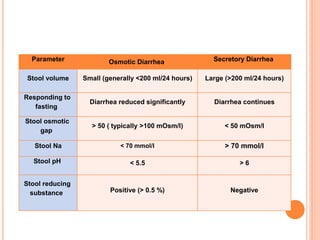
Parameter Osmotic Diarrhea Secretory Diarrhea
Stool volume Small (generally <200 ml/24 hours) Large (>200 ml/24 hours)
Responding to
fasting
Diarrhea reduced significantly Diarrhea continues
Stool osmotic
gap
> 50 ( typically >100 mOsm/l) < 50 mOsm/l
Stool Na < 70 mmol/l > 70 mmol/l
Stool pH < 5.5 > 6
Stool reducing
substance Positive (> 0.5 %) Negative
INFLAMMATORY DIARRHEA:
 Characterized by the presence of blood, mucus
and leukocytes in the stool
 Infective process,
 Allergic colitis (CMPA, allergic enteropathy)
 Inflammatory bowel disease (IBD).
DIARRHEA DUE TO MOTILITY DISTURBANCES:
 It can be either:
 hypermotility as in hyperthyroidism .
 Hypomotility as in pseudo-obstruction tends to
produce loose or normal looking stools. Stasis
predisposes to bacterial overgrowth, leading to
diarrhea and malabsorption.
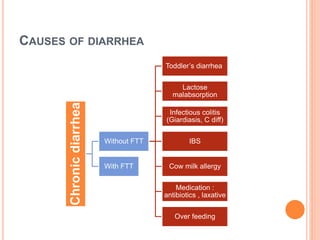
CAUSES OF DIARRHEA
Chronicdiarrhea
Without FTT
Toddler’s diarrhea
Lactose
malabsorption
Infectious colitis
(Giardiasis, C diff)
IBS
Cow milk allergy
Medication :
antibiotics , laxative
Over feeding
With FTT
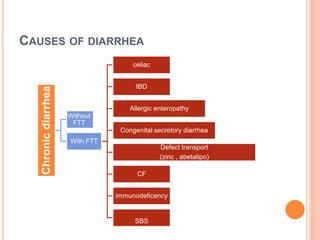
CAUSES OF DIARRHEAChronicdiarrhea
Without
FTT
With FTT
celiac
IBD
Allergic enteropathy
Congenital secretory diarrhea
Defect transport
(zinc , abetalipo)
CF
immunodeficency
SBS
CLINICAL APPROACH TO CHRONIC
DIARRHEA
HISTORY
Timing of onset:
 Neonatal onset of watery diarrhea strongly
suggests one of the congenital diarrheas :
microvillus atrophy or congenital chloride diarrhea.
 Gradual onset of a mild chronic diarrhea in an
otherwise healthy toddler suggests functional
diarrhea.
 The onset of symptoms in celiac disease varies
greatly, but cannot precede the introduction of
gluten-containing foods
HISTORY
Stool characteristics:
 Stools that become looser as the day progresses
are typical of functional diarrhea.
 Diarrheal stools that are passed at night are more
concerning for an underlying organic disorder.
HISTORY
Stool characteristics:
 Stools that contain visible or occult blood or
mucus suggest an inflammatory diarrhea, which
may be caused by a dietary protein intolerance
(common in infants), inflammatory bowel disease,
or (rarely) chronic infection with an enteric
pathogen.
 Infant having chronic diarrhea, with a history of
delayed passage of meconium and if constipation
preceded diarrhea,-Hirschsprung's disease
HISTORY
 history of failure to thrive or weight loss suggests
the possibility of malabsorption disease (celiac
disease, cystic fibrosis, or other cause of pancreatic
exocrine insufficiency), hyperthyroidism, or
anorexia nervosa in the school-age child or
adolescent.
 Weight loss is also a common feature of
inflammatory bowel disease .
 A history of recurrent infections suggests
underlying immunodeficiency or cystic fibrosis.
 history of previous abdominal surgery may
indicate anatomical or structural causes.
HISTORY
Diet history:
 record a detailed history of feeding, prior to the
onset of the disease and during the disease. It
may provide vital clues to the aetiology, e.g., cow's
milk protein intolerance, lactose intolerance, gluten
enteropathy. Soy protien intolerance,
 Overfeeding, concentrated formula feeds>
osmotic diarrhoea.
HISTORY
 Family history:
A family history of disease affecting the bowel may
provide clues to heritable diseases
 Abdominal examination:
Severe abdominal pain or abdominal distension may
be caused by intestinal obstruction or enterocolitis.
LABORATORY EVALUATION
 Celiac serology
(anti-tTG), which is highly sensitive, specific, and more
cost-effective than other antibody tests.
 Occult blood and leukocyte markers:
ulcerative colitis and Crohn's colitis . Sometimes celiac
disease and rotavirus diarrhea also test positive for occult
fecal blood.
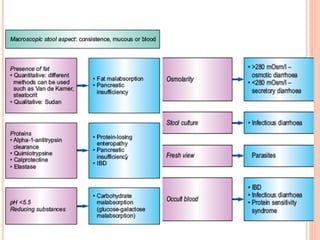
 Stool fat:
A variety of tests can be used to detect fat malabsorption
(steatorrhea). The gold standard for diagnosis of
steatorrhea is quantitative estimation of stool fat, usually
performed over 72 hours. qualitative tests also are used
LABORATORY EVALUATION
Stool pH, electrolytes, and reducing substances:
 stool pH < 5.5 (on cow's milk) or < 5 (on breast milk)
is suggestive of carbohydrate malabsorption and
proximal small bowel damage.
 Stool pH gives a clue to the amount of organic acids
in stool while the increased amounts of reducing
substances indicate the presence of unabsorbed
sugars.
LABORATORY EVALUATION
 CBC:
Haemoglobin
bacterial infections like septicaemia, urinary tract infection
etc.
ESR – CRP
 fecal alpha-1 antitrypsin testing:
to measure Protein-losing gastroenteropathy (reduced
serum concentrations of albumin and gamma globulins,
peripheral edema)
LABORATORY EVALUATION
 sweat chloride testing: CF
 zinc blood level
 fecal elastase-1 and/or chymotrypsin:
the stool content of these enzymes is reduced in patients
with pancreatic insufficiency.
Upper endoscopy and colonoscopy with biopsies
and small-bowel barium x-rays are helpful to rule
out structural or occult inflammatory disease.
FUNCTIONAL DIARRHEA
Consider functional diarrhea:
 Onset of diarrhea between 6 and 36 months of age
 Painless passage of three or more large, unformed
stools daily
 Stools usually passed only during waking hours
 No failure to thrive (if caloric intake is adequate)
MANAGEMENT
 Good hydration and treat underlying disease
 The most important complication of chronic
diarrhea is the malnutrition, and growth failure.
 adequate control of the diarrhea and rapid
improvement of the nutritional status is important
 Prolonged periods of clear liquid or diluted formula
feeding must be avoided in order to prevent
worsening of nutritional status.
MANAGEMENT
 Sufficient calories should be provided to allow for
catch-up weight gain. When oral intake is
inadequate or malabsorption prevent adequate
intake, continuous enteral feedings or parenteral
nutrition may be necessary.
 Micronutrient and vitamin supplementation are part
of nutritional rehabilitation
MANAGEMENT
Indications for TPN
 Persistent diarrhea with intolerance to oral diets
after 10 days.
 Severe forms of IBD and resistant colitis.
 Severe necrotizing enteritis.
Some of the Problems of' TPN
 Needs trained personnel and round the clock
monitoring and team work.
 Very high cost
 Sepsis
 Cholestasis which may lead to cirrhosis.
MEDICATIONS
Antidiarrheal drugs:
 Loperamide and diphenoxylate/atropine may
improve symptoms in children with severe and
protracted diarrhea
 side effects, including sedation and risk for toxic
megacolon
Somatostatin or Octreotide :
 has been used in diarrhea caused by neoplastic
diseases and in intestinal infections. It also has
been shown to be effective in reducing fecal output
in HIV infected children with severe
cryptosporidiosis
MANAGEMENT
Probiotics:
 Randomized studies and meta-analyses have
demonstrated modest efficacy of specific probiotics
in the prevention of C. difficile associated diarrhea
and treatment of acute diarrhea in children
 There is limited evidence, that probiotics are
effective in treating chronic pediatric diarrhea
SUMMARY
 A wide variety of problems can cause chronic
diarrhea in infants and children
 detailed history may provide clues to the
diagnosis
 suggest serologic testing for celiac disease for
all children with chronic diarrhea
 Functional diarrhea accounts for a high proportion
of chronic diarrheas in young children
 Regardless of the cause of the diarrhea, evaluation
for and treatment of malnutrition is an important
step in recovery.
Chronic diarrhea

Chronic diarrhea

  • 1.
    APPROACH PATIENT WITH CHRONICDIARRHEA Abdullah Alzahrani
  • 2.
     Definition  Pathophysiology Types  Causes  Clinical approach  Management
  • 3.
    DEFINITION As stool volumeof more than 10 grams/kg/day in infants and toddlers, or more than 200 grams/day in older children for more than 14 days • Increased frequency • Increased fluidity • Increased volume • Or any combination of above Persistent diarrhea : defined as an episode that begins acutely but lasts for 14 days or longer.  Most diarrheal disorders resolve within the first week of the illness. 3% of acute diarrhoeas become chronic, With a high mortality and morbidity.
  • 4.
    PATHOPHYSIOLOGY  Normal stoolfrequency ranges from three times a week to three times a day  Incomplete absorption of water from the intestinal lumen either because of a reduced rate of net water absorption (related to impaired electrolyte absorption or excessive electrolyte secretion) or because of osmotic retention of water in the lumen
  • 5.
    TYPES  osmotic (malabsorptive)diarrhea  secretory diarrhea  inflammatory vs. non-inflammatory diarrhea.
  • 6.
    SECRETORY DIARRHEA:  resultsfrom a disturbance in the balance between absorption and secretion  • Examples:  Various bacterial enterotoxins (Cholera, Escherichia coli, Shigella and Salmonella)  Tumors-secretions: neuroblastoma, Vaso-active Intestinal Peptides (VIPomas)..  Ion transport defects (congenital chloride diarrhea (CCD) and congenital sodium diarrhea(CSD)
  • 7.
    OSMOTIC DIARRHEA:  iscaused by ingestion of non-absorbable solutes or by disease states that interfere with normal solute absorption.  typical example is lactose intolerance  The colonic bacteria ferment the non-absorbed sugar to short chain organic acid , generate an osmotic load resulting in diarrhea  acidic pH (short chain organic acid): burning diaper area  Reducing substance (unabsorbed sugar in stool)
  • 8.
    Parameter Osmotic DiarrheaSecretory Diarrhea Stool volume Small (generally <200 ml/24 hours) Large (>200 ml/24 hours) Responding to fasting Diarrhea reduced significantly Diarrhea continues Stool osmotic gap > 50 ( typically >100 mOsm/l) < 50 mOsm/l Stool Na < 70 mmol/l > 70 mmol/l Stool pH < 5.5 > 6 Stool reducing substance Positive (> 0.5 %) Negative
  • 9.
    INFLAMMATORY DIARRHEA:  Characterizedby the presence of blood, mucus and leukocytes in the stool  Infective process,  Allergic colitis (CMPA, allergic enteropathy)  Inflammatory bowel disease (IBD).
  • 10.
    DIARRHEA DUE TOMOTILITY DISTURBANCES:  It can be either:  hypermotility as in hyperthyroidism .  Hypomotility as in pseudo-obstruction tends to produce loose or normal looking stools. Stasis predisposes to bacterial overgrowth, leading to diarrhea and malabsorption.
  • 11.
    CAUSES OF DIARRHEA Chronicdiarrhea WithoutFTT Toddler’s diarrhea Lactose malabsorption Infectious colitis (Giardiasis, C diff) IBS Cow milk allergy Medication : antibiotics , laxative Over feeding With FTT
  • 12.
    CAUSES OF DIARRHEAChronicdiarrhea Without FTT WithFTT celiac IBD Allergic enteropathy Congenital secretory diarrhea Defect transport (zinc , abetalipo) CF immunodeficency SBS
  • 13.
    CLINICAL APPROACH TOCHRONIC DIARRHEA
  • 14.
    HISTORY Timing of onset: Neonatal onset of watery diarrhea strongly suggests one of the congenital diarrheas : microvillus atrophy or congenital chloride diarrhea.  Gradual onset of a mild chronic diarrhea in an otherwise healthy toddler suggests functional diarrhea.  The onset of symptoms in celiac disease varies greatly, but cannot precede the introduction of gluten-containing foods
  • 15.
    HISTORY Stool characteristics:  Stoolsthat become looser as the day progresses are typical of functional diarrhea.  Diarrheal stools that are passed at night are more concerning for an underlying organic disorder.
  • 16.
    HISTORY Stool characteristics:  Stoolsthat contain visible or occult blood or mucus suggest an inflammatory diarrhea, which may be caused by a dietary protein intolerance (common in infants), inflammatory bowel disease, or (rarely) chronic infection with an enteric pathogen.  Infant having chronic diarrhea, with a history of delayed passage of meconium and if constipation preceded diarrhea,-Hirschsprung's disease
  • 17.
    HISTORY  history offailure to thrive or weight loss suggests the possibility of malabsorption disease (celiac disease, cystic fibrosis, or other cause of pancreatic exocrine insufficiency), hyperthyroidism, or anorexia nervosa in the school-age child or adolescent.  Weight loss is also a common feature of inflammatory bowel disease .  A history of recurrent infections suggests underlying immunodeficiency or cystic fibrosis.  history of previous abdominal surgery may indicate anatomical or structural causes.
  • 18.
    HISTORY Diet history:  recorda detailed history of feeding, prior to the onset of the disease and during the disease. It may provide vital clues to the aetiology, e.g., cow's milk protein intolerance, lactose intolerance, gluten enteropathy. Soy protien intolerance,  Overfeeding, concentrated formula feeds> osmotic diarrhoea.
  • 19.
    HISTORY  Family history: Afamily history of disease affecting the bowel may provide clues to heritable diseases  Abdominal examination: Severe abdominal pain or abdominal distension may be caused by intestinal obstruction or enterocolitis.
  • 20.
    LABORATORY EVALUATION  Celiacserology (anti-tTG), which is highly sensitive, specific, and more cost-effective than other antibody tests.  Occult blood and leukocyte markers: ulcerative colitis and Crohn's colitis . Sometimes celiac disease and rotavirus diarrhea also test positive for occult fecal blood.  Stool fat: A variety of tests can be used to detect fat malabsorption (steatorrhea). The gold standard for diagnosis of steatorrhea is quantitative estimation of stool fat, usually performed over 72 hours. qualitative tests also are used
  • 21.
    LABORATORY EVALUATION Stool pH,electrolytes, and reducing substances:  stool pH < 5.5 (on cow's milk) or < 5 (on breast milk) is suggestive of carbohydrate malabsorption and proximal small bowel damage.  Stool pH gives a clue to the amount of organic acids in stool while the increased amounts of reducing substances indicate the presence of unabsorbed sugars.
  • 22.
    LABORATORY EVALUATION  CBC: Haemoglobin bacterialinfections like septicaemia, urinary tract infection etc. ESR – CRP  fecal alpha-1 antitrypsin testing: to measure Protein-losing gastroenteropathy (reduced serum concentrations of albumin and gamma globulins, peripheral edema)
  • 23.
    LABORATORY EVALUATION  sweatchloride testing: CF  zinc blood level  fecal elastase-1 and/or chymotrypsin: the stool content of these enzymes is reduced in patients with pancreatic insufficiency. Upper endoscopy and colonoscopy with biopsies and small-bowel barium x-rays are helpful to rule out structural or occult inflammatory disease.
  • 25.
    FUNCTIONAL DIARRHEA Consider functionaldiarrhea:  Onset of diarrhea between 6 and 36 months of age  Painless passage of three or more large, unformed stools daily  Stools usually passed only during waking hours  No failure to thrive (if caloric intake is adequate)
  • 26.
    MANAGEMENT  Good hydrationand treat underlying disease  The most important complication of chronic diarrhea is the malnutrition, and growth failure.  adequate control of the diarrhea and rapid improvement of the nutritional status is important  Prolonged periods of clear liquid or diluted formula feeding must be avoided in order to prevent worsening of nutritional status.
  • 27.
    MANAGEMENT  Sufficient caloriesshould be provided to allow for catch-up weight gain. When oral intake is inadequate or malabsorption prevent adequate intake, continuous enteral feedings or parenteral nutrition may be necessary.  Micronutrient and vitamin supplementation are part of nutritional rehabilitation
  • 28.
    MANAGEMENT Indications for TPN Persistent diarrhea with intolerance to oral diets after 10 days.  Severe forms of IBD and resistant colitis.  Severe necrotizing enteritis. Some of the Problems of' TPN  Needs trained personnel and round the clock monitoring and team work.  Very high cost  Sepsis  Cholestasis which may lead to cirrhosis.
  • 29.
    MEDICATIONS Antidiarrheal drugs:  Loperamideand diphenoxylate/atropine may improve symptoms in children with severe and protracted diarrhea  side effects, including sedation and risk for toxic megacolon Somatostatin or Octreotide :  has been used in diarrhea caused by neoplastic diseases and in intestinal infections. It also has been shown to be effective in reducing fecal output in HIV infected children with severe cryptosporidiosis
  • 30.
    MANAGEMENT Probiotics:  Randomized studiesand meta-analyses have demonstrated modest efficacy of specific probiotics in the prevention of C. difficile associated diarrhea and treatment of acute diarrhea in children  There is limited evidence, that probiotics are effective in treating chronic pediatric diarrhea
  • 31.
    SUMMARY  A widevariety of problems can cause chronic diarrhea in infants and children  detailed history may provide clues to the diagnosis  suggest serologic testing for celiac disease for all children with chronic diarrhea  Functional diarrhea accounts for a high proportion of chronic diarrheas in young children  Regardless of the cause of the diarrhea, evaluation for and treatment of malnutrition is an important step in recovery.