APPROACH TO EDEMA
Presented by: Muhammad Wasil Khan
2018/066
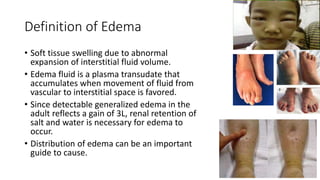
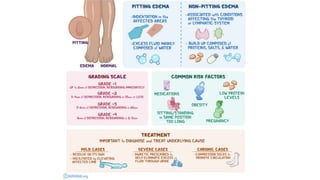
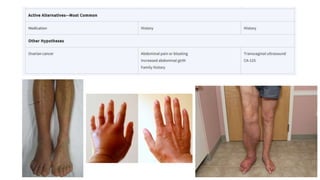
Definition of Edema
• Soft tissue swelling due to abnormal
expansion of interstitial fluid volume.
• Edema fluid is a plasma transudate that
accumulates when movement of fluid from
vascular to interstitial space is favored.
• Since detectable generalized edema in the
adult reflects a gain of 3L, renal retention of
salt and water is necessary for edema to
occur.
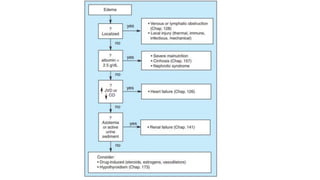
• Distribution of edema can be an important
guide to cause.
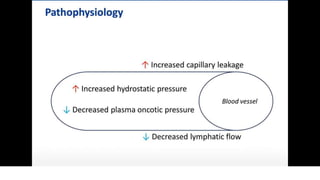
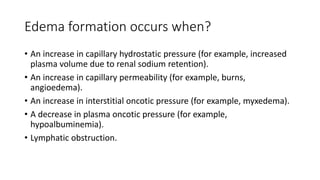
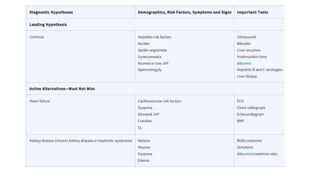
Edema formation occurs when?
• An increase in capillary hydrostatic pressure (for example, increased
plasma volume due to renal sodium retention).
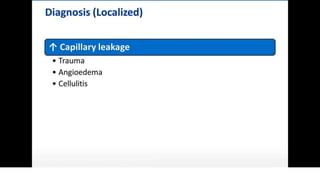
• An increase in capillary permeability (for example, burns,
angioedema).
• An increase in interstitial oncotic pressure (for example, myxedema).
• A decrease in plasma oncotic pressure (for example,
hypoalbuminemia).
• Lymphatic obstruction.
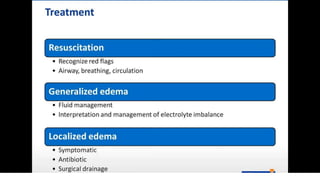
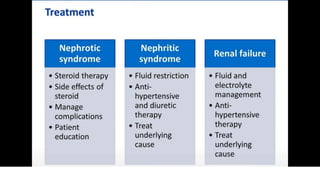
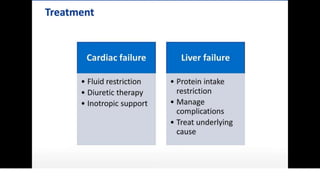
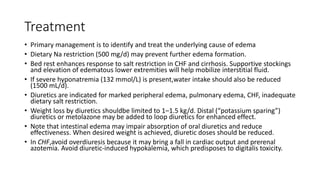
Treatment
• Primary management is to identify and treat the underlying cause of edema
• Dietary Na restriction (500 mg/d) may prevent further edema formation.
• Bed rest enhances response to salt restriction in CHF and cirrhosis. Supportive stockings
and elevation of edematous lower extremities will help mobilize interstitial fluid.
• If severe hyponatremia (132 mmol/L) is present,water intake should also be reduced
(1500 mL/d).
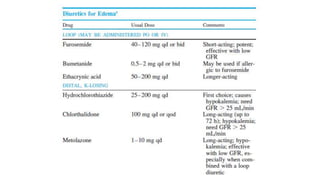
• Diuretics are indicated for marked peripheral edema, pulmonary edema, CHF, inadequate
dietary salt restriction.
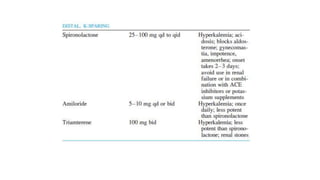
• Weight loss by diuretics shouldbe limited to 1–1.5 kg/d. Distal (“potassium sparing”)
diuretics or metolazone may be added to loop diuretics for enhanced effect.
• Note that intestinal edema may impair absorption of oral diuretics and reduce
effectiveness. When desired weight is achieved, diuretic doses should be reduced.
• In CHF,avoid overdiuresis because it may bring a fall in cardiac output and prerenal
azotemia. Avoid diuretic-induced hypokalemia, which predisposes to digitalis toxicity.
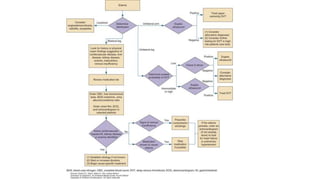
APPROACH TO EDEMA
APPROACH TO EDEMA
APPROACH TO EDEMA
APPROACH TO EDEMA

APPROACH TO EDEMA

  • 1.
    APPROACH TO EDEMA Presentedby: Muhammad Wasil Khan 2018/066
  • 3.
    Definition of Edema •Soft tissue swelling due to abnormal expansion of interstitial fluid volume. • Edema fluid is a plasma transudate that accumulates when movement of fluid from vascular to interstitial space is favored. • Since detectable generalized edema in the adult reflects a gain of 3L, renal retention of salt and water is necessary for edema to occur. • Distribution of edema can be an important guide to cause.
  • 7.
    Edema formation occurswhen? • An increase in capillary hydrostatic pressure (for example, increased plasma volume due to renal sodium retention). • An increase in capillary permeability (for example, burns, angioedema). • An increase in interstitial oncotic pressure (for example, myxedema). • A decrease in plasma oncotic pressure (for example, hypoalbuminemia). • Lymphatic obstruction.
  • 24.
    Treatment • Primary managementis to identify and treat the underlying cause of edema • Dietary Na restriction (500 mg/d) may prevent further edema formation. • Bed rest enhances response to salt restriction in CHF and cirrhosis. Supportive stockings and elevation of edematous lower extremities will help mobilize interstitial fluid. • If severe hyponatremia (132 mmol/L) is present,water intake should also be reduced (1500 mL/d). • Diuretics are indicated for marked peripheral edema, pulmonary edema, CHF, inadequate dietary salt restriction. • Weight loss by diuretics shouldbe limited to 1–1.5 kg/d. Distal (“potassium sparing”) diuretics or metolazone may be added to loop diuretics for enhanced effect. • Note that intestinal edema may impair absorption of oral diuretics and reduce effectiveness. When desired weight is achieved, diuretic doses should be reduced. • In CHF,avoid overdiuresis because it may bring a fall in cardiac output and prerenal azotemia. Avoid diuretic-induced hypokalemia, which predisposes to digitalis toxicity.