Dr. Tasnim Ara Jhilky
MD- Biochemistry
Phase-A Student.
Sir Salimullah medical college.
.
Atherosclerosis
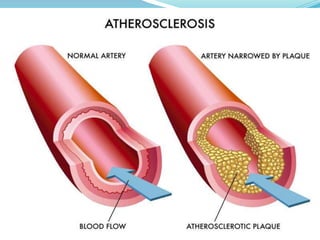
Atherosclerosis is a disease of large and
medium-sized muscular arteries and is
characterized by –
endothelial dysfunction,
vascular inflammation, and
the buildup of lipids, cholesterol, calcium, and
cellular debris within the intima of the vessel
wall.
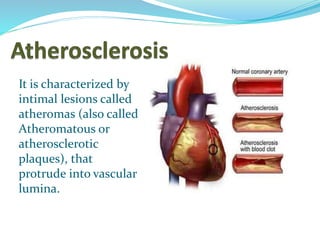
It is characterized by
intimal lesions called
atheromas (also called
Atheromatous or
atherosclerotic
plaques), that
protrude into vascular
lumina.
An Atheromatous plaque consists of a raised
lesion with a soft, yellow, grumous core of lipid
(mainly cholesterol and cholesterol esters) covered
by a firm, white fibrous cap.
Besides obstructing blood flow, atherosclerotic
plaques weaken the underlying media and can
themselves rupture, causing acute thrombosis.
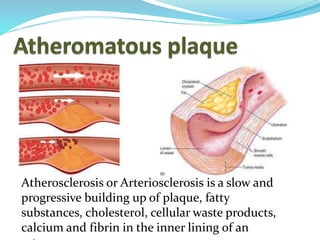
Atherosclerosis or Arteriosclerosis is a slow and
progressive building up of plaque, fatty
substances, cholesterol, cellular waste products,
calcium and fibrin in the inner lining of an
Risk Factors for Atherosclerosis
Major risk factors (Non Modifiable)-
 Increasing Age
 Male gender
 Family history
 Genetic abnormalities
Risk Factors for Atherosclerosis
Lesser, Uncertain, or Nonquantitated Risks-
Obesity
Physical Inactivity
Postmenopausal estrogen deficiency
High carbohydrate intake
Lipoprotein(a)
Hardened (trans)unsaturated fat intake
Chlamydia pneumoniae infection
Risk Factors for Atherosclerosis
Potentially Controllable-
 Hyperlipidemia
Hypertension
Cigarette smoking
Diabetes
C-reactive protein
Pathogenesis of Atherosclerosis
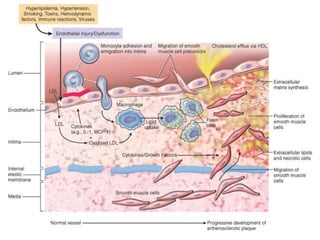
The contemporary view of atherogenesis is expressed
by the response-to-injury hypothesis.
This model views atherosclerosis as a chronic
inflammatory response of the arterial wall to
endothelial injury.
 Lesion progression occurs through interactions of
modified lipoproteins, monocyte-derived
macrophages, T lymphocytes, and the normal cellular
constituents of the arterial wall.
Pathogenesis of Atherosclerosis
1) Endothelial Injury
 Initial triggering event in the development of
Atherosclerotic lesions
 Causes ascribed to endothelial injury in include
mechanical trauma, hemodynamic forces,
immunological and chemical mechanisms,
metabolic agents like chronic hyperlipidemia,
homocystine, circulating toxins from systemic
infections, viruses, and tobacco products.
Pathogenesis of Atherosclerosis
2. Intimal Smooth Muscle Cell Proliferation
 Endothelial injury causes adherence aggregation and
platelet release reaction at the site of exposed sub
endothelial connective tissue.
 Proliferation of intimal smooth muscle cells is
stimulated by various mitogens released from platelets
adherent at the site of endothelial injury.
 These mitogens include platelet derived growth factor
(PDGF), fibroblast growth factor, TNF-ά.
 Proliferation is also facilitated by nitric oxide and
endothelin released from endothelial cells.
Pathogenesis of Atherosclerosis
3) Role of Blood Monocytes
Though blood monocytes do not possess receptors for
normal LDL, LDL does appear in the monocyte
cytoplasm to form foam cell.
Plasma LDL on entry into the intima undergoes
oxidation.
Oxidized LDL formed in the intima is readily taken up
by scavenger receptor on the monocyte to transform it to
a lipid laden foam cell.
Components of Atherosclerotic
plaque
 Atherosclerotic plaques have three principal
components:
Cells, including SMCs, macrophages, and T cells
 ECM, including collagen, elastic fibers, and
proteoglycans and
Intracellular and extracellular lipid
These components occur in varying proportions and
configurations in different lesions.
Changes in Atherosclerotic Plaque
Atherosclerotic plaques are susceptible to the following
pathologic changes with clinical significance:
Rupture, ulceration, or erosion
Hemorrhage
Atheroembolism
Aneurysm formation
Prevention of Atherosclerotic
Vascular Disease
Primary prevention of atherosclerosis
Cessation of cigarette smoking
 Control of hypertension
Weight loss
Exercise, and lowering total and LDL blood cholesterol
levels while increasing HDL (e.g., by diet or through
statins).
Statin use may also modulate the inflammatory state of the
vascular wall.
Risk factor stratification and reduction should even begin
in childhood.
Prevention of Atherosclerotic
Vascular Disease
Secondary prevention involves use of –
Aspirin (anti-platelet agent),
Statins, and beta blockers (to limit cardiac demand),
Surgical interventions (e.g., coronary artery bypass
surgery, carotid endarterectomy).
These can successfully reduce recurrent myocardial or
cerebral events.
Disorder of plasma lipoprotein
 Inherited disorders.
 Primary hyper or hypolipoproteinemias.
 Due to genetic defects in lipoprotein metabolism &
transport.
 The secondary acquired lipoprotein disorders are due
to diabetes mellitus, nephrotic syndrome,
atherosclerosis, hypothyrodism etc.
 Resulting in abnormal lipoprotein patterns.
hyperlipoproteinemia
 Elevation in one or more of the lipoprotein fractions
constitutes hyperlipoproteinemias.
 These disorders may be either primary or secondary.
 Also called as hyperlipidemias or dyslipidemia.
Frederickson's classification
of hyperliporoteinemias
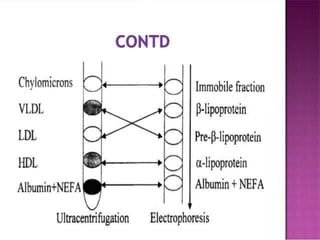
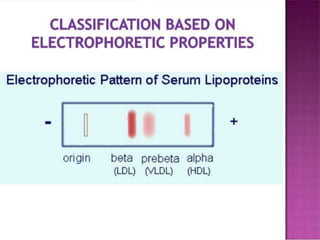
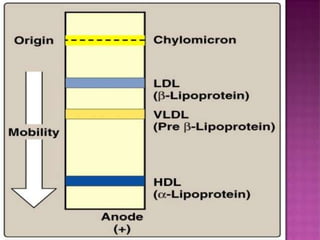
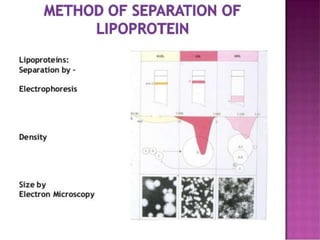
 Based on the electrophoretic patterns of plasma
lipoproteins.
 In all types, the elevated lipid fraction is either
cholesterol or TAG or both.
 Hyerlipidemias are classified into-
 Hypercholesterolemia (Type IIa),
 Hypertriglyceridemia (Type I, IV & V) &
 Combined hyperlipidemia (Type IIb & Type III).
The elevation of lipids in plasma leads to the deposition of cholesterol on
the arterial walls, leading to atherosclerosis.
The coronary & cerebral vessels are more commonly affected.
Thromboembolic episodes in these vessels lead to ischemic heart disease &
cerebrovascular accidents.
The deposition of lipids in subcutaneous
tissue leads to xanthomas.
The type of xanthoma depends on the
nature of lipid deposited.
Eruptive xanthomata are small yellow
nodules associated with deposition of
triglycerides.
They disappear when the lipid level
falls.
Type 1
 This is due to familial lipoprotein Iipase deficiency.
 It usually manifests in young age.
 The enzyme defect causes increase in plasma
chylomicron & triacylglycerol levels.
 Hepatomegaly, eruptive xanthoma & abdominal pain
are seen
type11a
 Also known as hyperbetalipoproteinemia.
 There is elevation of LDL.
 Caused by a defect in LDL receptors.
 Receptor deficiency in liver & peripheral tissues will
result in the elevation of LDL levels in plasma, leading
to hypercholesterolemia.
Defective binding of B-100 to the
receptor.
Secondary type lla
hyperlipoproteinemia is observed in
association with diabetes mellitus,
hypothyroidism, nephrotic syndrome
etc.
Characterized by hypercholesterolemia.
type11b
 Both LDL & VLDL increase along with elevation in
plasma cholesterol & triacylglycerol.
 This is believed to be due to overproduction of apo B.
Type111
 This is commonly known as broad beta disease.
 It is very rare.
 It is due to increased levels of LDL & IDL.
 Characterized by the appearance of a broad β-band
corresponding to intermediate density lipoprotein
(IDL) on electrophoresis.
type4
 This is due to overproduction of endogenous
triacylglycerols with a concomitant rise in VLDL.
 Cardiac manifestations are seen in the 4th decade of
life.
 It may be associated with diabetes mellitus, obesity &
impaired glucose tolerance.
typeV
 Chylomicrons & VLDL are elevated.
 This is mostly a secondary condition, due to disorders
such as obesity, diabetes and excessive alcohol
consumption etc.
hypolipoproteinemia
 Familial hypobetalipoproteinemia:
 It is an inherited disorder.
 Due to an impairment in the synthesis of apo B.
 The plasma LDL concentration in the affected
individuals is between 10 to 50% of normal values.
 This disorder is harmless & the individuals have
healthy & long life.
abtallipoproteinemia
 This is a rare disorder due to a defect in the synthesis
of apoprotein B.
 It is characterized by a total absence of B-lipoprotein
(LDL) in plasma.
 Triacylglycerols are not found in plasma, but they
accumulate in liver & intestine.
 Serum cholesterol level is low
Familial alpha-lipoprotein
deficiency (Tangier disease)
 The plasma HDL particles are almost absent.
 Due to this, reverse transport of cholesterol is
severely affected.
 Accumulation of cholesteryl esters in tissues.
 An absence of apoprotein C ll-which activates
lipoprotein lipase-is also found.
 The plasma triacylglycerol levels are elevated.
 The affected individuals are at an increased risk for
atherosclerosis.
.

lipid transport,lipoprotein metabolism, by dr.Tasnim

  • 1.
    Dr. Tasnim AraJhilky MD- Biochemistry Phase-A Student. Sir Salimullah medical college.
  • 2.
  • 77.
    Atherosclerosis Atherosclerosis is adisease of large and medium-sized muscular arteries and is characterized by – endothelial dysfunction, vascular inflammation, and the buildup of lipids, cholesterol, calcium, and cellular debris within the intima of the vessel wall.
  • 78.
    It is characterizedby intimal lesions called atheromas (also called Atheromatous or atherosclerotic plaques), that protrude into vascular lumina.
  • 79.
    An Atheromatous plaqueconsists of a raised lesion with a soft, yellow, grumous core of lipid (mainly cholesterol and cholesterol esters) covered by a firm, white fibrous cap. Besides obstructing blood flow, atherosclerotic plaques weaken the underlying media and can themselves rupture, causing acute thrombosis.
  • 80.
    Atherosclerosis or Arteriosclerosisis a slow and progressive building up of plaque, fatty substances, cholesterol, cellular waste products, calcium and fibrin in the inner lining of an
  • 81.
    Risk Factors forAtherosclerosis Major risk factors (Non Modifiable)-  Increasing Age  Male gender  Family history  Genetic abnormalities
  • 82.
    Risk Factors forAtherosclerosis Lesser, Uncertain, or Nonquantitated Risks- Obesity Physical Inactivity Postmenopausal estrogen deficiency High carbohydrate intake Lipoprotein(a) Hardened (trans)unsaturated fat intake Chlamydia pneumoniae infection
  • 83.
    Risk Factors forAtherosclerosis Potentially Controllable-  Hyperlipidemia Hypertension Cigarette smoking Diabetes C-reactive protein
  • 84.
    Pathogenesis of Atherosclerosis Thecontemporary view of atherogenesis is expressed by the response-to-injury hypothesis. This model views atherosclerosis as a chronic inflammatory response of the arterial wall to endothelial injury.  Lesion progression occurs through interactions of modified lipoproteins, monocyte-derived macrophages, T lymphocytes, and the normal cellular constituents of the arterial wall.
  • 85.
    Pathogenesis of Atherosclerosis 1)Endothelial Injury  Initial triggering event in the development of Atherosclerotic lesions  Causes ascribed to endothelial injury in include mechanical trauma, hemodynamic forces, immunological and chemical mechanisms, metabolic agents like chronic hyperlipidemia, homocystine, circulating toxins from systemic infections, viruses, and tobacco products.
  • 86.
    Pathogenesis of Atherosclerosis 2.Intimal Smooth Muscle Cell Proliferation  Endothelial injury causes adherence aggregation and platelet release reaction at the site of exposed sub endothelial connective tissue.  Proliferation of intimal smooth muscle cells is stimulated by various mitogens released from platelets adherent at the site of endothelial injury.  These mitogens include platelet derived growth factor (PDGF), fibroblast growth factor, TNF-ά.  Proliferation is also facilitated by nitric oxide and endothelin released from endothelial cells.
  • 87.
    Pathogenesis of Atherosclerosis 3)Role of Blood Monocytes Though blood monocytes do not possess receptors for normal LDL, LDL does appear in the monocyte cytoplasm to form foam cell. Plasma LDL on entry into the intima undergoes oxidation. Oxidized LDL formed in the intima is readily taken up by scavenger receptor on the monocyte to transform it to a lipid laden foam cell.
  • 89.
    Components of Atherosclerotic plaque Atherosclerotic plaques have three principal components: Cells, including SMCs, macrophages, and T cells  ECM, including collagen, elastic fibers, and proteoglycans and Intracellular and extracellular lipid These components occur in varying proportions and configurations in different lesions.
  • 90.
    Changes in AtheroscleroticPlaque Atherosclerotic plaques are susceptible to the following pathologic changes with clinical significance: Rupture, ulceration, or erosion Hemorrhage Atheroembolism Aneurysm formation
  • 91.
    Prevention of Atherosclerotic VascularDisease Primary prevention of atherosclerosis Cessation of cigarette smoking  Control of hypertension Weight loss Exercise, and lowering total and LDL blood cholesterol levels while increasing HDL (e.g., by diet or through statins). Statin use may also modulate the inflammatory state of the vascular wall. Risk factor stratification and reduction should even begin in childhood.
  • 92.
    Prevention of Atherosclerotic VascularDisease Secondary prevention involves use of – Aspirin (anti-platelet agent), Statins, and beta blockers (to limit cardiac demand), Surgical interventions (e.g., coronary artery bypass surgery, carotid endarterectomy). These can successfully reduce recurrent myocardial or cerebral events.
  • 94.
    Disorder of plasmalipoprotein  Inherited disorders.  Primary hyper or hypolipoproteinemias.  Due to genetic defects in lipoprotein metabolism & transport.  The secondary acquired lipoprotein disorders are due to diabetes mellitus, nephrotic syndrome, atherosclerosis, hypothyrodism etc.  Resulting in abnormal lipoprotein patterns.
  • 95.
    hyperlipoproteinemia  Elevation inone or more of the lipoprotein fractions constitutes hyperlipoproteinemias.  These disorders may be either primary or secondary.  Also called as hyperlipidemias or dyslipidemia.
  • 96.
    Frederickson's classification of hyperliporoteinemias Based on the electrophoretic patterns of plasma lipoproteins.  In all types, the elevated lipid fraction is either cholesterol or TAG or both.  Hyerlipidemias are classified into-  Hypercholesterolemia (Type IIa),  Hypertriglyceridemia (Type I, IV & V) &  Combined hyperlipidemia (Type IIb & Type III).
  • 97.
    The elevation oflipids in plasma leads to the deposition of cholesterol on the arterial walls, leading to atherosclerosis. The coronary & cerebral vessels are more commonly affected. Thromboembolic episodes in these vessels lead to ischemic heart disease & cerebrovascular accidents.
  • 98.
    The deposition oflipids in subcutaneous tissue leads to xanthomas. The type of xanthoma depends on the nature of lipid deposited. Eruptive xanthomata are small yellow nodules associated with deposition of triglycerides. They disappear when the lipid level falls.
  • 99.
    Type 1  Thisis due to familial lipoprotein Iipase deficiency.  It usually manifests in young age.  The enzyme defect causes increase in plasma chylomicron & triacylglycerol levels.  Hepatomegaly, eruptive xanthoma & abdominal pain are seen
  • 100.
    type11a  Also knownas hyperbetalipoproteinemia.  There is elevation of LDL.  Caused by a defect in LDL receptors.  Receptor deficiency in liver & peripheral tissues will result in the elevation of LDL levels in plasma, leading to hypercholesterolemia.
  • 101.
    Defective binding ofB-100 to the receptor. Secondary type lla hyperlipoproteinemia is observed in association with diabetes mellitus, hypothyroidism, nephrotic syndrome etc. Characterized by hypercholesterolemia.
  • 102.
    type11b  Both LDL& VLDL increase along with elevation in plasma cholesterol & triacylglycerol.  This is believed to be due to overproduction of apo B.
  • 103.
    Type111  This iscommonly known as broad beta disease.  It is very rare.  It is due to increased levels of LDL & IDL.  Characterized by the appearance of a broad β-band corresponding to intermediate density lipoprotein (IDL) on electrophoresis.
  • 104.
    type4  This isdue to overproduction of endogenous triacylglycerols with a concomitant rise in VLDL.  Cardiac manifestations are seen in the 4th decade of life.  It may be associated with diabetes mellitus, obesity & impaired glucose tolerance.
  • 105.
    typeV  Chylomicrons &VLDL are elevated.  This is mostly a secondary condition, due to disorders such as obesity, diabetes and excessive alcohol consumption etc.
  • 106.
    hypolipoproteinemia  Familial hypobetalipoproteinemia: It is an inherited disorder.  Due to an impairment in the synthesis of apo B.  The plasma LDL concentration in the affected individuals is between 10 to 50% of normal values.  This disorder is harmless & the individuals have healthy & long life.
  • 107.
    abtallipoproteinemia  This isa rare disorder due to a defect in the synthesis of apoprotein B.  It is characterized by a total absence of B-lipoprotein (LDL) in plasma.  Triacylglycerols are not found in plasma, but they accumulate in liver & intestine.  Serum cholesterol level is low
  • 108.
    Familial alpha-lipoprotein deficiency (Tangierdisease)  The plasma HDL particles are almost absent.  Due to this, reverse transport of cholesterol is severely affected.  Accumulation of cholesteryl esters in tissues.  An absence of apoprotein C ll-which activates lipoprotein lipase-is also found.  The plasma triacylglycerol levels are elevated.  The affected individuals are at an increased risk for atherosclerosis.
  • 109.