DYSLIPIDEMIA
BY
RAJESHWAREE NETHA
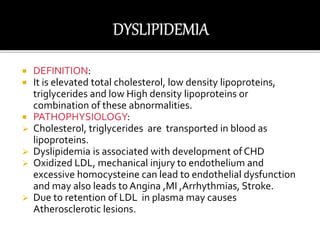
 DEFINITION:
 It is elevated total cholesterol, low density lipoproteins,
triglycerides and low High density lipoproteins or
combination of these abnormalities.
 PATHOPHYSIOLOGY:
 Cholesterol, triglycerides are transported in blood as
lipoproteins.
 Dyslipidemia is associated with development of CHD
 Oxidized LDL, mechanical injury to endothelium and
excessive homocysteine can lead to endothelial dysfunction
and may also leads to Angina ,MI ,Arrhythmias, Stroke.
 Due to retention of LDL in plasma may causes
Atherosclerotic lesions.
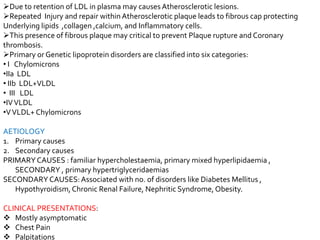
Due to retention of LDL in plasma may causes Atherosclerotic lesions.
Repeated Injury and repair within Atherosclerotic plaque leads to fibrous cap protecting
Underlying lipids ,collagen ,calcium, and Inflammatory cells.
This presence of fibrous plaque may critical to prevent Plaque rupture and Coronary
thrombosis.
Primary or Genetic lipoprotein disorders are classified into six categories:
• I Chylomicrons
•IIa LDL
• IIb LDL+VLDL
• III LDL
•IVVLDL
•VVLDL+ Chylomicrons
AETIOLOGY
1. Primary causes
2. Secondary causes
PRIMARY CAUSES : familiar hypercholestaemia, primary mixed hyperlipidaemia ,
SECONDARY , primary hypertriglyceridaemias
SECONDARY CAUSES:Associated with no. of disorders like Diabetes Mellitus ,
Hypothyroidism,Chronic Renal Failure, Nephritic Syndrome, Obesity.
CLINICAL PRESENTATIONS:
 Mostly asymptomatic
 Chest Pain
 Palpitations
Sweating
Anxiety
Abdominal pain
Loss of consciousness
Difficulty in speech and movement.
Depending on lipoprotein abnormality, signs and physical examinations, may include:
Xanthomas
Peripheral Polymyopathy
Hypertension
Increase in BMI
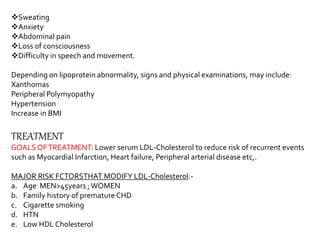
TREATMENT
GOALSOFTREATMENT: Lower serum LDL-Cholesterol to reduce risk of recurrent events
such as Myocardial Infarction, Heart failure, Peripheral arterial disease etc,.
MAJOR RISK FCTORSTHAT MODIFY LDL-Cholesterol:-
a. Age MEN>45years ;WOMEN
b. Family history of premature CHD
c. Cigarette smoking
d. HTN
e. Low HDL Cholesterol
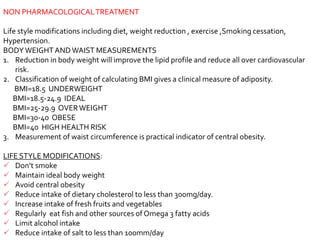
NON PHARMACOLOGICALTREATMENT
Life style modifications including diet, weight reduction , exercise ,Smoking cessation,
Hypertension.
BODYWEIGHT ANDWAIST MEASUREMENTS
1. Reduction in body weight will improve the lipid profile and reduce all over cardiovascular
risk.
2. Classification of weight of calculating BMI gives a clinical measure of adiposity.
BMI=18.5 UNDERWEIGHT
BMI=18.5-24.9 IDEAL
BMI=25-29.9 OVERWEIGHT
BMI=30-40 OBESE
BMI=40 HIGH HEALTH RISK
3. Measurement of waist circumference is practical indicator of central obesity.
LIFE STYLE MODIFICATIONS:
 Don’t smoke
 Maintain ideal body weight
 Avoid central obesity
 Reduce intake of dietary cholesterol to less than 300mg/day.
 Increase intake of fresh fruits and vegetables
 Regularly eat fish and other sources of Omega 3 fatty acids
 Limit alcohol intake
 Reduce intake of salt to less than 100mm/day
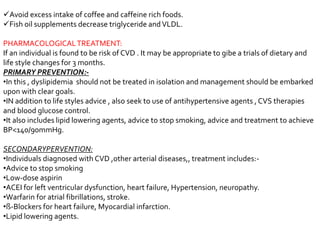
Avoid excess intake of coffee and caffeine rich foods.
Fish oil supplements decrease triglyceride andVLDL.
PHARMACOLOGICALTREATMENT:
If an individual is found to be risk of CVD . It may be appropriate to gibe a trials of dietary and
life style changes for 3 months.
PRIMARY PREVENTION:-
•In this , dyslipidemia should not be treated in isolation and management should be embarked
upon with clear goals.
•IN addition to life styles advice , also seek to use of antihypertensive agents , CVS therapies
and blood glucose control.
•It also includes lipid lowering agents, advice to stop smoking, advice and treatment to achieve
BP<140/90mmHg.
SECONDARYPERVENTION:
•Individuals diagnosed with CVD ,other arterial diseases,, treatment includes:-
•Advice to stop smoking
•Low-dose aspirin
•ACEI for left ventricular dysfunction, heart failure, Hypertension, neuropathy.
•Warfarin for atrial fibrillations, stroke.
•ß-Blockers for heart failure, Myocardial infarction.
•Lipid lowering agents.
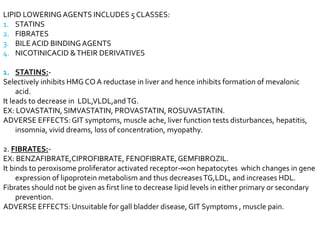
LIPID LOWERINGAGENTS INCLUDES 5 CLASSES:
1. STATINS
2. FIBRATES
3. BILEACID BINDINGAGENTS
4. NICOTINICACID &THEIR DERIVATIVES
1. STATINS:-
Selectively inhibits HMG CO A reductase in liver and hence inhibits formation of mevalonic
acid.
It leads to decrease in LDL,VLDL,andTG.
EX: LOVASTATIN, SIMVASTATIN, PROVASTATIN, ROSUVASTATIN.
ADVERSE EFFECTS:GIT symptoms, muscle ache, liver function tests disturbances, hepatitis,
insomnia, vivid dreams, loss of concentration, myopathy.
2. FIBRATES:-
EX: BENZAFIBRATE,CIPROFIBRATE, FENOFIBRATE,GEMFIBROZIL.
It binds to peroxisome proliferator activated receptor-∞on hepatocytes which changes in gene
expression of lipoprotein metabolism and thus decreasesTG,LDL, and increases HDL.
Fibrates should not be given as first line to decrease lipid levels in either primary or secondary
prevention.
ADVERSE EFFECTS: Unsuitable for gall bladder disease, GIT Symptoms , muscle pain.
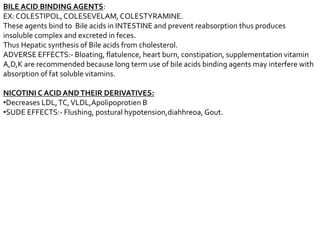
BILE ACID BINDING AGENTS:
EX: COLESTIPOL,COLESEVELAM, COLESTYRAMINE.
These agents bind to Bile acids in INTESTINE and prevent reabsorption thus produces
insoluble complex and excreted in feces.
Thus Hepatic synthesis of Bile acids from cholesterol.
ADVERSE EFFECTS:- Bloating, flatulence, heart burn, constipation, supplementation vitamin
A,D,K are recommended because long term use of bile acids binding agents may interfere with
absorption of fat soluble vitamins.
NICOTINI C ACID ANDTHEIR DERIVATIVES:
•Decreases LDL,TC,VLDL,Apolipoprotien B
•SUDE EFFECTS:- Flushing, postural hypotension,diahhreoa, Gout.
Dyslipidemia

Dyslipidemia

  • 1.
  • 2.
     DEFINITION:  Itis elevated total cholesterol, low density lipoproteins, triglycerides and low High density lipoproteins or combination of these abnormalities.  PATHOPHYSIOLOGY:  Cholesterol, triglycerides are transported in blood as lipoproteins.  Dyslipidemia is associated with development of CHD  Oxidized LDL, mechanical injury to endothelium and excessive homocysteine can lead to endothelial dysfunction and may also leads to Angina ,MI ,Arrhythmias, Stroke.  Due to retention of LDL in plasma may causes Atherosclerotic lesions.
  • 3.
    Due to retentionof LDL in plasma may causes Atherosclerotic lesions. Repeated Injury and repair within Atherosclerotic plaque leads to fibrous cap protecting Underlying lipids ,collagen ,calcium, and Inflammatory cells. This presence of fibrous plaque may critical to prevent Plaque rupture and Coronary thrombosis. Primary or Genetic lipoprotein disorders are classified into six categories: • I Chylomicrons •IIa LDL • IIb LDL+VLDL • III LDL •IVVLDL •VVLDL+ Chylomicrons AETIOLOGY 1. Primary causes 2. Secondary causes PRIMARY CAUSES : familiar hypercholestaemia, primary mixed hyperlipidaemia , SECONDARY , primary hypertriglyceridaemias SECONDARY CAUSES:Associated with no. of disorders like Diabetes Mellitus , Hypothyroidism,Chronic Renal Failure, Nephritic Syndrome, Obesity. CLINICAL PRESENTATIONS:  Mostly asymptomatic  Chest Pain  Palpitations
  • 4.
    Sweating Anxiety Abdominal pain Loss ofconsciousness Difficulty in speech and movement. Depending on lipoprotein abnormality, signs and physical examinations, may include: Xanthomas Peripheral Polymyopathy Hypertension Increase in BMI TREATMENT GOALSOFTREATMENT: Lower serum LDL-Cholesterol to reduce risk of recurrent events such as Myocardial Infarction, Heart failure, Peripheral arterial disease etc,. MAJOR RISK FCTORSTHAT MODIFY LDL-Cholesterol:- a. Age MEN>45years ;WOMEN b. Family history of premature CHD c. Cigarette smoking d. HTN e. Low HDL Cholesterol
  • 5.
    NON PHARMACOLOGICALTREATMENT Life stylemodifications including diet, weight reduction , exercise ,Smoking cessation, Hypertension. BODYWEIGHT ANDWAIST MEASUREMENTS 1. Reduction in body weight will improve the lipid profile and reduce all over cardiovascular risk. 2. Classification of weight of calculating BMI gives a clinical measure of adiposity. BMI=18.5 UNDERWEIGHT BMI=18.5-24.9 IDEAL BMI=25-29.9 OVERWEIGHT BMI=30-40 OBESE BMI=40 HIGH HEALTH RISK 3. Measurement of waist circumference is practical indicator of central obesity. LIFE STYLE MODIFICATIONS:  Don’t smoke  Maintain ideal body weight  Avoid central obesity  Reduce intake of dietary cholesterol to less than 300mg/day.  Increase intake of fresh fruits and vegetables  Regularly eat fish and other sources of Omega 3 fatty acids  Limit alcohol intake  Reduce intake of salt to less than 100mm/day
  • 6.
    Avoid excess intakeof coffee and caffeine rich foods. Fish oil supplements decrease triglyceride andVLDL. PHARMACOLOGICALTREATMENT: If an individual is found to be risk of CVD . It may be appropriate to gibe a trials of dietary and life style changes for 3 months. PRIMARY PREVENTION:- •In this , dyslipidemia should not be treated in isolation and management should be embarked upon with clear goals. •IN addition to life styles advice , also seek to use of antihypertensive agents , CVS therapies and blood glucose control. •It also includes lipid lowering agents, advice to stop smoking, advice and treatment to achieve BP<140/90mmHg. SECONDARYPERVENTION: •Individuals diagnosed with CVD ,other arterial diseases,, treatment includes:- •Advice to stop smoking •Low-dose aspirin •ACEI for left ventricular dysfunction, heart failure, Hypertension, neuropathy. •Warfarin for atrial fibrillations, stroke. •ß-Blockers for heart failure, Myocardial infarction. •Lipid lowering agents.
  • 7.
    LIPID LOWERINGAGENTS INCLUDES5 CLASSES: 1. STATINS 2. FIBRATES 3. BILEACID BINDINGAGENTS 4. NICOTINICACID &THEIR DERIVATIVES 1. STATINS:- Selectively inhibits HMG CO A reductase in liver and hence inhibits formation of mevalonic acid. It leads to decrease in LDL,VLDL,andTG. EX: LOVASTATIN, SIMVASTATIN, PROVASTATIN, ROSUVASTATIN. ADVERSE EFFECTS:GIT symptoms, muscle ache, liver function tests disturbances, hepatitis, insomnia, vivid dreams, loss of concentration, myopathy. 2. FIBRATES:- EX: BENZAFIBRATE,CIPROFIBRATE, FENOFIBRATE,GEMFIBROZIL. It binds to peroxisome proliferator activated receptor-∞on hepatocytes which changes in gene expression of lipoprotein metabolism and thus decreasesTG,LDL, and increases HDL. Fibrates should not be given as first line to decrease lipid levels in either primary or secondary prevention. ADVERSE EFFECTS: Unsuitable for gall bladder disease, GIT Symptoms , muscle pain.
  • 8.
    BILE ACID BINDINGAGENTS: EX: COLESTIPOL,COLESEVELAM, COLESTYRAMINE. These agents bind to Bile acids in INTESTINE and prevent reabsorption thus produces insoluble complex and excreted in feces. Thus Hepatic synthesis of Bile acids from cholesterol. ADVERSE EFFECTS:- Bloating, flatulence, heart burn, constipation, supplementation vitamin A,D,K are recommended because long term use of bile acids binding agents may interfere with absorption of fat soluble vitamins. NICOTINI C ACID ANDTHEIR DERIVATIVES: •Decreases LDL,TC,VLDL,Apolipoprotien B •SUDE EFFECTS:- Flushing, postural hypotension,diahhreoa, Gout.