Dyslipidaemia
Sameh Attia, MD
Lecturer of Cardiology
Ain Shams University
Management of dyslipidaemia
ESC 2016
1- Lipid profiling.
2- Assess total CVD risk.
3- Treatment strategies. ( according to 1 & 2 )
4- Life style modifications.
5- Treatment targets.
6- Choice of treatment.
7- Dyslipidaemia in special population.
Management of dyslipidaemia
ESC 2016
1- Lipid profiling ( For Whom & How
?? ).
2- Assess total CVD risk.
3- Treatment strategies. ( according to 1 & 2 )
4- Life style modifications.
5- Treatment targets.
6- Choice of treatment.
7- Dyslipidaemia in special population.
Lipid Profiling
For Whom ??
1- In subjects with CVD.
2- In clinical conditions associated with
increased risk of CVD and dyslipidemia.
3- For CVD risk stratification.
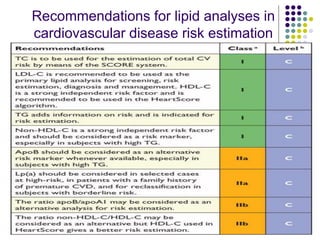
Recommendations for lipid analyses in
cardiovascular disease risk estimation
Risk modifiers
 For those at intermediate risk, other factors,
including metabolic factors such as :
1- Increased apolipoprotein B (apoB),
2- Lipoprotein(a) (Lp(a)),
3- Triglycerides (TGs) or
4- High-sensitivity C-reactive protein (hs-CRP) or
5- The presence of albuminuria, may improve risk
classification.
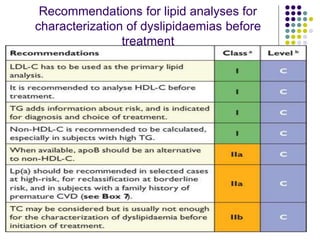
Recommendations for lipid analyses for
characterization of dyslipidaemias before
treatment
Non-HDL cholesterol
 Non-HDL-C is used as an estimation of the total number
of atherogenic particles in plasma [VLDL +
intermediate-density lipoprotein (IDL) + LDL] .
 Non-HDL-C correlates relates well to apo B levels.
 Non-HDL-C is easily calculated from TC minus HDL-C.
Non-HDL cholesterol
 Non-HDL-C can provide a better risk estimation
compared with LDL-C, in particular in Mixed
dyslipidaemias combined with diabetes, the
Metabolic Syndrome or CKD.
 This is supported by a recent meta-analysis
including 14 statin trials, seven fibrate trials, and
six nicotinic acid trials.
Apolipoproteins
1- Apolipoprotein B.
2- Apolipoprotein A1.
 From a technical point of view, there are
advantages in the determination of apoB and
apoA1.
 The analytical performance is good and the
assays do not require fasting conditions
and are not sensitive to markedly elevated
TG levels
Apolipoprotein B
 Apo B is the major apolipoprotein of the
atherogenic lipoprotein families VLDL, IDL,
and LDL.
 The concentration of apo B is a good
estimate of the number of these particles in
plasma.
Apolipoprotein B
 several post-hoc analyses of statin trials
suggest that apo B may be not only a risk
marker but also a better treatment target than
LDL-C.
 Another Met analysis showed that apo B
does not provide any benefit beyond non-
HDL-C or traditional lipid ratios.
Therefore, Apo B used as Secondary treatment
target.
Apolipoprotein A1
 Apo A1 is the major protein of HDL and
provides a good estimate of HDL
concentration.
 Plasma apo A1 of ˂ 120 mg/dL for men and
˂ 140 mg/dL for women approximately
correspond to what is considered as low for
HDL-C.
Lipoprotein a
 The plasma level of Lp(a) is to a major extent
genetically determined.
 Lp(a) has been found in several studies to be
an additional independent risk marker;
indeed,genetic data show it to be causal in
the pathophysiology of atherosclerotic
vascular disease and aortic stenosis.
Lipoprotein a
 Plasma Lp(a) is not recommended for risk screening in
the general population ;however, Lp(a) measurement
should be systematically considered in people with:
1- High CVD risk.
2- Strong family history of premature atherothrombotic
disease.
3- Correct reclassification in patients on the borderline
between high and moderate risk.
Lipoprotein a
 The risk is regarded as significant when
Lp(a) is above the 80th percentile (50
mg/dL).
Lipoprotein a
 Reduction of Lp(a) has been shown with several of the
emerging lipid-lowering drugs:
1- Proprotein convertase subtilisin/ kexin type 9 (PCSK9)
inhibitors and nicotinic acid reduce Lp(a) by 30%.
2- Anti sense drugs targeting the Lp(a) gene reduce the
circulating levels of this protein by up to 80%. A reasonable
option for patients at risk with high Lp(a) is an intensified
treatment of the modifiable risk factors, including LDL-C.
Management of dyslipidaemia
ESC 2016
1- Lipid profiling.
2- Assess total CVD risk.
3- Treatment strategies. ( according to 1 & 2 )
4- Life style modifications.
5- Treatment targets.
6- Choice of treatment.
7- Dyslipidaemia in special population.
Management of dyslipidaemia
ESC 2016
1- Lipid profiling.
2- Assess total CVD risk.
3- Treatment strategies (According to 1 & 2)
4- Life style modifications.
5- Treatment targets.
6- Choice of treatment.
7- Dyslipidaemia in special population.
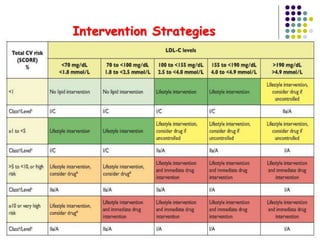
Intervention Strategies
Management of dyslipidaemia
ESC 2016
1- Lipid profiling.
2- Assess total CVD risk.
3- Treatment strategies. ( according to 1 & 2 )
4- Life style modifications.
5- Treatment targets.
6- Choice of treatment.
7- Dyslipidaemia in special population.
Life Style modifications
1- Nutrition.
2- Physical exercise.
3- Management of overweight & Obesity.
4- Smoking cessation.
5- Moderation of Alcohol consumption in
Alcoholics.
 Smoking cessation has clear benefits on
the overall CV risk and specifically on HDL-C.
 Aerobic physical activity corresponding to
a total energy expenditure of between 1500
and 2200 kcal/week, such as 25–30 km of
brisk walking per week (or any equivalent
activity) may increase HDL-C levels by 0.08
–0.15 mmol/L (3.1 – 6 mg/dL)
Management of dyslipidaemia
ESC 2016
1- Lipid profiling.
2- Assess total CVD risk.
3- Treatment strategies. ( according to 1 & 2 )
4- Life style modifications.
5- Treatment targets.
6- Choice of treatment.
7- Dyslipidaemia in special population.
Treatment Targets
For prevention of CVD
( Primary or Secondary Prevention )
1- Primary Treatment targets.
2- Secondary Treatment targets.
3- Not recommended as Treatment targets.
Treatment targets
 Treatment targets of dyslipidaemia are
primarily based on results from clinical trials.
 In nearly all lipid-lowering trials the LDL-C
level has been used as an indicator of
response to therapy.
Therefore, LDL-C remains the primary target of
therapy in most strategies of dyslipidaemia
management.
Treatment targets
 Non-HDL-C and apoB receive a moderate
grading as treatment targets as they have not
been extensively studied in RCTs compared
to LDL-C.
Therefore, Non-HDL-C & Apo B are considered as
Secondary treatment targets for dyslipidaemia
management.
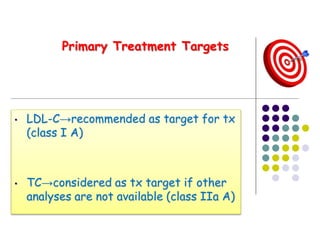
• LDL-C→recommended as target for tx
(class I A)
• TC→considered as tx target if other
analyses are not available (class IIa A)
Primary Treatment Targets
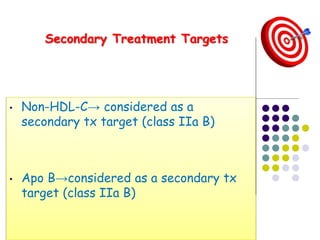
• Non-HDL-C→ considered as a
secondary tx target (class IIa B)
• Apo B→considered as a secondary tx
target (class IIa B)
Secondary Treatment Targets
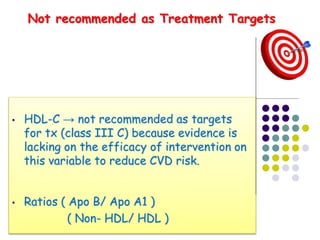
• HDL-C → not recommended as targets
for tx (class III C) because evidence is
lacking on the efficacy of intervention on
this variable to reduce CVD risk.
• Ratios ( Apo B/ Apo A1 )
( Non- HDL/ HDL )
Not recommended as Treatment Targets
 To date, No specific goals for HDL-C or TG
levels have been determined because clinical
trial evidence is lacking on the effectiveness
of intervening in these variables to reduce CV
risk further.
• In patients at VERY HIGH CV risk→the LDL-C goal is
<1.8 mmol/L (<~70 mg/dL) and/or ≥50% LDL-C
reduction when target level can not be reached (class I
A)
• In patients at HIGH CV risk→the LDL-C goal <2.5
mmol/L (<~100 mg/dL) should be considered (class IIa
A)
• In patients at MODERATE CV risk→the LDL-C goal
<3.0 mmol/L (<~115 mg/dL) should be considered
(class IIa C)
Treatment Targets for LDL-C
Why ( < 70 mg/dl ) ???????
 Extrapolating from the available data, an
absolute reduction to an LDL-C level less
than 70 mg/dL or at least a 50% relative
reduction in LDL-C provides the best benefit
in terms of CVD reduction.
• If non-HDL-C is used, the targets
should be; <2.6 mmol/L (<~100 mg/dL)
in those at VERY HIGH CV risk
and <3.3 mmol/L (<~130 mg/dL) in those
at HIGH CV risk
(class IIa B)
• If apo B is available, the targets are;
<80 mg/dL in those at VERY HIGH CV
risk and
<100 mg/dL in those at HIGH CV risk
(class IIa B)
Treatment Targets Other Than LDL-C
Management of dyslipidaemia
ESC 2016
1- Lipid profiling.
2- Assess total CVD risk.
3- Treatment strategies. ( according to 1 & 2 )
4- Life style modifications.
5- Treatment targets.
6- Choice of treatment.
7- Dyslipidaemia in special population.
Choice of lipid-lowering
drugs in the management of
dyslipidaemias
1- Hypercholesetrolaemia.
2- Hypertriglyceridaemia.
3- Mixed dyslipidaemia.
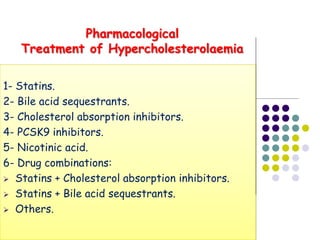
1- Statins.
2- Bile acid sequestrants.
3- Cholesterol absorption inhibitors.
4- PCSK9 inhibitors.
5- Nicotinic acid.
6- Drug combinations:
 Statins + Cholesterol absorption inhibitors.
 Statins + Bile acid sequestrants.
 Others.
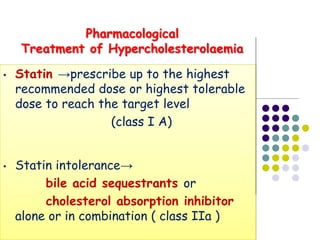
Pharmacological
Treatment of Hypercholesterolaemia
• Statin →prescribe up to the highest
recommended dose or highest tolerable
dose to reach the target level
(class I A)
• Statin intolerance→
bile acid sequestrants or
cholesterol absorption inhibitor
alone or in combination ( class IIa )
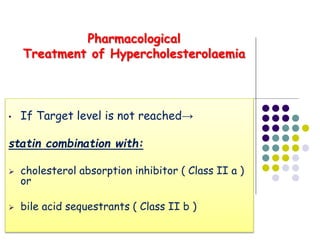
Pharmacological
Treatment of Hypercholesterolaemia
• If Target level is not reached→
statin combination with:
 cholesterol absorption inhibitor ( Class II a )
or
 bile acid sequestrants ( Class II b )
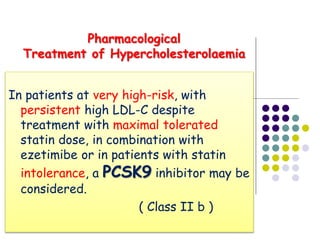
Pharmacological
Treatment of Hypercholesterolaemia
In patients at very high-risk, with
persistent high LDL-C despite
treatment with maximal tolerated
statin dose, in combination with
ezetimibe or in patients with statin
intolerance, a PCSK9 inhibitor may be
considered.
( Class II b )
Pharmacological
Treatment of Hypercholesterolaemia
Pharmacological
Treatment of
Hypertriglyceridaemia
1- Severe
2- Modest
Definition of
hypertriglyceridaemia
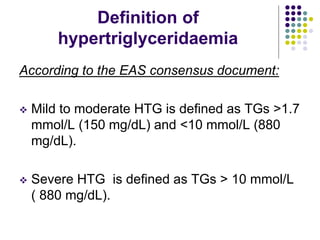
According to the EAS consensus document:
 Mild to moderate HTG is defined as TGs >1.7
mmol/L (150 mg/dL) and <10 mmol/L (880
mg/dL).
 Severe HTG is defined as TGs > 10 mmol/L
( 880 mg/dL).
Severe Hypertriglyceridemia
 Treatment of Severe Hypertiglyceridemia
( > 880mg/dl ) should begin immediately to
reduce risk of pancreatitis & usually fibrate is
tried first.
 Other treatment options include :
1- Lipid lowering therapy.
2- Dietary modifications.
3- Insulin in poorly controlled DM
4- Apheresis.
Modest Hypertriglyceridemia
 Treatment of modest hypertriglyceridemia should begin
with:
1- Assessment of total CVD risk.
2- Life style modifications.
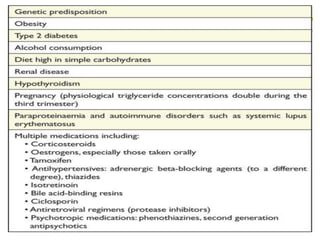
3- Search for underlying cause.
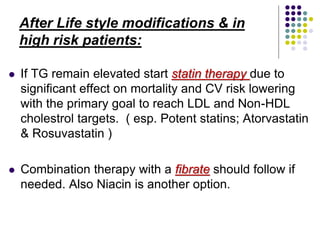
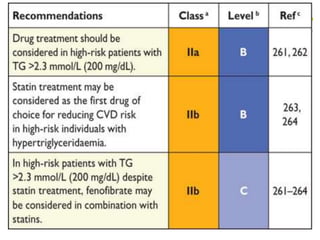
After Life style modifications & in
high risk patients:
 If TG remain elevated start statin therapy due to
significant effect on mortality and CV risk lowering
with the primary goal to reach LDL and Non-HDL
cholestrol targets. ( esp. Potent statins; Atorvastatin
& Rosuvastatin )
 Combination therapy with a fibrate should follow if
needed. Also Niacin is another option.
Efficacy of fibrates on CV
outcome
The clinical effects of fibrates are primarily illustrated
by five prospective RCTs:
1- Helsinki Heart Study (HHS),
2- Veterans Affairs Highdensity lipoprotein Intervention
Trial (VA-HIT),
3- Bezafibrate Infarction Prevention (BIP) study,
4- Fenofibrate Intervention and Event Lowering in Diabetes
(FIELD) and
5- Action to Control Cardiovascular Risk in Diabetes
(ACCORD) study, where fenofibrate was added to statin
therapy
 Neither the FIELD nor the ACCORD study showed a
reduction in total CVD outcomes.
 Results from other meta-analyses suggest reduced major
CVD events in patients with high TGs and low HDL-C in
fibrate-treated patients, but no decrease in CVD or total
mortality.
 Thus the overall efficacy of fibrates on CVD
outcomes is much less evident than that of
statins.
Overall, the possible benefits of fibrates require confirmation.
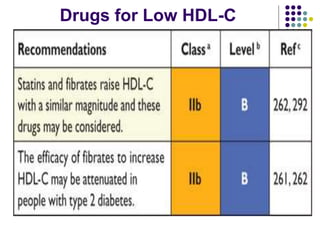
Drugs for Low HDL-C
 Low HDL-C constitute a strong, independent
and inverse predictor of the risk of premature
development of atherosclerosis.
Drugs for Low HDL-C
1- statins.
2- Fibrates.
3- Nicotinic acid.
4- CETP inhibitors
Drugs for Low HDL-C
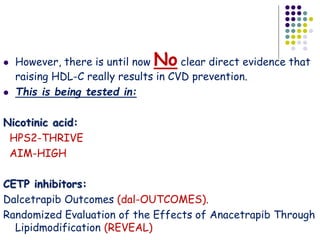
 However, there is until now No clear direct evidence that
raising HDL-C really results in CVD prevention.
 This is being tested in:
Nicotinic acid:
HPS2-THRIVE
AIM-HIGH
CETP inhibitors:
Dalcetrapib Outcomes (dal-OUTCOMES).
Randomized Evaluation of the Effects of Anacetrapib Through
Lipidmodification (REVEAL)
Pharmacological
Treatment of Mixed
Dyslipidaemia
• ↑ in HDL-C and ↓ in TG on top of ↓ in LDL-C
can be achieved by statins.
• Statin+fibrate→monitor for myopathy;
combination with gemfibrozil should be
avoided
• TG are not controlled by statins or
fibrates→n-3 fatty acids
Drug Combinations for the
Management of Mixed
Dyslipidaemias
Management of dyslipidaemia
ESC 2016
1- Lipid profiling.
2- Assess total CVD risk.
3- Treatment strategies. ( according to 1 & 2 )
4- Life style modifications.
5- Treatment targets.
6- Choice of treatment.
7- Dyslipidaemia in special
population.
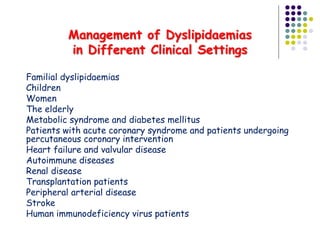
Management of Dyslipidaemias
in Different Clinical Settings
 Familial dyslipidaemias
 Children
 Women
 The elderly
 Metabolic syndrome and diabetes mellitus
 Patients with acute coronary syndrome and patients undergoing
percutaneous coronary intervention
 Heart failure and valvular disease
 Autoimmune diseases
 Renal disease
 Transplantation patients
 Peripheral arterial disease
 Stroke
 Human immunodeficiency virus patients
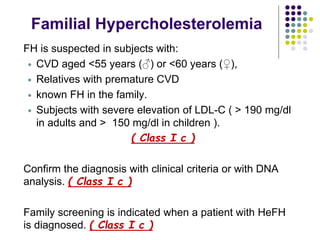
Familial Hypercholesterolemia
 FH is suspected in subjects with:
 CVD aged <55 years (♂) or <60 years (♀),
 Relatives with premature CVD
 known FH in the family.
 Subjects with severe elevation of LDL-C ( > 190 mg/dl
in adults and > 150 mg/dl in children ).
 ( Class I c )
 Confirm the diagnosis with clinical criteria or with DNA
analysis. ( Class I c )

 Family screening is indicated when a patient with HeFH
is diagnosed. ( Class I c )
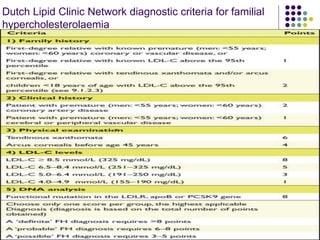
Dutch Lipid Clinic Network diagnostic criteria for familial
hypercholesterolaemia
Familial Hypercholesterolemia
Heterozygous Type:
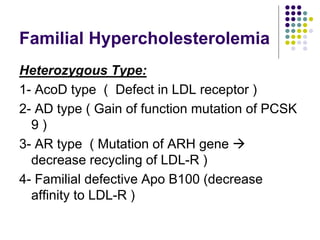
1- AcoD type ( Defect in LDL receptor )
2- AD type ( Gain of function mutation of PCSK
9 )
3- AR type ( Mutation of ARH gene 
decrease recycling of LDL-R )
4- Familial defective Apo B100 (decrease
affinity to LDL-R )
Familial Hypercholesterolemia
Heterozygous Type:
Treatment :
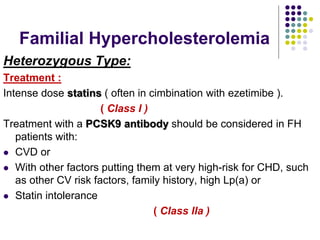
Intense dose statins ( often in cimbination with ezetimibe ).
( Class I )
Treatment with a PCSK9 antibody should be considered in FH
patients with:
 CVD or
 With other factors putting them at very high-risk for CHD, such
as other CV risk factors, family history, high Lp(a) or
 Statin intolerance
( Class IIa )
Familial Hypercholesterolemia
Heterozygous Type:
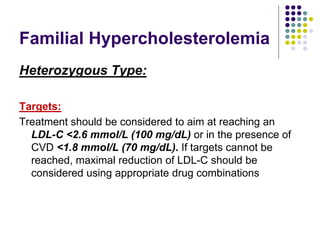
Targets:
Treatment should be considered to aim at reaching an
LDL-C <2.6 mmol/L (100 mg/dL) or in the presence of
CVD <1.8 mmol/L (70 mg/dL). If targets cannot be
reached, maximal reduction of LDL-C should be
considered using appropriate drug combinations
Familial Hypercholesterolemia
Heterozygous Type: ( Children )
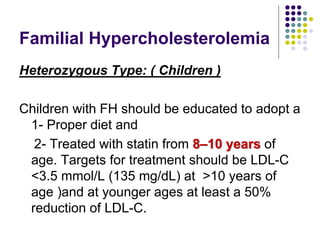
Children with FH should be educated to adopt a
1- Proper diet and
2- Treated with statin from 8–10 years of
age. Targets for treatment should be LDL-C
<3.5 mmol/L (135 mg/dL) at >10 years of
age )and at younger ages at least a 50%
reduction of LDL-C.
Familial Hypercholesterolemia
Homozygous Type ( Rare )
 Both Parents had HeFH
 Failure of LDL-R expression severe increase of LDL
with death in early adulthood due to Myocardial ischemia
or AS.
 Treatment:
High dose statins + combination therapy
LDL apharesis
CABG usually at young age
Novel ttt ( Antisense RNA against Apo B synthesis in liver )
Children
 Only in FH consideration should be given to
lipid-lowering drug treatment.
 In other cases of dyslipidaemia in children,
focus should be on diet and treatment of
underlying metabolic disorders.
When to start Statin therapy ??
 The exact age at which to start statin treatment
is, however, a matter for clinical judgement.
 HoFH patients should be treated with lipid-
lowering drugs as early as possible, and the
same is true for HeFH patients with extremely
high LDL-C, i.e. ≥400 mg/dL (10.3 mmol/L).
 In the case of other HeFH children,statin
treatment is generally with held until sometime
between the ages of 8 and 10 years.
Women
 Statin tx→recommended for
primary prevention of CAD in
high risk women
 Statins→recommended for
secondary prevention in
women with the same
indications and targets as in
men
Women
 Lipid-lowering drugs should not be given when
pregnancy is planned, during pregnancy or
during the breast-feeding period
Bile acid sequestrants (which are not absorbed)
may be considered.
The Elderly
 Tx with statins→recommended for elderly
patients with established CVD in the same
way as for younger patients (class I B)
 Elderly people often have comorbidities
and have altered pharmacokinetics
 Recommended to start lipid-lowering
medication at a low dose and then
titrate with caution to achieve target
lipid levels which are the same as in the
younger subjects (class I C)
DM & dyslipidemia
 Patterns of dyslipidemia in DM.
T1DM: Serum TGs ( Normal )
HDL ( Upper normal or slightly
elevated )
Due to Insulin therapy -> increase lipoprotein
lipase activity in adipose tissue -> Increase
turn over of VLDL ( TRLs )
Increased CV risk is due to Qualitative
changes in LDL & HDL i.e. become
atherogenic.
T1DM
 In patients with T1DM and in presence of
microalbuminuria &/or renal disease LDL-C
lowering ( at least 50% ) with statins as the
first choice is recommended irrespective of
base line LDL-C level.
Class I
( drug combination may be used if required )
DM & dyslipidemia
T2DM: ( Mixed dyslipidemia )
 Moderate increase of TGs.
 Increase of TRLs including LDL & VLDL.
 Decrease of HDL & Apo A.
Due to Insulin resistance  flux of FFA to
liver  Non- alcoholic fatty liver disease 
increase content of liver fat  Increase VLDL
& TGs
CVD risk assessment in DM
 ESC 2013/2016:
Very high risk: DM + other CVD risk factors
or TOD
High risk: DM
T2DM
Manag. ???
 Life style modifications
 Statins are recommended irrespective of
baseline LDL-C ( target acc. To level of risk )
High or very high risk
( drug combination may be used if required )
CKD & Dyslipidemia
 Pattern of dyslipidemia in CKD:
Mixed dyslipidemia
1- Increased TGs ( due to increased production & impaired
turn over of TRLs ).
2- Decreased HDL-C.
3- Increased LDL-C ( due to prolonged catabolic rate of
LDL-C )
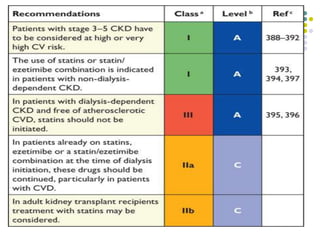
 Based on results of different RCTs &
meta-analyses:
In patients with CKD not on dialysis: treatment with
statins reduced all-cause mortality by 34%, CV
mortality by 31%,CV events by 45% and stroke by
34%.
In patients receiving dialysis: treatment with
statins had no effect on all-cause mortality and no
convincing evidence of reduced CVD events.,
Patients with ACS & patients
undergoing PCI
It was shown that either pretreatment
with high-dose statin (ranging from > 2 weeks
to a single dose) in patients not on statin
therapy (11studies) or loading of a high-dose
statin in patients receiving chronic statin
therapy decreased peri-procedural MI and
30-day adverse events in patients
undergoing PCI.
Routine short pretreatment or loading (on the
background of chronic therapy) with high-dose
statins before PCI should be considered in
elective PCI or in NSTE-ACS.
Class II a
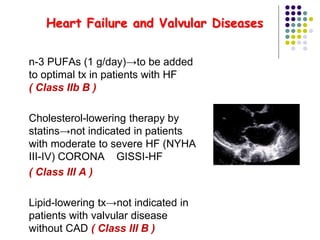
Heart Failure and Valvular Diseases
 n-3 PUFAs (1 g/day)→to be added
to optimal tx in patients with HF
( Class IIb B )
 Cholesterol-lowering therapy by
statins→not indicated in patients
with moderate to severe HF (NYHA
III-IV) CORONA GISSI-HF
 ( Class III A )
 Lipid-lowering tx→not indicated in
patients with valvular disease
without CAD ( Class III B )
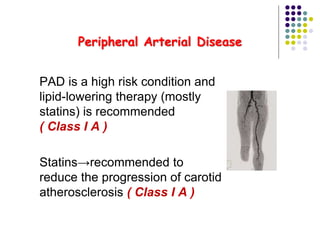
Peripheral Arterial Disease
 PAD is a high risk condition and
lipid-lowering therapy (mostly
statins) is recommended
( Class I A )
 Statins→recommended to
reduce the progression of carotid
atherosclerosis ( Class I A )
Autoimmune disease & Dyslipidemia
 Rheumatoid arthritis, SLE, psoriasis and anti-
phospholipid syndrome, are characterized by enhanced
atherosclerosis and consequently higher CV morbidity
and mortality rates compared with the general
population.
 Statins are effective in reducing disease activity, CV
events and mortality (particularly in primary prevention)
in this setting However,there is no firm indication to use
lipid-lowering therapy only on the basis of the presence
of the disease.
ACC 2013
Guidelines for LDL-C lowering for
prevention of ASCVD
There are 4 defined Statin
Benefit groups
1- Patients with clinical ASCVD.
2- LDL greater than 190 mg/dl.
3- Patients with diabetes, age 40-75 years.
4- Age 40-75 years that do not meet above
criteria, but have a 10 year risk of >7.5 %
( according to the New pooled cohort risk equation )
Q: why 4 major statin benefit
groups ???
 Because Statins RCTs showed the greatest
ASCVD event reduction that EXCEEDS risk
of adverse events.
There are 4 defined Statin Benefit
groups
 All of these are indicated for statin treatment
 Results are mainly derived from CTT
metanalyses which showed that each 39
mg/dl reduction in LDL-C with statins
Reduction of ASCVD events by 22%
1. Patients with clinical
ASCVD
 Coronary artery disease or peripheral artery
disease
 Acute coronary syndromes
 Coronary or other arterial revascularization
 Stroke or TIA
 These patients get high intensity statin treatment
If they cannot tolerate high intensity statin therapy, use
other agent to achieve >50% reduction of baseline LDL.
2. LDL greater than 190 mg/dl
 These are patients with familial hyperlipidema
( we should exclude secondary causes first to
avoid unnecessary use of statins )
 These patients get high intensity statin treatment
If they cannot tolerate high intensity statin therapy, use
other agent to achieve >50% reduction of baseline LDL.
3. Patients with diabetes, age 40-75
years
All have indication for statin
 Level of intensity of statin treatment depends
on calculated 10 year risk.
 Diabetics with > 7.5% 10 year risk get high
intensity statin therapy
 Diabetics with < 7.5% 10 year risk of CAD
get moderate intensity statin therapy
4. Age 40-75 years that do not meet above
criteria, but have a 10 year risk of >7.5 %
 10 year and lifetime risk as determined by CV
Risk Calculator.
 Moderate to high intensity statin therapy
recommended
In these individuals whose 10 year risk is less
that 7.5%, or when the decision is unclear,
other factors should be considered
 Family history of premature CAD
 LDL > 160 mg/dl
 Increased CRP greater than 2.0
 Coronary calcium greater than 300
 ABI < 0.9
There are no longer treatment targets
for LDL or non-HDL
 This is a huge change for patients and
providers.
 No longer treat to target
 Goal is no longer “lower is better.”
Q: Why no longer treatment
targets ???
 No RCTs compare 2 LDL-C or Non-HDL-C
targets.
 No RCTs had evaluated titration of all
individuals in treatment group to specific
LDL-C targets to ˂ 100 mg/dl or ˂ 70 mg/dl.
 Potential adverse effects from multidrug
therpy to achieve a specific goal.
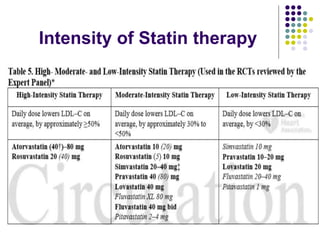
Intensity of Statin therapy
Remember that this classification done
ONLY to monitor therapeutic response BUT
NOT cosidered as Treatment TARGETS
Insufficient response to statins
1- Assess adherence to medications & life style
modifications.
2- Exclude Secondary causes of
Hyperlipidemia.
3- Intolerance to Statins.
Non-statin therapies
 For hyperlipidemia, non statin therapies, alone or in combination
with statins, do not provide acceptable risk reduction benefits
compared to adverse effects. CLASS IIb
 For the most part, these should be avoided
with few exceptions when risk reduction outweigh the potential
adverse events.
Why don’t non-statins play a
more prominent role in the new
guidelines?
Recent troublesome non-Statin Trials
 Fibrate
 ACCORD.
 FIELD.
( Fenofibrate showed no reduction of CV death &
NFMI ) but in subgroup analysis in pts with
elevated TGs and Low HDL it showed reduction
of CV risk.
Troublesome non-Statin Trials
 Niacin
 HPS2-THRIVE (Treatment of HDL to reduce the
Incidence of Vascular Events ).
 AIM-HIGH
Statins
 Mech. of action ( HMG CoA reductase inhibitors ).
 Actions:
decrease LDL ( 20 – 60% )
decrease TGs ( 10 – 25 % )
Increase HDL ( 5 – 15 % )
Pleiotropic actions of statins
 Side effects:
Myopathy ( least with Pra- & Flu- ) / Rhabdomyolysis
Liver function abnormalities ( least with Pra- & Sim- )
GIT disturbances, Fatigue, Myalgia
Trials of Statins
 For Primary prevention:
ASCOT ( Ator- ) JUPITER ( Rosu-) HPS ( Simv- )
 For Secondary prevention:
CARE ( Prav- )
 In ACS:
MIRACLE ( Ator- ) PROVE IT ( Ator- vs Prav- )
 Atherosclerosis regression :
REVERSAL ( Ator- vs Prav- ) ASTEROID ( Rosuv- )
Non- statin therapy
Fibrates
Mech. : Agonists of PPAR- α  regulate gene expression
 ++ LPL activity  ++ lipolysis of TGLs
Action: Decrease TGs ( 20 – 50% ) & LDL ( 5 – 20% )
Side effects: Myopathy , GIT disturbances, Erectile
dysfunction
Trials: FIELD & ACCORD ( Fenofibrate showed no
reduction of CV death & NFMI ) but in subgroup analysis
in pts with elevated TGs and Low HDL it showed
reduction of CV risk.
Niacin
Mech. : Decrease hepatic secretion of VLDL from liver and
FFAs mobilization from periphery.
Action: Decrease TGs ( 20 – 25% ) & LDL ( 5 – 20% )
Increase HDL ( 15 – 35 % )
Side effects: Flushing , GIT disturbances, Hyperuricemia,
Hepatotoxicity….
Trials: HPS2 – THRIVE & AIM HIGH ( Adding Niacin to
statins showed no significant reduction of CV events )
Cholestrol Absorption Inhibitors
Mech. : Decrease selective uptake of cholestrol by
intestinal epithelial cells. ( inhibit NPC1- like protein )
Action: Decrease LDL ( 18% ).
Side effects: Increase Liver Transaminases
Trials:
SEAS ( Ezetimibe + Simv. ) in AS  Decrease CV events
but not decreasing progression of AS.
IMPROVE-IT
 Ezetimibe was added to simvastatin (40 mg) in patients after ACS.
A total of 18144 patients were randomized:
 170 fewer events were recorded in the group taking simvastatin plus
ezetimibe (P = 0.016).
 The average LDL-C during the study was 1.8 mmol/L in the simvastatin
group and 1.4 mmol/L in patients taking ezetimibe plus simvastatin.
 Also, ischaemic stroke was reduced by 21% in this trial (P = 0.008).
 There was no evidence of harm caused by the further LDL-C reduction.
the study supports the proposition that LDL-C lowering by means other
than statins is beneficial and can be performed without adverse effects.
Bile Acid Binding Resins
Mech. : Interrupt enterohepatic circulation of Bile acids by
inhibiting their reabsorption in intestine  lost in feaces
 plasma cholestrol used in synthesis of Bile acids by
liver.
Action: Decrease LDL ( 15 - 30% ).
Side effects: Constipation, GIT disturbances
Hypertriglyceridemia ( ++ phosphatidic acid
phosphatase leading to increased TG synthesis )
CETP inhibitors
Torcetrapib : Toxic ( ILLUMINATE )
Anacetrapib ( REVEAL )
Dalcetrapib ( DAL-OUTCOME )
PCSK9 inhibitors
PCSK 9 inhibitor
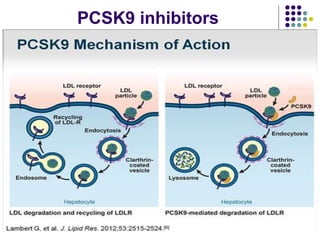
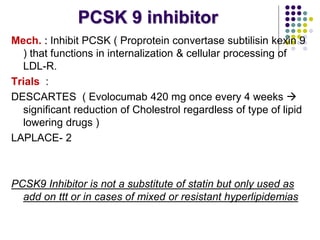
Mech. : Inhibit PCSK ( Proprotein convertase subtilisin kexin 9
) that functions in internalization & cellular processing of
LDL-R.
Trials :
DESCARTES ( Evolocumab 420 mg once every 4 weeks 
significant reduction of Cholestrol regardless of type of lipid
lowering drugs )
LAPLACE- 2
PCSK9 Inhibitor is not a substitute of statin but only used as
add on ttt or in cases of mixed or resistant hyperlipidemias
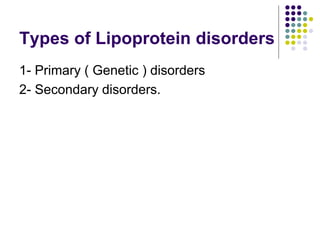
Types of Lipoprotein disorders
1- Primary ( Genetic ) disorders
2- Secondary disorders.
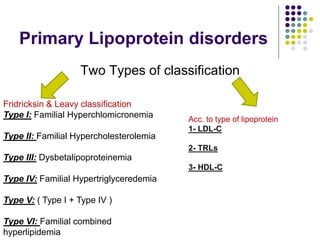
Primary Lipoprotein disorders
Two Types of classification
Fridricksin & Leavy classification
Type I: Familial Hyperchlomicronemia
Type II: Familial Hypercholesterolemia
Type III: Dysbetalipoproteinemia
Type IV: Familial Hypertriglyceredemia
Type V: ( Type I + Type IV )
Type VI: Familial combined
hyperlipidemia
Acc. to type of lipoprotein
1- LDL-C
2- TRLs
3- HDL-C
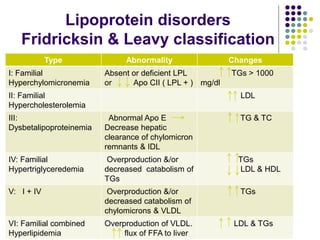
Lipoprotein disorders
Fridricksin & Leavy classification
Type Abnormality Changes
I: Familial
Hyperchylomicronemia
Absent or deficient LPL
or Apo CII ( LPL + )
TGs > 1000
mg/dl
II: Familial
Hypercholesterolemia
LDL
III:
Dysbetalipoproteinemia
Abnormal Apo E
Decrease hepatic
clearance of chylomicron
remnants & IDL
TG & TC
IV: Familial
Hypertriglyceredemia
Overproduction &/or
decreased catabolism of
TGs
TGs
LDL & HDL
V: I + IV Overproduction &/or
decreased catabolism of
chylomicrons & VLDL
TGs
VI: Familial combined
Hyperlipidemia
Overproduction of VLDL.
flux of FFA to liver
LDL & TGs
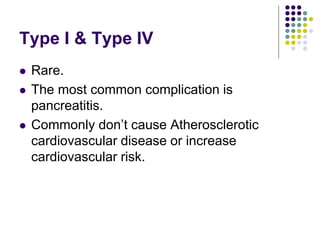
Type I & Type IV
 Rare.
 The most common complication is
pancreatitis.
 Commonly don’t cause Atherosclerotic
cardiovascular disease or increase
cardiovascular risk.
Type III
 AR disorder.
 Majority are homozygous for Apo E2 with
defective binding to LDL receptors.
 Usually doesn’t cause a problem except if
associated with other lipid disorders as in
DM, Obesity or Metabolic syndrome.
Type IV and VI
 AD
 Mechanism is not clearly understood
however it is mostly due to overproduction
&/or decreased catabolism of affected
lipoproteins.
LDL-C disorders
( Primary & Secondary )
 Familial Hypercholesterolemia
 Dysbetalipoproteinemia
 Familial combined hyperlipidemia
 Hypobetalipoproteinemia
( Due to defective Apo B )
 Abetalipoproteinemia
( Due to Absent Apo B )
Don’t forget Secondary causes
TRLs disorders
( Primary & Secondary )
 Familial Hyperchylomicronemia
 Familial Hypertriglyceredemia
 Familial combined Hyperlipidemia
Don’t forget Secondary causes
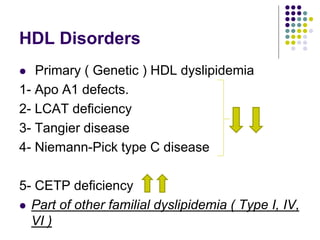
HDL Disorders
 Primary ( Genetic ) HDL dyslipidemia
1- Apo A1 defects.
2- LCAT deficiency
3- Tangier disease
4- Niemann-Pick type C disease
5- CETP deficiency
 Part of other familial dyslipidemia ( Type I, IV,
VI )
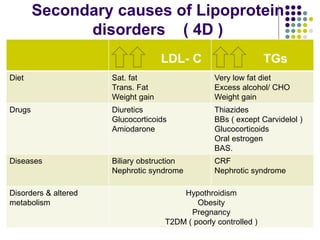
Secondary causes of Lipoprotein
disorders ( 4D )
LDL- C TGs
Diet Sat. fat
Trans. Fat
Weight gain
Very low fat diet
Excess alcohol/ CHO
Weight gain
Drugs Diuretics
Glucocorticoids
Amiodarone
Thiazides
BBs ( except Carvidelol )
Glucocorticoids
Oral estrogen
BAS.
Diseases Biliary obstruction
Nephrotic syndrome
CRF
Nephrotic syndrome
Disorders & altered
metabolism
Hypothroidism
Obesity
Pregnancy
T2DM ( poorly controlled )
Dyslipidemia guidelines

Dyslipidemia guidelines

  • 1.
    Dyslipidaemia Sameh Attia, MD Lecturerof Cardiology Ain Shams University
  • 2.
    Management of dyslipidaemia ESC2016 1- Lipid profiling. 2- Assess total CVD risk. 3- Treatment strategies. ( according to 1 & 2 ) 4- Life style modifications. 5- Treatment targets. 6- Choice of treatment. 7- Dyslipidaemia in special population.
  • 3.
    Management of dyslipidaemia ESC2016 1- Lipid profiling ( For Whom & How ?? ). 2- Assess total CVD risk. 3- Treatment strategies. ( according to 1 & 2 ) 4- Life style modifications. 5- Treatment targets. 6- Choice of treatment. 7- Dyslipidaemia in special population.
  • 4.
    Lipid Profiling For Whom?? 1- In subjects with CVD. 2- In clinical conditions associated with increased risk of CVD and dyslipidemia. 3- For CVD risk stratification.
  • 5.
    Recommendations for lipidanalyses in cardiovascular disease risk estimation
  • 6.
    Risk modifiers  Forthose at intermediate risk, other factors, including metabolic factors such as : 1- Increased apolipoprotein B (apoB), 2- Lipoprotein(a) (Lp(a)), 3- Triglycerides (TGs) or 4- High-sensitivity C-reactive protein (hs-CRP) or 5- The presence of albuminuria, may improve risk classification.
  • 7.
    Recommendations for lipidanalyses for characterization of dyslipidaemias before treatment
  • 8.
    Non-HDL cholesterol  Non-HDL-Cis used as an estimation of the total number of atherogenic particles in plasma [VLDL + intermediate-density lipoprotein (IDL) + LDL] .  Non-HDL-C correlates relates well to apo B levels.  Non-HDL-C is easily calculated from TC minus HDL-C.
  • 9.
    Non-HDL cholesterol  Non-HDL-Ccan provide a better risk estimation compared with LDL-C, in particular in Mixed dyslipidaemias combined with diabetes, the Metabolic Syndrome or CKD.  This is supported by a recent meta-analysis including 14 statin trials, seven fibrate trials, and six nicotinic acid trials.
  • 10.
  • 11.
     From atechnical point of view, there are advantages in the determination of apoB and apoA1.  The analytical performance is good and the assays do not require fasting conditions and are not sensitive to markedly elevated TG levels
  • 12.
    Apolipoprotein B  ApoB is the major apolipoprotein of the atherogenic lipoprotein families VLDL, IDL, and LDL.  The concentration of apo B is a good estimate of the number of these particles in plasma.
  • 13.
    Apolipoprotein B  severalpost-hoc analyses of statin trials suggest that apo B may be not only a risk marker but also a better treatment target than LDL-C.  Another Met analysis showed that apo B does not provide any benefit beyond non- HDL-C or traditional lipid ratios. Therefore, Apo B used as Secondary treatment target.
  • 14.
    Apolipoprotein A1  ApoA1 is the major protein of HDL and provides a good estimate of HDL concentration.  Plasma apo A1 of ˂ 120 mg/dL for men and ˂ 140 mg/dL for women approximately correspond to what is considered as low for HDL-C.
  • 15.
    Lipoprotein a  Theplasma level of Lp(a) is to a major extent genetically determined.  Lp(a) has been found in several studies to be an additional independent risk marker; indeed,genetic data show it to be causal in the pathophysiology of atherosclerotic vascular disease and aortic stenosis.
  • 16.
    Lipoprotein a  PlasmaLp(a) is not recommended for risk screening in the general population ;however, Lp(a) measurement should be systematically considered in people with: 1- High CVD risk. 2- Strong family history of premature atherothrombotic disease. 3- Correct reclassification in patients on the borderline between high and moderate risk.
  • 17.
    Lipoprotein a  Therisk is regarded as significant when Lp(a) is above the 80th percentile (50 mg/dL).
  • 18.
    Lipoprotein a  Reductionof Lp(a) has been shown with several of the emerging lipid-lowering drugs: 1- Proprotein convertase subtilisin/ kexin type 9 (PCSK9) inhibitors and nicotinic acid reduce Lp(a) by 30%. 2- Anti sense drugs targeting the Lp(a) gene reduce the circulating levels of this protein by up to 80%. A reasonable option for patients at risk with high Lp(a) is an intensified treatment of the modifiable risk factors, including LDL-C.
  • 19.
    Management of dyslipidaemia ESC2016 1- Lipid profiling. 2- Assess total CVD risk. 3- Treatment strategies. ( according to 1 & 2 ) 4- Life style modifications. 5- Treatment targets. 6- Choice of treatment. 7- Dyslipidaemia in special population.
  • 20.
    Management of dyslipidaemia ESC2016 1- Lipid profiling. 2- Assess total CVD risk. 3- Treatment strategies (According to 1 & 2) 4- Life style modifications. 5- Treatment targets. 6- Choice of treatment. 7- Dyslipidaemia in special population.
  • 21.
  • 22.
    Management of dyslipidaemia ESC2016 1- Lipid profiling. 2- Assess total CVD risk. 3- Treatment strategies. ( according to 1 & 2 ) 4- Life style modifications. 5- Treatment targets. 6- Choice of treatment. 7- Dyslipidaemia in special population.
  • 23.
    Life Style modifications 1-Nutrition. 2- Physical exercise. 3- Management of overweight & Obesity. 4- Smoking cessation. 5- Moderation of Alcohol consumption in Alcoholics.
  • 24.
     Smoking cessationhas clear benefits on the overall CV risk and specifically on HDL-C.
  • 25.
     Aerobic physicalactivity corresponding to a total energy expenditure of between 1500 and 2200 kcal/week, such as 25–30 km of brisk walking per week (or any equivalent activity) may increase HDL-C levels by 0.08 –0.15 mmol/L (3.1 – 6 mg/dL)
  • 26.
    Management of dyslipidaemia ESC2016 1- Lipid profiling. 2- Assess total CVD risk. 3- Treatment strategies. ( according to 1 & 2 ) 4- Life style modifications. 5- Treatment targets. 6- Choice of treatment. 7- Dyslipidaemia in special population.
  • 27.
    Treatment Targets For preventionof CVD ( Primary or Secondary Prevention ) 1- Primary Treatment targets. 2- Secondary Treatment targets. 3- Not recommended as Treatment targets.
  • 28.
    Treatment targets  Treatmenttargets of dyslipidaemia are primarily based on results from clinical trials.  In nearly all lipid-lowering trials the LDL-C level has been used as an indicator of response to therapy. Therefore, LDL-C remains the primary target of therapy in most strategies of dyslipidaemia management.
  • 29.
    Treatment targets  Non-HDL-Cand apoB receive a moderate grading as treatment targets as they have not been extensively studied in RCTs compared to LDL-C. Therefore, Non-HDL-C & Apo B are considered as Secondary treatment targets for dyslipidaemia management.
  • 30.
    • LDL-C→recommended astarget for tx (class I A) • TC→considered as tx target if other analyses are not available (class IIa A) Primary Treatment Targets
  • 31.
    • Non-HDL-C→ consideredas a secondary tx target (class IIa B) • Apo B→considered as a secondary tx target (class IIa B) Secondary Treatment Targets
  • 32.
    • HDL-C →not recommended as targets for tx (class III C) because evidence is lacking on the efficacy of intervention on this variable to reduce CVD risk. • Ratios ( Apo B/ Apo A1 ) ( Non- HDL/ HDL ) Not recommended as Treatment Targets
  • 33.
     To date,No specific goals for HDL-C or TG levels have been determined because clinical trial evidence is lacking on the effectiveness of intervening in these variables to reduce CV risk further.
  • 34.
    • In patientsat VERY HIGH CV risk→the LDL-C goal is <1.8 mmol/L (<~70 mg/dL) and/or ≥50% LDL-C reduction when target level can not be reached (class I A) • In patients at HIGH CV risk→the LDL-C goal <2.5 mmol/L (<~100 mg/dL) should be considered (class IIa A) • In patients at MODERATE CV risk→the LDL-C goal <3.0 mmol/L (<~115 mg/dL) should be considered (class IIa C) Treatment Targets for LDL-C
  • 35.
    Why ( <70 mg/dl ) ???????  Extrapolating from the available data, an absolute reduction to an LDL-C level less than 70 mg/dL or at least a 50% relative reduction in LDL-C provides the best benefit in terms of CVD reduction.
  • 36.
    • If non-HDL-Cis used, the targets should be; <2.6 mmol/L (<~100 mg/dL) in those at VERY HIGH CV risk and <3.3 mmol/L (<~130 mg/dL) in those at HIGH CV risk (class IIa B) • If apo B is available, the targets are; <80 mg/dL in those at VERY HIGH CV risk and <100 mg/dL in those at HIGH CV risk (class IIa B) Treatment Targets Other Than LDL-C
  • 37.
    Management of dyslipidaemia ESC2016 1- Lipid profiling. 2- Assess total CVD risk. 3- Treatment strategies. ( according to 1 & 2 ) 4- Life style modifications. 5- Treatment targets. 6- Choice of treatment. 7- Dyslipidaemia in special population.
  • 38.
    Choice of lipid-lowering drugsin the management of dyslipidaemias
  • 39.
  • 40.
    1- Statins. 2- Bileacid sequestrants. 3- Cholesterol absorption inhibitors. 4- PCSK9 inhibitors. 5- Nicotinic acid. 6- Drug combinations:  Statins + Cholesterol absorption inhibitors.  Statins + Bile acid sequestrants.  Others. Pharmacological Treatment of Hypercholesterolaemia
  • 41.
    • Statin →prescribeup to the highest recommended dose or highest tolerable dose to reach the target level (class I A) • Statin intolerance→ bile acid sequestrants or cholesterol absorption inhibitor alone or in combination ( class IIa ) Pharmacological Treatment of Hypercholesterolaemia
  • 42.
    • If Targetlevel is not reached→ statin combination with:  cholesterol absorption inhibitor ( Class II a ) or  bile acid sequestrants ( Class II b ) Pharmacological Treatment of Hypercholesterolaemia
  • 43.
    In patients atvery high-risk, with persistent high LDL-C despite treatment with maximal tolerated statin dose, in combination with ezetimibe or in patients with statin intolerance, a PCSK9 inhibitor may be considered. ( Class II b ) Pharmacological Treatment of Hypercholesterolaemia
  • 44.
  • 45.
    Definition of hypertriglyceridaemia According tothe EAS consensus document:  Mild to moderate HTG is defined as TGs >1.7 mmol/L (150 mg/dL) and <10 mmol/L (880 mg/dL).  Severe HTG is defined as TGs > 10 mmol/L ( 880 mg/dL).
  • 46.
    Severe Hypertriglyceridemia  Treatmentof Severe Hypertiglyceridemia ( > 880mg/dl ) should begin immediately to reduce risk of pancreatitis & usually fibrate is tried first.  Other treatment options include : 1- Lipid lowering therapy. 2- Dietary modifications. 3- Insulin in poorly controlled DM 4- Apheresis.
  • 47.
    Modest Hypertriglyceridemia  Treatmentof modest hypertriglyceridemia should begin with: 1- Assessment of total CVD risk. 2- Life style modifications. 3- Search for underlying cause.
  • 49.
    After Life stylemodifications & in high risk patients:  If TG remain elevated start statin therapy due to significant effect on mortality and CV risk lowering with the primary goal to reach LDL and Non-HDL cholestrol targets. ( esp. Potent statins; Atorvastatin & Rosuvastatin )  Combination therapy with a fibrate should follow if needed. Also Niacin is another option.
  • 51.
    Efficacy of fibrateson CV outcome The clinical effects of fibrates are primarily illustrated by five prospective RCTs: 1- Helsinki Heart Study (HHS), 2- Veterans Affairs Highdensity lipoprotein Intervention Trial (VA-HIT), 3- Bezafibrate Infarction Prevention (BIP) study, 4- Fenofibrate Intervention and Event Lowering in Diabetes (FIELD) and 5- Action to Control Cardiovascular Risk in Diabetes (ACCORD) study, where fenofibrate was added to statin therapy
  • 52.
     Neither theFIELD nor the ACCORD study showed a reduction in total CVD outcomes.  Results from other meta-analyses suggest reduced major CVD events in patients with high TGs and low HDL-C in fibrate-treated patients, but no decrease in CVD or total mortality.  Thus the overall efficacy of fibrates on CVD outcomes is much less evident than that of statins. Overall, the possible benefits of fibrates require confirmation.
  • 53.
    Drugs for LowHDL-C  Low HDL-C constitute a strong, independent and inverse predictor of the risk of premature development of atherosclerosis.
  • 54.
    Drugs for LowHDL-C 1- statins. 2- Fibrates. 3- Nicotinic acid. 4- CETP inhibitors
  • 55.
  • 56.
     However, thereis until now No clear direct evidence that raising HDL-C really results in CVD prevention.  This is being tested in: Nicotinic acid: HPS2-THRIVE AIM-HIGH CETP inhibitors: Dalcetrapib Outcomes (dal-OUTCOMES). Randomized Evaluation of the Effects of Anacetrapib Through Lipidmodification (REVEAL)
  • 57.
  • 58.
    • ↑ inHDL-C and ↓ in TG on top of ↓ in LDL-C can be achieved by statins. • Statin+fibrate→monitor for myopathy; combination with gemfibrozil should be avoided • TG are not controlled by statins or fibrates→n-3 fatty acids Drug Combinations for the Management of Mixed Dyslipidaemias
  • 59.
    Management of dyslipidaemia ESC2016 1- Lipid profiling. 2- Assess total CVD risk. 3- Treatment strategies. ( according to 1 & 2 ) 4- Life style modifications. 5- Treatment targets. 6- Choice of treatment. 7- Dyslipidaemia in special population.
  • 60.
    Management of Dyslipidaemias inDifferent Clinical Settings  Familial dyslipidaemias  Children  Women  The elderly  Metabolic syndrome and diabetes mellitus  Patients with acute coronary syndrome and patients undergoing percutaneous coronary intervention  Heart failure and valvular disease  Autoimmune diseases  Renal disease  Transplantation patients  Peripheral arterial disease  Stroke  Human immunodeficiency virus patients
  • 61.
    Familial Hypercholesterolemia  FHis suspected in subjects with:  CVD aged <55 years (♂) or <60 years (♀),  Relatives with premature CVD  known FH in the family.  Subjects with severe elevation of LDL-C ( > 190 mg/dl in adults and > 150 mg/dl in children ).  ( Class I c )  Confirm the diagnosis with clinical criteria or with DNA analysis. ( Class I c )   Family screening is indicated when a patient with HeFH is diagnosed. ( Class I c )
  • 62.
    Dutch Lipid ClinicNetwork diagnostic criteria for familial hypercholesterolaemia
  • 63.
    Familial Hypercholesterolemia Heterozygous Type: 1-AcoD type ( Defect in LDL receptor ) 2- AD type ( Gain of function mutation of PCSK 9 ) 3- AR type ( Mutation of ARH gene  decrease recycling of LDL-R ) 4- Familial defective Apo B100 (decrease affinity to LDL-R )
  • 64.
    Familial Hypercholesterolemia Heterozygous Type: Treatment: Intense dose statins ( often in cimbination with ezetimibe ). ( Class I ) Treatment with a PCSK9 antibody should be considered in FH patients with:  CVD or  With other factors putting them at very high-risk for CHD, such as other CV risk factors, family history, high Lp(a) or  Statin intolerance ( Class IIa )
  • 65.
    Familial Hypercholesterolemia Heterozygous Type: Targets: Treatmentshould be considered to aim at reaching an LDL-C <2.6 mmol/L (100 mg/dL) or in the presence of CVD <1.8 mmol/L (70 mg/dL). If targets cannot be reached, maximal reduction of LDL-C should be considered using appropriate drug combinations
  • 66.
    Familial Hypercholesterolemia Heterozygous Type:( Children ) Children with FH should be educated to adopt a 1- Proper diet and 2- Treated with statin from 8–10 years of age. Targets for treatment should be LDL-C <3.5 mmol/L (135 mg/dL) at >10 years of age )and at younger ages at least a 50% reduction of LDL-C.
  • 67.
    Familial Hypercholesterolemia Homozygous Type( Rare )  Both Parents had HeFH  Failure of LDL-R expression severe increase of LDL with death in early adulthood due to Myocardial ischemia or AS.  Treatment: High dose statins + combination therapy LDL apharesis CABG usually at young age Novel ttt ( Antisense RNA against Apo B synthesis in liver )
  • 68.
    Children  Only inFH consideration should be given to lipid-lowering drug treatment.  In other cases of dyslipidaemia in children, focus should be on diet and treatment of underlying metabolic disorders.
  • 69.
    When to startStatin therapy ??  The exact age at which to start statin treatment is, however, a matter for clinical judgement.  HoFH patients should be treated with lipid- lowering drugs as early as possible, and the same is true for HeFH patients with extremely high LDL-C, i.e. ≥400 mg/dL (10.3 mmol/L).  In the case of other HeFH children,statin treatment is generally with held until sometime between the ages of 8 and 10 years.
  • 70.
    Women  Statin tx→recommendedfor primary prevention of CAD in high risk women  Statins→recommended for secondary prevention in women with the same indications and targets as in men
  • 71.
    Women  Lipid-lowering drugsshould not be given when pregnancy is planned, during pregnancy or during the breast-feeding period Bile acid sequestrants (which are not absorbed) may be considered.
  • 72.
    The Elderly  Txwith statins→recommended for elderly patients with established CVD in the same way as for younger patients (class I B)  Elderly people often have comorbidities and have altered pharmacokinetics  Recommended to start lipid-lowering medication at a low dose and then titrate with caution to achieve target lipid levels which are the same as in the younger subjects (class I C)
  • 73.
    DM & dyslipidemia Patterns of dyslipidemia in DM. T1DM: Serum TGs ( Normal ) HDL ( Upper normal or slightly elevated ) Due to Insulin therapy -> increase lipoprotein lipase activity in adipose tissue -> Increase turn over of VLDL ( TRLs ) Increased CV risk is due to Qualitative changes in LDL & HDL i.e. become atherogenic.
  • 74.
    T1DM  In patientswith T1DM and in presence of microalbuminuria &/or renal disease LDL-C lowering ( at least 50% ) with statins as the first choice is recommended irrespective of base line LDL-C level. Class I ( drug combination may be used if required )
  • 75.
    DM & dyslipidemia T2DM:( Mixed dyslipidemia )  Moderate increase of TGs.  Increase of TRLs including LDL & VLDL.  Decrease of HDL & Apo A. Due to Insulin resistance  flux of FFA to liver  Non- alcoholic fatty liver disease  increase content of liver fat  Increase VLDL & TGs
  • 76.
    CVD risk assessmentin DM  ESC 2013/2016: Very high risk: DM + other CVD risk factors or TOD High risk: DM
  • 77.
    T2DM Manag. ???  Lifestyle modifications  Statins are recommended irrespective of baseline LDL-C ( target acc. To level of risk ) High or very high risk ( drug combination may be used if required )
  • 78.
    CKD & Dyslipidemia Pattern of dyslipidemia in CKD: Mixed dyslipidemia 1- Increased TGs ( due to increased production & impaired turn over of TRLs ). 2- Decreased HDL-C. 3- Increased LDL-C ( due to prolonged catabolic rate of LDL-C )
  • 79.
     Based onresults of different RCTs & meta-analyses: In patients with CKD not on dialysis: treatment with statins reduced all-cause mortality by 34%, CV mortality by 31%,CV events by 45% and stroke by 34%. In patients receiving dialysis: treatment with statins had no effect on all-cause mortality and no convincing evidence of reduced CVD events.,
  • 81.
    Patients with ACS& patients undergoing PCI It was shown that either pretreatment with high-dose statin (ranging from > 2 weeks to a single dose) in patients not on statin therapy (11studies) or loading of a high-dose statin in patients receiving chronic statin therapy decreased peri-procedural MI and 30-day adverse events in patients undergoing PCI.
  • 82.
    Routine short pretreatmentor loading (on the background of chronic therapy) with high-dose statins before PCI should be considered in elective PCI or in NSTE-ACS. Class II a
  • 83.
    Heart Failure andValvular Diseases  n-3 PUFAs (1 g/day)→to be added to optimal tx in patients with HF ( Class IIb B )  Cholesterol-lowering therapy by statins→not indicated in patients with moderate to severe HF (NYHA III-IV) CORONA GISSI-HF  ( Class III A )  Lipid-lowering tx→not indicated in patients with valvular disease without CAD ( Class III B )
  • 84.
    Peripheral Arterial Disease PAD is a high risk condition and lipid-lowering therapy (mostly statins) is recommended ( Class I A )  Statins→recommended to reduce the progression of carotid atherosclerosis ( Class I A )
  • 85.
    Autoimmune disease &Dyslipidemia  Rheumatoid arthritis, SLE, psoriasis and anti- phospholipid syndrome, are characterized by enhanced atherosclerosis and consequently higher CV morbidity and mortality rates compared with the general population.  Statins are effective in reducing disease activity, CV events and mortality (particularly in primary prevention) in this setting However,there is no firm indication to use lipid-lowering therapy only on the basis of the presence of the disease.
  • 86.
    ACC 2013 Guidelines forLDL-C lowering for prevention of ASCVD
  • 87.
    There are 4defined Statin Benefit groups 1- Patients with clinical ASCVD. 2- LDL greater than 190 mg/dl. 3- Patients with diabetes, age 40-75 years. 4- Age 40-75 years that do not meet above criteria, but have a 10 year risk of >7.5 % ( according to the New pooled cohort risk equation )
  • 88.
    Q: why 4major statin benefit groups ???  Because Statins RCTs showed the greatest ASCVD event reduction that EXCEEDS risk of adverse events.
  • 89.
    There are 4defined Statin Benefit groups  All of these are indicated for statin treatment  Results are mainly derived from CTT metanalyses which showed that each 39 mg/dl reduction in LDL-C with statins Reduction of ASCVD events by 22%
  • 90.
    1. Patients withclinical ASCVD  Coronary artery disease or peripheral artery disease  Acute coronary syndromes  Coronary or other arterial revascularization  Stroke or TIA  These patients get high intensity statin treatment If they cannot tolerate high intensity statin therapy, use other agent to achieve >50% reduction of baseline LDL.
  • 91.
    2. LDL greaterthan 190 mg/dl  These are patients with familial hyperlipidema ( we should exclude secondary causes first to avoid unnecessary use of statins )  These patients get high intensity statin treatment If they cannot tolerate high intensity statin therapy, use other agent to achieve >50% reduction of baseline LDL.
  • 92.
    3. Patients withdiabetes, age 40-75 years All have indication for statin  Level of intensity of statin treatment depends on calculated 10 year risk.  Diabetics with > 7.5% 10 year risk get high intensity statin therapy  Diabetics with < 7.5% 10 year risk of CAD get moderate intensity statin therapy
  • 93.
    4. Age 40-75years that do not meet above criteria, but have a 10 year risk of >7.5 %  10 year and lifetime risk as determined by CV Risk Calculator.  Moderate to high intensity statin therapy recommended
  • 94.
    In these individualswhose 10 year risk is less that 7.5%, or when the decision is unclear, other factors should be considered  Family history of premature CAD  LDL > 160 mg/dl  Increased CRP greater than 2.0  Coronary calcium greater than 300  ABI < 0.9
  • 95.
    There are nolonger treatment targets for LDL or non-HDL  This is a huge change for patients and providers.  No longer treat to target  Goal is no longer “lower is better.”
  • 96.
    Q: Why nolonger treatment targets ???  No RCTs compare 2 LDL-C or Non-HDL-C targets.  No RCTs had evaluated titration of all individuals in treatment group to specific LDL-C targets to ˂ 100 mg/dl or ˂ 70 mg/dl.  Potential adverse effects from multidrug therpy to achieve a specific goal.
  • 97.
  • 98.
    Remember that thisclassification done ONLY to monitor therapeutic response BUT NOT cosidered as Treatment TARGETS
  • 99.
    Insufficient response tostatins 1- Assess adherence to medications & life style modifications. 2- Exclude Secondary causes of Hyperlipidemia. 3- Intolerance to Statins.
  • 100.
    Non-statin therapies  Forhyperlipidemia, non statin therapies, alone or in combination with statins, do not provide acceptable risk reduction benefits compared to adverse effects. CLASS IIb  For the most part, these should be avoided with few exceptions when risk reduction outweigh the potential adverse events.
  • 101.
    Why don’t non-statinsplay a more prominent role in the new guidelines?
  • 102.
    Recent troublesome non-StatinTrials  Fibrate  ACCORD.  FIELD. ( Fenofibrate showed no reduction of CV death & NFMI ) but in subgroup analysis in pts with elevated TGs and Low HDL it showed reduction of CV risk.
  • 103.
    Troublesome non-Statin Trials Niacin  HPS2-THRIVE (Treatment of HDL to reduce the Incidence of Vascular Events ).  AIM-HIGH
  • 104.
    Statins  Mech. ofaction ( HMG CoA reductase inhibitors ).  Actions: decrease LDL ( 20 – 60% ) decrease TGs ( 10 – 25 % ) Increase HDL ( 5 – 15 % ) Pleiotropic actions of statins  Side effects: Myopathy ( least with Pra- & Flu- ) / Rhabdomyolysis Liver function abnormalities ( least with Pra- & Sim- ) GIT disturbances, Fatigue, Myalgia
  • 105.
    Trials of Statins For Primary prevention: ASCOT ( Ator- ) JUPITER ( Rosu-) HPS ( Simv- )  For Secondary prevention: CARE ( Prav- )  In ACS: MIRACLE ( Ator- ) PROVE IT ( Ator- vs Prav- )  Atherosclerosis regression : REVERSAL ( Ator- vs Prav- ) ASTEROID ( Rosuv- )
  • 106.
    Non- statin therapy Fibrates Mech.: Agonists of PPAR- α  regulate gene expression  ++ LPL activity  ++ lipolysis of TGLs Action: Decrease TGs ( 20 – 50% ) & LDL ( 5 – 20% ) Side effects: Myopathy , GIT disturbances, Erectile dysfunction Trials: FIELD & ACCORD ( Fenofibrate showed no reduction of CV death & NFMI ) but in subgroup analysis in pts with elevated TGs and Low HDL it showed reduction of CV risk.
  • 107.
    Niacin Mech. : Decreasehepatic secretion of VLDL from liver and FFAs mobilization from periphery. Action: Decrease TGs ( 20 – 25% ) & LDL ( 5 – 20% ) Increase HDL ( 15 – 35 % ) Side effects: Flushing , GIT disturbances, Hyperuricemia, Hepatotoxicity…. Trials: HPS2 – THRIVE & AIM HIGH ( Adding Niacin to statins showed no significant reduction of CV events )
  • 108.
    Cholestrol Absorption Inhibitors Mech.: Decrease selective uptake of cholestrol by intestinal epithelial cells. ( inhibit NPC1- like protein ) Action: Decrease LDL ( 18% ). Side effects: Increase Liver Transaminases Trials: SEAS ( Ezetimibe + Simv. ) in AS  Decrease CV events but not decreasing progression of AS.
  • 109.
    IMPROVE-IT  Ezetimibe wasadded to simvastatin (40 mg) in patients after ACS. A total of 18144 patients were randomized:  170 fewer events were recorded in the group taking simvastatin plus ezetimibe (P = 0.016).  The average LDL-C during the study was 1.8 mmol/L in the simvastatin group and 1.4 mmol/L in patients taking ezetimibe plus simvastatin.  Also, ischaemic stroke was reduced by 21% in this trial (P = 0.008).  There was no evidence of harm caused by the further LDL-C reduction. the study supports the proposition that LDL-C lowering by means other than statins is beneficial and can be performed without adverse effects.
  • 110.
    Bile Acid BindingResins Mech. : Interrupt enterohepatic circulation of Bile acids by inhibiting their reabsorption in intestine  lost in feaces  plasma cholestrol used in synthesis of Bile acids by liver. Action: Decrease LDL ( 15 - 30% ). Side effects: Constipation, GIT disturbances Hypertriglyceridemia ( ++ phosphatidic acid phosphatase leading to increased TG synthesis )
  • 111.
    CETP inhibitors Torcetrapib :Toxic ( ILLUMINATE ) Anacetrapib ( REVEAL ) Dalcetrapib ( DAL-OUTCOME )
  • 112.
  • 113.
    PCSK 9 inhibitor Mech.: Inhibit PCSK ( Proprotein convertase subtilisin kexin 9 ) that functions in internalization & cellular processing of LDL-R. Trials : DESCARTES ( Evolocumab 420 mg once every 4 weeks  significant reduction of Cholestrol regardless of type of lipid lowering drugs ) LAPLACE- 2 PCSK9 Inhibitor is not a substitute of statin but only used as add on ttt or in cases of mixed or resistant hyperlipidemias
  • 115.
    Types of Lipoproteindisorders 1- Primary ( Genetic ) disorders 2- Secondary disorders.
  • 116.
    Primary Lipoprotein disorders TwoTypes of classification Fridricksin & Leavy classification Type I: Familial Hyperchlomicronemia Type II: Familial Hypercholesterolemia Type III: Dysbetalipoproteinemia Type IV: Familial Hypertriglyceredemia Type V: ( Type I + Type IV ) Type VI: Familial combined hyperlipidemia Acc. to type of lipoprotein 1- LDL-C 2- TRLs 3- HDL-C
  • 117.
    Lipoprotein disorders Fridricksin &Leavy classification Type Abnormality Changes I: Familial Hyperchylomicronemia Absent or deficient LPL or Apo CII ( LPL + ) TGs > 1000 mg/dl II: Familial Hypercholesterolemia LDL III: Dysbetalipoproteinemia Abnormal Apo E Decrease hepatic clearance of chylomicron remnants & IDL TG & TC IV: Familial Hypertriglyceredemia Overproduction &/or decreased catabolism of TGs TGs LDL & HDL V: I + IV Overproduction &/or decreased catabolism of chylomicrons & VLDL TGs VI: Familial combined Hyperlipidemia Overproduction of VLDL. flux of FFA to liver LDL & TGs
  • 118.
    Type I &Type IV  Rare.  The most common complication is pancreatitis.  Commonly don’t cause Atherosclerotic cardiovascular disease or increase cardiovascular risk.
  • 119.
    Type III  ARdisorder.  Majority are homozygous for Apo E2 with defective binding to LDL receptors.  Usually doesn’t cause a problem except if associated with other lipid disorders as in DM, Obesity or Metabolic syndrome.
  • 120.
    Type IV andVI  AD  Mechanism is not clearly understood however it is mostly due to overproduction &/or decreased catabolism of affected lipoproteins.
  • 121.
    LDL-C disorders ( Primary& Secondary )  Familial Hypercholesterolemia  Dysbetalipoproteinemia  Familial combined hyperlipidemia  Hypobetalipoproteinemia ( Due to defective Apo B )  Abetalipoproteinemia ( Due to Absent Apo B ) Don’t forget Secondary causes
  • 122.
    TRLs disorders ( Primary& Secondary )  Familial Hyperchylomicronemia  Familial Hypertriglyceredemia  Familial combined Hyperlipidemia Don’t forget Secondary causes
  • 123.
    HDL Disorders  Primary( Genetic ) HDL dyslipidemia 1- Apo A1 defects. 2- LCAT deficiency 3- Tangier disease 4- Niemann-Pick type C disease 5- CETP deficiency  Part of other familial dyslipidemia ( Type I, IV, VI )
  • 124.
    Secondary causes ofLipoprotein disorders ( 4D ) LDL- C TGs Diet Sat. fat Trans. Fat Weight gain Very low fat diet Excess alcohol/ CHO Weight gain Drugs Diuretics Glucocorticoids Amiodarone Thiazides BBs ( except Carvidelol ) Glucocorticoids Oral estrogen BAS. Diseases Biliary obstruction Nephrotic syndrome CRF Nephrotic syndrome Disorders & altered metabolism Hypothroidism Obesity Pregnancy T2DM ( poorly controlled )