SEMINAR ON MANAGEMENT
OF HYPERLIPIDEMIA.
PRESENTED BY MISS PRIYANSHI PATEL
DEPARTMENT OF PHARMACOLOGY
17SSRMPH020
INTRODUCTION
 Hyperlipidemia is defined as an elevation of one or more of the following:
cholesterol, cholesterol esters, phospholipids, or triglycerides.
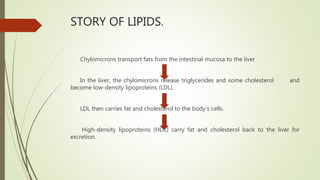
STORY OF LIPIDS.
Chylomicrons transport fats from the intestinal mucosa to the liver
In the liver, the chylomicrons release triglycerides and some cholesterol and
become low-density lipoproteins (LDL).
LDL then carries fat and cholesterol to the body’s cells.
High-density lipoproteins (HDL) carry fat and cholesterol back to the liver for
excretion.
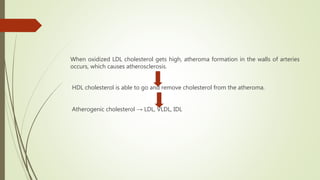
When oxidized LDL cholesterol gets high, atheroma formation in the walls of arteries
occurs, which causes atherosclerosis.
HDL cholesterol is able to go and remove cholesterol from the atheroma.
Atherogenic cholesterol → LDL, VLDL, IDL
CAUSES OF HYPERLIPIDEMIA
 Diet
 Hypothyroidism
 Nephrotic syndrome
 Anorexia nervosa
 Obstructive liver disease
 Obesity
 Diabetes mellitus
 Pregnancy
 Obstructive liver disease
 Acute heaptitis
 Systemic lupus erythematousus
 AIDS (protease inhibitors)
HEREDITARY CAUSES OF HYPERLIPIDEMIA.
 Familial Hypercholesterolemia
Codominant genetic disorder, coccurs in heterozygous form
Occurs in 1 in 500 individuals
Mutation in LDL receptor, resulting in elevated levels of LDL at birth and throughout
life
High risk for atherosclerosis, tendon xanthomas (75% of patients), tuberous
xanthomas and xanthelasmas of eyes.
 Familial Combined Hyperlipidemia
Autosomal dominant
Increased secretions of VLDLs
 Dysbetalipoproteinemia
Affects 1 in 10,000
Results in apo E2, a binding-defective form of apoE (which usually plays important
role in catabolism of chylomicron and VLDL)
Increased risk for atherosclerosis, peripheral vascular disease
Tuberous xanthomas, striae palmaris
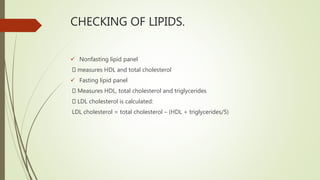
CHECKING OF LIPIDS.
 Nonfasting lipid panel
measures HDL and total cholesterol
 Fasting lipid panel
Measures HDL, total cholesterol and triglycerides
LDL cholesterol is calculated:
LDL cholesterol = total cholesterol – (HDL + triglycerides/5)
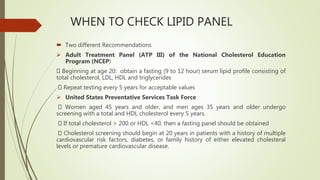
WHEN TO CHECK LIPID PANEL
 Two different Recommendations
 Adult Treatment Panel (ATP III) of the National Cholesterol Education
Program (NCEP)
Beginning at age 20: obtain a fasting (9 to 12 hour) serum lipid profile consisting of
total cholesterol, LDL, HDL and triglycerides
Repeat testing every 5 years for acceptable values
 United States Preventative Services Task Force
Women aged 45 years and older, and men ages 35 years and older undergo
screening with a total and HDL cholesterol every 5 years.
If total cholesterol > 200 or HDL <40, then a fasting panel should be obtained
Cholesterol screening should begin at 20 years in patients with a history of multiple
cardiovascular risk factors, diabetes, or family history of either elevated cholesteral
levels or premature cardiovascular disease.
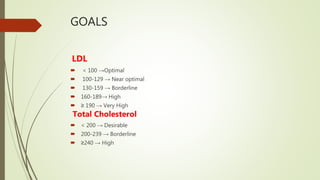
GOALS
LDL
 < 100 →Optimal
 100-129 → Near optimal
 130-159 → Borderline
 160-189→ High
 ≥ 190 → Very High
Total Cholesterol
 < 200 → Desirable
 200-239 → Borderline
 ≥240 → High
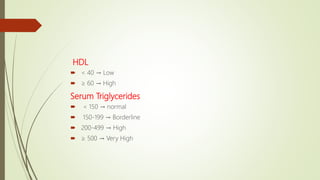
HDL
 < 40 → Low
 ≥ 60 → High
Serum Triglycerides
 < 150 → normal
 150-199 → Borderline
 200-499 → High
 ≥ 500 → Very High
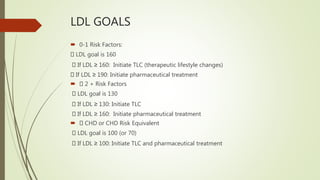
LDL GOALS
 0-1 Risk Factors:
LDL goal is 160
If LDL ≥ 160: Initiate TLC (therapeutic lifestyle changes)
If LDL ≥ 190: Initiate pharmaceutical treatment
 2 + Risk Factors
LDL goal is 130
If LDL ≥ 130: Initiate TLC
If LDL ≥ 160: Initiate pharmaceutical treatment
 CHD or CHD Risk Equivalent
LDL goal is 100 (or 70)
If LDL ≥ 100: Initiate TLC and pharmaceutical treatment
TREATMENT
LIFESTYLE MODIFICATIONS
 Recommended reasonable and feasible approach to fitness therapy: Exercise
programs that include
at least 30 minutes of moderate-intensity physical activity [consuming 4-7 kcal/min]
4 to 6 times weekly,
with an expenditure of at least 200 kcal/day);
suggested activities include brisk walking,
riding a stationary bike,
water aerobics,
cleaning/scrubbing,
mowing the lawn, and sporting activities
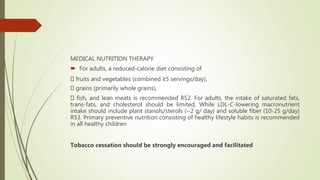
MEDICAL NUTRITION THERAPY
 For adults, a reduced-calorie diet consisting of
fruits and vegetables (combined ≥5 servings/day),
grains (primarily whole grains),
fish, and lean meats is recommended R52. For adults, the intake of saturated fats,
trans-fats, and cholesterol should be limited, While LDL-C-lowering macronutrient
intake should include plant stanols/sterols (~2 g/ day) and soluble fiber (10-25 g/day)
R53. Primary preventive nutrition consisting of healthy lifestyle habits is recommended
in all healthy children
Tobacco cessation should be strongly encouraged and facilitated
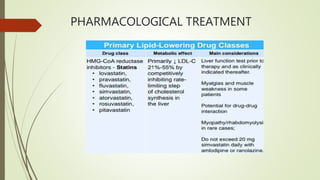
PHARMACOLOGICAL TREATMENT
Other classes are:
Niacin (nicotinic acid)
Bile acid sequestrants (cholestyramine, colestipol, colesevelam hydrochloride)
Microsomal Transfer Triglyceride Protein (MTP) inhibitor
(lomitapide)
Anti-sense Apolipoprotein B oligonucleotide (mipomersen - subQ injection)
Omega-3 fatty acids (icosapent ethyl, omega-3-acid ethyl , esters
STATINS
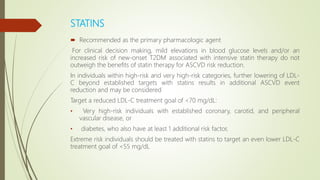
 Recommended as the primary pharmacologic agent
For clinical decision making, mild elevations in blood glucose levels and/or an
increased risk of new-onset T2DM associated with intensive statin therapy do not
outweigh the benefits of statin therapy for ASCVD risk reduction.
In individuals within high-risk and very high-risk categories, further lowering of LDL-
C beyond established targets with statins results in additional ASCVD event
reduction and may be considered
Target a reduced LDL-C treatment goal of <70 mg/dL:
• Very high-risk individuals with established coronary, carotid, and peripheral
vascular disease, or
• diabetes, who also have at least 1 additional risk factor,
Extreme risk individuals should be treated with statins to target an even lower LDL-C
treatment goal of <55 mg/dL
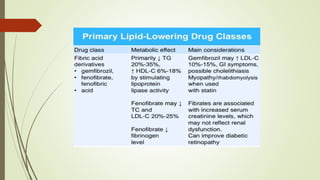
FIBRATES
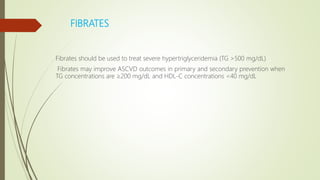
Fibrates should be used to treat severe hypertriglyceridemia (TG >500 mg/dL)
Fibrates may improve ASCVD outcomes in primary and secondary prevention when
TG concentrations are ≥200 mg/dL and HDL-C concentrations <40 mg/dL
OTHER DRUGS
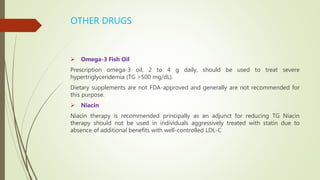
 Omega-3 Fish Oil
Prescription omega-3 oil, 2 to 4 g daily, should be used to treat severe
hypertriglyceridemia (TG >500 mg/dL).
Dietary supplements are not FDA-approved and generally are not recommended for
this purpose.
 Niacin
Niacin therapy is recommended principally as an adjunct for reducing TG Niacin
therapy should not be used in individuals aggressively treated with statin due to
absence of additional benefits with well-controlled LDL-C
 Bile Acid Sequestrants
Bile acid sequestrants may be considered for reducing LDL-C and apo B and
increasing HDL-C, but they may increase TG
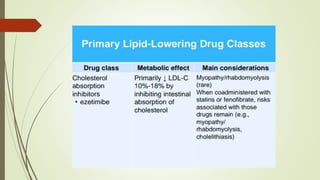
 Cholesterol Absorption Inhibitors
Ezetimibe may be considered as monotherapy in reducing LDL-C and apo B,
in statin-intolerant individuals.
Ezetimibe can be used in combination with statins to further reduce both LDL-C
ASCVD risk
 PCSK9 Inhibitors
Proprotein convertase subtilisin/kexin type 9 (PCSK9) inhibitors should be considered
for use in combination with statin therapy for LDL-C lowering in individuals with FH
R70.
PCSK9 inhibitors should be considered in patients with clinical cardiovascular disease
who are unable to reach LDL-C/non-HDL-C goals with maximally tolerated statin
therapy. They should not be used as monotherapy except in statin intolerant
individuals
COMBINATION THERAPY
Combination therapy of lipid-lowering agents should be considered when the LDL-C
/non HDL-C level is markedly increased and monotherapy (usually with a statin)
not achieve the therapeutic goal
SPECIAL CONSIDERATION: WOMEN
 Women should be evaluated for their ASCVD risk and be treated with
pharmacotherapy if lifestyle intervention is insufficient.
 Hormone replacement therapy for the treatment of dyslipidemia in
postmenopausal women is not recommended
CHILDREN ANS ADOLSCENTS
 Recommended for children and adolescents older than 10 years who do not
respond sufficiently to lifestyle modification, and
Particularly for those satisfying the following criteria
LDL-C ≥190 mg/Dl
LDL-C ≥160 mg/dL and the presence of 2 or more cardiovascular risk factors,
even after vigorous intervention
Family history of premature ASCVD (before 55 years of age),
Having overweight, obesity, or other elements of the insulin resistance syndrome
FOLLOW UP AND MONITORING
 Reassess individuals’ lipid status 6 weeks after therapy initiation and again at 6-
week intervals until the treatment goal is achieved
 While on stable lipid therapy, individuals should be tested at 6- to 12-month
intervals
 While on stable lipid therapy, the specific interval of testing should depend on
individual adherence to therapy and lipid profile consistency; if adherence is a
concern or the lipid profile is unstable, the individual will probably benefit from
more frequent assessment
More frequent lipid status evaluation is recommended in situations such as
deterioration of diabetes control,
use of a new drug known to affect lipid levels,
progression of atherothrombotic disease,
considerable weight gain,
unexpected adverse change in any lipid parameter, development of a new ASCVD
risk factor, or
convincing new clinical trial evidence or guidelines that suggest stricter lipid goals
 Liver transaminase levels should be measured before and 3 months after niacin or
fibric acid treatment initiation because most liver abnormalities occur within 3
months of treatment initiation. Liver transaminase levels should be measured
periodically thereafter (e.g. semiannually or annually)
 Creatine kinase levels should be assessed and the statin discontinued, at least
temporarily, when an individual reports clinically significant myalgias or muscle
weakness on statin therapy
Hyperlipidemia