Presentation on Biosphere & Hydrosphere
SAAD BIN HASAN
Objectives
• To know about Biosphere
• To know about Hydrosphere
Biosphere
• The biosphere is the layer of the planet Earth where life exists.
This layer ranges from heights of up to ten kilometres above sea
level, to depths of the ocean at more than 8 kilometres deep.
• The biosphere is one of the four layers that surround the Earth
along with the lithosphere (rock), hydrosphere (water) and
atmosphere (air) and it is the sum of all the ecosystems.
• The biosphere is unique. So far there has been no existence of
life elsewhere in the universe.
Differentiate Biosphere from other spheres
• lithosphere is (geology) the rigid, mechanically strong, outer
layer of the earth; divided into twelve major plates
while biosphere is the part of the earth and its atmosphere
capable of supporting life.
• Biosphere is a zone on earth in which living beings exist. It has
many ecosystems. All the ecosystems of the earth together make
up the biosphere. It serves as the highest level of organization. It
consists of the life giving areas of Lithosphere , Hydrosphere
and Atmosphere
• As nouns the difference between biosphere and hydrosphere. is
that biosphere is the part of the earth and
its atmosphere capable of supporting life while hydrosphere is
all the waters of the earth, as distinguished from the land and
the gases of the atmosphere.
Interaction Biosphere between other spheres
• Biosphere-Atmosphere Interactions focuses on the sources and
sinks of greenhouse gases (GHGs), air pollutants, particulate
matter, water, and energy between the Earth's surface and the
atmosphere.
• The interaction between biosphere and hydrosphere is
that hydrosphere provides water for the biosphere to function,
grow, and live. Animals (biosphere) drinks water (hydrosphere),
Fish (biosphere) need water (hydrosphere) to live and swim.
Another interaction between biosphere and hydrosphere is the
flood.
• When these animals and plants die, their bodies decompose and
contribute to the lithosphere. The minerals and nutrients, thus
released form a part of lithosphere.
Composition of Biosphere
The structure of Biosphere has three components: Abiotic, Biotic and energy
components.
I. Abiotic Components: It consists of all non-living elements which are
essential for the survival of all living organisms. Mineral nutrients, gases
and water are three basic requirements of organic life.
II. Biotic Components: It includes Plants, animals and human beings to
make biotic components of environment. there are three sub-system:
• Plants: They are primary producers of food through process of photosynthesis.
They are called autotrophs.
• Animals: They are main consumers of plant produce, hence known as
Heterotrophs. They use organic matter produced by plants and transform the food
into energy.
• Micro-organism: They act as decomposers of dead plants and animals.
III. Energy : It is vital component of biosphere which is essential for
reproduction and generation of all biological life on Earth.
Pollution in the Biosphere
There are three main types of pollution: air, water, and land pollution.
• For air pollution it comes in two forms: particles and noxious gasses.
Particles are usually released into the atmosphere by burning fossil fuels
and wood. Noxious gasses consists of carbon dioxide and sulfur dioxide
but may include other harmful chemical vapors. These harmful gasses are
released by factories and unregulated cars. The effect that air pollution has
in our biosphere is evident: the Earths poles are melting which could mean
a rise in sea level, the Earth is warming up due to gasses that trap the Suns
heat, less fresh water will be available, and ecosystems will change causing
species to adapt or else they will become extinct.
• Land pollution is man-made, as it contributes to air and water pollution.
This type of pollution is caused by urban or agricultural runoff which
contaminates the soil. All of it is due to our rapid urbanization.
• As the water mixes with trash it collects pollutants which then will travel to
the sea or a nearby lake.
Elements of Biosphere
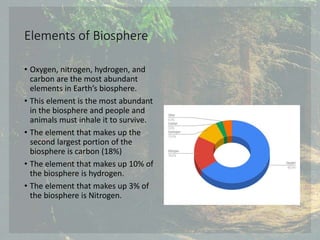
• Oxygen, nitrogen, hydrogen, and
carbon are the most abundant
elements in Earth’s biosphere.
• This element is the most abundant
in the biosphere and people and
animals must inhale it to survive.
• The element that makes up the
second largest portion of the
biosphere is carbon (18%)
• The element that makes up 10% of
the biosphere is hydrogen.
• The element that makes up 3% of
the biosphere is Nitrogen.
Hydrosphere
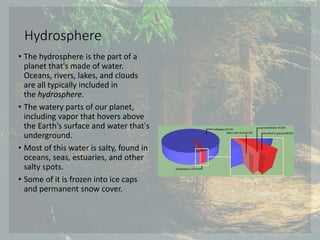
• The hydrosphere is the part of a
planet that's made of water.
Oceans, rivers, lakes, and clouds
are all typically included in
the hydrosphere.
• The watery parts of our planet,
including vapor that hovers above
the Earth's surface and water that's
underground.
• Most of this water is salty, found in
oceans, seas, estuaries, and other
salty spots.
• Some of it is frozen into ice caps
and permanent snow cover.
Differentiate Hydrosphere from other spheres
• The atmosphere, therefore, consists of gases that envelop the
Earth. The hydrosphere defines the water that covers 71% of the
Earth's surface.
• Biosphere is the part of the earth and its atmosphere capable of
supporting life while hydrosphere is all the waters of the earth,
as distinguished from the land and the gases of the atmosphere.
• The hydrosphere defines the water that covers 71% of the
Earth's surface. The lithosphere refers to the rocks of the Earth's
surface and upper mantle, or the depth of the plates.
Interaction Hydrosphere between other spheres
• The winds from the atmosphere affect movement of water, depending on
direction, force and temperature. Water that heats from the sun
evaporates into the atmosphere, where it resides as water vapor. When
cooled, the heavier water molecules release, causing rain, snow, sleet and
other forms of precipitation.
• Hydrosphere provides water for the biosphere to function, grow, and live.
Animals (biosphere) drinks water (hydrosphere), Fish (biosphere) need
water (hydrosphere) to live and swim. Another interaction between
biosphere and hydrosphere is the flood.
• Lithosphere and the hydrosphere have many things in common, but The
first one is they both cause erosion. the wind blows things over to the
ocean and then the waves of the ocean take the objects in to the ocean.
that pollutes the oceans. Another one is they cause earthquakes. the air
gets hot and the land cracks!
Pollution in the Hydrosphere
• The dynamic steady state is being disturbed by the discharge
of toxic chemicals, radioactive substances, and other industrial
wastes and by the seepage of mineral fertilizers, herbicides,
and pesticides into surface and subsurface aquatic systems.
• Inadvertent and deliberate discharge of petroleum, improper
sewage disposal, and thermal pollution also are seriously
affecting the quality of the hydrosphere.
Elements of Hydrosphere
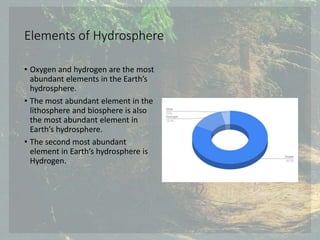
• Oxygen and hydrogen are the most
abundant elements in the Earth’s
hydrosphere.
• The most abundant element in the
lithosphere and biosphere is also
the most abundant element in
Earth’s hydrosphere.
• The second most abundant
element in Earth’s hydrosphere is
Hydrogen.

Biosphere and hydrosphere

  • 1.
    Presentation on Biosphere& Hydrosphere SAAD BIN HASAN
  • 2.
    Objectives • To knowabout Biosphere • To know about Hydrosphere
  • 3.
    Biosphere • The biosphereis the layer of the planet Earth where life exists. This layer ranges from heights of up to ten kilometres above sea level, to depths of the ocean at more than 8 kilometres deep. • The biosphere is one of the four layers that surround the Earth along with the lithosphere (rock), hydrosphere (water) and atmosphere (air) and it is the sum of all the ecosystems. • The biosphere is unique. So far there has been no existence of life elsewhere in the universe.
  • 4.
    Differentiate Biosphere fromother spheres • lithosphere is (geology) the rigid, mechanically strong, outer layer of the earth; divided into twelve major plates while biosphere is the part of the earth and its atmosphere capable of supporting life. • Biosphere is a zone on earth in which living beings exist. It has many ecosystems. All the ecosystems of the earth together make up the biosphere. It serves as the highest level of organization. It consists of the life giving areas of Lithosphere , Hydrosphere and Atmosphere • As nouns the difference between biosphere and hydrosphere. is that biosphere is the part of the earth and its atmosphere capable of supporting life while hydrosphere is all the waters of the earth, as distinguished from the land and the gases of the atmosphere.
  • 5.
    Interaction Biosphere betweenother spheres • Biosphere-Atmosphere Interactions focuses on the sources and sinks of greenhouse gases (GHGs), air pollutants, particulate matter, water, and energy between the Earth's surface and the atmosphere. • The interaction between biosphere and hydrosphere is that hydrosphere provides water for the biosphere to function, grow, and live. Animals (biosphere) drinks water (hydrosphere), Fish (biosphere) need water (hydrosphere) to live and swim. Another interaction between biosphere and hydrosphere is the flood. • When these animals and plants die, their bodies decompose and contribute to the lithosphere. The minerals and nutrients, thus released form a part of lithosphere.
  • 6.
    Composition of Biosphere Thestructure of Biosphere has three components: Abiotic, Biotic and energy components. I. Abiotic Components: It consists of all non-living elements which are essential for the survival of all living organisms. Mineral nutrients, gases and water are three basic requirements of organic life. II. Biotic Components: It includes Plants, animals and human beings to make biotic components of environment. there are three sub-system: • Plants: They are primary producers of food through process of photosynthesis. They are called autotrophs. • Animals: They are main consumers of plant produce, hence known as Heterotrophs. They use organic matter produced by plants and transform the food into energy. • Micro-organism: They act as decomposers of dead plants and animals. III. Energy : It is vital component of biosphere which is essential for reproduction and generation of all biological life on Earth.
  • 7.
    Pollution in theBiosphere There are three main types of pollution: air, water, and land pollution. • For air pollution it comes in two forms: particles and noxious gasses. Particles are usually released into the atmosphere by burning fossil fuels and wood. Noxious gasses consists of carbon dioxide and sulfur dioxide but may include other harmful chemical vapors. These harmful gasses are released by factories and unregulated cars. The effect that air pollution has in our biosphere is evident: the Earths poles are melting which could mean a rise in sea level, the Earth is warming up due to gasses that trap the Suns heat, less fresh water will be available, and ecosystems will change causing species to adapt or else they will become extinct. • Land pollution is man-made, as it contributes to air and water pollution. This type of pollution is caused by urban or agricultural runoff which contaminates the soil. All of it is due to our rapid urbanization. • As the water mixes with trash it collects pollutants which then will travel to the sea or a nearby lake.
  • 8.
    Elements of Biosphere •Oxygen, nitrogen, hydrogen, and carbon are the most abundant elements in Earth’s biosphere. • This element is the most abundant in the biosphere and people and animals must inhale it to survive. • The element that makes up the second largest portion of the biosphere is carbon (18%) • The element that makes up 10% of the biosphere is hydrogen. • The element that makes up 3% of the biosphere is Nitrogen.
  • 9.
    Hydrosphere • The hydrosphereis the part of a planet that's made of water. Oceans, rivers, lakes, and clouds are all typically included in the hydrosphere. • The watery parts of our planet, including vapor that hovers above the Earth's surface and water that's underground. • Most of this water is salty, found in oceans, seas, estuaries, and other salty spots. • Some of it is frozen into ice caps and permanent snow cover.
  • 10.
    Differentiate Hydrosphere fromother spheres • The atmosphere, therefore, consists of gases that envelop the Earth. The hydrosphere defines the water that covers 71% of the Earth's surface. • Biosphere is the part of the earth and its atmosphere capable of supporting life while hydrosphere is all the waters of the earth, as distinguished from the land and the gases of the atmosphere. • The hydrosphere defines the water that covers 71% of the Earth's surface. The lithosphere refers to the rocks of the Earth's surface and upper mantle, or the depth of the plates.
  • 11.
    Interaction Hydrosphere betweenother spheres • The winds from the atmosphere affect movement of water, depending on direction, force and temperature. Water that heats from the sun evaporates into the atmosphere, where it resides as water vapor. When cooled, the heavier water molecules release, causing rain, snow, sleet and other forms of precipitation. • Hydrosphere provides water for the biosphere to function, grow, and live. Animals (biosphere) drinks water (hydrosphere), Fish (biosphere) need water (hydrosphere) to live and swim. Another interaction between biosphere and hydrosphere is the flood. • Lithosphere and the hydrosphere have many things in common, but The first one is they both cause erosion. the wind blows things over to the ocean and then the waves of the ocean take the objects in to the ocean. that pollutes the oceans. Another one is they cause earthquakes. the air gets hot and the land cracks!
  • 12.
    Pollution in theHydrosphere • The dynamic steady state is being disturbed by the discharge of toxic chemicals, radioactive substances, and other industrial wastes and by the seepage of mineral fertilizers, herbicides, and pesticides into surface and subsurface aquatic systems. • Inadvertent and deliberate discharge of petroleum, improper sewage disposal, and thermal pollution also are seriously affecting the quality of the hydrosphere.
  • 13.
    Elements of Hydrosphere •Oxygen and hydrogen are the most abundant elements in the Earth’s hydrosphere. • The most abundant element in the lithosphere and biosphere is also the most abundant element in Earth’s hydrosphere. • The second most abundant element in Earth’s hydrosphere is Hydrogen.