Objective
Here, we are going to learn about
  the following aspects:
• Occurrence of minerals
• Economic importance of
  minerals
• Depletion of minerals
• Need for conservation of
  minerals
• Conservation of minerals
Introduction
We use objects that are made
from minerals every day. We are
actually eating a mineral when
we eat food that contains salt.
We are drinking from a
container made from a mineral
when we drink from a glass.
Women even wear jewelry which
is made of minerals. Scientists
have identified more than 4,000
minerals in Earth's crust. Some
minerals are found in very large
amounts, but most minerals are
found in small amounts.
Mineral- A mineral is a crystalline
 solid formed through natural
 processes. A mineral can be an
 element or a compound, but it has
 a specific chemical composition
 and physical properties that are
 different from those of other
 minerals.
Each one has a different chemical
 composition, as well as different
 physical properties such as
 crystalline structure, hardness,
 density, flammability, and color.
 For example, silver is shiny and
 salt is white.
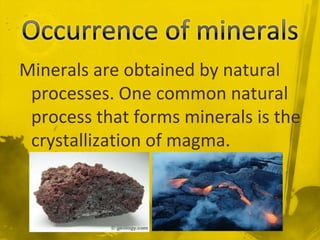
Minerals are obtained by natural
 processes. One common natural
 process that forms minerals is the
 crystallization of magma.
Rocks and minerals are formed in
 sedimentary layers of sand and
 mud and in the folding of those
 layers deep in the Earth, where
 they are exposed to high
 pressures and temperatures.
Economic importance of
minerals
• It provides the base for industrial
  development.
• It provides raw materials for a
  large variety of manufacturing
  industries.
• Mining provides jobs to millions
  of people.
• Transport of minerals to
  refining sites again provides
  more jobs.
• Minerals like iron, steel and lime
  stone are essential for
  development of infrastructural
  facilities.
Depletion of minerals
• The USGS reported in Materials Flow
  and Sustainability (1998) that the number
  of renewable resources are decreasing;
  meanwhile there is an increasing
  demand for nonrenewable resources.
  Since 1900, the use of construction
  materials such as stone, sand, and gravel
  has soared.
• The large-scale exploitation of
  minerals began in the Industrial
  Revolution around 1760 in England
  and has grown rapidly ever since.
  Today’s economy is largely based
  on fossil fuels, minerals and oil.
  The value increases because of the
  large demand, but the supply is
  decreasing.
• The value increases because of
  the large demand, but the supply
  is decreasing. This has resulted
  in more efforts to drill and
  search other territories. The
  environment is being abused and
  this depletion of resources is one
  way of showing the effects.
• Mining still pollutes the
  environment, only on a larger
  scale.
Miners face  many dangers
 while mining. The dangers
 faced by the miners include
 collapsing of mine roofs,
 fires in mines and miners
 getting trapped after the
 mine gets flooded with
 water and so on.
Working in the mines,
 the miners are
 constantly exposed to
 dust and poisonous
 fumes. They become
 vulnerable to a number
 of diseases of the
 lungs.
Mining   also pollutes the
 land where slurry is
 dumped. The slurry
 flowing into neighboring
 streams pollutes the
 water resources. When
 the polluted water is
 used for irrigation, the
 soil gets polluted.
Crops grown on polluted soils
 pass on the pollution to
 humans and animals who
 feed on these crops.
Need for conservation of mineral
resources
 • The total volume of the workable
   mineral deposits is an insignificant
   fraction i.e., one per cent of the
   earth’s crust. We are rapidly
   consuming mineral resources that
   required millions of years to be
   created and concentrated.
• Thegeological processes of
mineral deposits are so slow that
the rates of replenishment are
infinitely small in comparison to
the present rates of consumption.
• Mineralresources need to be
conserved for use by future
generations as they cannot be
renewed. So we have to use them
in a sustainable manner so that
these minerals last for a long
period.
A concerted effort has to be made in
 order to use our mineral resources in
 a planned and sustainable manner.
Recycling of metals, using scrap
 metals and other substitutes.
Improved technologies need to be
 constantly evolved to allow use of
 low grade ores at low costs.
Wastage needs to be minimized
 specially in the areas of mining
 and manufacturing.
Burden on minerals can be
 reduced by substituting them
 with renewable resources.
Minerals play a vital role
 in our everyday life.
 Their occurrence in a
 particular region is a
 great help in industrial
 development of the
 region.
But these are non
renewable resources that
need to be conserved for
the future generations. So
we have to use them in a
very careful manner so that
it lasts for a long time.
Minerals

Minerals

  • 1.
    Objective Here, we aregoing to learn about the following aspects: • Occurrence of minerals • Economic importance of minerals • Depletion of minerals
  • 2.
    • Need forconservation of minerals • Conservation of minerals
  • 3.
    Introduction We use objectsthat are made from minerals every day. We are actually eating a mineral when we eat food that contains salt. We are drinking from a container made from a mineral when we drink from a glass.
  • 4.
    Women even wearjewelry which is made of minerals. Scientists have identified more than 4,000 minerals in Earth's crust. Some minerals are found in very large amounts, but most minerals are found in small amounts.
  • 5.
    Mineral- A mineralis a crystalline solid formed through natural processes. A mineral can be an element or a compound, but it has a specific chemical composition and physical properties that are different from those of other minerals.
  • 7.
    Each one hasa different chemical composition, as well as different physical properties such as crystalline structure, hardness, density, flammability, and color. For example, silver is shiny and salt is white.
  • 8.
    Minerals are obtainedby natural processes. One common natural process that forms minerals is the crystallization of magma.
  • 9.
    Rocks and mineralsare formed in sedimentary layers of sand and mud and in the folding of those layers deep in the Earth, where they are exposed to high pressures and temperatures.
  • 10.
    Economic importance of minerals •It provides the base for industrial development. • It provides raw materials for a large variety of manufacturing industries. • Mining provides jobs to millions of people.
  • 11.
    • Transport ofminerals to refining sites again provides more jobs. • Minerals like iron, steel and lime stone are essential for development of infrastructural facilities.
  • 12.
    Depletion of minerals •The USGS reported in Materials Flow and Sustainability (1998) that the number of renewable resources are decreasing; meanwhile there is an increasing demand for nonrenewable resources. Since 1900, the use of construction materials such as stone, sand, and gravel has soared.
  • 13.
    • The large-scaleexploitation of minerals began in the Industrial Revolution around 1760 in England and has grown rapidly ever since. Today’s economy is largely based on fossil fuels, minerals and oil. The value increases because of the large demand, but the supply is decreasing.
  • 14.
    • The valueincreases because of the large demand, but the supply is decreasing. This has resulted in more efforts to drill and search other territories. The environment is being abused and this depletion of resources is one way of showing the effects.
  • 15.
    • Mining stillpollutes the environment, only on a larger scale.
  • 17.
    Miners face many dangers while mining. The dangers faced by the miners include collapsing of mine roofs, fires in mines and miners getting trapped after the mine gets flooded with water and so on.
  • 18.
    Working in themines, the miners are constantly exposed to dust and poisonous fumes. They become vulnerable to a number of diseases of the lungs.
  • 19.
    Mining also pollutes the land where slurry is dumped. The slurry flowing into neighboring streams pollutes the water resources. When the polluted water is used for irrigation, the soil gets polluted.
  • 20.
    Crops grown onpolluted soils pass on the pollution to humans and animals who feed on these crops.
  • 21.
    Need for conservationof mineral resources • The total volume of the workable mineral deposits is an insignificant fraction i.e., one per cent of the earth’s crust. We are rapidly consuming mineral resources that required millions of years to be created and concentrated.
  • 22.
    • Thegeological processesof mineral deposits are so slow that the rates of replenishment are infinitely small in comparison to the present rates of consumption.
  • 23.
    • Mineralresources needto be conserved for use by future generations as they cannot be renewed. So we have to use them in a sustainable manner so that these minerals last for a long period.
  • 24.
    A concerted efforthas to be made in order to use our mineral resources in a planned and sustainable manner. Recycling of metals, using scrap metals and other substitutes. Improved technologies need to be constantly evolved to allow use of low grade ores at low costs.
  • 26.
    Wastage needs tobe minimized specially in the areas of mining and manufacturing. Burden on minerals can be reduced by substituting them with renewable resources.
  • 27.
    Minerals play avital role in our everyday life. Their occurrence in a particular region is a great help in industrial development of the region.
  • 28.
    But these arenon renewable resources that need to be conserved for the future generations. So we have to use them in a very careful manner so that it lasts for a long time.