Department of WR
WaterInstitute
(WI)
Dar es Salaam, Tanzania
WRUO7212: Hydrological Analysis
and Design
Lecture 6b – Unit Hydrograph
2.
Unit Hydrograph
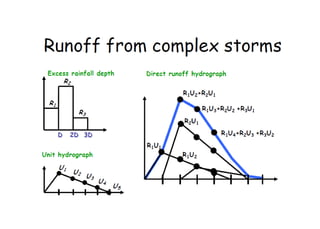
• Thetheory of the unit hydrograph was introduced by Sherman in
1932. The method is based on the assumption that the physical
characteristics within a river basin (such as slope, size, drainage
network, etc.) do not change significantly, and consequently there
should be a great similarity in the shape of the hydrographs resulting
from similar high intensity rainfalls
• The unit hydrograph is defined as the runoff of a catchment
resulting from a unit depth of effective rainfall (e.g. 1 cm) falling
uniformly in space and time during a period T (minute, hour,
day). It should be noted that the intensity of the rainfall during this
period T is equal to 1/T in order to obtain unit depth. The
requirement of an effective precipitation falling uniformly in space
limits the application of the unit hydrograph theory to catchments
smaller than 100 - 500 km2
, since for larger basins the assumption of
a uniform distribution of the rainfall is hardly ever valid.
3.
Unit Hydrograph
• EffectiveRainfall is that part of rainfall that becomes prompt surface
runoff i.e. The portion of rainfall that reaches a river.
• The other part of rainfall contributes to initial losses such as soil
moisture deficit, interception, evaporation, depression storage, etc.
• The portion of effective rainfall increases and that of lost rainfall
decreases with increasing rainfall duration
• The purpose of establishing a Unit Hydrograph which establishes a
rainfall-runoff relationships for a given basin is
to give a quick prediction of expected flows from a storm that has
already occurred.
to predict future floods from data of probabilities of rainfall.
4.
Unit Hydrograph
• Thespecific period of time for the excess rainfall T is
known as the ‘unit storm period’.
• For small to medium sized drainage basins there is a
certain unit storm period for which the shape of the
hydrograph is not significantly affected by changes in the
time distribution of the excess rainfall over this unit storm
period
• This means that equal depths of excess rainfall with
different time-intensity patterns produce hydrographs of
direct runoff which are the same when the duration of this
excess rainfall is equal to or shorter than the unit storm
period.
5.
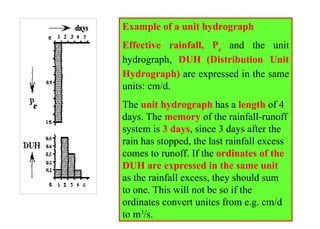
Example of aunit hydrograph
Effective rainfall, Pe
and the unit
hydrograph, DUH (Distribution Unit
Hydrograph) are expressed in the same
units: cm/d.
The unit hydrograph has a length of 4
days. The memory of the rainfall-runoff
system is 3 days, since 3 days after the
rain has stopped, the last rainfall excess
comes to runoff. If the ordinates of the
DUH are expressed in the same unit
as the rainfall excess, they should sum
to one. This will not be so if the
ordinates convert unites from e.g. cm/d
to m3
/s.
• Assumption 1:
Assumption1: The excess rainfall has a constant intensity
constant intensity
within the effective duration
effective duration
– the storms selected for analysis should be of short duration, since
these will most likely produce an intense and nearly constant
excess rainfall rate, yielding a well-defined single-peaked
hydrograph of short time base
• Assumption 2:
Assumption 2: The excess rainfall is uniformly distributed
uniformly distributed
throughout the drainage area
– the unit hydrograph may become inapplicable when the
drainage area is too large to be covered by a nearly uniform
distribution of rainfall
7
Unit Hydrograph
Assumptions
Assumptions
8.
• Assumption 3:
Assumption3: The base time
base time of the DRH (the duration of
direct runoff) resulting from an excess rainfall of given
duration is constant
is constant
– the base time of DRH is generally uncertain but depends on the
method of baseflow separation . The base time is usually short if
the direct runoff is considered to include the surface runoff only
and long if the direct runoff also includes subsurface runoff.
8
Unit Hydrograph
Assumptions…
Assumptions…
9.
• Assumption 4:
Assumption4: The ordinates of all DRH’s of a common
base time are directly proportional to the total amount of
direct runoff represented by each hydrograph
– the principles of superposition
superposition and proportionality
proportionality are assumed so
that the ordinates Qn of the DRH may be computed by discrete
convolution equation.
• Principle of Proportionality:
Principle of Proportionality: If a solution f(Q) is multiplied by a
constant c, the resulting cf(Q) is also a solution
• Principle of Additivity or Superposition:
Principle of Additivity or Superposition: If two solutions f1(Q) and
f2(Q) of the equation are added, the resulting function f (Q) =
f1(Q)+f2(Q) is also a solution of the equation
9
Unit Hydrograph
Assumptions…
Assumptions…
10.
• Assumption 5:
Assumption5: For a given watershed, the hydrograph
resulting from a given excess rainfall reflects the
unchanging characteristics of the watershed
– the unit hydrograph is considered unique
unique for a given watershed
and invariable
invariable with respect to time (principle of time invariance
principle of time invariance)
– This principles of time invariant, superposition and proportionality
are fundamental to the unit hydrograph model
– Unit hydrographs are applicable only when channel conditions
remain unchanged and watersheds do not have appreciable
storage
• This condition is violated when the drainage area contains
reservoirs or when floods overflow into the floodplain thereby
producing considerable storage
Unit Hydrograph
Assumptions…
Assumptions…
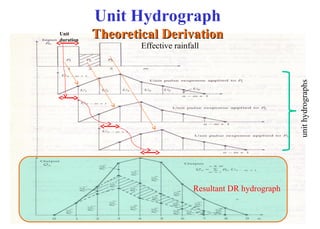
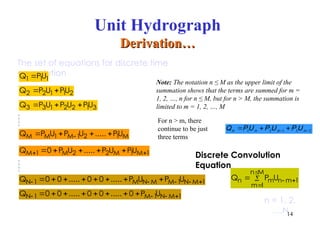
The set ofequations for discrete time
convolution
n M
n m n m 1
m 1
Q P U
1 1 1
Q PU
2 2 1 1 2
Q P U PU
3 3 1 2 2 1 3
Q P U P U PU
M M 1 M 1 2 1 M
Q P U P U ..... PU
M 1 M 2 2 M 1 M 1
Q 0 P U ..... P U PU
N 1 M N M M 1 N M 1
Q 0 0 ..... 0 0 ..... P U P U
N 1 M 1 N M 1
Q 0 0 ..... 0 0 ..... 0 P U
n = 1, 2,
…,N
2
3
1
2
1
n
n
n
n U
P
U
P
U
P
Q
For n > m, there
continue to be just
three terms
Note: The notation n ≤ M as the upper limit of the
summation shows that the terms are summed for m =
1, 2, …, n for n ≤ M, but for n > M, the summation is
limited to m = 1, 2, …, M
14
Unit Hydrograph
Derivation…
Derivation…
Discrete Convolution
Equation
15.
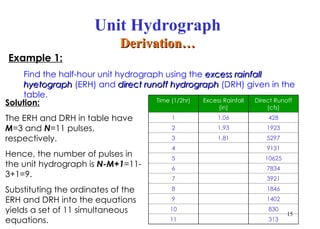
Example 1:
Find thehalf-hour unit hydrograph using the excess rainfall
excess rainfall
hyetograph
hyetograph (ERH) and direct runoff hydrograph
direct runoff hydrograph (DRH) given in the
table.
Solution:
The ERH and DRH in table have
M=3 and N=11 pulses,
respectively.
Hence, the number of pulses in
the unit hydrograph is N-M+1=11-
3+1=9.
Substituting the ordinates of the
ERH and DRH into the equations
yields a set of 11 simultaneous
equations.
Time (1/2hr) Excess Rainfall
(in)
Direct Runoff
(cfs)
1 1.06 428
2 1.93 1923
3 1.81 5297
4 9131
5 10625
6 7834
7 3921
8 1846
9 1402
10 830
11 313
15
Unit Hydrograph
Derivation…
Derivation…
16.
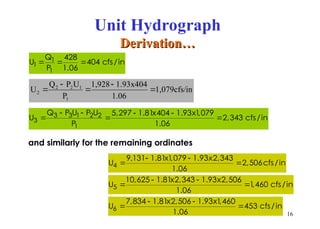
1
1
1
Q428
U 404 cfs/in
P 1.06
3 3 1 2 2
3
1
Q P U P U 5,297 1.81x404 1.93x1
,079
U 2,343 cfs/in
P 1.06
and similarly for the remaining ordinates
4
9,131 1.81x1
,079 1.93x2,343
U 2,506cfs/in
1.06
5
10,625 1.81x2,343 1.93x2,506
U 1
,460 cfs/in
1.06
6
7,834 1.81x2,506 1.93x1
,460
U 453 cfs/in
1.06
n
1,079cfs/i
1.06
1.93x404
1,928
P
U
P
Q
U
1
1
2
2
2
16
Unit Hydrograph
Derivation…
Derivation…
17.
n 1 23 4 5 6 7 8 9
Un (cfs/in) 404 1,079 2,343 2,506 1,460 453 381 274 173
7
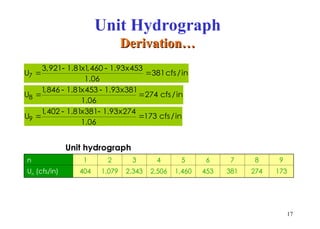
3,921 1.81x1
,460 1.93x453
U 381cfs/in
1.06
8
1
,846 1.81x453 1.93x381
U 274 cfs/in
1.06
9
1
,402 1.81x381 1.93x274
U 173 cfs/in
1.06
Unit hydrograph
17
Unit Hydrograph
Derivation…
Derivation…
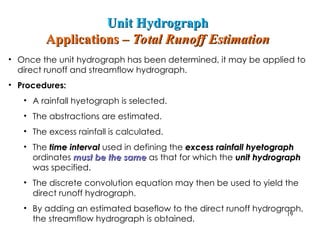
• Once theunit hydrograph has been determined, it may be applied to
direct runoff and streamflow hydrograph.
• Procedures:
• A rainfall hyetograph is selected.
• The abstractions are estimated.
• The excess rainfall is calculated.
• The time interval
time interval used in defining the excess rainfall hyetograph
excess rainfall hyetograph
ordinates must be the same
must be the same as that for which the unit hydrograph
unit hydrograph
was specified.
• The discrete convolution equation may then be used to yield the
direct runoff hydrograph.
• By adding an estimated baseflow to the direct runoff hydrograph,
the streamflow hydrograph is obtained.
19
Unit Hydrograph
Unit Hydrograph
Applications –
Applications – Total Runoff Estimation
Total Runoff Estimation
20.
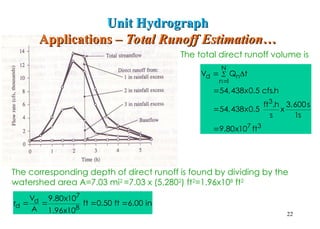
Example 2:
Example 2:
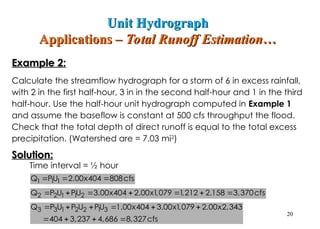
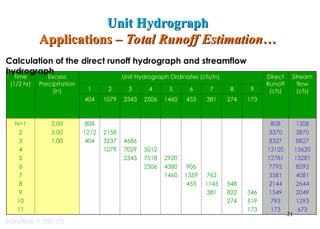
Calculatethe streamflow hydrograph for a storm of 6 in excess rainfall,
with 2 in the first half-hour, 3 in in the second half-hour and 1 in the third
half-hour. Use the half-hour unit hydrograph computed in Example 1
and assume the baseflow is constant at 500 cfs throughput the flood.
Check that the total depth of direct runoff is equal to the total excess
precipitation. (Watershed are = 7.03 mi2
)
1 1 1
Q PU 2.00x404 808cfs
2 2 1 1 2
Q P U PU 3.00x404 2.00x1
,079 1
,212 2,158 3,370cfs
3 3 1 2 2 1 3
Q P U P U PU 1.00x404 3.00x1
,079 2.00x2,343
404 3,237 4,686 8,327cfs
Solution:
Solution:
20
Time interval = ½ hour
Unit Hydrograph
Unit Hydrograph
Applications –
Applications – Total Runoff Estimation…
Total Runoff Estimation…
The total directrunoff volume is
N
d n
n 1
3
7 3
V Q t
54,438x0.5 cfs.h
ft .h 3,600s
54,438x0.5 x
s 1s
9.80x10 ft
The corresponding depth of direct runoff is found by dividing by the
watershed area A=7.03 mi2
=7.03 x (5,2802
) ft2
=1.96x10⁸
ft2
7
d
d 8
V 9.80x10
r ft 0.50 ft 6.00 in
A 1.96x10 22
Unit Hydrograph
Unit Hydrograph
Applications –
Applications – Total Runoff Estimation…
Total Runoff Estimation…
23.
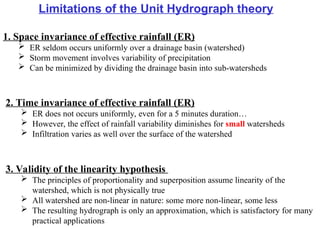
Limitations of theUnit Hydrograph theory
1. Space invariance of effective rainfall (ER)
ER seldom occurs uniformly over a drainage basin (watershed)
Storm movement involves variability of precipitation
Can be minimized by dividing the drainage basin into sub-watersheds
2. Time invariance of effective rainfall (ER)
ER does not occurs uniformly, even for a 5 minutes duration…
However, the effect of rainfall variability diminishes for small watersheds
Infiltration varies as well over the surface of the watershed
3. Validity of the linearity hypothesis
The principles of proportionality and superposition assume linearity of the
watershed, which is not physically true
All watershed are non-linear in nature: some more non-linear, some less
The resulting hydrograph is only an approximation, which is satisfactory for many
practical applications