Water Resource Engineering
K D MANWAR
Department of Civil Engineering
MPGISOE,
Nanded , Maharashtra.
Reservoir sedimentation
 It is a difficult problem for which an economical solution has discovered, except by
providing a “dead storage” to accommodate the deposits during the life of the dam.
 Disintegration, erosion, transportation and sedimentation are the different stages
leading to silting of reservoir.
 All the river carry certain amount of silt eroded from the catchment area during heavy
rain. The extent of erosion, and hence the silt load in the stream depends upon the
following factors :
1. Nature of soil of the catchment area
2. Topography of the catchment area
3. Vegetation cover
4. Intensity of rainfall
 The nature of the soil of the catchment area is an important factor. If the soil is soft,
there is always a possibility of sheet erosion. The tributaries collecting water of the
catchment area containing hard soil carry lesser silt. Steep slopes give rise to high
velocities and erode the surface soil easily. Similarly higher intensity of rainfall causes
greater run-off and more erosion. If the catchment area has sufficient vegetation
cover the higher velocity are checked and erosion is very much reduced. Area having
poor or practically no vegetal cover are productive of more silt. The rivers or
tributaries passing through such area carry more silt load with it, causing quick silting
of the reservoir.
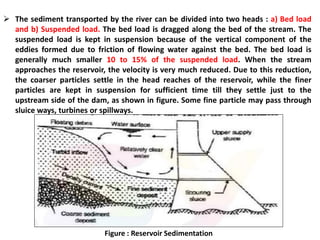
 The sediment transported by the river can be divided into two heads : a) Bed load
and b) Suspended load. The bed load is dragged along the bed of the stream. The
suspended load is kept in suspension because of the vertical component of the
eddies formed due to friction of flowing water against the bed. The bed load is
generally much smaller 10 to 15% of the suspended load. When the stream
approaches the reservoir, the velocity is very much reduced. Due to this reduction,
the coarser particles settle in the head reaches of the reservoir, while the finer
particles are kept in suspension for sufficient time till they settle just to the
upstream side of the dam, as shown in figure. Some fine particle may pass through
sluice ways, turbines or spillways.
Figure : Reservoir Sedimentation
Density Currents : density current may be defined as a gravity flow of fluid under
another fluid of approximately equal density. In case of reservoirs the water stored is
usually clear and the heavy turbid water flows along the channel bottom towards
the dam under the influence of gravity as shown in figure. This is known as density
current. The rate of silting in case of reservoirs reduces if the density currents are
vented by proper location and operation of outlet and sluice gate.
Measurement of sediment load : the amount of silt or the sediment load carried by a
stream is determined by taking the samples of water carrying silt, at various depths.
The sample are then filtered and the sediment is removed and dried. The sediment
load measured in the units of parts per millions part of water (ppm). There are no
accurate devices to measure the bed load, which is estimated to about 15% of the
suspended load.
Life of reservoir : the ultimate density of a reservoir is to be filled with silt deposits.
To allow for silting , a certain percentage of the total storage is usually left unutilized,
and is called ‘dead storage.’ However, as the time passes on, more and more silting
takes place and the ‘live’ or ‘effective storage’ is gradually reduced. The useful life of
reservoir is terminated when its capacity is reduced to 20% of the designed capacity.
The reservoir planning must, therefore, include the consideration of probable rate of
silting so that the useful life of the reservoir may be determined.
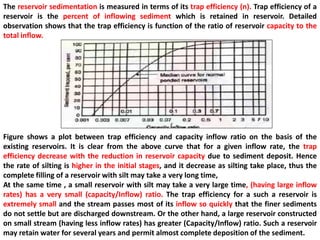
The reservoir sedimentation is measured in terms of its trap efficiency (n). Trap efficiency of a
reservoir is the percent of inflowing sediment which is retained in reservoir. Detailed
observation shows that the trap efficiency is function of the ratio of reservoir capacity to the
total inflow.
Figure shows a plot between trap efficiency and capacity inflow ratio on the basis of the
existing reservoirs. It is clear from the above curve that for a given inflow rate, the trap
efficiency decrease with the reduction in reservoir capacity due to sediment deposit. Hence
the rate of silting is higher in the initial stages, and it decrease as silting take place, thus the
complete filling of a reservoir with silt may take a very long time,
At the same time , a small reservoir with silt may take a very large time, (having large inflow
rates) has a very small (capacity/Inflow) ratio. The trap efficiency for a such a reservoir is
extremely small and the stream passes most of its inflow so quickly that the finer sediments
do not settle but are discharged downstream. Or the other hand, a large reservoir constructed
on small stream (having less inflow rates) has greater (Capacity/Inflow) ratio. Such a reservoir
may retain water for several years and permit almost complete deposition of the sediment.
Procedure for calculation reservoir life
1. Knowing the inflow rate calculate the (capacity/inflow)
ratio and obtain the trap efficiency from the curve.
• Trap Efficiency : The reservoir sedimentation is measured in
terms of its trap efficiency (n), Trap efficiency of a reservoir is
the percent of inflowing sediment which is retained in
reservoir.
n = f(capacity/inflow)
2. Divide the total capacity into any suitable interval, say
10%. Assuming the 10% capacity has been reduced due
to sediment deposit, find the trap efficiency for reduced
capacity (i.e. 90% of the original) and the inflow ratio
3. For this interval of 10% capacity, find the average trap
efficiency by taking average if n found in step 2 and 3.
4. Determine the sediment inflow rate by taking water
sample and drying the sediment.
Procedure for calculation reservoir life
5. Multiply the total annual sediment transported by
the trap efficiency found in step 3.
6. Divide the volume interval by the sediment
deposited to get the number of years to fill this
volume interval of 10% capacity.
7. Repeat the procedure for further intervals of the
capacity.
8. The total life of the reservoir will be equal to the
total number of year required to fill each of the
volume intervals.
Causes of sedimentation
1. Nature of soil in catchment area
2. Topography of the catchment area
3. Cultivation in catchment area
4. Vegetation cover in catchment area
5. Intensity of rainfall in catchment area
Sediment management
• Maximum efforts should water should be
released so that less sediments should retain in
reservoir.
• Following option are:
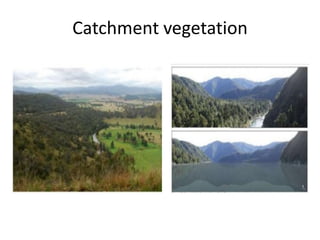
1. Catchment vegetation
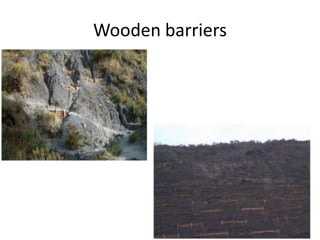
2. Construction of coffer dam (a watertight enclosure
pumped dry to permit construction work below the
waterline/ low height barriers)
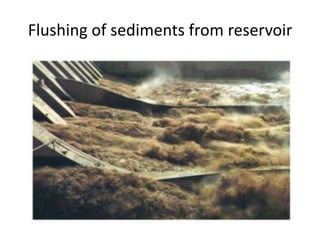
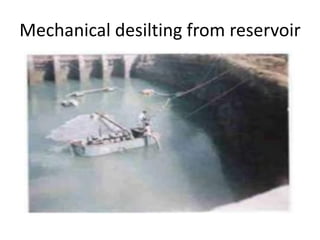
3. Flushing and desilting of sediments
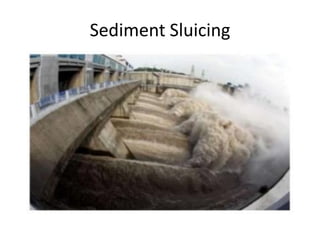
4. Low level outlets/ sediment sluicing (sliding gate)
Catchment vegetation
Wooden barriers
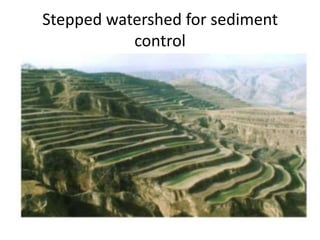
Stepped watershed for sediment
control
Flushing of sediments from reservoir
Mechanical desilting from reservoir
Sediment Sluicing
RESERVOIR SEDIMENTATION

RESERVOIR SEDIMENTATION

  • 1.
    Water Resource Engineering KD MANWAR Department of Civil Engineering MPGISOE, Nanded , Maharashtra.
  • 2.
    Reservoir sedimentation  Itis a difficult problem for which an economical solution has discovered, except by providing a “dead storage” to accommodate the deposits during the life of the dam.  Disintegration, erosion, transportation and sedimentation are the different stages leading to silting of reservoir.  All the river carry certain amount of silt eroded from the catchment area during heavy rain. The extent of erosion, and hence the silt load in the stream depends upon the following factors : 1. Nature of soil of the catchment area 2. Topography of the catchment area 3. Vegetation cover 4. Intensity of rainfall  The nature of the soil of the catchment area is an important factor. If the soil is soft, there is always a possibility of sheet erosion. The tributaries collecting water of the catchment area containing hard soil carry lesser silt. Steep slopes give rise to high velocities and erode the surface soil easily. Similarly higher intensity of rainfall causes greater run-off and more erosion. If the catchment area has sufficient vegetation cover the higher velocity are checked and erosion is very much reduced. Area having poor or practically no vegetal cover are productive of more silt. The rivers or tributaries passing through such area carry more silt load with it, causing quick silting of the reservoir.
  • 3.
     The sedimenttransported by the river can be divided into two heads : a) Bed load and b) Suspended load. The bed load is dragged along the bed of the stream. The suspended load is kept in suspension because of the vertical component of the eddies formed due to friction of flowing water against the bed. The bed load is generally much smaller 10 to 15% of the suspended load. When the stream approaches the reservoir, the velocity is very much reduced. Due to this reduction, the coarser particles settle in the head reaches of the reservoir, while the finer particles are kept in suspension for sufficient time till they settle just to the upstream side of the dam, as shown in figure. Some fine particle may pass through sluice ways, turbines or spillways. Figure : Reservoir Sedimentation
  • 4.
    Density Currents :density current may be defined as a gravity flow of fluid under another fluid of approximately equal density. In case of reservoirs the water stored is usually clear and the heavy turbid water flows along the channel bottom towards the dam under the influence of gravity as shown in figure. This is known as density current. The rate of silting in case of reservoirs reduces if the density currents are vented by proper location and operation of outlet and sluice gate. Measurement of sediment load : the amount of silt or the sediment load carried by a stream is determined by taking the samples of water carrying silt, at various depths. The sample are then filtered and the sediment is removed and dried. The sediment load measured in the units of parts per millions part of water (ppm). There are no accurate devices to measure the bed load, which is estimated to about 15% of the suspended load. Life of reservoir : the ultimate density of a reservoir is to be filled with silt deposits. To allow for silting , a certain percentage of the total storage is usually left unutilized, and is called ‘dead storage.’ However, as the time passes on, more and more silting takes place and the ‘live’ or ‘effective storage’ is gradually reduced. The useful life of reservoir is terminated when its capacity is reduced to 20% of the designed capacity. The reservoir planning must, therefore, include the consideration of probable rate of silting so that the useful life of the reservoir may be determined.
  • 5.
    The reservoir sedimentationis measured in terms of its trap efficiency (n). Trap efficiency of a reservoir is the percent of inflowing sediment which is retained in reservoir. Detailed observation shows that the trap efficiency is function of the ratio of reservoir capacity to the total inflow. Figure shows a plot between trap efficiency and capacity inflow ratio on the basis of the existing reservoirs. It is clear from the above curve that for a given inflow rate, the trap efficiency decrease with the reduction in reservoir capacity due to sediment deposit. Hence the rate of silting is higher in the initial stages, and it decrease as silting take place, thus the complete filling of a reservoir with silt may take a very long time, At the same time , a small reservoir with silt may take a very large time, (having large inflow rates) has a very small (capacity/Inflow) ratio. The trap efficiency for a such a reservoir is extremely small and the stream passes most of its inflow so quickly that the finer sediments do not settle but are discharged downstream. Or the other hand, a large reservoir constructed on small stream (having less inflow rates) has greater (Capacity/Inflow) ratio. Such a reservoir may retain water for several years and permit almost complete deposition of the sediment.
  • 6.
    Procedure for calculationreservoir life 1. Knowing the inflow rate calculate the (capacity/inflow) ratio and obtain the trap efficiency from the curve. • Trap Efficiency : The reservoir sedimentation is measured in terms of its trap efficiency (n), Trap efficiency of a reservoir is the percent of inflowing sediment which is retained in reservoir. n = f(capacity/inflow) 2. Divide the total capacity into any suitable interval, say 10%. Assuming the 10% capacity has been reduced due to sediment deposit, find the trap efficiency for reduced capacity (i.e. 90% of the original) and the inflow ratio 3. For this interval of 10% capacity, find the average trap efficiency by taking average if n found in step 2 and 3. 4. Determine the sediment inflow rate by taking water sample and drying the sediment.
  • 7.
    Procedure for calculationreservoir life 5. Multiply the total annual sediment transported by the trap efficiency found in step 3. 6. Divide the volume interval by the sediment deposited to get the number of years to fill this volume interval of 10% capacity. 7. Repeat the procedure for further intervals of the capacity. 8. The total life of the reservoir will be equal to the total number of year required to fill each of the volume intervals.
  • 8.
    Causes of sedimentation 1.Nature of soil in catchment area 2. Topography of the catchment area 3. Cultivation in catchment area 4. Vegetation cover in catchment area 5. Intensity of rainfall in catchment area
  • 9.
    Sediment management • Maximumefforts should water should be released so that less sediments should retain in reservoir. • Following option are: 1. Catchment vegetation 2. Construction of coffer dam (a watertight enclosure pumped dry to permit construction work below the waterline/ low height barriers) 3. Flushing and desilting of sediments 4. Low level outlets/ sediment sluicing (sliding gate)
  • 10.
  • 11.
  • 12.
    Stepped watershed forsediment control
  • 13.
    Flushing of sedimentsfrom reservoir
  • 14.
  • 15.