HVAC FORMULAS


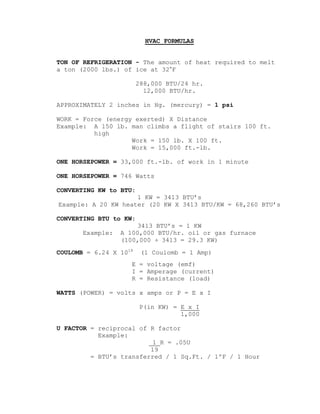
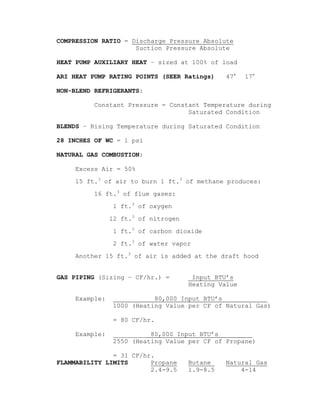
TON OF REFRIGERATION - The amount of heat required to melt
a ton (2000 lbs.) of ice at 32°F

                        288,000 BTU/24 hr.
                          12,000 BTU/hr.

APPROXIMATELY 2 inches in Hg. (mercury) = 1 psi

WORK = Force (energy exerted) X Distance
Example: A 150 lb. man climbs a flight of stairs 100 ft.
          high
                    Work = 150 lb. X 100 ft.
                    Work = 15,000 ft.-lb.

ONE HORSEPOWER = 33,000 ft.-lb. of work in 1 minute

ONE HORSEPOWER = 746 Watts

CONVERTING KW to BTU:
                     1 KW = 3413 BTU’s
Example: A 20 KW heater (20 KW X 3413 BTU/KW = 68,260 BTU’s

CONVERTING BTU to KW:
                       3413 BTU’s = 1 KW
       Example:   A 100,000 BTU/hr. oil or gas furnace
                  (100,000 ÷ 3413 = 29.3 KW)
COULOMB = 6.24 X 10¹⁸    (1 Coulomb = 1 Amp)
                     E = voltage (emf)
                     I = Amperage (current)
                     R = Resistance (load)

WATTS (POWER) = volts x amps or P = E x I

                        P(in KW) = E x I
                                   1,000

U FACTOR = reciprocal of R factor
           Example:
                          1 R = .05U
                         19
         = BTU’s transferred / 1 Sq.Ft. / 1ºF / 1 Hour
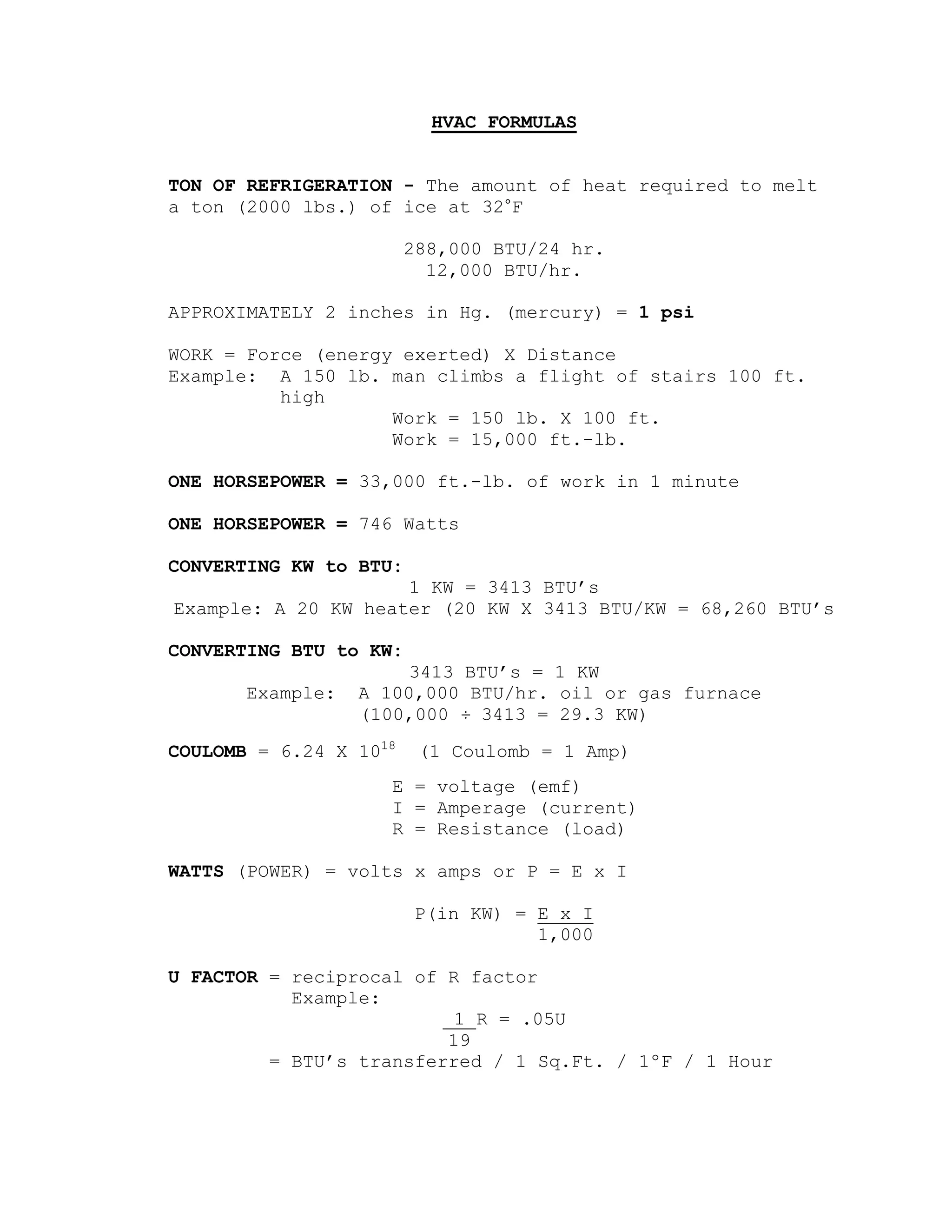
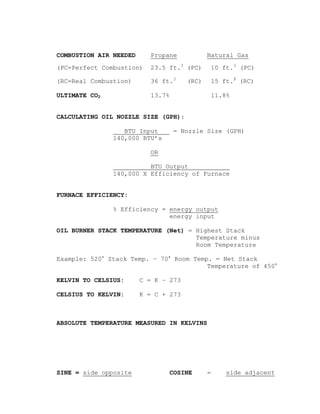
VA (how the secondary of a transformer is rated) =      volts X amps


     Example:            24V x .41A = 10 VA

ONE FARAD CAPACITY = 1 amp. stored under 1 volt of pressure

MFD (microfarad) =           1     Farad
                         1,000,000

LRA (Locked rotor amps) = FLA (Full Load Amps)
 5

                            LRA = FLA x 5

TXV (shown in equilibrium)

                      46.7            Bulb Pressure
                 _______________
 Spring
Pressure           9.7        37      Evaporator Pressure


               Bulb Pressure = opening force
     Spring and Evaporator Pressures = closing forces

RPM of motor =       60Hz x 120_
                    No. of Poles

          1800 RPM Motor – slippage makes it about 1750
          3600 RPM Motor – slippage makes it about 3450

DRY AIR     =    78.0% Nitrogen
                 21.0% Oxygen
                  1.0% Other Gases

WET AIR     =    Same as dry air plus water vapor

SPECIFIC DENSITY =              1_______
                         Specific Volume

SPECIFIC DENSITY OF AIR = __1__ = .075 lbs./cu.ft.
                          13.33

STANDARD AIR = .24 Specific Heat (BTU’s needed
                to raise 1 lb. 1 degree)
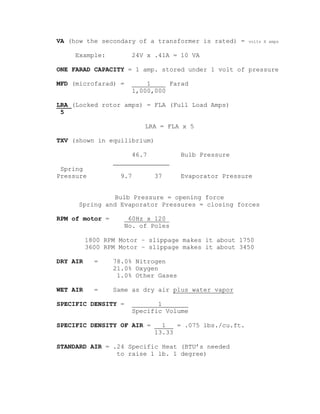
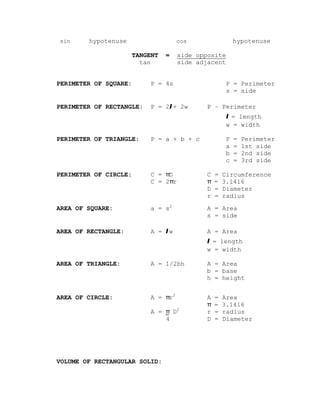
SENSIBLE HEAT FORMULA (Furnaces):

BTU/hr. – Specific Heat X Specific Density X 60 min./hr. =
           X CFM X ∆T

          .24 X .075 X 60 X CFM X ∆T = 1.08 X CFM X ∆T

ENTHALPHY = Sensible heat and Latent heat

TOTAL HEAT FORMULA
(for cooling, humidifying or dehumidifying)

    BTU/hr. = Specific Density X 60 min./hr. X CFM X ∆H

                    = 0.75 x 60 x CFM x ∆H

                        = 4.5 x CFM x ∆H

        RELATIVE HUMIDITY =    __Moisture present___
                               Moisture air can hold

SPECIFIC HUMIDITY = grains of moisture per dry air

                 7000 GRAINS in 1 lb. of water

DEW POINT = when wet bulb equals dry bulb

TOTAL PRESSURE (Ductwork) = Static Pressure plus
                            Velocity Pressure

CFM = Area (sq. ft.) X Velocity (ft. min.)

HOW TO CALCULATE AREA

     Rectangular Duct          Round Duct

     A = L x W                 A =   πD2__   OR   πr2
                                     4

RETURN AIR GRILLES – Net free area = about 75%

3 PHASE VOLTAGE UNBALANCE =

           100 x maximum deg. from average volts
                         Average Volts
NET OIL PRESSURE = Gross Oil Pressure – Suction Pressure
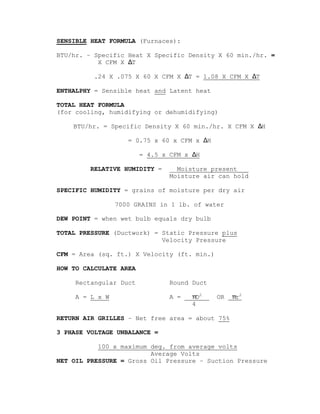
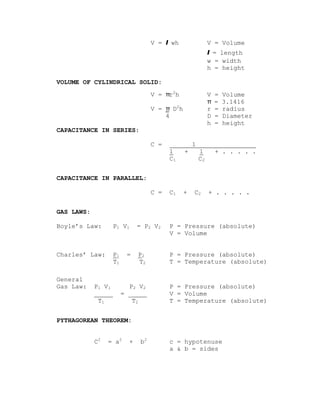
COMPRESSION RATIO = Discharge Pressure Absolute
                     Suction Pressure Absolute

HEAT PUMP AUXILIARY HEAT – sized at 100% of load

ARI HEAT PUMP RATING POINTS (SEER Ratings)      47°   17°

NON-BLEND REFRIGERANTS:

          Constant Pressure = Constant Temperature during
                                   Saturated Condition

BLENDS – Rising Temperature during Saturated Condition

28 INCHES OF WC = 1 psi

NATURAL GAS COMBUSTION:

     Excess Air = 50%
     15 ft.3 of air to burn 1 ft.3 of methane produces:
          16 ft.3 of flue gases:
                 1 ft.3 of oxygen
                12 ft.3 of nitrogen

                 1 ft.3 of carbon dioxide
                 2 ft.3 of water vapor
     Another 15 ft.3 of air is added at the draft hood


GAS PIPING (Sizing – CF/hr.) =         Input BTU’s
                                      Heating Value

     Example:     ___       80,000 Input BTU’s____________
                 1000 (Heating Value per CF of Natural Gas)

                 = 80 CF/hr.

     Example:    _________ 80,000 Input BTU’s_________
                 2550 (Heating Value per CF of Propane)

               = 31 CF/hr.
FLAMMABILITY LIMITS      Propane      Butane_   Natural Gas
                         2.4-9.5      1.9-8.5       4-14
COMBUSTION AIR NEEDED     Propane            Natural Gas
(PC=Perfect Combustion)   23.5 ft.3 (PC)      10 ft.3 (PC)

(RC=Real Combustion)      36 ft.3     (RC)    15 ft.3 (RC)

ULTIMATE CO2              13.7%               11.8%


CALCULATING OIL NOZZLE SIZE (GPH):

                 _BTU Input___ = Nozzle Size (GPH)
               140,000 BTU’s

                          OR

               _______   BTU Output___________
               140,000 X Efficiency of Furnace


FURNACE EFFICIENCY:

               % Efficiency = energy output
                              energy input

OIL BURNER STACK TEMPERATURE (Net) = Highest Stack
                                     Temperature minus
                                     Room Temperature

Example: 520° Stack Temp. – 70° Room Temp. = Net Stack
                                         Temperature of 450°

KELVIN TO CELSIUS:      C = K – 273

CELSIUS TO KELVIN:      K = C + 273


ABSOLUTE TEMPERATURE MEASURED IN KELVINS


SINE = side opposite              COSINE     =    side adjacent
sin     hypotenuse                    cos                 hypotenuse

                       TANGENT   =    side opposite
                         tan          side adjacent


PERIMETER OF SQUARE:        P = 4s                    P = Perimeter
                                                      s = side

PERIMETER OF RECTANGLE:     P = 2l + 2w      P – Perimeter
                                                      l = length
                                                      w = width

PERIMETER OF TRIANGLE:      P = a + b + c             P   =   Perimeter
                                                      a   =   1st side
                                                      b   =   2nd side
                                                      c   =   3rd side

PERIMETER OF CIRCLE:        C = πD           C   =   Circumference
                            C = 2πr          π   =   3.1416
                                             D   =   Diameter
                                             r   =   radius
AREA OF SQUARE:             a = s2           A = Area
                                             s = side

AREA OF RECTANGLE:          A = lw           A = Area
                                             l = length
                                             w = width

AREA OF TRIANGLE:           A = 1/2bh        A = Area
                                             b = base
                                             h = height


AREA OF CIRCLE:             A = πr2          A   =   Area
                                             π   =   3.1416
                            A = π D2         r   =   radius
                                4            D   =   Diameter


VOLUME OF RECTANGULAR SOLID:
V = l wh             V = Volume
                                                           l = length
                                                           w = width
                                                           h = height

VOLUME OF CYLINDRICAL SOLID:
                                      V = πr2h             V   =   Volume
                                                           π   =   3.1416
                                      V = π D2h            r   =   radius
                                          4                D   =   Diameter
                                                           h   =   height
CAPACITANCE IN SERIES:

                                      C =   ______1________________
                                            1   +   1   + . . . . .
                                            C1      C2


CAPACITANCE IN PARALLEL:

                                      C =   C1    +   C2   + . . . . .


GAS LAWS:

Boyle’s Law:         P1 V 1     = P2 V 2    P = Pressure (absolute)
                                            V = Volume


Charles’ Law:        P1    =    P2          P = Pressure (absolute)
                     T1         T2          T = Temperature (absolute)

General
Gas Law:    P1 V 1          P2 V 2          P = Pressure (absolute)
            _____         = _____           V = Volume
             T1              T2             T = Temperature (absolute)


PYTHAGOREAN THEOREM:


            C2   = a2       +    b2         c = hypotenuse
                                            a & b = sides

Hvac formulas

  • 1.
    HVAC FORMULAS TON OFREFRIGERATION - The amount of heat required to melt a ton (2000 lbs.) of ice at 32°F 288,000 BTU/24 hr. 12,000 BTU/hr. APPROXIMATELY 2 inches in Hg. (mercury) = 1 psi WORK = Force (energy exerted) X Distance Example: A 150 lb. man climbs a flight of stairs 100 ft. high Work = 150 lb. X 100 ft. Work = 15,000 ft.-lb. ONE HORSEPOWER = 33,000 ft.-lb. of work in 1 minute ONE HORSEPOWER = 746 Watts CONVERTING KW to BTU: 1 KW = 3413 BTU’s Example: A 20 KW heater (20 KW X 3413 BTU/KW = 68,260 BTU’s CONVERTING BTU to KW: 3413 BTU’s = 1 KW Example: A 100,000 BTU/hr. oil or gas furnace (100,000 ÷ 3413 = 29.3 KW) COULOMB = 6.24 X 10¹⁸ (1 Coulomb = 1 Amp) E = voltage (emf) I = Amperage (current) R = Resistance (load) WATTS (POWER) = volts x amps or P = E x I P(in KW) = E x I 1,000 U FACTOR = reciprocal of R factor Example: 1 R = .05U 19 = BTU’s transferred / 1 Sq.Ft. / 1ºF / 1 Hour
  • 2.
    VA (how thesecondary of a transformer is rated) = volts X amps Example: 24V x .41A = 10 VA ONE FARAD CAPACITY = 1 amp. stored under 1 volt of pressure MFD (microfarad) = 1 Farad 1,000,000 LRA (Locked rotor amps) = FLA (Full Load Amps) 5 LRA = FLA x 5 TXV (shown in equilibrium) 46.7 Bulb Pressure _______________ Spring Pressure 9.7 37 Evaporator Pressure Bulb Pressure = opening force Spring and Evaporator Pressures = closing forces RPM of motor = 60Hz x 120_ No. of Poles 1800 RPM Motor – slippage makes it about 1750 3600 RPM Motor – slippage makes it about 3450 DRY AIR = 78.0% Nitrogen 21.0% Oxygen 1.0% Other Gases WET AIR = Same as dry air plus water vapor SPECIFIC DENSITY = 1_______ Specific Volume SPECIFIC DENSITY OF AIR = __1__ = .075 lbs./cu.ft. 13.33 STANDARD AIR = .24 Specific Heat (BTU’s needed to raise 1 lb. 1 degree)
  • 3.
    SENSIBLE HEAT FORMULA(Furnaces): BTU/hr. – Specific Heat X Specific Density X 60 min./hr. = X CFM X ∆T .24 X .075 X 60 X CFM X ∆T = 1.08 X CFM X ∆T ENTHALPHY = Sensible heat and Latent heat TOTAL HEAT FORMULA (for cooling, humidifying or dehumidifying) BTU/hr. = Specific Density X 60 min./hr. X CFM X ∆H = 0.75 x 60 x CFM x ∆H = 4.5 x CFM x ∆H RELATIVE HUMIDITY = __Moisture present___ Moisture air can hold SPECIFIC HUMIDITY = grains of moisture per dry air 7000 GRAINS in 1 lb. of water DEW POINT = when wet bulb equals dry bulb TOTAL PRESSURE (Ductwork) = Static Pressure plus Velocity Pressure CFM = Area (sq. ft.) X Velocity (ft. min.) HOW TO CALCULATE AREA Rectangular Duct Round Duct A = L x W A = πD2__ OR πr2 4 RETURN AIR GRILLES – Net free area = about 75% 3 PHASE VOLTAGE UNBALANCE = 100 x maximum deg. from average volts Average Volts NET OIL PRESSURE = Gross Oil Pressure – Suction Pressure
  • 4.
    COMPRESSION RATIO =Discharge Pressure Absolute Suction Pressure Absolute HEAT PUMP AUXILIARY HEAT – sized at 100% of load ARI HEAT PUMP RATING POINTS (SEER Ratings) 47° 17° NON-BLEND REFRIGERANTS: Constant Pressure = Constant Temperature during Saturated Condition BLENDS – Rising Temperature during Saturated Condition 28 INCHES OF WC = 1 psi NATURAL GAS COMBUSTION: Excess Air = 50% 15 ft.3 of air to burn 1 ft.3 of methane produces: 16 ft.3 of flue gases: 1 ft.3 of oxygen 12 ft.3 of nitrogen 1 ft.3 of carbon dioxide 2 ft.3 of water vapor Another 15 ft.3 of air is added at the draft hood GAS PIPING (Sizing – CF/hr.) = Input BTU’s Heating Value Example: ___ 80,000 Input BTU’s____________ 1000 (Heating Value per CF of Natural Gas) = 80 CF/hr. Example: _________ 80,000 Input BTU’s_________ 2550 (Heating Value per CF of Propane) = 31 CF/hr. FLAMMABILITY LIMITS Propane Butane_ Natural Gas 2.4-9.5 1.9-8.5 4-14
  • 5.
    COMBUSTION AIR NEEDED Propane Natural Gas (PC=Perfect Combustion) 23.5 ft.3 (PC) 10 ft.3 (PC) (RC=Real Combustion) 36 ft.3 (RC) 15 ft.3 (RC) ULTIMATE CO2 13.7% 11.8% CALCULATING OIL NOZZLE SIZE (GPH): _BTU Input___ = Nozzle Size (GPH) 140,000 BTU’s OR _______ BTU Output___________ 140,000 X Efficiency of Furnace FURNACE EFFICIENCY: % Efficiency = energy output energy input OIL BURNER STACK TEMPERATURE (Net) = Highest Stack Temperature minus Room Temperature Example: 520° Stack Temp. – 70° Room Temp. = Net Stack Temperature of 450° KELVIN TO CELSIUS: C = K – 273 CELSIUS TO KELVIN: K = C + 273 ABSOLUTE TEMPERATURE MEASURED IN KELVINS SINE = side opposite COSINE = side adjacent
  • 6.
    sin hypotenuse cos hypotenuse TANGENT = side opposite tan side adjacent PERIMETER OF SQUARE: P = 4s P = Perimeter s = side PERIMETER OF RECTANGLE: P = 2l + 2w P – Perimeter l = length w = width PERIMETER OF TRIANGLE: P = a + b + c P = Perimeter a = 1st side b = 2nd side c = 3rd side PERIMETER OF CIRCLE: C = πD C = Circumference C = 2πr π = 3.1416 D = Diameter r = radius AREA OF SQUARE: a = s2 A = Area s = side AREA OF RECTANGLE: A = lw A = Area l = length w = width AREA OF TRIANGLE: A = 1/2bh A = Area b = base h = height AREA OF CIRCLE: A = πr2 A = Area π = 3.1416 A = π D2 r = radius 4 D = Diameter VOLUME OF RECTANGULAR SOLID:
  • 7.
    V = lwh V = Volume l = length w = width h = height VOLUME OF CYLINDRICAL SOLID: V = πr2h V = Volume π = 3.1416 V = π D2h r = radius 4 D = Diameter h = height CAPACITANCE IN SERIES: C = ______1________________ 1 + 1 + . . . . . C1 C2 CAPACITANCE IN PARALLEL: C = C1 + C2 + . . . . . GAS LAWS: Boyle’s Law: P1 V 1 = P2 V 2 P = Pressure (absolute) V = Volume Charles’ Law: P1 = P2 P = Pressure (absolute) T1 T2 T = Temperature (absolute) General Gas Law: P1 V 1 P2 V 2 P = Pressure (absolute) _____ = _____ V = Volume T1 T2 T = Temperature (absolute) PYTHAGOREAN THEOREM: C2 = a2 + b2 c = hypotenuse a & b = sides