
SCADA
Eyes and Ears for the operator
What is SCADA?
• SCADA abbreviates for Supervisory Control And
Data Acquisition system
• Definition – It is a system operating with coded
signals over communication channels so as to
provide control of remote equipment.
Source: www.engineersgarage.com
Elements of SCADA system
• SCADA Master Station Computer System
• Human Machine Interface
• Remote Terminal Units
• Programmable Logic Controllers
• SCADA communications
Source: www.engineersgarage.com
SCADA Master Station Computer
System
• It is the repository of the real-time or near real-time
reported data collected from the remote terminal
units connected to it.
• It is generally standard computer hardware
equipment.
• The back end SCADA software must be able to
repeatedly poll the RTUs for data values, should have
software for their retrieval, storage and processing.
Source: www.engineersgarage.com
Human-Machine Interface
• This is the eye candy part on the host station
• The values that have been stored in the host
computers are presented to the human operator in an
understandable and comprehensible form using
HMIs
• These may provide trending, diagnostic or
management information and detailed schematics
and animations representing the current states of the
machines under its control
Source: www.engineersgarage.com
Remote Terminal Units
• An RTU is a normally a transducer or a sensor which
allows the electrical circuitry to interface with the process
instrumentation and control equipment.
• A single RTU may measure many different types of
parameters
• The Input/Output circuitry of a RTU can be analog or
digital
• RTUs are microprocessor based devices and these
conversions are primarily internal to them.
Source: www.engineersgarage.com
Programmable Logic Controllers
• PLCs have been built around the philosophy of
automation
• Re-programmability being the biggest asset
• PLC based RTUs can be fixed on the field itself along
with adding new features like support for multiple polling,
exception reporting, time tagging etc.
• This also enables them to execute simple logical processes
without involving the master station
Source: www.engineersgarage.com
SCADA Communication
• The conveying of data from an RTU to the master
station and commands from the host to the RTU need to be
done over a communication system
• SCADA system might not be localized to just a single plant
• The vastness of the network also has to be catered to along
with speed, accuracy, security and performance being among
other important issues
• Before the computer networking communication were voice
communication based
• It has now embraced LANs and WANs for seamless integration
with everyday office computer networks
Source: www.engineersgarage.com
Generation of SCADA systems
• 1st gen – Monolithic SCADA Systems
• 2nd gen – Distributed SCADA Systems
• 3rd gen – Networked SCADA Systems
• 4th gen – Internet of Things Systems
Source: www.engineersgarage.com
Monolithic SCADA Systems
• Owing to their origins in times when computing revolved
around standalone ‘Mainframe computers’ with networks being
virtually non-existent
• The communication between RTU and the central computer
was a dedicated line solely for that purpose
• Redundancy was provided by connecting a similar mainframe at
the bus level which continuously monitored and took over the
main computer in case of failure
Source: www.engineersgarage.com
Distributed SCADA Systems
• It uses the LAN networks to its advantage, the computing load
was distributed across multiple systems
• Each system being given a specific function like communication
processor, calculation processor, database server etc. and
sharing information in real time
• This had a limitation of geographical extent and could not be
used for widely distributed systems
Note: The use of WAN to provide communication between the
RTUs and the main distributed system remained unchanged.
Source: www.engineersgarage.com
Networked SCADA Systems
• Based on the second generation, it follows open system
architecture
• Using Open standards mitigates many limitations allowing cross
vendor compatibility and the use of any off-the-shelf standard
product
• The use of WAN networks like Internet Protocol for
communication has separated the Main master station from the
network by the use if an intervening communications server,
thus adding another layer of security to the data and improved
disaster survivability
Source: www.engineersgarage.com
Internet of Things
• With the commercial availability of cloud computing,
it has adopted Internet of Things technology to
reduce infrastructure costs and increase ease of
maintenance and integration
• Can implement more complex control algorithms
than are practically feasible to implement on
traditional programmable logic controllers
Source: en.wikipedia.org
Where is SCADA used ???
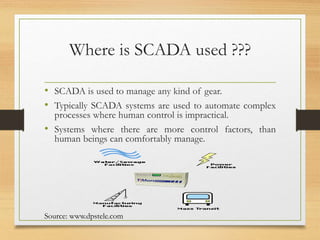
• SCADA is used to manage any kind of gear.
• Typically SCADA systems are used to automate complex
processes where human control is impractical.
• Systems where there are more control factors, than
human beings can comfortably manage.
Source: www.dpstele.com
Continued…
1) Electric power Generation, Transmission &
Distribution – Utilities use SCADA system to direct
current, flow and line voltage, to monitor the
operation.
2) Water & Sewage
3) Manufacturing
4) Buildings, Facilities &
Environment
5) Mass Transit
6) Traffic signals
Benefits of SCADA
• Reliability & Robustness-These systems are used for mission
critical industrial processes where reliability and performance are
paramount.
• Maximize productivity- Maximizes productivity and ensures
continuous production.
• Improve product quality- Analyzes and controls the quality of
manufactured products using standard SCADA functionality.
• Reduce your operating and maintenance costs- Fewer
personnel are required to monitor & less maintenance trips are
required.
• Integrate with your business systems- A SCADA system can be
easily integrated with your existing business systems, leading to
increased production and profitability.
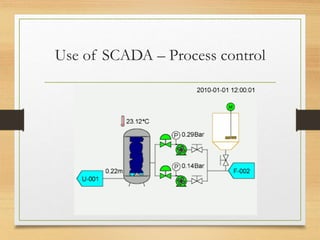
Use of SCADA – Process control
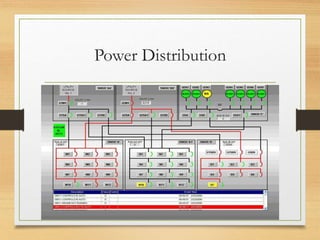
Power Distribution
SCADA

SCADA

  • 1.
    SCADA Eyes and Earsfor the operator
  • 2.
    What is SCADA? •SCADA abbreviates for Supervisory Control And Data Acquisition system • Definition – It is a system operating with coded signals over communication channels so as to provide control of remote equipment. Source: www.engineersgarage.com
  • 3.
    Elements of SCADAsystem • SCADA Master Station Computer System • Human Machine Interface • Remote Terminal Units • Programmable Logic Controllers • SCADA communications Source: www.engineersgarage.com
  • 4.
    SCADA Master StationComputer System • It is the repository of the real-time or near real-time reported data collected from the remote terminal units connected to it. • It is generally standard computer hardware equipment. • The back end SCADA software must be able to repeatedly poll the RTUs for data values, should have software for their retrieval, storage and processing. Source: www.engineersgarage.com
  • 5.
    Human-Machine Interface • Thisis the eye candy part on the host station • The values that have been stored in the host computers are presented to the human operator in an understandable and comprehensible form using HMIs • These may provide trending, diagnostic or management information and detailed schematics and animations representing the current states of the machines under its control Source: www.engineersgarage.com
  • 6.
    Remote Terminal Units •An RTU is a normally a transducer or a sensor which allows the electrical circuitry to interface with the process instrumentation and control equipment. • A single RTU may measure many different types of parameters • The Input/Output circuitry of a RTU can be analog or digital • RTUs are microprocessor based devices and these conversions are primarily internal to them. Source: www.engineersgarage.com
  • 7.
    Programmable Logic Controllers •PLCs have been built around the philosophy of automation • Re-programmability being the biggest asset • PLC based RTUs can be fixed on the field itself along with adding new features like support for multiple polling, exception reporting, time tagging etc. • This also enables them to execute simple logical processes without involving the master station Source: www.engineersgarage.com
  • 8.
    SCADA Communication • Theconveying of data from an RTU to the master station and commands from the host to the RTU need to be done over a communication system • SCADA system might not be localized to just a single plant • The vastness of the network also has to be catered to along with speed, accuracy, security and performance being among other important issues • Before the computer networking communication were voice communication based • It has now embraced LANs and WANs for seamless integration with everyday office computer networks Source: www.engineersgarage.com
  • 9.
    Generation of SCADAsystems • 1st gen – Monolithic SCADA Systems • 2nd gen – Distributed SCADA Systems • 3rd gen – Networked SCADA Systems • 4th gen – Internet of Things Systems Source: www.engineersgarage.com
  • 10.
    Monolithic SCADA Systems •Owing to their origins in times when computing revolved around standalone ‘Mainframe computers’ with networks being virtually non-existent • The communication between RTU and the central computer was a dedicated line solely for that purpose • Redundancy was provided by connecting a similar mainframe at the bus level which continuously monitored and took over the main computer in case of failure Source: www.engineersgarage.com
  • 11.
    Distributed SCADA Systems •It uses the LAN networks to its advantage, the computing load was distributed across multiple systems • Each system being given a specific function like communication processor, calculation processor, database server etc. and sharing information in real time • This had a limitation of geographical extent and could not be used for widely distributed systems Note: The use of WAN to provide communication between the RTUs and the main distributed system remained unchanged. Source: www.engineersgarage.com
  • 12.
    Networked SCADA Systems •Based on the second generation, it follows open system architecture • Using Open standards mitigates many limitations allowing cross vendor compatibility and the use of any off-the-shelf standard product • The use of WAN networks like Internet Protocol for communication has separated the Main master station from the network by the use if an intervening communications server, thus adding another layer of security to the data and improved disaster survivability Source: www.engineersgarage.com
  • 13.
    Internet of Things •With the commercial availability of cloud computing, it has adopted Internet of Things technology to reduce infrastructure costs and increase ease of maintenance and integration • Can implement more complex control algorithms than are practically feasible to implement on traditional programmable logic controllers Source: en.wikipedia.org
  • 14.
    Where is SCADAused ??? • SCADA is used to manage any kind of gear. • Typically SCADA systems are used to automate complex processes where human control is impractical. • Systems where there are more control factors, than human beings can comfortably manage. Source: www.dpstele.com
  • 15.
    Continued… 1) Electric powerGeneration, Transmission & Distribution – Utilities use SCADA system to direct current, flow and line voltage, to monitor the operation. 2) Water & Sewage 3) Manufacturing 4) Buildings, Facilities & Environment 5) Mass Transit 6) Traffic signals
  • 16.
    Benefits of SCADA •Reliability & Robustness-These systems are used for mission critical industrial processes where reliability and performance are paramount. • Maximize productivity- Maximizes productivity and ensures continuous production. • Improve product quality- Analyzes and controls the quality of manufactured products using standard SCADA functionality. • Reduce your operating and maintenance costs- Fewer personnel are required to monitor & less maintenance trips are required. • Integrate with your business systems- A SCADA system can be easily integrated with your existing business systems, leading to increased production and profitability.
  • 17.
    Use of SCADA– Process control
  • 18.