CIS Electricals Pvt. Ltd.
MD KHURSHID ALAM
M.TECH ENGINEER
Email- sm.arzoo111@gmail.com
Ph- +91 8750848018
HVAC- Presentation: HVAC Overview
General overview of HVAC
Technology
General overview of VRF
Technology
Benefits of VRF
General overview of Refrigerant
General overview of Ton
General overview of Compressor
INTRODUCTION:
Heating, ventilation, and air
conditioning (HVAC) is the
technology of indoor environmental
comfort. Its goal is to provide thermal
comfort and acceptable indoor air
quality.
What Is Air-Conditioning?
Air-Conditioning
Means
control of five parameter
First modern electrical air conditioning unit was invented by Willis Carrier in
1902 at Buffalo, New York
Total
Air-
conditioning
Solution
Air Movement
& circulation
Temperature
Control
Humidity
Control
Noise
Level
Indoor Air
Quality
Refrigeration Cycle:
Working of Refrigeration Cycle:
1. COMPRESSOR: There are two function of
compressor:
 Refrigerant flow create.
 Pressure difference create.
2. CONDENSOR: There are two function of
condenser:
 Release the heat of refrigerant.
 Convert vapor to liquid refrigerant.
Drier ( Receiver/Accumulator): Filtration of
refrigerant.
Silica Gel: Absorption of moisture.
3. EXPANSION DEVICE: Controls the amount
of refrigerant flow.
4. EVAPORATOR: There are two function of
evaporator:
 Absorption of heat energy.
 Convert liquid to vapor refrigerant.
Types of Air-Conditioning:
 Window Air-Conditioning System
 Split Air-Conditioning System
 Packaged Air-Conditioning System
 Central Air-Conditioning System
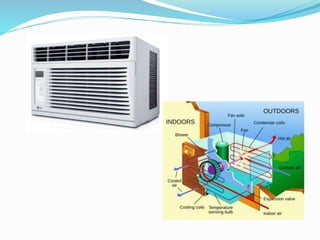
Window Air-Conditioning System:
 In this air conditioner all the components namely the
compressor, condenser ,expansion valve, evaporator and
cooling coil are enclosed in a single box
 Window air-conditioning system are one of the most
commonly used and cheapest type of air conditioners.
 Window air conditioner units are reliable and simple-to-
install solution to keep a room cool while avoiding the
costly construction of a central air system.
 Capacity up to 5 tons
Split Air-Conditioning system:
 The split air conditioner comprises of
two parts the outdoor unit and the
indoor unit.
 Outdoor unit consists of compressor,
condenser and expansion valve.
 Indoor unit consists of evaporator or
cooling coil and cooling fan.
Package Air-Conditioning System:
 They are used where the cooling loads extend
beyond 20 tons.
 All the components are housed in a same box.
 Cooled air is thrown by the high capacity
blower, and it flows through the duct laid
through various rooms.
 They are of two types PACS
i) air cooled ii) water cooled
Variable Refrigerant Flow (VRF) System:
 Variable refrigerant flow (VRF),
also known as variable refrigerant
volume (VRV), VRFs use
refrigerant as the cooling and
heating medium.
Heat Pump
versus
Heat pump with Heat Recovery
Heat Pump:
Outdoor
Unit
Indoor
Units
Controls
System
Heat Pump:
Heat Pump with Heat Recovery:
Simultaneous Cooling & Heating
Heat Pump with Heat Recovery:
Simultaneous Cooling & Heating
Branch
Circuit
Controller
Indoor
Units
Controls
System
Outdoor
Unit
Outdoor Unit:
 Controls compressor speed
 Controls condenser fan speed
 Controls pressure of refrigerant to maximize capacity
and efficiency
Branch Circuit (BC) Controller:
Separates refrigerant into gas and liquid
Ensures units in heating receive superheated gas
Ensures units in cooling receive sub-cooled liquid
Indoor Units:
Sense the space temperature
Contain a Linear Expansion Valve (LEV) that
automatically modulates
Allow the precise amount of refrigerant through the
heat exchanger
Filter and distributes air
Controls System:
Integrated sequence of operation
Takes input from the user and provides feedback to the
system
What are the benefits of VRF?
Two-pipe System
INVERTER Technology
Multiple Indoor Units
Variable Capacity System
Zoning System
Complete Control Offering
What Is Refrigerant:
Refrigerant is a fluid. Chemically use in cooling
machine.
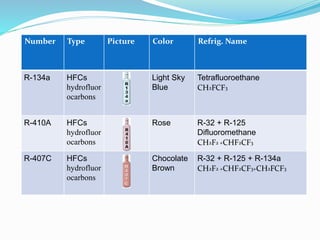
Refrigerant Color Codes:
Number Type Picture Color Refrig. Name
R-22 HCFCs
hydrochlor
ofluorocarb
on
Light Green Monochlorodifluoro
methane
CHClF2
Number Type Picture Color Refrig. Name
R-134a HFCs
hydrofluor
ocarbons
Light Sky
Blue
Tetrafluoroethane
CH2FCF3
R-410A HFCs
hydrofluor
ocarbons
Rose R-32 + R-125
Difluoromethane
CH2F2 +CHF2CF3
R-407C HFCs
hydrofluor
ocarbons
Chocolate
Brown
R-32 + R-125 + R-134a
CH2F2 +CHF2CF3+CH2FCF3
Suction And Discharge Pressure Of
Refrigerant: PSI – Pounds per square inch
Refrigerant Suction
(PSIG)
Discharge
(PSIG)
Stand By
(PSIG)
R-22 60 265 150
R-134a 40 – 45 180 - 190 75 - 80
R-407 c 70 - 80 270 – 280 150
R-410A 100 - 110 380 – 400 220
Ton Of Refrigeration:
R
AC
1 TR
ICE
1 TR
AC
Ton of Refrigeration foot-pound-
second (fps) System:
1 Ton = 2000 (lb)
Latent heat of ice = 144 btu/lb
2000 x 144 = 2,88,000 btu/day
2,88,000/24 = 12000 btu/ hr
12000/60 = 200 btu/min
200/60 = 3.333 btu/sec
Note- 1 Tr = 12000 btu/sec
Ton of Refrigeration Meter,
Kilogram, Second, (MKS) System:
1 Ton = 907 kg
Latent heat of ice = 80 kcl/kg
907 x 80 = 72000 kcl
72000/ 24 = 3000 kcl/hr
3000/60 = 50 kcl/min
50/60 = 0.833 kcl/sec
Note- 1 kw = 0.24 kcl/sec
COMPRESSOR:
It is a heart of refrigeration system:
A Compressor is a device used to increase the
low pressure of air to High pressure.
Types of compressor:
 Reciprocating Compressor.
 Scroll Compressor.
 Screw Compressor.
 Centrifugal Compressor.
Reciprocating Compressor:
 The reciprocating compressor are slowly being
phased out because power consumption of 0.94 kw
per ton.
 There maintenance cost is high due to a large
number of moving parts.
Scroll Compressor:
 The scroll compressor are slowly replacing the
reciprocating compressor in capacity up to 40 tons.
 These compressor are more efficient requiring
approx. 0.75 kw per ton.
 They are maintenance free since they are rotary type
with minimum moving parts.
Screw compressor:
 These compressor are replacement for large size
reciprocating compressor and are available in much
large capacity then reciprocating unit.
 They have a high efficiency between 0.68 to 0.75 kw
per ton.
 The require minimum maintenance since there are less
moving parts.
Centrifugal compressor:
 These compressor are meant for large capacity between
200 tons to 2500 tons.
 They have the highest efficiency which can be as high as
0.62 kw per tons.
They require more maintenance then screw compressor
but are preferred for their large capacity range.
Motor Winding: (TERMINAL COVER)
 COMMON.
 STARTING.
 RUNNING.
Common
Starting Running
Continuity, Resistance(Ω) or winding
Testing:
Continuity is OK between common and starting terminal.
Continuity is OK between common and running terminal.
Continuity is OK between starting and running terminal.
Continuity is OK between starting and common terminal.
Continuity is OK between running and starting terminal.
Continuity is OK between running and common terminal.
Ground Testing:
Continuity is NOT OK between Common and Earth
terminal.
Continuity is NOT OK between Starting and Earth
terminal.
Continuity is NOT OK between Running and Earth
terminal.
Compressor testing:
Common
Starting Running
19.1 Ω63.2 Ω
82.7 Ω
Lowest valueMedium value
Highest value
Find out compressor motor terminal:
 Resistance is lowest between common and running.
 Resistance is Medium between common and starting.
 Resistance is Highest between starting and running.
Find out common:
Common
Starting Running
19.1 Ω63.2 Ω
82.7 Ω
CRCS
SR
To start compressor without relay:
Common
Starting
Running
Starting winding
Running winding
N
P
Check the quality of the broken comp.’s oil. the oil
has turn bad.
 Push out the bad oil inside the other compressors.
 Change the accumulator and oil separator
 Use high pressure nitrogen to purge the system and
 Then add necessary refrigerant oil.
 Vacuuming and add refrigerant.
Carbonized oil
Effect of poor maintenance on compressor power
consumption
Condition
Te
(0C)
Tc
(0C)
Refrigeration
Capacity* (TR)
Specific
Power
Consumption
(kW/TR)
Increase
kW/TR
(%)
Normal 7.2 40.5 17.0 0.69 -
Dirty condenser 7.2 46.1 15.6 0.84 20.4
Dirty evaporator 1.7 40.5 13.8 0.82 18.3
Dirty condenser
and evaporator
1.7 46.1 12.7 0.96 38.7
MAIN CAUSE OF COMPRESSOR FAILURE:
 Bad Vacuum.
 Moisture in compressor.
 Insufficient oil.
 Carbonized oil.
 Weak Capacitor.
 Terminal rusty.
 Loose connection.
 Low voltage.
 Low Refrigerant.
 High Refrigerant.
 Chocked Condenser.
 Low speed of Outdoor fan due to weak capacitor.
COPPER PIPE LEAKE PROBLEM:
 Due to not proper Brazing.
 Due to not proper tight of flaring point.
 Due to not proper insulation.
 Due to near carbon mono- oxide formation.
 Due to pinch.
 Due to not proper bend.
 Due to corrosion.
 Vibration at suction valve and discharge valve for this install rubber
pad at four side of the outdoor unit.
COPPER PIPE SIZING DETAILS:
TUBE OD WALL THICKNESS Temper
DesignPre
ssure
Weight
Working
Pressure
Inch mm mm swg (N/mm2) kg/mt (kg/cm2 or bar)
1/4" 6.35 0.80 21 soft 46.00 0.125 132.6
3/8" 9.53 0.80 21 soft 46.00 0.196 84.3
1/2" 12.7 0.80 21 soft 46.00 0.268 61.8
5/8" 15.88 0.99 19 soft 46.00 0.414 61.2
3/4", 6/8" 19.05 0.99 19 soft 46.00 0.507 51.0
3/4", 6/8" 19.05 0.80 21 Hard 72.50 0.410 63.6
7/8" 22.22 0.80 21 Hard 72.50 0.482 54.2
1" 25.4 0.88 20.5 Hard 72.50 0.607 52.0
1 1/8" 28.58 0.99 19 Hard 72.50 0.768 52.0
1 1/4" 31.75 1.10 18.5 Hard 72.50 0.948 52.0
1 3/8" 34.93 1.21 18 Hard 72.50 1.147 52.0
1 1/2" 38.1 1.32 17.5 Hard 72.50 1.365 52.0
1 5/8" 41.28 1.43 17 Hard 72.50 1.602 52.0
THANK YOU

Hvac - presentation (Air conditioning presentation)

  • 1.
    CIS Electricals Pvt.Ltd. MD KHURSHID ALAM M.TECH ENGINEER Email- sm.arzoo111@gmail.com Ph- +91 8750848018 HVAC- Presentation: HVAC Overview
  • 2.
    General overview ofHVAC Technology General overview of VRF Technology Benefits of VRF General overview of Refrigerant General overview of Ton General overview of Compressor
  • 3.
    INTRODUCTION: Heating, ventilation, andair conditioning (HVAC) is the technology of indoor environmental comfort. Its goal is to provide thermal comfort and acceptable indoor air quality.
  • 4.
    What Is Air-Conditioning? Air-Conditioning Means controlof five parameter First modern electrical air conditioning unit was invented by Willis Carrier in 1902 at Buffalo, New York
  • 5.
  • 6.
  • 7.
    Working of RefrigerationCycle: 1. COMPRESSOR: There are two function of compressor:  Refrigerant flow create.  Pressure difference create. 2. CONDENSOR: There are two function of condenser:  Release the heat of refrigerant.  Convert vapor to liquid refrigerant.
  • 8.
    Drier ( Receiver/Accumulator):Filtration of refrigerant. Silica Gel: Absorption of moisture. 3. EXPANSION DEVICE: Controls the amount of refrigerant flow. 4. EVAPORATOR: There are two function of evaporator:  Absorption of heat energy.  Convert liquid to vapor refrigerant.
  • 9.
    Types of Air-Conditioning: Window Air-Conditioning System  Split Air-Conditioning System  Packaged Air-Conditioning System  Central Air-Conditioning System
  • 10.
    Window Air-Conditioning System: In this air conditioner all the components namely the compressor, condenser ,expansion valve, evaporator and cooling coil are enclosed in a single box  Window air-conditioning system are one of the most commonly used and cheapest type of air conditioners.  Window air conditioner units are reliable and simple-to- install solution to keep a room cool while avoiding the costly construction of a central air system.  Capacity up to 5 tons
  • 12.
    Split Air-Conditioning system: The split air conditioner comprises of two parts the outdoor unit and the indoor unit.  Outdoor unit consists of compressor, condenser and expansion valve.  Indoor unit consists of evaporator or cooling coil and cooling fan.
  • 14.
    Package Air-Conditioning System: They are used where the cooling loads extend beyond 20 tons.  All the components are housed in a same box.  Cooled air is thrown by the high capacity blower, and it flows through the duct laid through various rooms.  They are of two types PACS i) air cooled ii) water cooled
  • 16.
    Variable Refrigerant Flow(VRF) System:  Variable refrigerant flow (VRF), also known as variable refrigerant volume (VRV), VRFs use refrigerant as the cooling and heating medium.
  • 18.
    Heat Pump versus Heat pumpwith Heat Recovery
  • 19.
  • 20.
  • 21.
    Heat Pump withHeat Recovery: Simultaneous Cooling & Heating
  • 22.
    Heat Pump withHeat Recovery: Simultaneous Cooling & Heating Branch Circuit Controller Indoor Units Controls System Outdoor Unit
  • 23.
    Outdoor Unit:  Controlscompressor speed  Controls condenser fan speed  Controls pressure of refrigerant to maximize capacity and efficiency
  • 24.
    Branch Circuit (BC)Controller: Separates refrigerant into gas and liquid Ensures units in heating receive superheated gas Ensures units in cooling receive sub-cooled liquid
  • 25.
    Indoor Units: Sense thespace temperature Contain a Linear Expansion Valve (LEV) that automatically modulates Allow the precise amount of refrigerant through the heat exchanger Filter and distributes air
  • 26.
    Controls System: Integrated sequenceof operation Takes input from the user and provides feedback to the system
  • 27.
    What are thebenefits of VRF? Two-pipe System INVERTER Technology Multiple Indoor Units Variable Capacity System Zoning System Complete Control Offering
  • 28.
    What Is Refrigerant: Refrigerantis a fluid. Chemically use in cooling machine. Refrigerant Color Codes: Number Type Picture Color Refrig. Name R-22 HCFCs hydrochlor ofluorocarb on Light Green Monochlorodifluoro methane CHClF2
  • 29.
    Number Type PictureColor Refrig. Name R-134a HFCs hydrofluor ocarbons Light Sky Blue Tetrafluoroethane CH2FCF3 R-410A HFCs hydrofluor ocarbons Rose R-32 + R-125 Difluoromethane CH2F2 +CHF2CF3 R-407C HFCs hydrofluor ocarbons Chocolate Brown R-32 + R-125 + R-134a CH2F2 +CHF2CF3+CH2FCF3
  • 30.
    Suction And DischargePressure Of Refrigerant: PSI – Pounds per square inch Refrigerant Suction (PSIG) Discharge (PSIG) Stand By (PSIG) R-22 60 265 150 R-134a 40 – 45 180 - 190 75 - 80 R-407 c 70 - 80 270 – 280 150 R-410A 100 - 110 380 – 400 220
  • 31.
    Ton Of Refrigeration: R AC 1TR ICE 1 TR AC Ton of Refrigeration foot-pound- second (fps) System: 1 Ton = 2000 (lb) Latent heat of ice = 144 btu/lb 2000 x 144 = 2,88,000 btu/day 2,88,000/24 = 12000 btu/ hr 12000/60 = 200 btu/min 200/60 = 3.333 btu/sec Note- 1 Tr = 12000 btu/sec
  • 32.
    Ton of RefrigerationMeter, Kilogram, Second, (MKS) System: 1 Ton = 907 kg Latent heat of ice = 80 kcl/kg 907 x 80 = 72000 kcl 72000/ 24 = 3000 kcl/hr 3000/60 = 50 kcl/min 50/60 = 0.833 kcl/sec Note- 1 kw = 0.24 kcl/sec
  • 33.
    COMPRESSOR: It is aheart of refrigeration system: A Compressor is a device used to increase the low pressure of air to High pressure. Types of compressor:  Reciprocating Compressor.  Scroll Compressor.  Screw Compressor.  Centrifugal Compressor.
  • 34.
    Reciprocating Compressor:  Thereciprocating compressor are slowly being phased out because power consumption of 0.94 kw per ton.  There maintenance cost is high due to a large number of moving parts. Scroll Compressor:  The scroll compressor are slowly replacing the reciprocating compressor in capacity up to 40 tons.  These compressor are more efficient requiring approx. 0.75 kw per ton.  They are maintenance free since they are rotary type with minimum moving parts.
  • 35.
    Screw compressor:  Thesecompressor are replacement for large size reciprocating compressor and are available in much large capacity then reciprocating unit.  They have a high efficiency between 0.68 to 0.75 kw per ton.  The require minimum maintenance since there are less moving parts. Centrifugal compressor:  These compressor are meant for large capacity between 200 tons to 2500 tons.  They have the highest efficiency which can be as high as 0.62 kw per tons.
  • 36.
    They require moremaintenance then screw compressor but are preferred for their large capacity range. Motor Winding: (TERMINAL COVER)  COMMON.  STARTING.  RUNNING. Common Starting Running
  • 37.
    Continuity, Resistance(Ω) orwinding Testing: Continuity is OK between common and starting terminal. Continuity is OK between common and running terminal. Continuity is OK between starting and running terminal. Continuity is OK between starting and common terminal. Continuity is OK between running and starting terminal. Continuity is OK between running and common terminal.
  • 38.
    Ground Testing: Continuity isNOT OK between Common and Earth terminal. Continuity is NOT OK between Starting and Earth terminal. Continuity is NOT OK between Running and Earth terminal.
  • 39.
    Compressor testing: Common Starting Running 19.1Ω63.2 Ω 82.7 Ω Lowest valueMedium value Highest value
  • 40.
    Find out compressormotor terminal:  Resistance is lowest between common and running.  Resistance is Medium between common and starting.  Resistance is Highest between starting and running. Find out common: Common Starting Running 19.1 Ω63.2 Ω 82.7 Ω CRCS SR
  • 41.
    To start compressorwithout relay: Common Starting Running Starting winding Running winding N P
  • 42.
    Check the qualityof the broken comp.’s oil. the oil has turn bad.  Push out the bad oil inside the other compressors.  Change the accumulator and oil separator  Use high pressure nitrogen to purge the system and  Then add necessary refrigerant oil.  Vacuuming and add refrigerant. Carbonized oil
  • 44.
    Effect of poormaintenance on compressor power consumption Condition Te (0C) Tc (0C) Refrigeration Capacity* (TR) Specific Power Consumption (kW/TR) Increase kW/TR (%) Normal 7.2 40.5 17.0 0.69 - Dirty condenser 7.2 46.1 15.6 0.84 20.4 Dirty evaporator 1.7 40.5 13.8 0.82 18.3 Dirty condenser and evaporator 1.7 46.1 12.7 0.96 38.7
  • 45.
    MAIN CAUSE OFCOMPRESSOR FAILURE:  Bad Vacuum.  Moisture in compressor.  Insufficient oil.  Carbonized oil.  Weak Capacitor.  Terminal rusty.  Loose connection.  Low voltage.  Low Refrigerant.  High Refrigerant.  Chocked Condenser.  Low speed of Outdoor fan due to weak capacitor.
  • 46.
    COPPER PIPE LEAKEPROBLEM:  Due to not proper Brazing.  Due to not proper tight of flaring point.  Due to not proper insulation.  Due to near carbon mono- oxide formation.  Due to pinch.  Due to not proper bend.  Due to corrosion.  Vibration at suction valve and discharge valve for this install rubber pad at four side of the outdoor unit.
  • 47.
    COPPER PIPE SIZINGDETAILS: TUBE OD WALL THICKNESS Temper DesignPre ssure Weight Working Pressure Inch mm mm swg (N/mm2) kg/mt (kg/cm2 or bar) 1/4" 6.35 0.80 21 soft 46.00 0.125 132.6 3/8" 9.53 0.80 21 soft 46.00 0.196 84.3 1/2" 12.7 0.80 21 soft 46.00 0.268 61.8 5/8" 15.88 0.99 19 soft 46.00 0.414 61.2 3/4", 6/8" 19.05 0.99 19 soft 46.00 0.507 51.0 3/4", 6/8" 19.05 0.80 21 Hard 72.50 0.410 63.6 7/8" 22.22 0.80 21 Hard 72.50 0.482 54.2 1" 25.4 0.88 20.5 Hard 72.50 0.607 52.0 1 1/8" 28.58 0.99 19 Hard 72.50 0.768 52.0 1 1/4" 31.75 1.10 18.5 Hard 72.50 0.948 52.0 1 3/8" 34.93 1.21 18 Hard 72.50 1.147 52.0 1 1/2" 38.1 1.32 17.5 Hard 72.50 1.365 52.0 1 5/8" 41.28 1.43 17 Hard 72.50 1.602 52.0
  • 48.