Twa Panel Systems Inc.         April 12, 2012
1201 – 4th St.
Nisku, Alberta, Canada   P: +1 (780) 955-8757
T9E 7L3                  F: +1 (780) 965-8757
www.twapanels.ca
Agenda


• Active Beam Origin     • Air-side Information
• Active Beam Overview   • Water-side Information

• How A.B.’s Function    • Capacity
• Construction           • Benefits & Limitations

• System comparisons     • Applications
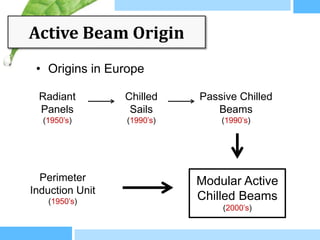
Active Beam Origin
 • Origins in Europe

 Radiant         Chilled    Passive Chilled
 Panels           Sails        Beams
  (1950’s)       (1990’s)       (1990’s)


  Perimeter                 Modular Active
Induction Unit
   (1950’s)
                            Chilled Beams
                                (2000’s)
Active Beam Overview

• High acceptance rate in Europe
  • Historically high energy costs


• North American market increasing due largely to:
  •   Green initiatives
  •   Increasing energy costs
  •   Increased installed base (Familiarity & Successful projects)
  •   Lowering cost due to increasingly competitive market
Active Beam Overview
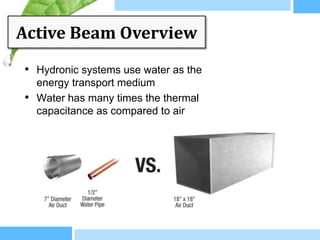
• Hydronic systems use water as the
  energy transport medium
• Water has many times the thermal
  capacitance as compared to air
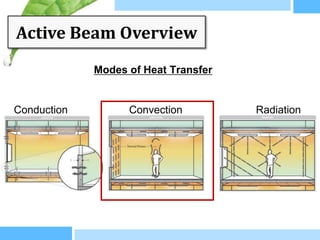
Active Beam Overview
             Modes of Heat Transfer


Conduction         Convection         Radiation
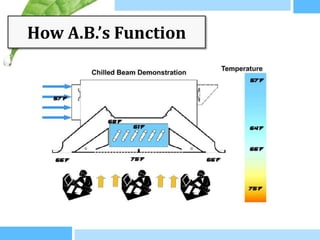
How A.B.’s Function

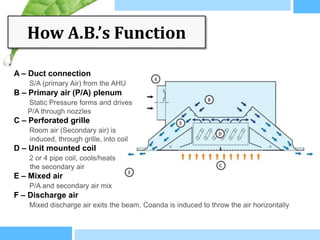
A – Duct connection
    S/A (primary Air) from the AHU
B – Primary air (P/A) plenum
   Static Pressure forms and drives
   P/A through nozzles
C – Perforated grille
    Room air (Secondary air) is
    induced, through grille, into coil
D – Unit mounted coil
    2 or 4 pipe coil, cools/heats
    the secondary air
E – Mixed air
    P/A and secondary air mix
F – Discharge air
    Mixed discharge air exits the beam, Coanda is induced to throw the air horizontally
How A.B.’s Function
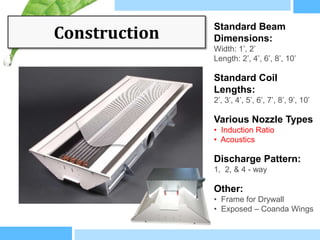
Construction   Standard Beam
               Dimensions:
               Width: 1’, 2’
               Length: 2’, 4’, 6’, 8’, 10’

               Standard Coil
               Lengths:
               2’, 3’, 4’, 5’, 6’, 7’, 8’, 9’, 10’

               Various Nozzle Types
               • Induction Ratio
               • Acoustics

               Discharge Pattern:
               1, 2, & 4 - way

               Other:
               • Frame for Drywall
               • Exposed – Coanda Wings
System comparisons
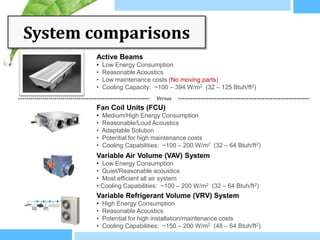
       Active Beams
       •   Low Energy Consumption
       •   Reasonable Acoustics
       •   Low maintenance costs (No moving parts)
       •   Cooling Capacity: ~100 – 394 W/m2 (32 – 125 Btuh/ft2)
                              Versus
       Fan Coil Units (FCU)
       •   Medium/High Energy Consumption
       •   Reasonable/Loud Acoustics
       •   Adaptable Solution
       •   Potential for high maintenance costs
       •   Cooling Capabilities: ~100 – 200 W/m2 (32 – 64 Btuh/ft2)
       Variable Air Volume (VAV) System
       • Low Energy Consumption
       • Quiet/Reasonable acoustics
       • Most efficient all air system
       • Cooling Capabilities: ~100 – 200 W/m2 (32 – 64 Btuh/ft2)
       Variable Refrigerant Volume (VRV) System
       •   High Energy Consumption
       •   Reasonable Acoustics
       •   Potential for high installation/maintenance costs
       •   Cooling Capabilities: ~150 – 200 W/m2 (48 – 64 Btuh/ft2)
Air Side Information
  (Primary Air - Overview)

• Meet all ventilation requirements
   • Min. Vent. (O/A requirements)
   • Remove 100% of the latent loads (Psychrometrics)
   • Induce enough Rm./A to meet sensible loads

**Greatest of these factors sets the minimum air flow rate**

• Higher SAT may be used
   • May use heat recovery strategies for increased energy savings
• Decreased AHU & Duct size
• Decrease in fan energy
Air Side Information
            (Primary Air)

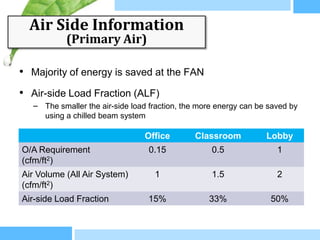
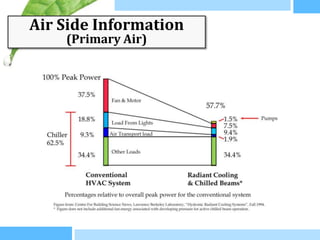
• Majority of energy is saved at the FAN
• Air-side Load Fraction (ALF)
   – The smaller the air-side load fraction, the more energy can be saved by
     using a chilled beam system

                                 Office        Classroom           Lobby
O/A Requirement                   0.15              0.5               1
(cfm/ft2)
Air Volume (All Air System)         1               1.5               2
(cfm/ft2)
Air-side Load Fraction            15%              33%              50%
Air Side Information
    (Primary Air)
Air Side Information
       (Psychrometrics)
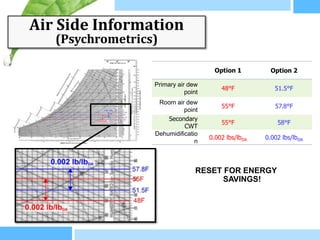
Psychrometric review required to prevent condensation
Standard Procedure:
   • Remove moisture from the P/A at AHU
   • Dry P/A lowers the space dew point temperature
   • To prevent condensate on the coil:

            Space dew point temp. < EWT

Not all spaces are suitable for active beams:
• Suitability engineering check - % of Sensible from CFMLatent
Air Side Information
   (Psychrometrics)

                                       Option 1         Option 2

                  Primary air dew
                                         48°F            51.5°F
                             point
                   Room air dew
                                         55°F            57.8°F
                            point
                      Secondary
                                         55°F             58°F
                            CWT
                  Dehumidificatio
                                     0.002 lbs/lbDA   0.002 lbs/lbDA
                                n


                                 RESET FOR ENERGY
                                       SAVINGS!
Air Side Information
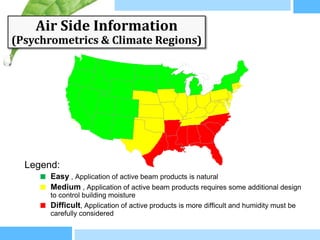
(Psychrometrics & Climate Regions)


  Legend:
     ■ Easy , Application of active beam products is natural
     ■ Medium , Application of active beam products requires some additional design
       to control building moisture
     ■ Difficult, Application of active products is more difficult and humidity must be
       carefully considered
Air Side Information
 (P/A Design Parameters)
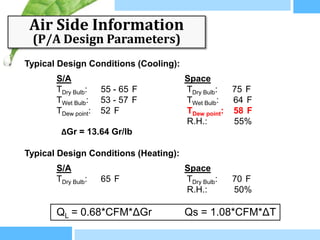
Typical Design Conditions (Cooling):
       S/A                             Space
       TDry Bulb:    55 - 65 F         TDry Bulb:  75 F
       TWet Bulb:    53 - 57 F         TWet Bulb:  64 F
       TDew point:   52 F              TDew point: 58 F
                                       R.H.:       55%
        ΔGr = 13.64 Gr/lb

Typical Design Conditions (Heating):
       S/A                             Space
       TDry Bulb:    65 F              TDry Bulb:   70 F
                                       R.H.:        50%

       QL = 0.68*CFM*ΔGr               Qs = 1.08*CFM*ΔT
Air Side Information
    (Space Over Cooling)

• Maintain reasonable dew point control
   • Meet 100% of latent load under Peak Design conditions
       • Infiltration
       • Maximum occupancy
       • Other sources of moisture

• Limit over-cooling
   • Keep air-side load fraction low
   • Reset air temperature
   • CHWS Shut-off control or EWT reset
   • VAV for fluctuating occupancy
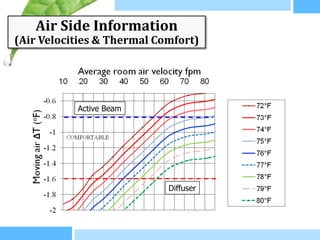
Air Side Information
(Air Velocities & Thermal Comfort)

ASHRAE Std. 55

• Occupied Zone
• ΔT and Air velocity determine
Thermal Comfort
• 80% Occupancy Satisfaction
• Radiant Affect

Active Beams

• Higher discharge air temp.
• Highest air velocities are at
the perimeter of the space
Air Side Information
(Air Velocities & Thermal Comfort)


           Active Beam


                            Diffuser
Air Side Information
        (Plenum Air Pressure Drop)
 250
1.00”

 230
0.93”
                                                                                         •   Fan Static is higher
 210                                                                                           •   Less penalty then high air flow
0.85”
           Plenum Pressure [Pa]


 190
                                                                                         • Can correlate pressure and air flow
0.77”

                                                                                         • Air volume is difficult to measure
 170
0.69”                                                                      K 60A
 150
0.60”                                                                      K 60C         • Measuring pressure is easy and
 130
0.52”
                                                                                         reliable
                                                                           K 60D
 110
0.44”
                                                                           K 60B         • Pressure is the common factor
   90
0.36”
   70
                                                                                         • Plenum and ducting should be
0.28”                                                 Primary air [l/s]                  sealed
   50
0.20” 0                            5   10   15   20       25      30       35       40
          CFM                     10   21   32   42       53      64      74       85
Air Side Information
                            (Acoustics)

              45


              40
                         2’x8’ – Larger Nozzles                                 Chart reports
              35                                                               acoustic values
LwA [dB(A)]


                                                                                without room
              30                                                                 attenuation
                                                                                    effect
              25

                                               2’x8’ – Smaller Nozzles         Active beams can
              20
                                                                                 be very quiet!
              15
                   0.4        0.6        0.8       1          1.2        1.4
                                    Plenum Pressure [“w.c.]
Air Side Information
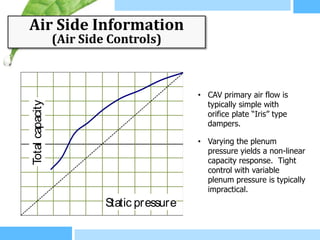
                 (Air Side Controls)


                                            • CAV primary air flow is
                                              typically simple with
Total capacity


                                              orifice plate “Iris” type
                                              dampers.

                                            • Varying the plenum
                                              pressure yields a non-linear
                                              capacity response. Tight
                                              control with variable
                                              plenum pressure is typically
                                              impractical.
                          Static pressure
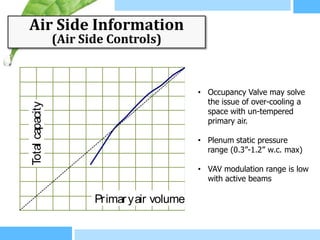
Air Side Information
                 (Air Side Controls)


                                              • Occupancy Valve may solve
                                                the issue of over-cooling a
Total capacity


                                                space with un-tempered
                                                primary air.

                                              • Plenum static pressure
                                                range (0.3”-1.2” w.c. max)

                                              • VAV modulation range is low
                                                with active beams

                        Primar y air volume
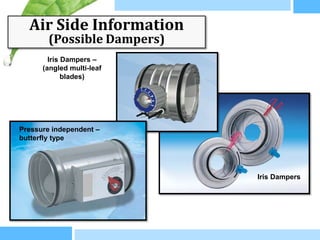
Air Side Information
       (Possible Dampers)
        Iris Dampers –
      (angled multi-leaf
             blades)


Pressure independent –
butterfly type


                            Iris Dampers
Air Side Information
 (Common Design Pitfalls)


• Two Air-side Design Concerns:


  1) Psychrometrics (Cooling only)
  2) Preliminary Design based on DOAS system
Water Side Information
            (Overview)


• Coil responsible for majority of the sensible load
   • Cooling & Heating
• Design requires:
   • Water flow rate
   • Circuit pressure drop
   • Temperatures (EWT, LWT)
• Increase in pump size and pump energy
   • Fan Energy vs. Pump Energy = Net energy savings
Water Side Information
(Water Design Parameters)
 • Active Beam Cooling:
    • EWT temperature, typically between 56 – 62 F
       • Secondary CHWS loop required
    • Psychrometrics – (Condensation control)
       • Generally EWT = 1 – 2 F above SPACE dew point temp.
 • Active Beam Heating:
    • EWT temperature, typically between 100 – 120 F
       • Secondary HWS loop required

 • Minimum flow rate per circuit = 0.45 to 0.65 GPM
    • Prevent laminar flow (more important for cooling)
Water Side Information
        (Piping Design)

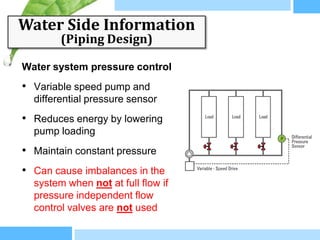
Water system pressure control
• Variable speed pump and
  differential pressure sensor
• Reduces energy by lowering
  pump loading
• Maintain constant pressure
• Can cause imbalances in the
  system when not at full flow if
  pressure independent flow
  control valves are not used
Water Side Information
         (Piping Design)
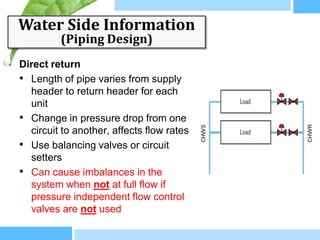
Direct return
• Length of pipe varies from supply
  header to return header for each
  unit
• Change in pressure drop from one
  circuit to another, affects flow rates
• Use balancing valves or circuit
  setters
• Can cause imbalances in the
  system when not at full flow if
  pressure independent flow control
  valves are not used
Water Side Information
        (Piping Design)

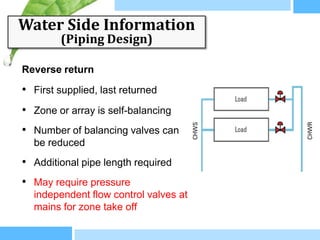
Reverse return

• First supplied, last returned
• Zone or array is self-balancing
• Number of balancing valves can
  be reduced
• Additional pipe length required
• May require pressure
  independent flow control valves at
  mains for zone take off
Water Side Information
        (Piping Design)

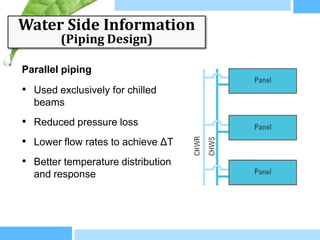
Parallel piping

• Used exclusively for chilled
  beams
• Reduced pressure loss
• Lower flow rates to achieve ΔT
• Better temperature distribution
  and response
Water Side Information
       (Water Side Controls)

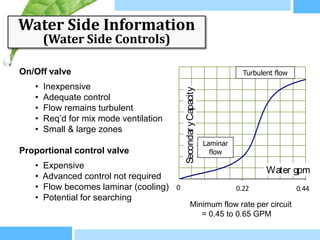
On/Off valve                                                                Turbulent flow
   •   Inexpensive


                                          Secondar y Capacity
   •   Adequate control
   •   Flow remains turbulent
   •   Req’d for mix mode ventilation
   •   Small & large zones
                                                                Laminar
Proportional control valve                                        flow
   •   Expensive
                                                                                   Water gpm
   •   Advanced control not required
   •   Flow becomes laminar (cooling) 0
                                      0                                    50
                                                                          0.22                 100
                                                                                             0.44
   •   Potential for searching
                                                 Minimum flow rate per circuit
                                                    = 0.45 to 0.65 GPM
Water Side Information
 (Common Design Pitfalls)

• Three water-side Design Concerns:
  1) Use of Glycol as the operating fluid
     •   Especially in cooling
  2) Not considering Pressure independent flow control valves
     •   Especially with large hydronic systems
     •   Modulating valves
     •   Variable frequency drive pumps
  3) Valve & Entrapped air noise
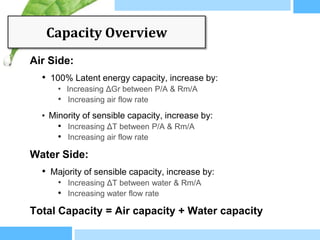
Capacity Overview
Air Side:
  • 100% Latent energy capacity, increase by:
      • Increasing ΔGr between P/A & Rm/A
      • Increasing air flow rate
  • Minority of sensible capacity, increase by:
      • Increasing ΔT between P/A & Rm/A
      • Increasing air flow rate
Water Side:
  • Majority of sensible capacity, increase by:
      • Increasing ΔT between water & Rm/A
      • Increasing water flow rate
Total Capacity = Air capacity + Water capacity
Capacity vs. Air Volume

40
                                   A-DT 8
                                   A-DT 10

35
                                   B-DT 8
                                   B-DT 10                                         • Increasing air flow rate and
                                   C-DT 8

30
                                   C-DT 10
                                   D-DT 8
                                                                                     pressure:
                                   D-DT 10
       Air Volume [l/s]


                                                                                     • Significant Increase in Capacity
25


20                                                                                 • Increasing GPM in turbulent
                                                                                     flow:
15
                                                                                     • Marginal Increase in Capacity
10

                                                         Secondary Capacity [W]
 5
 100                       200   300         400   500     600      700      800

        Typical sensible range is approx. 250 – 1500 BTUh/Ft
Capacity
     (Performance Data)


• Applicable standards:
  • EN 15116: Chilled Beams
  • ASHRAE/AHRI - SPC 200


• When choosing a manufacturer, ensure they
  test to an applicable standard!
Active Beam Benefits
• Significant Fan Energy savings
   • lower overall S/A
• Increased air circulation with high thermal comfort
• Smaller AHU & Ductwork
   • Lower floor-floor heights
   • Good retrofit applications
   • Significant reduction of riser space

• Low maintenance requirements
• Can be integrated with other energy saving systems
   • Geothermal, ERV’s, Enthalpy wheel…etc
• Water side free cooling may be an option
Active Beam Benefits
• Spaces may be zoned
  • Increased Comfort
  • Reduced energy consumption
  • Individual space temperature control (LEED Compliant)

• Quick response time
• Low to Reasonable Acoustics
Active Beam Limitations
• Potential for higher first cost
• Increase in pump energy
   • Small Compared to Fan Energy Savings
• Limited air-side free cooling
• Limited VAV modulating range
• High importance for building humidity control in Cooling
   •   Dehumidification at the AHU is required
   •   May require a building envelope upgrade
   •   May require more sophisticated controls for humidity control
   •   May not be acceptable for all spaces, based on latent loads
Commercial
           Applications                                                    Office spaces
                                                                           Data centers
                                                                           Shops/Stores
Sensible and Latent energy drive suitability
                                                                           Institutional
                                                                           Labs
Higher the sensible - the greater the energy savings                       Lecture Theatres*
Lower the latent - the easier it is to control the dew point temperature
                   of the space (Required due to no condensate pan)        Government
                                                                           Schools
                                                                           Hospital**
Spaces with:                                                               Airports
• High sensible loads & low latent loads                                   Clinics
     • Ideal
                                                                           Other
• High sensible loads & high latent loads
                                                                           Child care facilities
     • May be suitable with careful examination
                                                                           *Occupancy may produce high
• Low sensible loads & high latent loads                                   latent requirements
    • Would not be recommended for use with chilled beams                  **Some areas such as surgical
                                                                           suites do not allow room air to
                                                                           be induce or circulated through
                                                                           the HVAC equipment
          Not a silver bullet, each space should be individually
          reviewed to determine suitability
Applications


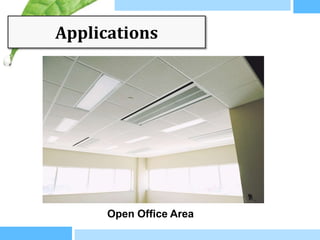
      Open Office Area
Applications


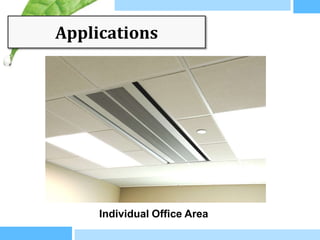
     Individual Office Area
Applications


     Child Care Center
Applications


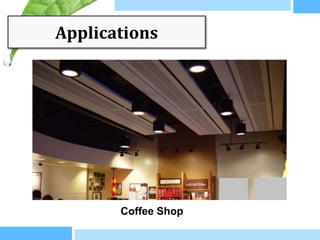
       Coffee Shop
Questions

(Apr 12 2012) Chilled Beam Presentation

  • 1.
    Twa Panel SystemsInc. April 12, 2012 1201 – 4th St. Nisku, Alberta, Canada P: +1 (780) 955-8757 T9E 7L3 F: +1 (780) 965-8757 www.twapanels.ca
  • 2.
    Agenda • Active BeamOrigin • Air-side Information • Active Beam Overview • Water-side Information • How A.B.’s Function • Capacity • Construction • Benefits & Limitations • System comparisons • Applications
  • 3.
    Active Beam Origin • Origins in Europe Radiant Chilled Passive Chilled Panels Sails Beams (1950’s) (1990’s) (1990’s) Perimeter Modular Active Induction Unit (1950’s) Chilled Beams (2000’s)
  • 4.
    Active Beam Overview •High acceptance rate in Europe • Historically high energy costs • North American market increasing due largely to: • Green initiatives • Increasing energy costs • Increased installed base (Familiarity & Successful projects) • Lowering cost due to increasingly competitive market
  • 5.
    Active Beam Overview •Hydronic systems use water as the energy transport medium • Water has many times the thermal capacitance as compared to air
  • 6.
    Active Beam Overview Modes of Heat Transfer Conduction Convection Radiation
  • 7.
    How A.B.’s Function A– Duct connection S/A (primary Air) from the AHU B – Primary air (P/A) plenum Static Pressure forms and drives P/A through nozzles C – Perforated grille Room air (Secondary air) is induced, through grille, into coil D – Unit mounted coil 2 or 4 pipe coil, cools/heats the secondary air E – Mixed air P/A and secondary air mix F – Discharge air Mixed discharge air exits the beam, Coanda is induced to throw the air horizontally
  • 8.
  • 9.
    Construction Standard Beam Dimensions: Width: 1’, 2’ Length: 2’, 4’, 6’, 8’, 10’ Standard Coil Lengths: 2’, 3’, 4’, 5’, 6’, 7’, 8’, 9’, 10’ Various Nozzle Types • Induction Ratio • Acoustics Discharge Pattern: 1, 2, & 4 - way Other: • Frame for Drywall • Exposed – Coanda Wings
  • 10.
    System comparisons Active Beams • Low Energy Consumption • Reasonable Acoustics • Low maintenance costs (No moving parts) • Cooling Capacity: ~100 – 394 W/m2 (32 – 125 Btuh/ft2) Versus Fan Coil Units (FCU) • Medium/High Energy Consumption • Reasonable/Loud Acoustics • Adaptable Solution • Potential for high maintenance costs • Cooling Capabilities: ~100 – 200 W/m2 (32 – 64 Btuh/ft2) Variable Air Volume (VAV) System • Low Energy Consumption • Quiet/Reasonable acoustics • Most efficient all air system • Cooling Capabilities: ~100 – 200 W/m2 (32 – 64 Btuh/ft2) Variable Refrigerant Volume (VRV) System • High Energy Consumption • Reasonable Acoustics • Potential for high installation/maintenance costs • Cooling Capabilities: ~150 – 200 W/m2 (48 – 64 Btuh/ft2)
  • 11.
    Air Side Information (Primary Air - Overview) • Meet all ventilation requirements • Min. Vent. (O/A requirements) • Remove 100% of the latent loads (Psychrometrics) • Induce enough Rm./A to meet sensible loads **Greatest of these factors sets the minimum air flow rate** • Higher SAT may be used • May use heat recovery strategies for increased energy savings • Decreased AHU & Duct size • Decrease in fan energy
  • 12.
    Air Side Information (Primary Air) • Majority of energy is saved at the FAN • Air-side Load Fraction (ALF) – The smaller the air-side load fraction, the more energy can be saved by using a chilled beam system Office Classroom Lobby O/A Requirement 0.15 0.5 1 (cfm/ft2) Air Volume (All Air System) 1 1.5 2 (cfm/ft2) Air-side Load Fraction 15% 33% 50%
  • 13.
    Air Side Information (Primary Air)
  • 14.
    Air Side Information (Psychrometrics) Psychrometric review required to prevent condensation Standard Procedure: • Remove moisture from the P/A at AHU • Dry P/A lowers the space dew point temperature • To prevent condensate on the coil: Space dew point temp. < EWT Not all spaces are suitable for active beams: • Suitability engineering check - % of Sensible from CFMLatent
  • 15.
    Air Side Information (Psychrometrics) Option 1 Option 2 Primary air dew 48°F 51.5°F point Room air dew 55°F 57.8°F point Secondary 55°F 58°F CWT Dehumidificatio 0.002 lbs/lbDA 0.002 lbs/lbDA n RESET FOR ENERGY SAVINGS!
  • 16.
    Air Side Information (Psychrometrics& Climate Regions) Legend: ■ Easy , Application of active beam products is natural ■ Medium , Application of active beam products requires some additional design to control building moisture ■ Difficult, Application of active products is more difficult and humidity must be carefully considered
  • 17.
    Air Side Information (P/A Design Parameters) Typical Design Conditions (Cooling): S/A Space TDry Bulb: 55 - 65 F TDry Bulb: 75 F TWet Bulb: 53 - 57 F TWet Bulb: 64 F TDew point: 52 F TDew point: 58 F R.H.: 55% ΔGr = 13.64 Gr/lb Typical Design Conditions (Heating): S/A Space TDry Bulb: 65 F TDry Bulb: 70 F R.H.: 50% QL = 0.68*CFM*ΔGr Qs = 1.08*CFM*ΔT
  • 18.
    Air Side Information (Space Over Cooling) • Maintain reasonable dew point control • Meet 100% of latent load under Peak Design conditions • Infiltration • Maximum occupancy • Other sources of moisture • Limit over-cooling • Keep air-side load fraction low • Reset air temperature • CHWS Shut-off control or EWT reset • VAV for fluctuating occupancy
  • 19.
    Air Side Information (AirVelocities & Thermal Comfort) ASHRAE Std. 55 • Occupied Zone • ΔT and Air velocity determine Thermal Comfort • 80% Occupancy Satisfaction • Radiant Affect Active Beams • Higher discharge air temp. • Highest air velocities are at the perimeter of the space
  • 20.
    Air Side Information (AirVelocities & Thermal Comfort) Active Beam Diffuser
  • 21.
    Air Side Information (Plenum Air Pressure Drop) 250 1.00” 230 0.93” • Fan Static is higher 210 • Less penalty then high air flow 0.85” Plenum Pressure [Pa] 190 • Can correlate pressure and air flow 0.77” • Air volume is difficult to measure 170 0.69” K 60A 150 0.60” K 60C • Measuring pressure is easy and 130 0.52” reliable K 60D 110 0.44” K 60B • Pressure is the common factor 90 0.36” 70 • Plenum and ducting should be 0.28” Primary air [l/s] sealed 50 0.20” 0 5 10 15 20 25 30 35 40 CFM 10 21 32 42 53 64 74 85
  • 22.
    Air Side Information (Acoustics) 45 40 2’x8’ – Larger Nozzles Chart reports 35 acoustic values LwA [dB(A)] without room 30 attenuation effect 25 2’x8’ – Smaller Nozzles Active beams can 20 be very quiet! 15 0.4 0.6 0.8 1 1.2 1.4 Plenum Pressure [“w.c.]
  • 23.
    Air Side Information (Air Side Controls) • CAV primary air flow is typically simple with Total capacity orifice plate “Iris” type dampers. • Varying the plenum pressure yields a non-linear capacity response. Tight control with variable plenum pressure is typically impractical. Static pressure
  • 24.
    Air Side Information (Air Side Controls) • Occupancy Valve may solve the issue of over-cooling a Total capacity space with un-tempered primary air. • Plenum static pressure range (0.3”-1.2” w.c. max) • VAV modulation range is low with active beams Primar y air volume
  • 25.
    Air Side Information (Possible Dampers) Iris Dampers – (angled multi-leaf blades) Pressure independent – butterfly type Iris Dampers
  • 26.
    Air Side Information (Common Design Pitfalls) • Two Air-side Design Concerns: 1) Psychrometrics (Cooling only) 2) Preliminary Design based on DOAS system
  • 27.
    Water Side Information (Overview) • Coil responsible for majority of the sensible load • Cooling & Heating • Design requires: • Water flow rate • Circuit pressure drop • Temperatures (EWT, LWT) • Increase in pump size and pump energy • Fan Energy vs. Pump Energy = Net energy savings
  • 28.
    Water Side Information (WaterDesign Parameters) • Active Beam Cooling: • EWT temperature, typically between 56 – 62 F • Secondary CHWS loop required • Psychrometrics – (Condensation control) • Generally EWT = 1 – 2 F above SPACE dew point temp. • Active Beam Heating: • EWT temperature, typically between 100 – 120 F • Secondary HWS loop required • Minimum flow rate per circuit = 0.45 to 0.65 GPM • Prevent laminar flow (more important for cooling)
  • 29.
    Water Side Information (Piping Design) Water system pressure control • Variable speed pump and differential pressure sensor • Reduces energy by lowering pump loading • Maintain constant pressure • Can cause imbalances in the system when not at full flow if pressure independent flow control valves are not used
  • 30.
    Water Side Information (Piping Design) Direct return • Length of pipe varies from supply header to return header for each unit • Change in pressure drop from one circuit to another, affects flow rates • Use balancing valves or circuit setters • Can cause imbalances in the system when not at full flow if pressure independent flow control valves are not used
  • 31.
    Water Side Information (Piping Design) Reverse return • First supplied, last returned • Zone or array is self-balancing • Number of balancing valves can be reduced • Additional pipe length required • May require pressure independent flow control valves at mains for zone take off
  • 32.
    Water Side Information (Piping Design) Parallel piping • Used exclusively for chilled beams • Reduced pressure loss • Lower flow rates to achieve ΔT • Better temperature distribution and response
  • 33.
    Water Side Information (Water Side Controls) On/Off valve Turbulent flow • Inexpensive Secondar y Capacity • Adequate control • Flow remains turbulent • Req’d for mix mode ventilation • Small & large zones Laminar Proportional control valve flow • Expensive Water gpm • Advanced control not required • Flow becomes laminar (cooling) 0 0 50 0.22 100 0.44 • Potential for searching Minimum flow rate per circuit = 0.45 to 0.65 GPM
  • 34.
    Water Side Information (Common Design Pitfalls) • Three water-side Design Concerns: 1) Use of Glycol as the operating fluid • Especially in cooling 2) Not considering Pressure independent flow control valves • Especially with large hydronic systems • Modulating valves • Variable frequency drive pumps 3) Valve & Entrapped air noise
  • 35.
    Capacity Overview Air Side: • 100% Latent energy capacity, increase by: • Increasing ΔGr between P/A & Rm/A • Increasing air flow rate • Minority of sensible capacity, increase by: • Increasing ΔT between P/A & Rm/A • Increasing air flow rate Water Side: • Majority of sensible capacity, increase by: • Increasing ΔT between water & Rm/A • Increasing water flow rate Total Capacity = Air capacity + Water capacity
  • 36.
    Capacity vs. AirVolume 40 A-DT 8 A-DT 10 35 B-DT 8 B-DT 10 • Increasing air flow rate and C-DT 8 30 C-DT 10 D-DT 8 pressure: D-DT 10 Air Volume [l/s] • Significant Increase in Capacity 25 20 • Increasing GPM in turbulent flow: 15 • Marginal Increase in Capacity 10 Secondary Capacity [W] 5 100 200 300 400 500 600 700 800 Typical sensible range is approx. 250 – 1500 BTUh/Ft
  • 37.
    Capacity (Performance Data) • Applicable standards: • EN 15116: Chilled Beams • ASHRAE/AHRI - SPC 200 • When choosing a manufacturer, ensure they test to an applicable standard!
  • 38.
    Active Beam Benefits •Significant Fan Energy savings • lower overall S/A • Increased air circulation with high thermal comfort • Smaller AHU & Ductwork • Lower floor-floor heights • Good retrofit applications • Significant reduction of riser space • Low maintenance requirements • Can be integrated with other energy saving systems • Geothermal, ERV’s, Enthalpy wheel…etc • Water side free cooling may be an option
  • 39.
    Active Beam Benefits •Spaces may be zoned • Increased Comfort • Reduced energy consumption • Individual space temperature control (LEED Compliant) • Quick response time • Low to Reasonable Acoustics
  • 40.
    Active Beam Limitations •Potential for higher first cost • Increase in pump energy • Small Compared to Fan Energy Savings • Limited air-side free cooling • Limited VAV modulating range • High importance for building humidity control in Cooling • Dehumidification at the AHU is required • May require a building envelope upgrade • May require more sophisticated controls for humidity control • May not be acceptable for all spaces, based on latent loads
  • 41.
    Commercial Applications Office spaces Data centers Shops/Stores Sensible and Latent energy drive suitability Institutional Labs Higher the sensible - the greater the energy savings Lecture Theatres* Lower the latent - the easier it is to control the dew point temperature of the space (Required due to no condensate pan) Government Schools Hospital** Spaces with: Airports • High sensible loads & low latent loads Clinics • Ideal Other • High sensible loads & high latent loads Child care facilities • May be suitable with careful examination *Occupancy may produce high • Low sensible loads & high latent loads latent requirements • Would not be recommended for use with chilled beams **Some areas such as surgical suites do not allow room air to be induce or circulated through the HVAC equipment Not a silver bullet, each space should be individually reviewed to determine suitability
  • 42.
    Applications Open Office Area
  • 43.
    Applications Individual Office Area
  • 44.
    Applications Child Care Center
  • 45.
    Applications Coffee Shop
  • 46.