HUNTINGTON’S
  DISEASE
  By: Stephanie Michel
What is Huntington’s
         disease?
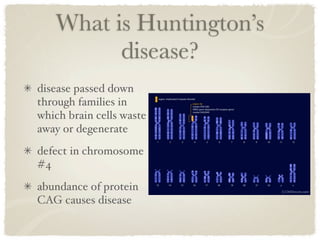
disease passed down
through families in
which brain cells waste
away or degenerate
defect in chromosome
#4
abundance of protein
CAG causes disease
Two Type of Huntington’s
Adult Onset          Childhood Onset

  Occurs in Mid       Occurs at young age
  30’s-40’s
                      Small amount of cases
  Most Common Form    reported

  Severe Symptoms     Symptoms of
                      Parkinson’s disease
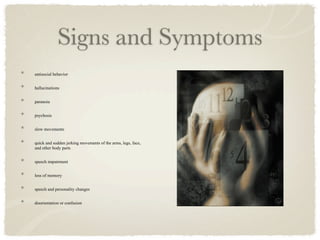
Signs and Symptoms
antisocial behavior


hallucinations


paranoia


psychosis


slow movements


quick and sudden jerking movements of the arms, legs, face,
and other body parts


speech impairment


loss of memory


speech and personality changes


disorientation or confusion
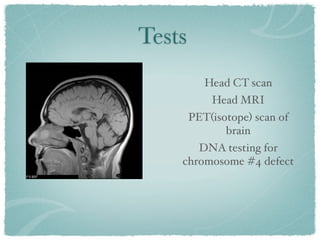
Tests
           Head CT scan
            Head MRI
        PET(isotope) scan of
               brain
       DNA testing for
    chromosome #4 defect
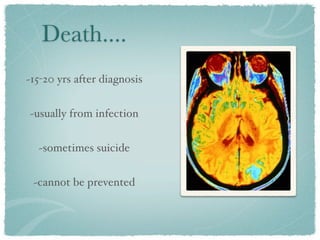
Death....
~15-20 yrs after diagnosis


~usually from infection


  ~sometimes suicide


 ~cannot be prevented
HTTP://WWW.YOUTUBE.COM/WATCH?V=PCVO9C9Q4TE
SOURCE FOR
   INFORMATION
 http://www.ncbi.nlm.nih.gov/pubmedhealth/

PMH0001775/#adam_000770.disease.treatment

Huntingtons disease

  • 1.
    HUNTINGTON’S DISEASE By: Stephanie Michel
  • 2.
    What is Huntington’s disease? disease passed down through families in which brain cells waste away or degenerate defect in chromosome #4 abundance of protein CAG causes disease
  • 3.
    Two Type ofHuntington’s Adult Onset Childhood Onset Occurs in Mid Occurs at young age 30’s-40’s Small amount of cases Most Common Form reported Severe Symptoms Symptoms of Parkinson’s disease
  • 4.
    Signs and Symptoms antisocialbehavior hallucinations paranoia psychosis slow movements quick and sudden jerking movements of the arms, legs, face, and other body parts speech impairment loss of memory speech and personality changes disorientation or confusion
  • 5.
    Tests Head CT scan Head MRI PET(isotope) scan of brain DNA testing for chromosome #4 defect
  • 6.
    Death.... ~15-20 yrs afterdiagnosis ~usually from infection ~sometimes suicide ~cannot be prevented
  • 7.
  • 8.
    SOURCE FOR INFORMATION http://www.ncbi.nlm.nih.gov/pubmedhealth/ PMH0001775/#adam_000770.disease.treatment

Editor's Notes