HUNTINGTON’S
DISEASE
Presented by: Alisha Moazzam.
B.S (HONS) BIOTECHNOLOGY.
UNIVERSITY OF VETERINARY AND
ANIMALS SCIENCES, LAHORE
PAKISTAN.
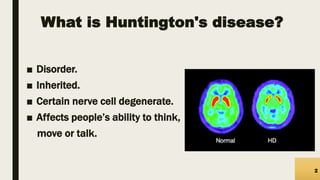
What is Huntington's disease?
■ Disorder.
■ Inherited.
■ Certain nerve cell degenerate.
■ Affects people’s ability to think,
move or talk.
How is it inherited?
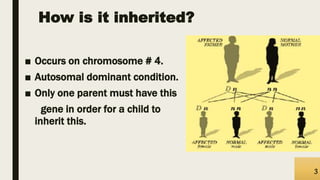
■ Occurs on chromosome # 4.
■ Autosomal dominant condition.
■ Only one parent must have this
gene in order for a child to
inherit this.
3
■ Makes CAG repeats occur more rapidly
– Normal 10 to 35 times.
– In defect 36 to 120 times (abnormal).
– Greater CAG repeats higher chances
Of receiving disease.
4
Signs and symptoms
■ Appears between age 30-50.
■ Minor twitching in fingers and toes.
■ Excessive restlessness.
■ Some clumsiness.
■ Periods of depression.
5
■ Short term memory loss.
■ Less ability to recognize routines.
■ Difficult to concentrate.
■ Troubling in moving eyes.
■ Speech impairment.
6
How it is detected?
■ Genetic testing's.
■ Neurological testing's.
■ Blood testing's.
7
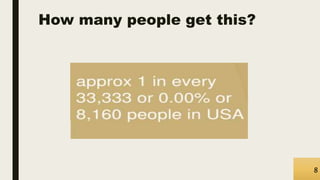
How many people get this?
8
Treatment or medications
■ No cure for HD as of this time.
■ Doctors prescribe tetra benzene to minimize the
jerky movements.
■ Some tranquilizers have proved helpful, but have
severe side effects.
■ Speech and physical therapies.
9
References
10
11
12

Huntington's disease

  • 1.
    HUNTINGTON’S DISEASE Presented by: AlishaMoazzam. B.S (HONS) BIOTECHNOLOGY. UNIVERSITY OF VETERINARY AND ANIMALS SCIENCES, LAHORE PAKISTAN.
  • 2.
    What is Huntington'sdisease? ■ Disorder. ■ Inherited. ■ Certain nerve cell degenerate. ■ Affects people’s ability to think, move or talk.
  • 3.
    How is itinherited? ■ Occurs on chromosome # 4. ■ Autosomal dominant condition. ■ Only one parent must have this gene in order for a child to inherit this. 3
  • 4.
    ■ Makes CAGrepeats occur more rapidly – Normal 10 to 35 times. – In defect 36 to 120 times (abnormal). – Greater CAG repeats higher chances Of receiving disease. 4
  • 5.
    Signs and symptoms ■Appears between age 30-50. ■ Minor twitching in fingers and toes. ■ Excessive restlessness. ■ Some clumsiness. ■ Periods of depression. 5
  • 6.
    ■ Short termmemory loss. ■ Less ability to recognize routines. ■ Difficult to concentrate. ■ Troubling in moving eyes. ■ Speech impairment. 6
  • 7.
    How it isdetected? ■ Genetic testing's. ■ Neurological testing's. ■ Blood testing's. 7
  • 8.
    How many peopleget this? 8
  • 9.
    Treatment or medications ■No cure for HD as of this time. ■ Doctors prescribe tetra benzene to minimize the jerky movements. ■ Some tranquilizers have proved helpful, but have severe side effects. ■ Speech and physical therapies. 9
  • 10.
  • 11.
  • 12.