FRACTURE SHAFT
HUMERUS
Edited by
Abdelrahman youssif
HYDERABAD
Mansoura university
faculty of medicine
orthopedics department
Supervisor: Head of department:
Prof.Dr.hani.M.Elmowafy
FRACTURE SHAFT
HUMERUS
 Introduction
 History
 Epidemiology
 Mechanism of injury
 Classification
 Clinical features
 Investigations
 Treatment
 Complications
INTRODUCTION
 3% to 5% of all fractures
 Most will heal with appropriate
conservative care, although a limited
number will require surgery for optimal
outcome.
GENERAL
CONSIDERATIONS
 Current research -- decreasing the
surgical failure rate through
 New implants and techniques,
 Optimizing the postinjury rehabilitation
programs
 Minimizing the duration and magnitude
of remaining disability.
GENERAL
CONSIDERATIONS
Successful treatment demands a
knowledge of :
 Anatomy,
 Biomechanics
 Techniques
 Patient Function and Expectations.
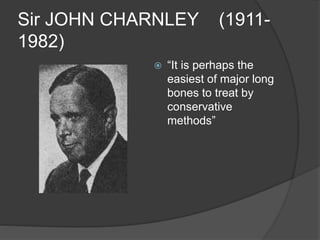
HISTORY
Sir JOHN CHARNLEY (1911-
1982)
 “It is perhaps the
easiest of major long
bones to treat by
conservative
methods”
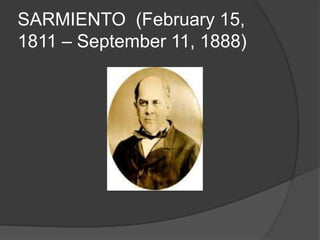
SARMIENTO (February 15,
1811 – September 11, 1888)
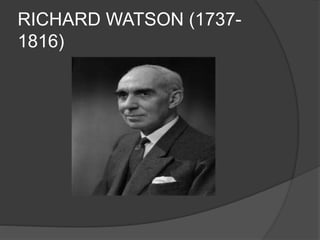
RICHARD WATSON (1737-
1816)
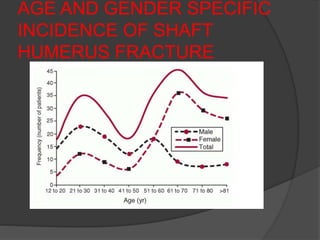
EPIDEMIOLOGY
 High energy trauma is more common in
the young males
 Low energy trauma is more common in
the elderly female
AGE AND GENDER SPECIFIC
INCIDENCE OF SHAFT
HUMERUS FRACTURE
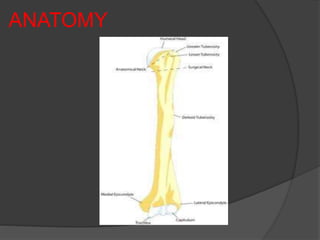
ANATOMY
 Proximally, the humerus is roughly
cylindrical in cross section, tapering to a
triangular shape distally.
 The medullary canal of the humerus
tapers to an end above the
supracondylar expansion.
 The humerus is well enveloped in
muscle and soft tissue, hence there is a
good prognosis for healing in the
majority of uncomplicated fractures.
ANATOMY
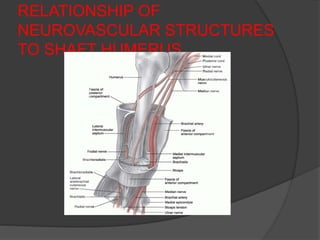
 Nutrient artery- enters the bone very
constantly at the junction of M/3- L/3 and
foramina of entry are concentrated in a
small area of the distal half of M/3 on
medial side
 Radial nerve- it does not travel along the
spiral groove and it lies close to the inferior
lip of spiral groove but not in it
 It is only for a short distance near the
lateral supracondylar ridge that the nerve is
direct contact with the humerus and
pierces lateral intermuscular septum
ANATOMY
RELATIONSHIP OF
NEUROVASCULAR STRUCTURES
TO SHAFT HUMERUS
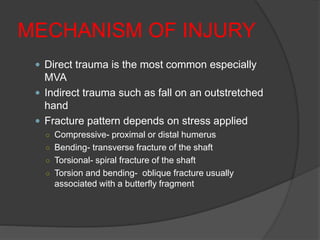
MECHANISM OF INJURY
 Direct trauma is the most common especially
MVA
 Indirect trauma such as fall on an outstretched
hand
 Fracture pattern depends on stress applied
○ Compressive- proximal or distal humerus
○ Bending- transverse fracture of the shaft
○ Torsional- spiral fracture of the shaft
○ Torsion and bending- oblique fracture usually
associated with a butterfly fragment
MECHANISM OF HEALING
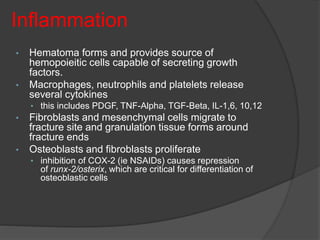
Inflammation
• Hematoma forms and provides source of
hemopoieitic cells capable of secreting growth
factors.
• Macrophages, neutrophils and platelets release
several cytokines
• this includes PDGF, TNF-Alpha, TGF-Beta, IL-1,6, 10,12
• Fibroblasts and mesenchymal cells migrate to
fracture site and granulation tissue forms around
fracture ends
• Osteoblasts and fibroblasts proliferate
• inhibition of COX-2 (ie NSAIDs) causes repression
of runx-2/osterix, which are critical for differentiation of
osteoblastic cells
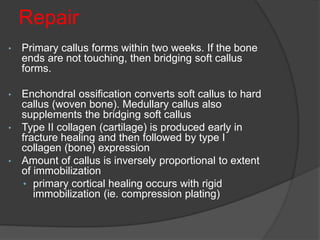
Repair
• Primary callus forms within two weeks. If the bone
ends are not touching, then bridging soft callus
forms.
• Enchondral ossification converts soft callus to hard
callus (woven bone). Medullary callus also
supplements the bridging soft callus
• Type II collagen (cartilage) is produced early in
fracture healing and then followed by type I
collagen (bone) expression
• Amount of callus is inversely proportional to extent
of immobilization
• primary cortical healing occurs with rigid
immobilization (ie. compression plating)
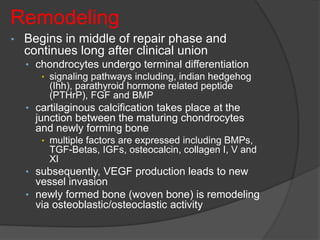
Remodeling
• Begins in middle of repair phase and
continues long after clinical union
• chondrocytes undergo terminal differentiation
• signaling pathways including, indian hedgehog
(Ihh), parathyroid hormone related peptide
(PTHrP), FGF and BMP
• cartilaginous calcification takes place at the
junction between the maturing chondrocytes
and newly forming bone
• multiple factors are expressed including BMPs,
TGF-Betas, IGFs, osteocalcin, collagen I, V and
XI
• subsequently, VEGF production leads to new
vessel invasion
• newly formed bone (woven bone) is remodeling
via osteoblastic/osteoclastic activity
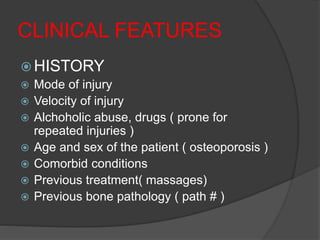
CLINICAL FEATURES
 HISTORY
 Mode of injury
 Velocity of injury
 Alchoholic abuse, drugs ( prone for
repeated injuries )
 Age and sex of the patient ( osteoporosis )
 Comorbid conditions
 Previous treatment( massages)
 Previous bone pathology ( path # )
CLINICAL FEATURES
 Pain.
 Deformity.
 Bruising.
 Crepitus.
 Abnormal mobility
 Swelling.
 Any neurovascular injury
CLINICAL FEATURES
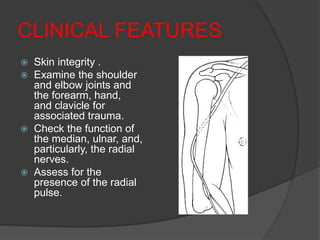
 Skin integrity .
 Examine the shoulder
and elbow joints and
the forearm, hand,
and clavicle for
associated trauma.
 Check the function of
the median, ulnar, and,
particularly, the radial
nerves.
 Assess for the
presence of the radial
pulse.
INVESTIGATIONS
 Radiographs
 CT scan
 MRI scan
 Nerve conduction studies
 Routine investigations
IMAGING
AP and lateral views plain x-ray of the
humerus,
including the joints below and above the
injury.
 CT scanning may also be indicated in
the rare situation where a significant
rotational abnormality exists. A CT scan
through the humeral condyles distally and
the humeral head proximally can provide
exact rotational alignment
 MRI for pathological cause
CLASSIFICATION
 CLOSED
 OPEN
 LOCATION- proximal, middle, distal
 FRACTURE PATTERN-tranverse, spiral,
oblique,comminuted segmental
 SOFT TISSUE STATUS – Gustilo
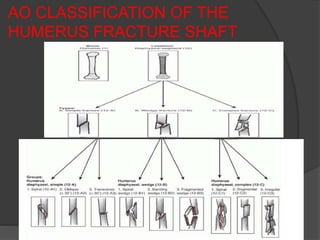
AO CLASSIFICATION OF THE
HUMERUS FRACTURE SHAFT
ASSOCIATED INJURIES
○ Radial Nerve injury = Wrist Drop =
Inability of extend wrist, fingers, thumb,
Loss of sensation over dorsal web
space of 1st digit
 Neuropraxia at time of injury will often
resolve spontaneously
 Nerve palsy after manipulation or
splinting is due to nerve entrapment
and must be immediately explored by
orthopedic surgery
○ Ulnar and Median nerve injury (less
common)
○ Brachial Artery Injury
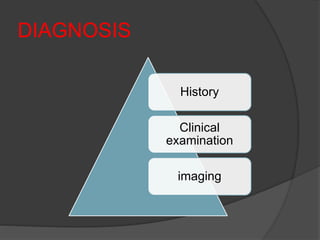
DIAGNOSIS
History
Clinical
examination
imaging
TREATMENT
Goal of treatment is to
establish
union with acceptable
alignment
TREATMENT OPTIONS
Non operative operative
NON OPERATIVE
TREATMENT
 INDICATIONS
Undisplaced closed simple
fractures
Displaced closed fractures with
less than 20 anterior angulation, 30
varus/ valgus angulation
Spiral fractures
Short oblique fractures
HUMERAL SHAFT
FRACTURES Conservative Treatment
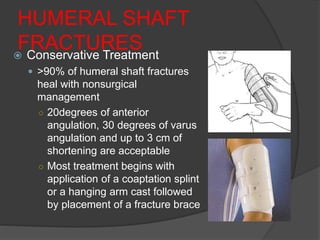
 >90% of humeral shaft fractures
heal with nonsurgical
management
○ 20degrees of anterior
angulation, 30 degrees of varus
angulation and up to 3 cm of
shortening are acceptable
○ Most treatment begins with
application of a coaptation splint
or a hanging arm cast followed
by placement of a fracture brace
NON OPERATIVE
METHODS
 Splinting:
 Fractures are splinted with a hanging splint,
which is from the axilla, under the elbow,
postioned to the top of the shoulder .
 The U splint.
 The splinted extremity is supported by a
sling.
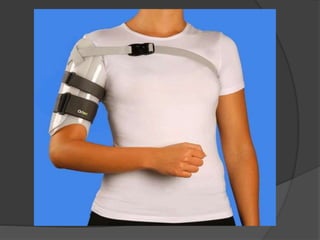
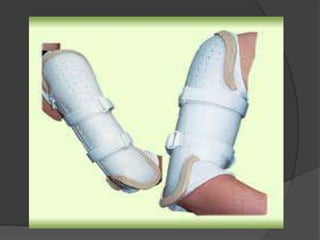
 Immobilization by fracture bracing is
continued for at least 2 months or until
clinical and radiographic evidence of fracture
healing is observed.
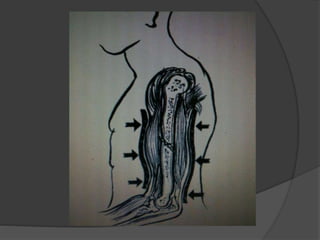
HUMERUS BRACE
- INTRODUCTION
 A closed method of treating fractures
based on the belief that continuing
function while a fracture is uniting ,
encourages osteogenesis, promotes the
healing of tissues and prevents the
development of joint stiffness, thus
accelerating rehabilitation
 Not merely a technique but constitute a
positive attitude towards fracture
healing.
CONCEPT
 The end to end bone contact is not
required for bony union and that rigid
immobilization of the fracture fragment
and immobilization of the joints above
and below a fracture as well as
prolonged rest are detrimental to
healing.
 It complements rather than replaces
other forms of treatment.
CONTRAINDICATIONS
 Lack of co-operation by the pt.
 Bed-ridden & mentally incompetent pts.
 Deficient sensibility of the limb [D.M with
P.N]
 When the brace cannot fitted closely
and accurately.
 Fractures of both bones forearm when
reduction is difficult.
 Intraarticular fractures.
TIME TO APPLY
 Not at the time of injury.
 Regular casts, time to correct any angular
or rotational deformity.
 Compound # es , application to be
delayed.
 Assess the # , when pain and swelling
subsided
1. Minor movts at # site should be pain free
2. Any deformity should disappear once
deforming forces are removed
3. Reasonable resistance to telescoping.
OPERATIVE MANAGEMENT
OPERATIVE TREATMENT
INDICATIONS
 Fractures in which reduction is unable to be
achieved or maintained.
 Fractures with nerve injuries after reduction
maneuvers.
 Open fractures.
 Intra articular extension injury.
 Neurovascular injury.
 Impending pathologic fractures.
 Segmental fractures.
 Multiple extremity fractures.
METHODS OF SURGICAL
MANAGEMENT
 Plating
 Nailing
 External fixation
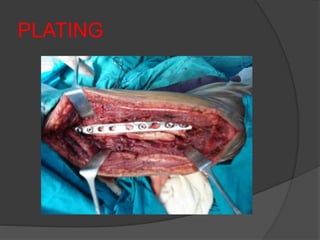
PLATING
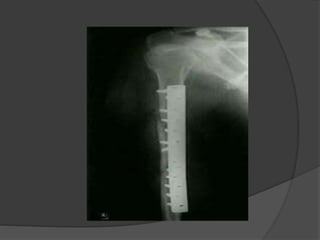
PLATING
 Plate osteosynthesis remains the
criterion standard of fixation of humeral
shaft fractures
 high union rate, low complication rate,
and a rapid return to function
 Complications are infrequent and
include radial nerve palsy, infection and
refracture.
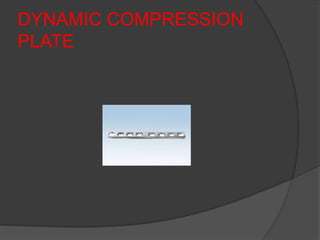
DYNAMIC COMPRESSION
PLATE
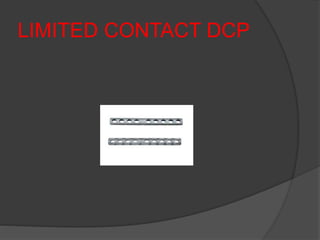
LIMITED CONTACT DCP
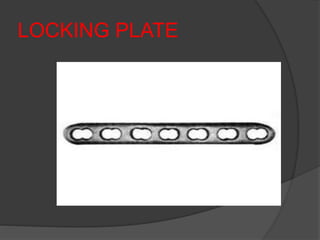
LOCKING PLATE
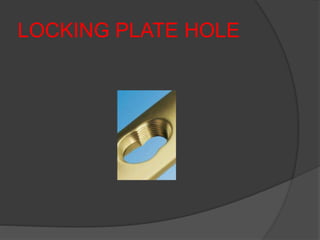
LOCKING PLATE HOLE
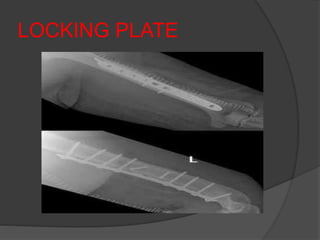
LOCKING PLATE
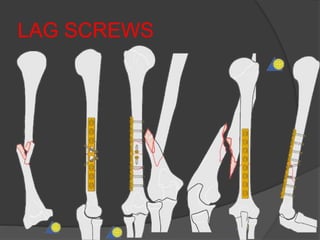
LAG SCREWS
INTRAMEDULLARY NAILING
 Rush pins or Enders nails, while effective
in many cases with simple fracture
patterns, had significant drawbacks such
as poor or nonexistent axial or rotational
stability
 With the newer generation of nails came a
number of locking mechanisms distally
including interference fits from expandable
bolts (Seidel nail) or ridged fins (Trueflex
nail), or interlocking screws (Russell-Taylor
nail, Synthes nail, Biomet nail)
INTRAMEDULLARY NAILING
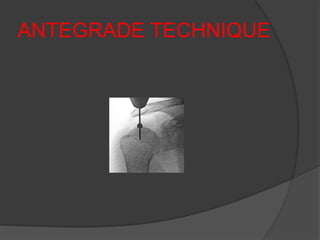
 Antegrade Technique
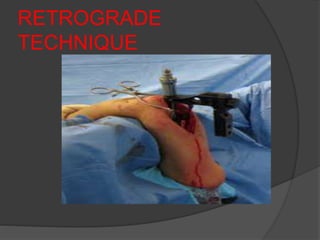
 Retrograde Technique-best suited for
fractures in the middle and distal thirds
of the humerus
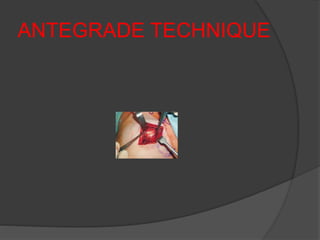
ANTEGRADE TECHNIQUE
ANTEGRADE TECHNIQUE
RETROGRADE
TECHNIQUE
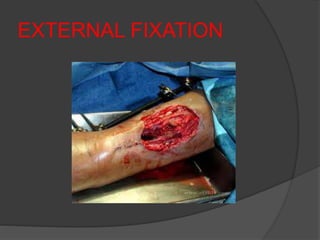
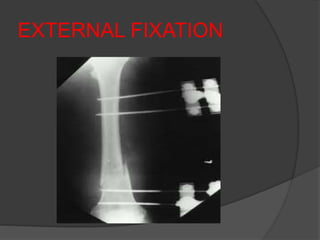
EXTERNAL FIXATION
 External fixation is cumbersome for the
humerus and the complication rate is
high.
 AS IT MAY accentuate the risk of delayed
union and malunion, resulting in
significant rates of pin tract irritation,
infection, and pin breakage.
EXTERNAL FIXATION
EXTERNAL FIXATION
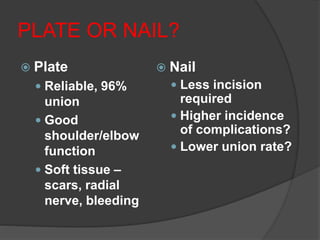
PLATE OR NAIL?
 Plate
 Reliable, 96%
union
 Good
shoulder/elbow
function
 Soft tissue –
scars, radial
nerve, bleeding
 Nail
 Less incision
required
 Higher incidence
of complications?
 Lower union rate?
WHAT IS THE ROLE FOR
NAILING?
 Segmental fractures
 Particularly with a very proximal fracture line
 Pathologic fractures
 ? Cosmesis
COMPLICATIONS OF OPERATIVE
MANAGEMENT
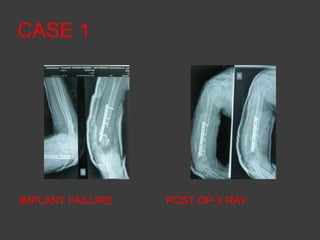
 Injury to the radial nerve.
 Nonunion rates are higher when fractures
are treated with intramedullary nailing.
 Malunion.
 Shoulder pain -when fractures are treated
with nails and with plates .
 Elbow or shoulder stiffness.
CASE 1
IMPLANT FAILURE POST OP X RAY
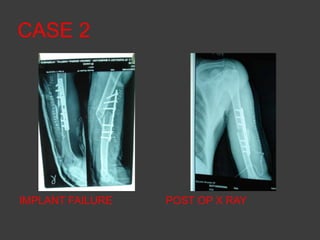
CASE 2
IMPLANT FAILURE POST OP X RAY
REHABILITATION
 Allow early shoulder and elbow rom
 Weight bearing delayed till fracture is
united
Thank
you

Humerus fracture

  • 1.
    FRACTURE SHAFT HUMERUS Edited by Abdelrahmanyoussif HYDERABAD Mansoura university faculty of medicine orthopedics department Supervisor: Head of department: Prof.Dr.hani.M.Elmowafy
  • 2.
    FRACTURE SHAFT HUMERUS  Introduction History  Epidemiology  Mechanism of injury  Classification  Clinical features  Investigations  Treatment  Complications
  • 3.
    INTRODUCTION  3% to5% of all fractures  Most will heal with appropriate conservative care, although a limited number will require surgery for optimal outcome.
  • 4.
    GENERAL CONSIDERATIONS  Current research-- decreasing the surgical failure rate through  New implants and techniques,  Optimizing the postinjury rehabilitation programs  Minimizing the duration and magnitude of remaining disability.
  • 5.
    GENERAL CONSIDERATIONS Successful treatment demandsa knowledge of :  Anatomy,  Biomechanics  Techniques  Patient Function and Expectations.
  • 6.
  • 7.
    Sir JOHN CHARNLEY(1911- 1982)  “It is perhaps the easiest of major long bones to treat by conservative methods”
  • 8.
    SARMIENTO (February 15, 1811– September 11, 1888)
  • 9.
  • 10.
    EPIDEMIOLOGY  High energytrauma is more common in the young males  Low energy trauma is more common in the elderly female
  • 11.
    AGE AND GENDERSPECIFIC INCIDENCE OF SHAFT HUMERUS FRACTURE
  • 12.
    ANATOMY  Proximally, thehumerus is roughly cylindrical in cross section, tapering to a triangular shape distally.  The medullary canal of the humerus tapers to an end above the supracondylar expansion.  The humerus is well enveloped in muscle and soft tissue, hence there is a good prognosis for healing in the majority of uncomplicated fractures.
  • 13.
    ANATOMY  Nutrient artery-enters the bone very constantly at the junction of M/3- L/3 and foramina of entry are concentrated in a small area of the distal half of M/3 on medial side  Radial nerve- it does not travel along the spiral groove and it lies close to the inferior lip of spiral groove but not in it  It is only for a short distance near the lateral supracondylar ridge that the nerve is direct contact with the humerus and pierces lateral intermuscular septum
  • 14.
  • 15.
  • 16.
    MECHANISM OF INJURY Direct trauma is the most common especially MVA  Indirect trauma such as fall on an outstretched hand  Fracture pattern depends on stress applied ○ Compressive- proximal or distal humerus ○ Bending- transverse fracture of the shaft ○ Torsional- spiral fracture of the shaft ○ Torsion and bending- oblique fracture usually associated with a butterfly fragment
  • 17.
  • 18.
    Inflammation • Hematoma formsand provides source of hemopoieitic cells capable of secreting growth factors. • Macrophages, neutrophils and platelets release several cytokines • this includes PDGF, TNF-Alpha, TGF-Beta, IL-1,6, 10,12 • Fibroblasts and mesenchymal cells migrate to fracture site and granulation tissue forms around fracture ends • Osteoblasts and fibroblasts proliferate • inhibition of COX-2 (ie NSAIDs) causes repression of runx-2/osterix, which are critical for differentiation of osteoblastic cells
  • 19.
    Repair • Primary callusforms within two weeks. If the bone ends are not touching, then bridging soft callus forms. • Enchondral ossification converts soft callus to hard callus (woven bone). Medullary callus also supplements the bridging soft callus • Type II collagen (cartilage) is produced early in fracture healing and then followed by type I collagen (bone) expression • Amount of callus is inversely proportional to extent of immobilization • primary cortical healing occurs with rigid immobilization (ie. compression plating)
  • 20.
    Remodeling • Begins inmiddle of repair phase and continues long after clinical union • chondrocytes undergo terminal differentiation • signaling pathways including, indian hedgehog (Ihh), parathyroid hormone related peptide (PTHrP), FGF and BMP • cartilaginous calcification takes place at the junction between the maturing chondrocytes and newly forming bone • multiple factors are expressed including BMPs, TGF-Betas, IGFs, osteocalcin, collagen I, V and XI • subsequently, VEGF production leads to new vessel invasion • newly formed bone (woven bone) is remodeling via osteoblastic/osteoclastic activity
  • 21.
    CLINICAL FEATURES  HISTORY Mode of injury  Velocity of injury  Alchoholic abuse, drugs ( prone for repeated injuries )  Age and sex of the patient ( osteoporosis )  Comorbid conditions  Previous treatment( massages)  Previous bone pathology ( path # )
  • 22.
    CLINICAL FEATURES  Pain. Deformity.  Bruising.  Crepitus.  Abnormal mobility  Swelling.  Any neurovascular injury
  • 23.
    CLINICAL FEATURES  Skinintegrity .  Examine the shoulder and elbow joints and the forearm, hand, and clavicle for associated trauma.  Check the function of the median, ulnar, and, particularly, the radial nerves.  Assess for the presence of the radial pulse.
  • 24.
    INVESTIGATIONS  Radiographs  CTscan  MRI scan  Nerve conduction studies  Routine investigations
  • 25.
    IMAGING AP and lateralviews plain x-ray of the humerus, including the joints below and above the injury.  CT scanning may also be indicated in the rare situation where a significant rotational abnormality exists. A CT scan through the humeral condyles distally and the humeral head proximally can provide exact rotational alignment  MRI for pathological cause
  • 26.
    CLASSIFICATION  CLOSED  OPEN LOCATION- proximal, middle, distal  FRACTURE PATTERN-tranverse, spiral, oblique,comminuted segmental  SOFT TISSUE STATUS – Gustilo
  • 27.
    AO CLASSIFICATION OFTHE HUMERUS FRACTURE SHAFT
  • 28.
    ASSOCIATED INJURIES ○ RadialNerve injury = Wrist Drop = Inability of extend wrist, fingers, thumb, Loss of sensation over dorsal web space of 1st digit  Neuropraxia at time of injury will often resolve spontaneously  Nerve palsy after manipulation or splinting is due to nerve entrapment and must be immediately explored by orthopedic surgery ○ Ulnar and Median nerve injury (less common) ○ Brachial Artery Injury
  • 29.
  • 30.
    TREATMENT Goal of treatmentis to establish union with acceptable alignment
  • 31.
  • 33.
    NON OPERATIVE TREATMENT  INDICATIONS Undisplacedclosed simple fractures Displaced closed fractures with less than 20 anterior angulation, 30 varus/ valgus angulation Spiral fractures Short oblique fractures
  • 34.
    HUMERAL SHAFT FRACTURES ConservativeTreatment  >90% of humeral shaft fractures heal with nonsurgical management ○ 20degrees of anterior angulation, 30 degrees of varus angulation and up to 3 cm of shortening are acceptable ○ Most treatment begins with application of a coaptation splint or a hanging arm cast followed by placement of a fracture brace
  • 35.
    NON OPERATIVE METHODS  Splinting: Fractures are splinted with a hanging splint, which is from the axilla, under the elbow, postioned to the top of the shoulder .  The U splint.  The splinted extremity is supported by a sling.  Immobilization by fracture bracing is continued for at least 2 months or until clinical and radiographic evidence of fracture healing is observed.
  • 36.
    HUMERUS BRACE - INTRODUCTION A closed method of treating fractures based on the belief that continuing function while a fracture is uniting , encourages osteogenesis, promotes the healing of tissues and prevents the development of joint stiffness, thus accelerating rehabilitation  Not merely a technique but constitute a positive attitude towards fracture healing.
  • 37.
    CONCEPT  The endto end bone contact is not required for bony union and that rigid immobilization of the fracture fragment and immobilization of the joints above and below a fracture as well as prolonged rest are detrimental to healing.  It complements rather than replaces other forms of treatment.
  • 39.
    CONTRAINDICATIONS  Lack ofco-operation by the pt.  Bed-ridden & mentally incompetent pts.  Deficient sensibility of the limb [D.M with P.N]  When the brace cannot fitted closely and accurately.  Fractures of both bones forearm when reduction is difficult.  Intraarticular fractures.
  • 40.
    TIME TO APPLY Not at the time of injury.  Regular casts, time to correct any angular or rotational deformity.  Compound # es , application to be delayed.  Assess the # , when pain and swelling subsided 1. Minor movts at # site should be pain free 2. Any deformity should disappear once deforming forces are removed 3. Reasonable resistance to telescoping.
  • 43.
  • 44.
    OPERATIVE TREATMENT INDICATIONS  Fracturesin which reduction is unable to be achieved or maintained.  Fractures with nerve injuries after reduction maneuvers.  Open fractures.  Intra articular extension injury.  Neurovascular injury.  Impending pathologic fractures.  Segmental fractures.  Multiple extremity fractures.
  • 45.
    METHODS OF SURGICAL MANAGEMENT Plating  Nailing  External fixation
  • 46.
  • 47.
    PLATING  Plate osteosynthesisremains the criterion standard of fixation of humeral shaft fractures  high union rate, low complication rate, and a rapid return to function  Complications are infrequent and include radial nerve palsy, infection and refracture.
  • 48.
  • 50.
  • 51.
  • 52.
  • 53.
  • 54.
  • 55.
    INTRAMEDULLARY NAILING  Rushpins or Enders nails, while effective in many cases with simple fracture patterns, had significant drawbacks such as poor or nonexistent axial or rotational stability  With the newer generation of nails came a number of locking mechanisms distally including interference fits from expandable bolts (Seidel nail) or ridged fins (Trueflex nail), or interlocking screws (Russell-Taylor nail, Synthes nail, Biomet nail)
  • 56.
    INTRAMEDULLARY NAILING  AntegradeTechnique  Retrograde Technique-best suited for fractures in the middle and distal thirds of the humerus
  • 57.
  • 58.
  • 59.
  • 60.
    EXTERNAL FIXATION  Externalfixation is cumbersome for the humerus and the complication rate is high.  AS IT MAY accentuate the risk of delayed union and malunion, resulting in significant rates of pin tract irritation, infection, and pin breakage.
  • 61.
  • 62.
  • 63.
    PLATE OR NAIL? Plate  Reliable, 96% union  Good shoulder/elbow function  Soft tissue – scars, radial nerve, bleeding  Nail  Less incision required  Higher incidence of complications?  Lower union rate?
  • 64.
    WHAT IS THEROLE FOR NAILING?  Segmental fractures  Particularly with a very proximal fracture line  Pathologic fractures  ? Cosmesis
  • 65.
    COMPLICATIONS OF OPERATIVE MANAGEMENT Injury to the radial nerve.  Nonunion rates are higher when fractures are treated with intramedullary nailing.  Malunion.  Shoulder pain -when fractures are treated with nails and with plates .  Elbow or shoulder stiffness.
  • 66.
  • 67.
  • 68.
    REHABILITATION  Allow earlyshoulder and elbow rom  Weight bearing delayed till fracture is united
  • 69.