HUMERUS FRACTURES
Fahad zakwan
MD5
• In evaluating humerus injuries, being able to classify the fracture and if
necessary reduce, immobilize and know when to seek orthopaedic
consultation is important.
• 80% of proximal humeral fractures are non displaced or minimally
displaced and therefore can be managed nonoperatively.
• Distal humeral fractures are associated with ipsilateral proximal forearm
fractures.
• Rarely, vascular or nervous injuries are associated with humeral fractures.
HUMERUS FRACTURES
Proximal
Mid shaft
Supra condylar
1. PROXIMAL HUMERUS FRACTURES
Primarily older population
arm pronation limits abduction
Older pts #, while younger pts dislocate
Both if middle aged
Arm held close to body, mov’t limited by pain
Tender, hematoma, bruising
Proximal Humerus Fractures
85% minimally displaced – conservative rx
Separation along old epiphyseal lines
Articular surface (anatomic neck)
Greater and lesser tuberosity
Humeral shaft (surgical neck)
Considered displaced if:
> 1cm away
> 45 degrees
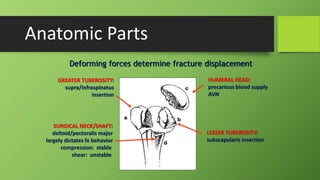
HUMERAL HEAD:
precarious blood supply
AVN
LESSER TUBEROSITY:
subscapularis insertion
GREATER TUBEROSITY:
supra/infraspinatus
insertion
SURGICAL NECK/SHAFT:
deltoid/pectoralis major
largely dictates fx behavior
compression: stable
shear: unstable
Anatomic Parts
Deforming forces determine fracture displacement
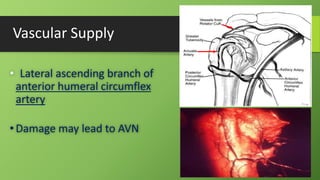
Vascular Supply
• Lateral ascending branch of
anterior humeral circumflex
artery
•Damage may lead to AVN
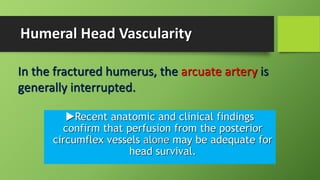
Humeral Head Vascularity
Recent anatomic and clinical findings
confirm that perfusion from the posterior
circumflex vessels alone may be adequate for
head survival.
In the fractured humerus, the arcuate artery is
generally interrupted.
Proximal Humeral Fractures
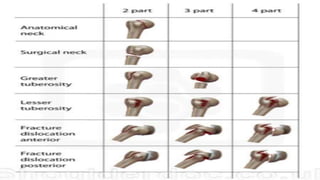
Neer’s Classification
•The two main components of the class
ification are:
1.number of fracture parts
2.displacement
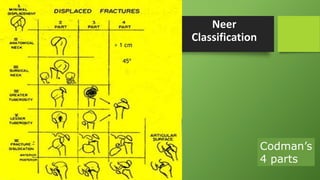
Neer
Classification
Codman’s
4 parts
> 1 cm
45º
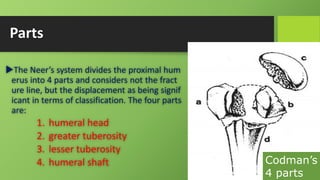
Parts
The Neer’s system divides the proximal hum
erus into 4 parts and considers not the fract
ure line, but the displacement as being signif
icant in terms of classification. The four parts
are:
1. humeral head
2. greater tuberosity
3. lesser tuberosity
4. humeral shaft Codman’s
4 parts
One-part fracture
•fracture lines involve 1 - 4 parts
•none of the parts are displaced
(i.e. <1cm and <45 degrees)
•These undisplaced / minimally displaced fractures accoun
t for ~ 70 - 80% of all proximal humeral fractures and a
re almost always treated conservatively.
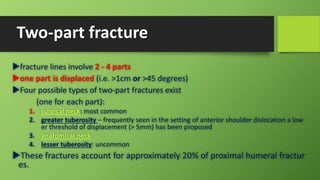
Two-part fracture
fracture lines involve 2 - 4 parts
one part is displaced (i.e. >1cm or >45 degrees)
Four possible types of two-part fractures exist
(one for each part):
1. surgical neck: most common
2. greater tuberosity – frequently seen in the setting of anterior shoulder dislocation a low
er threshold of displacement (> 5mm) has been proposed
3. anatomical neck
4. lesser tuberosity: uncommon
These fractures account for approximately 20% of proximal humeral fractur
es.
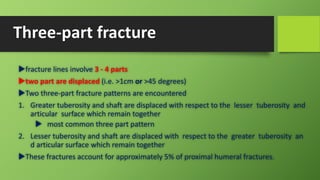
Three-part fracture
fracture lines involve 3 - 4 parts
two part are displaced (i.e. >1cm or >45 degrees)
Two three-part fracture patterns are encountered
1. Greater tuberosity and shaft are displaced with respect to the lesser tuberosity and
articular surface which remain together
 most common three part pattern
2. Lesser tuberosity and shaft are displaced with respect to the greater tuberosity an
d articular surface which remain together
These fractures account for approximately 5% of proximal humeral fractures.
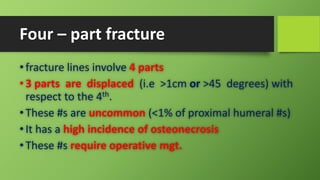
Four – part fracture
•fracture lines involve 4 parts
•3 parts are displaced (i.e >1cm or >45 degrees) with
respect to the 4th.
•These #s are uncommon (<1% of proximal humeral #s)
•It has a high incidence of osteonecrosis
•These #s require operative mgt.
Proximal Humerus Fractures
Management
•Minimally displaced
•# held together by capsule, periosteum, muscles
•Analgesia, sling and swathe x 3-4/52
•2,3,4 part – ORIF
•Fracture/dislocation – caution with force, don’t
want to displace segments
•Complications: adhesive capsulitis
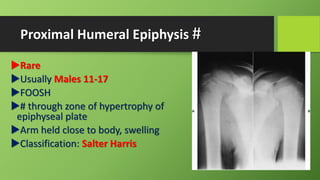
Proximal Humeral Epiphysis #
Rare
Usually Males 11-17
FOOSH
# through zone of hypertrophy of
epiphyseal plate
Arm held close to body, swelling
Classification: Salter Harris
Proximal Humeral Epiphysis
Management
•Potential for growth disturbance
•<6 yo : usually Salter I, analgesia, sling and swathe
•> 6 yo: usually Salter II
•If > 20 deg need to reduce
MIDSHAFT HUMERUS FRACTURES
•Mechanism
•Direct blow, severe twisting, FOOSH
•Obvious deformity, crepitus
•Shortened limb, rotated
•Assess radial nerve
•Exam shoulder and elbow
Midshaft Humerus Fractures
Management
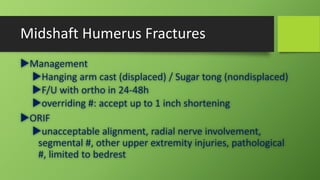
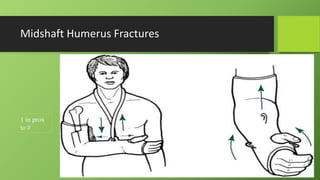
Hanging arm cast (displaced) / Sugar tong (nondisplaced)
F/U with ortho in 24-48h
overriding #: accept up to 1 inch shortening
ORIF
unacceptable alignment, radial nerve involvement,
segmental #, other upper extremity injuries, pathological
#, limited to bedrest
Midshaft Humerus Fractures
1 in prox
to #
Midshaft Humerus Fractures
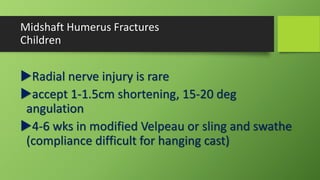
Children
Radial nerve injury is rare
accept 1-1.5cm shortening, 15-20 deg
angulation
4-6 wks in modified Velpeau or sling and swathe
(compliance difficult for hanging cast)
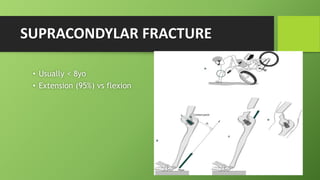
SUPRACONDYLAR FRACTURE
• Usually < 8yo
• Extension (95%) vs flexion
Supracondylar Fracture-
clinically
•Mild swelling to gross deformity
•arm held to side, immobile, extension
•S-shaped configuration
Supracondylar Fracture-
Classification
• Gartland
• I - nondisplaced
• II - displaced with intact posterior cortex
• III - displaced fracture, no intact cortex
• A: postermedial rotation of distal fragment
• B: posterolateral rotation
Supracondylar Fracture-
Management
• If NV compromise - urgent ortho consult
• if no response in 60 min may attempt 1 reduction
• watch brachial artery and median nerve
• Gartland I - splint and ortho f/u 24h
• Gartland II - controversy but most get pinned
• Gartland III - closed reduction and pin
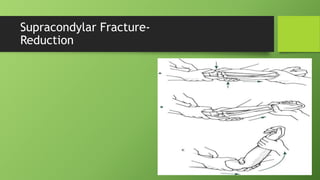
Supracondylar Fracture-
Reduction
PEARL *** Physical examination
• Pain occurs with palpation or movement of
shoulder or elbow.
• Ecchymosis and Oedema are usually present
• Perform careful neurovascular examination
• Radial nerve injury following humeral shaft fractures
is relatively common
Proximal #
• Patients presents with a painful shoulder and a very
restricted ROM.
• Obvious deformity is suggestive of glenohumeral
dislocation.
• Swelling and ecchymosis are common examination findings
• Nerve damage with proximal humeral # is rare
• Have risk of vascular injuries
Diaphyseal #
• Presents with painful deformed arm that may be
associated with radial nerve palsy.
• Usually the radial nerve palsy is reversible
• Crepitus may be observed
• Shortening of the arm suggests displacement
Assessment of radial nerve
• The radial nerve primary motor function is to innervate the
dorsal extrinsic muscles in the fore arm
• Motor testing should include extension of the wrist and
metacarpophalangeal (MCP) joints as well as abduction and
extension of the thumb.
• Proximal injury of the radial nerve causes wrist drop
• On examination, the fingers are in flexion at the MCP joints and
thumb is adducted.
Treatment and management
•Prehospital care
•Immobilization of the limb
•Hospital care
•Minimize the patients movements and
provide analgesia to make the patient
comfortable in the acute care settings
Proximal humerus #
• Most minimally displaced proximal fractures can be
managed non operatively.
• Sling and swathe application is the primary treatment
• Fractures of the anatomical neck should be referred to
orthopedist due to the risk of avascular necrosis
• Neers 2,3,4 - ORIF
Humerus shaft (diaphyseal) #
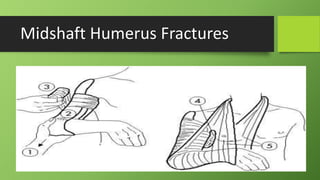
• Humerus shaft fractures should be stabilized using coaptation
splint.
• Wrap splinting material snugly from axilla to nape of neck,
creating a stirrup around the elbow.
• Fracture reduction is usually not necessary because reduction is
usually difficult to maintain.
• Because of the shoulders ability to compensate, 30 – 40
degrees angulation is acceptable
consultations
• Most isolated proximal and diaphyseal humeral fractures can be
managed by an orthopedist in an outpatient setting.
• Even patients with fractures that may eventually require surgery generally may be
discharged with early follow up care if fracture is otherwise uncomplicated.
• Fractures that can not be adequately reduced or when fracture reduction
can not be controlled with functional bracing because of patient obesity,
head trauma, or soft tissue injuries, surgical stabilization is indicated.
• Open fractures represent a surgical emergency, obtain an
immediate orthopaedic consult.
• Penetrating trauma requires particular neurovascular scrutiny.
• Glenohumeral dislocation in conjunction with a proximal
humerus fracture requires orthopaedic evaluation.
• Floating elbow (an ipsilateral humerus and forearm fracture)
requires operative repair.
medications
NSAIDS:
• Ibuprofen:
• Usually DOC for treatment of mild to moderately severe pain, if no contraindications.
• Inhibits inflammatory reactions and pain, probably by decreasing activity of enzyme
cyclooxygenase, which inhibits prostaglandin synthesis.
• 300 – 800 mg 6 – 8 hrly
• Ketoprofen
• Naproxen
• Flurbiprofen**.
ANALGESICS
• Acetaminophen:
• DOC for treatment of pain in patients with documented hypersensitivity to
aspirin or NSAIDS and in those with upper GI disease or taking oral
anticoagulants.
• Acetaminophen and codaine
• Morphine sulphate
ANXIOLYTICS
• lorazepam

4. humerus fractures

  • 1.
  • 2.
    • In evaluatinghumerus injuries, being able to classify the fracture and if necessary reduce, immobilize and know when to seek orthopaedic consultation is important. • 80% of proximal humeral fractures are non displaced or minimally displaced and therefore can be managed nonoperatively. • Distal humeral fractures are associated with ipsilateral proximal forearm fractures. • Rarely, vascular or nervous injuries are associated with humeral fractures.
  • 3.
  • 4.
    1. PROXIMAL HUMERUSFRACTURES Primarily older population arm pronation limits abduction Older pts #, while younger pts dislocate Both if middle aged Arm held close to body, mov’t limited by pain Tender, hematoma, bruising
  • 5.
    Proximal Humerus Fractures 85%minimally displaced – conservative rx Separation along old epiphyseal lines Articular surface (anatomic neck) Greater and lesser tuberosity Humeral shaft (surgical neck) Considered displaced if: > 1cm away > 45 degrees
  • 6.
    HUMERAL HEAD: precarious bloodsupply AVN LESSER TUBEROSITY: subscapularis insertion GREATER TUBEROSITY: supra/infraspinatus insertion SURGICAL NECK/SHAFT: deltoid/pectoralis major largely dictates fx behavior compression: stable shear: unstable Anatomic Parts Deforming forces determine fracture displacement
  • 7.
    Vascular Supply • Lateralascending branch of anterior humeral circumflex artery •Damage may lead to AVN
  • 8.
    Humeral Head Vascularity Recentanatomic and clinical findings confirm that perfusion from the posterior circumflex vessels alone may be adequate for head survival. In the fractured humerus, the arcuate artery is generally interrupted.
  • 9.
    Proximal Humeral Fractures Neer’sClassification •The two main components of the class ification are: 1.number of fracture parts 2.displacement
  • 10.
  • 11.
    Parts The Neer’s systemdivides the proximal hum erus into 4 parts and considers not the fract ure line, but the displacement as being signif icant in terms of classification. The four parts are: 1. humeral head 2. greater tuberosity 3. lesser tuberosity 4. humeral shaft Codman’s 4 parts
  • 12.
    One-part fracture •fracture linesinvolve 1 - 4 parts •none of the parts are displaced (i.e. <1cm and <45 degrees) •These undisplaced / minimally displaced fractures accoun t for ~ 70 - 80% of all proximal humeral fractures and a re almost always treated conservatively.
  • 13.
    Two-part fracture fracture linesinvolve 2 - 4 parts one part is displaced (i.e. >1cm or >45 degrees) Four possible types of two-part fractures exist (one for each part): 1. surgical neck: most common 2. greater tuberosity – frequently seen in the setting of anterior shoulder dislocation a low er threshold of displacement (> 5mm) has been proposed 3. anatomical neck 4. lesser tuberosity: uncommon These fractures account for approximately 20% of proximal humeral fractur es.
  • 14.
    Three-part fracture fracture linesinvolve 3 - 4 parts two part are displaced (i.e. >1cm or >45 degrees) Two three-part fracture patterns are encountered 1. Greater tuberosity and shaft are displaced with respect to the lesser tuberosity and articular surface which remain together  most common three part pattern 2. Lesser tuberosity and shaft are displaced with respect to the greater tuberosity an d articular surface which remain together These fractures account for approximately 5% of proximal humeral fractures.
  • 15.
    Four – partfracture •fracture lines involve 4 parts •3 parts are displaced (i.e >1cm or >45 degrees) with respect to the 4th. •These #s are uncommon (<1% of proximal humeral #s) •It has a high incidence of osteonecrosis •These #s require operative mgt.
  • 17.
    Proximal Humerus Fractures Management •Minimallydisplaced •# held together by capsule, periosteum, muscles •Analgesia, sling and swathe x 3-4/52 •2,3,4 part – ORIF •Fracture/dislocation – caution with force, don’t want to displace segments •Complications: adhesive capsulitis
  • 18.
    Proximal Humeral Epiphysis# Rare Usually Males 11-17 FOOSH # through zone of hypertrophy of epiphyseal plate Arm held close to body, swelling Classification: Salter Harris
  • 19.
    Proximal Humeral Epiphysis Management •Potentialfor growth disturbance •<6 yo : usually Salter I, analgesia, sling and swathe •> 6 yo: usually Salter II •If > 20 deg need to reduce
  • 20.
    MIDSHAFT HUMERUS FRACTURES •Mechanism •Directblow, severe twisting, FOOSH •Obvious deformity, crepitus •Shortened limb, rotated •Assess radial nerve •Exam shoulder and elbow
  • 21.
    Midshaft Humerus Fractures Management Hangingarm cast (displaced) / Sugar tong (nondisplaced) F/U with ortho in 24-48h overriding #: accept up to 1 inch shortening ORIF unacceptable alignment, radial nerve involvement, segmental #, other upper extremity injuries, pathological #, limited to bedrest
  • 22.
  • 23.
  • 24.
    Midshaft Humerus Fractures Children Radialnerve injury is rare accept 1-1.5cm shortening, 15-20 deg angulation 4-6 wks in modified Velpeau or sling and swathe (compliance difficult for hanging cast)
  • 25.
    SUPRACONDYLAR FRACTURE • Usually< 8yo • Extension (95%) vs flexion
  • 26.
    Supracondylar Fracture- clinically •Mild swellingto gross deformity •arm held to side, immobile, extension •S-shaped configuration
  • 27.
    Supracondylar Fracture- Classification • Gartland •I - nondisplaced • II - displaced with intact posterior cortex • III - displaced fracture, no intact cortex • A: postermedial rotation of distal fragment • B: posterolateral rotation
  • 28.
    Supracondylar Fracture- Management • IfNV compromise - urgent ortho consult • if no response in 60 min may attempt 1 reduction • watch brachial artery and median nerve • Gartland I - splint and ortho f/u 24h • Gartland II - controversy but most get pinned • Gartland III - closed reduction and pin
  • 29.
  • 30.
    PEARL *** Physicalexamination • Pain occurs with palpation or movement of shoulder or elbow. • Ecchymosis and Oedema are usually present • Perform careful neurovascular examination • Radial nerve injury following humeral shaft fractures is relatively common
  • 31.
    Proximal # • Patientspresents with a painful shoulder and a very restricted ROM. • Obvious deformity is suggestive of glenohumeral dislocation. • Swelling and ecchymosis are common examination findings • Nerve damage with proximal humeral # is rare • Have risk of vascular injuries
  • 32.
    Diaphyseal # • Presentswith painful deformed arm that may be associated with radial nerve palsy. • Usually the radial nerve palsy is reversible • Crepitus may be observed • Shortening of the arm suggests displacement
  • 33.
    Assessment of radialnerve • The radial nerve primary motor function is to innervate the dorsal extrinsic muscles in the fore arm • Motor testing should include extension of the wrist and metacarpophalangeal (MCP) joints as well as abduction and extension of the thumb. • Proximal injury of the radial nerve causes wrist drop • On examination, the fingers are in flexion at the MCP joints and thumb is adducted.
  • 34.
    Treatment and management •Prehospitalcare •Immobilization of the limb •Hospital care •Minimize the patients movements and provide analgesia to make the patient comfortable in the acute care settings
  • 35.
    Proximal humerus # •Most minimally displaced proximal fractures can be managed non operatively. • Sling and swathe application is the primary treatment • Fractures of the anatomical neck should be referred to orthopedist due to the risk of avascular necrosis • Neers 2,3,4 - ORIF
  • 36.
    Humerus shaft (diaphyseal)# • Humerus shaft fractures should be stabilized using coaptation splint. • Wrap splinting material snugly from axilla to nape of neck, creating a stirrup around the elbow. • Fracture reduction is usually not necessary because reduction is usually difficult to maintain. • Because of the shoulders ability to compensate, 30 – 40 degrees angulation is acceptable
  • 37.
    consultations • Most isolatedproximal and diaphyseal humeral fractures can be managed by an orthopedist in an outpatient setting. • Even patients with fractures that may eventually require surgery generally may be discharged with early follow up care if fracture is otherwise uncomplicated. • Fractures that can not be adequately reduced or when fracture reduction can not be controlled with functional bracing because of patient obesity, head trauma, or soft tissue injuries, surgical stabilization is indicated.
  • 38.
    • Open fracturesrepresent a surgical emergency, obtain an immediate orthopaedic consult. • Penetrating trauma requires particular neurovascular scrutiny. • Glenohumeral dislocation in conjunction with a proximal humerus fracture requires orthopaedic evaluation. • Floating elbow (an ipsilateral humerus and forearm fracture) requires operative repair.
  • 39.
    medications NSAIDS: • Ibuprofen: • UsuallyDOC for treatment of mild to moderately severe pain, if no contraindications. • Inhibits inflammatory reactions and pain, probably by decreasing activity of enzyme cyclooxygenase, which inhibits prostaglandin synthesis. • 300 – 800 mg 6 – 8 hrly • Ketoprofen • Naproxen • Flurbiprofen**.
  • 40.
    ANALGESICS • Acetaminophen: • DOCfor treatment of pain in patients with documented hypersensitivity to aspirin or NSAIDS and in those with upper GI disease or taking oral anticoagulants. • Acetaminophen and codaine • Morphine sulphate ANXIOLYTICS • lorazepam