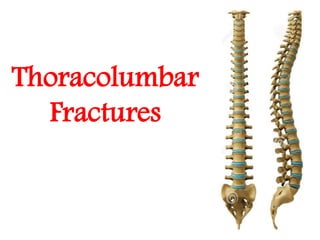
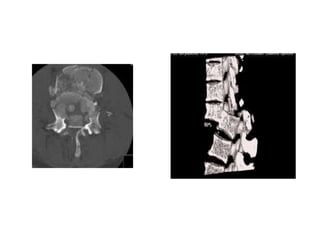
Thoracolumbar
Fractures
Thoracic and lumbar fractures account for 50% of
all spinal traumatic fractures.
• Incidence.
4-5 per 100,000.
18 - 35 years.
Male Female = 4:1
Neurologic injury  25% of cases.
• 65% of TL#s occurs between the T9&L2 vertebrae.
(thoracolumbar Junction)
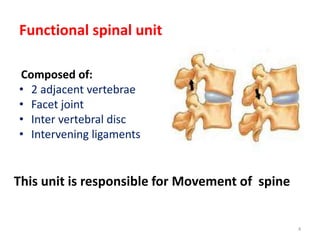
Functional spinal unit
Composed of:
• 2 adjacent vertebrae
• Facet joint
• Inter vertebral disc
• Intervening ligaments
4
This unit is responsible for Movement of spine
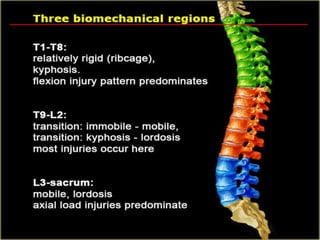
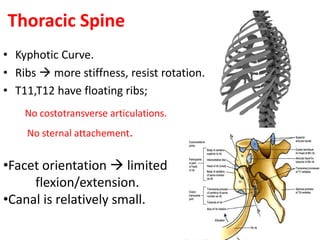
Thoracic Spine
• Kyphotic Curve.
• Ribs  more stiffness, resist rotation.
• T11,T12 have floating ribs;
No costotransverse articulations.
No sternal attachement.
•Facet orientation  limited
flexion/extension.
•Canal is relatively small.
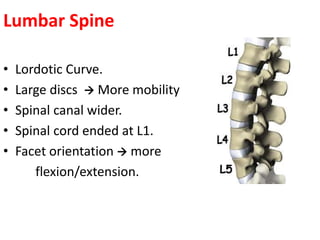
Lumbar Spine
• Lordotic Curve.
• Large discs  More mobility
• Spinal canal wider.
• Spinal cord ended at L1.
• Facet orientation  more
flexion/extension.
•Transition between the stiff kyphotic thoracic spine
and mobile lordotic lumbar spine.
• In trauma;
Thoracic spine deforms into kyphosis,
Lumbar spine into lordosis leaving,
Junction exposed to pure compression.
• T11, T12 are less stable  less resistance to
rotation  more stress.
Why Thoraco-lumbar junction is more succeptible?
ETIOLOGY
• High energy trauma (RTA 50%)
• Falls.
• Sports accident.
• Gunshot injury.
• Osteoporosis
• Tumors
• Weak bone(malnutrition,renal,RA,DM,endocrine).
– 16% major chest injury
– 10% major abdominal injury
– 8% long bone/ pelvic fractures
Spinal fracture should be suspected in;
1. Comatosed patient.
2. High energy trauma.
3. Evidence of neurological deficit.
4. Multiple injuries:
Missed TL#s reach 5%, And reach 22% in cervical fractures.
The main causes are,
• Poly trauma.
• low level of suspicion.
• Intoxication  unconsciousness
• Failure to take proper radiographs.
• Failure to interpret the x ray.
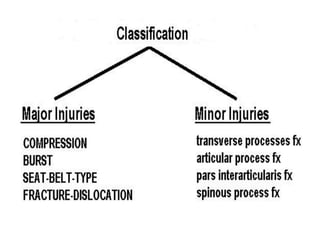
CLASSIFICATION
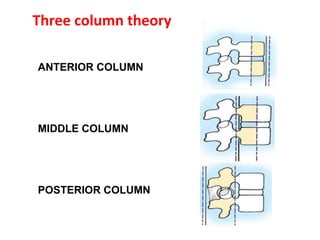
Three column theory
ANTERIOR COLUMN
MIDDLE COLUMN
POSTERIOR COLUMN
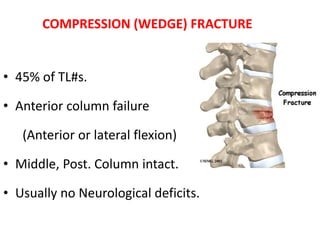
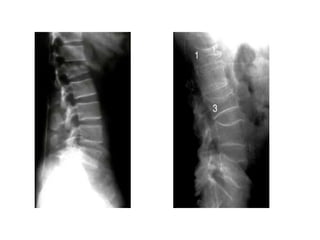
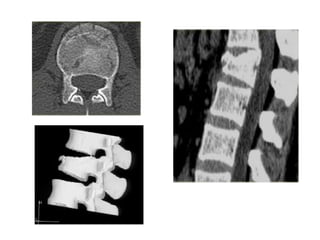
• 45% of TL#s.
• Anterior column failure
(Anterior or lateral flexion)
• Middle, Post. Column intact.
• Usually no Neurological deficits.
COMPRESSION (WEDGE) FRACTURE
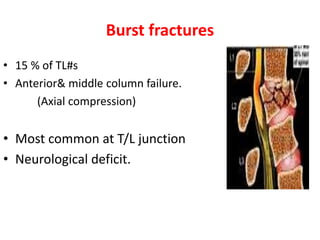
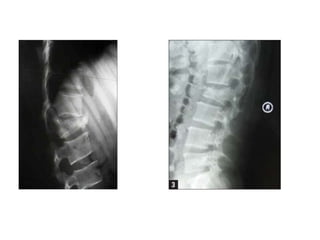
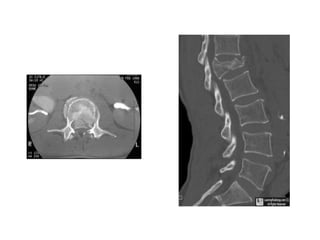
Burst fractures
• 15 % of TL#s
• Anterior& middle column failure.
(Axial compression)
• Most common at T/L junction
• Neurological deficit.
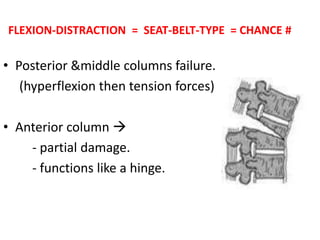
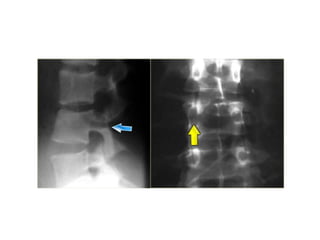
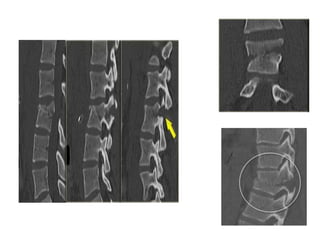
FLEXION-DISTRACTION = SEAT-BELT-TYPE = CHANCE #
• Posterior &middle columns failure.
(hyperflexion then tension forces)
• Anterior column 
- partial damage.
- functions like a hinge.
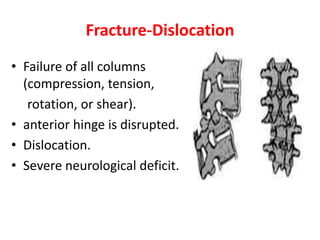
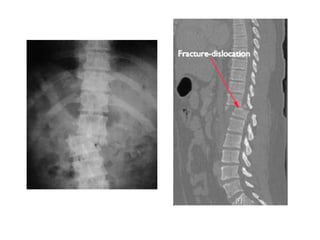
Fracture-Dislocation
• Failure of all columns
(compression, tension,
rotation, or shear).
• anterior hinge is disrupted.
• Dislocation.
• Severe neurological deficit.
Approach to Spine
Trauma
Pre Hospital Care
• Proper extraction & Immobilization;
Cervical collar
Hard board (log roll)
Sand bag
Tape
• Airway protection.
• Rapid & safe transfer  for suitable facilities.
Emergency Assessment
ABCs & Immobilization Hemodynamically stable
Secondary Survey:
1-Log roll technique
2-Remove the spinal board
3-Remove cervical collar carefully
4-Brief history (Mechanism, movement, position)
Inspection
• Clothes removed.
• Bleeding , abrasion or lacerations.
• Deformity, Swelling.
• Limb asymmetry (movements).
• Chest expansion, Paradoxical breathing.
Palpation
1. Tenderness.
2. Swelling.
3. Interspinous widening (>7mm).
4. Malialignement of spinouse process .
5. Step off.
Initial Neurological
Assessment
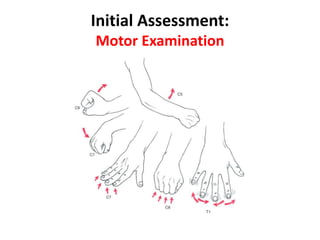
Initial Assessment:
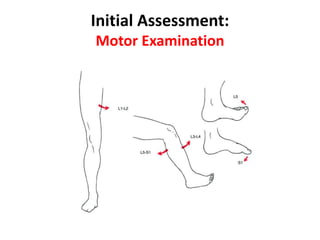
Motor Examination
Initial Assessment:
Motor Examination
Initial Assessment:
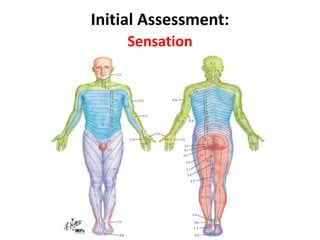
Sensation
Initial Assessment:
Reflexes
1. Babiniski sign.
2. Perianal/perineal sensation
3. Rectal tone
4. Cresmatic reflex
RADIOLOGICAL ASSESMENT
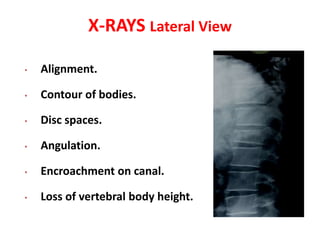
X-RAYS Lateral View
• Alignment.
• Contour of bodies.
• Disc spaces.
• Angulation.
• Encroachment on canal.
• Loss of vertebral body height.
X-RAYS Lateral View
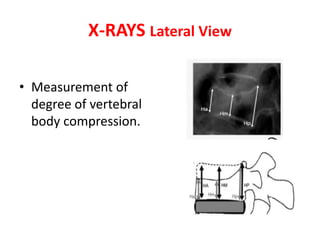
• Measurement of
degree of vertebral
body compression.
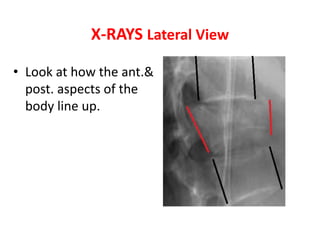
• Look at how the ant.&
post. aspects of the
body line up.
X-RAYS Lateral View
X-RAYS Lateral View
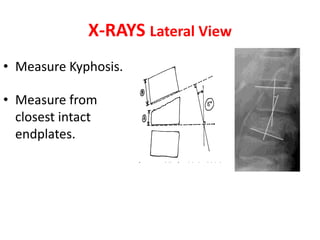
• Measure Kyphosis.
• Measure from
closest intact
endplates.
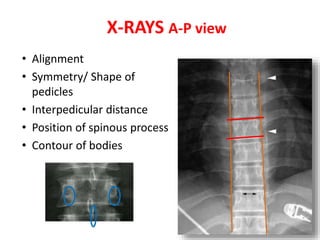
• Alignment
• Symmetry/ Shape of
pedicles
• Interpedicular distance
• Position of spinous process
• Contour of bodies
X-RAYS A-P view
X-RAYS A-P view
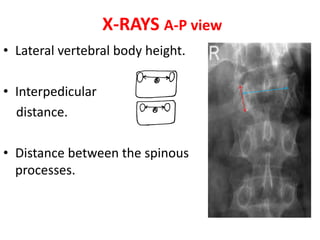
• Lateral vertebral body height.
• Interpedicular
distance.
• Distance between the spinous
processes.
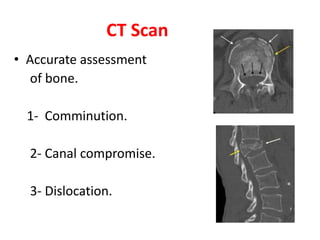
CT Scan
• Accurate assessment
of bone.
1- Comminution.
2- Canal compromise.
3- Dislocation.
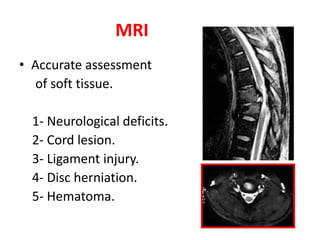
MRI
• Accurate assessment
of soft tissue.
1- Neurological deficits.
2- Cord lesion.
3- Ligament injury.
4- Disc herniation.
5- Hematoma.
Treatment
Goals
1. Maximise neurological recovery .
2. Maintain or restore spinal alignment.
3. Obtain a healed and stable spinal column.
4. Prevent future deformity.
Spinal Cord Injury
Methylprednisolone
• 30mg/kg iv bolus over 15min.
• 5.4 mg/kg/h infusion over 23 hrs (first 3 hours).
• 5.4 mg/kg/h for 47hrs (if > 3 – 8 hrs passed).
Proton pump inhibitor & LMW Heparin
Non-operative treatment
Indications:
• Ant. vertebral height loss < 40%.
• Canal compromise < 40%.
• kyphosis < 25 degrees.
Bed Rest
• Strict bed rest for 3- 4 weeks.
• Avoid flexion, sit-ups, & spinal rotation.
• Avoid weight bearing.
• Bed rolling encouraged.
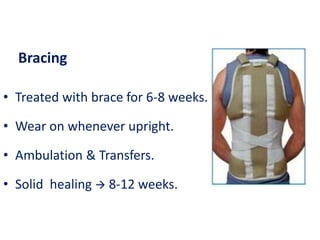
Bracing
• Treated with brace for 6-8 weeks.
• Wear on whenever upright.
• Ambulation & Transfers.
• Solid healing  8-12 weeks.
Operative treatment
Indications:
• Ant. vertebral height loss > 40%.
• Canal compromise > 40%.
• Kyphosis > 25 degrees.
• Neural compression.
Aim
• Neural Decompression.
• Stabilization.
• Solid fusion.
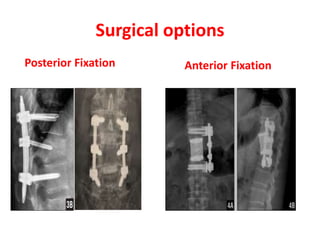
Surgical options
Anterior FixationPosterior Fixation
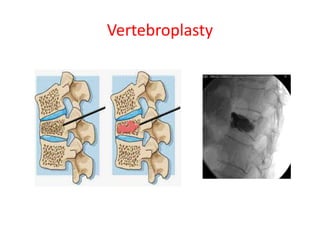
Vertebroplasty
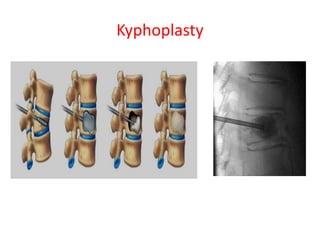
Kyphoplasty
Rehabilitation
• Physiotherapy.
• Bladder dysfunction: Intermittent cath.
Supra-pubic cath.
• Bowel dysfunction: high fluids, fibers, Prokinetic.
• Spasticity: Stretching exercises, Baclofen, surgical.
• DVT prevention.
• Chest physiotherapy.
• Bed sore prevention: Postural change/2h, Air mattress,
High protein diet.
Thoraco lumbar fractures

Thoraco lumbar fractures

  • 1.
  • 2.
    Thoracic and lumbarfractures account for 50% of all spinal traumatic fractures. • Incidence. 4-5 per 100,000. 18 - 35 years. Male Female = 4:1 Neurologic injury  25% of cases. • 65% of TL#s occurs between the T9&L2 vertebrae. (thoracolumbar Junction)
  • 4.
    Functional spinal unit Composedof: • 2 adjacent vertebrae • Facet joint • Inter vertebral disc • Intervening ligaments 4 This unit is responsible for Movement of spine
  • 5.
    Thoracic Spine • KyphoticCurve. • Ribs  more stiffness, resist rotation. • T11,T12 have floating ribs; No costotransverse articulations. No sternal attachement. •Facet orientation  limited flexion/extension. •Canal is relatively small.
  • 6.
    Lumbar Spine • LordoticCurve. • Large discs  More mobility • Spinal canal wider. • Spinal cord ended at L1. • Facet orientation  more flexion/extension.
  • 7.
    •Transition between thestiff kyphotic thoracic spine and mobile lordotic lumbar spine. • In trauma; Thoracic spine deforms into kyphosis, Lumbar spine into lordosis leaving, Junction exposed to pure compression. • T11, T12 are less stable  less resistance to rotation  more stress. Why Thoraco-lumbar junction is more succeptible?
  • 8.
    ETIOLOGY • High energytrauma (RTA 50%) • Falls. • Sports accident. • Gunshot injury. • Osteoporosis • Tumors • Weak bone(malnutrition,renal,RA,DM,endocrine).
  • 9.
    – 16% majorchest injury – 10% major abdominal injury – 8% long bone/ pelvic fractures Spinal fracture should be suspected in; 1. Comatosed patient. 2. High energy trauma. 3. Evidence of neurological deficit. 4. Multiple injuries:
  • 10.
    Missed TL#s reach5%, And reach 22% in cervical fractures. The main causes are, • Poly trauma. • low level of suspicion. • Intoxication unconsciousness • Failure to take proper radiographs. • Failure to interpret the x ray.
  • 11.
  • 12.
    Three column theory ANTERIORCOLUMN MIDDLE COLUMN POSTERIOR COLUMN
  • 14.
    • 45% ofTL#s. • Anterior column failure (Anterior or lateral flexion) • Middle, Post. Column intact. • Usually no Neurological deficits. COMPRESSION (WEDGE) FRACTURE
  • 17.
    Burst fractures • 15% of TL#s • Anterior& middle column failure. (Axial compression) • Most common at T/L junction • Neurological deficit.
  • 20.
    FLEXION-DISTRACTION = SEAT-BELT-TYPE= CHANCE # • Posterior &middle columns failure. (hyperflexion then tension forces) • Anterior column  - partial damage. - functions like a hinge.
  • 23.
    Fracture-Dislocation • Failure ofall columns (compression, tension, rotation, or shear). • anterior hinge is disrupted. • Dislocation. • Severe neurological deficit.
  • 26.
  • 27.
    Pre Hospital Care •Proper extraction & Immobilization; Cervical collar Hard board (log roll) Sand bag Tape • Airway protection. • Rapid & safe transfer  for suitable facilities.
  • 28.
    Emergency Assessment ABCs &Immobilization Hemodynamically stable Secondary Survey: 1-Log roll technique 2-Remove the spinal board 3-Remove cervical collar carefully 4-Brief history (Mechanism, movement, position)
  • 29.
    Inspection • Clothes removed. •Bleeding , abrasion or lacerations. • Deformity, Swelling. • Limb asymmetry (movements). • Chest expansion, Paradoxical breathing.
  • 30.
    Palpation 1. Tenderness. 2. Swelling. 3.Interspinous widening (>7mm). 4. Malialignement of spinouse process . 5. Step off.
  • 31.
  • 32.
  • 33.
  • 34.
  • 35.
    Initial Assessment: Reflexes 1. Babiniskisign. 2. Perianal/perineal sensation 3. Rectal tone 4. Cresmatic reflex
  • 36.
  • 37.
    X-RAYS Lateral View •Alignment. • Contour of bodies. • Disc spaces. • Angulation. • Encroachment on canal. • Loss of vertebral body height.
  • 38.
    X-RAYS Lateral View •Measurement of degree of vertebral body compression.
  • 39.
    • Look athow the ant.& post. aspects of the body line up. X-RAYS Lateral View
  • 40.
    X-RAYS Lateral View •Measure Kyphosis. • Measure from closest intact endplates.
  • 41.
    • Alignment • Symmetry/Shape of pedicles • Interpedicular distance • Position of spinous process • Contour of bodies X-RAYS A-P view
  • 42.
    X-RAYS A-P view •Lateral vertebral body height. • Interpedicular distance. • Distance between the spinous processes.
  • 43.
    CT Scan • Accurateassessment of bone. 1- Comminution. 2- Canal compromise. 3- Dislocation.
  • 44.
    MRI • Accurate assessment ofsoft tissue. 1- Neurological deficits. 2- Cord lesion. 3- Ligament injury. 4- Disc herniation. 5- Hematoma.
  • 45.
  • 46.
    Goals 1. Maximise neurologicalrecovery . 2. Maintain or restore spinal alignment. 3. Obtain a healed and stable spinal column. 4. Prevent future deformity.
  • 47.
    Spinal Cord Injury Methylprednisolone •30mg/kg iv bolus over 15min. • 5.4 mg/kg/h infusion over 23 hrs (first 3 hours). • 5.4 mg/kg/h for 47hrs (if > 3 – 8 hrs passed). Proton pump inhibitor & LMW Heparin
  • 48.
    Non-operative treatment Indications: • Ant.vertebral height loss < 40%. • Canal compromise < 40%. • kyphosis < 25 degrees. Bed Rest • Strict bed rest for 3- 4 weeks. • Avoid flexion, sit-ups, & spinal rotation. • Avoid weight bearing. • Bed rolling encouraged.
  • 49.
    Bracing • Treated withbrace for 6-8 weeks. • Wear on whenever upright. • Ambulation & Transfers. • Solid healing  8-12 weeks.
  • 50.
    Operative treatment Indications: • Ant.vertebral height loss > 40%. • Canal compromise > 40%. • Kyphosis > 25 degrees. • Neural compression. Aim • Neural Decompression. • Stabilization. • Solid fusion.
  • 51.
  • 52.
  • 53.
  • 54.
    Rehabilitation • Physiotherapy. • Bladderdysfunction: Intermittent cath. Supra-pubic cath. • Bowel dysfunction: high fluids, fibers, Prokinetic. • Spasticity: Stretching exercises, Baclofen, surgical. • DVT prevention. • Chest physiotherapy. • Bed sore prevention: Postural change/2h, Air mattress, High protein diet.