THE FAILED BACK
SYNDROME

    PROF.WALID MAANI
JORDAN UNIVERSITY HOSPITAL
DEFINITION


Any condition where there is failure to
 improve satisfactorily following back
               surgery
Vert Mooney in 1988
  We in the industrialized societies have a
     significant burden. We must explain why the
     problem of chronic back disability in third
     world countries is virtually unknown. Have we
     the sophisticated, scientific physicians
     created our own monster, the failed back
     syndrome?

    Mooney V. (1988): The failed back. Int Disabil Stud 10:32-36
CLASSIFICATION OF FAILURE
 No improvement immediately after surgery
  with outright failure to improve mono- or
  polyradiculopathy

 Temporary relief but recurrence of pain
   Early recurrence of symptoms (within weeks)
   Mid-term (within weeks to months)
   Longer-term failures (within months to years)
CLASSIFICATION OF FAILURE
 No improvement immediately after surgery
   with outright failure to improve mono- or
   polyradiculopathy
  1)   Wrong pre-operative diagnosis
  2)   Technical error
CLASSIFICATION OF FAILURE
 No improvement immediately after surgery
   with outright failure to improve mono- or
   polyradiculopathy
  1) Wrong pre-operative diagnosis
     1)   Tumor
     2)   Infection
     3)   Metabolic Disease
     4)   Psychosocial
     5)   Discogenic pain (IDD,IDR)
     6)   Decompression done too late for disc
          sequestration
CLASSIFICATION OF FAILURE
 No improvement immediately after surgery
   with outright failure to improve mono- or
   polyradiculopathy
  2) Technical error
     1)   Missed level or levels
     2)   Failure to perform adequate decompression
          1) Missed fragment including foraminal disc
          2) Failure to recognize canal stenosis
          3) Conjoined nerve root
CLASSIFICATION OF FAILURE

 Temporary relief but recurrence of pain
  1)   Early recurrence of symptoms (within weeks)
  2)   Mid-term (within weeks to months)
  3)   Longer-term failures (within months to years)
CLASSIFICATION OF FAILURE

 Temporary relief but recurrence of pain
  1) Early recurrence of symptoms (within weeks)
     1)   Infection
     2)   Meningeal cyst
     3)   Juxtafacet cyst
             1) Synovial cyst
             2) Ganglion cyst
CLASSIFICATION OF FAILURE

 Temporary relief but recurrence of pain
  2) Mid-term (within weeks to months)
        Recurrent disc prolapse
        Battered root
        Arachnoiditis
        Patient expectations
Battered root syndrome
 The permanent radiculopathy caused by surgical
  trauma was first called the battered root problem by
  Bertrand in 1975. It is the reappearance of radicular
  pain after the relief of sciatica by operation. The pain
  is constant, burning, increased by motion or Valsalva.
  At that time rhizotomy was suggested as the
  treatment. Since it is considered now as a type of
  peripheral neuropathy, the treatment shifted to spinal
  cord stimulation (SCS).


   Bertrand G. The battered root problem Orthop Clin North Am. 1975 Jan;6(1):305-10
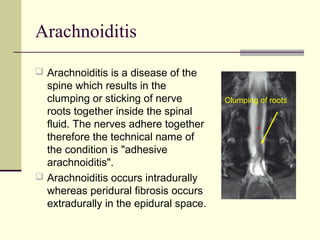
Arachnoiditis

 Arachnoiditis is a disease of the
  spine which results in the
  clumping or sticking of nerve         Clumping of roots
  roots together inside the spinal
  fluid. The nerves adhere together
  therefore the technical name of
  the condition is "adhesive
  arachnoiditis".
 Arachnoiditis occurs intradurally
  whereas peridural fibrosis occurs
  extradurally in the epidural space.
Arachnoiditis
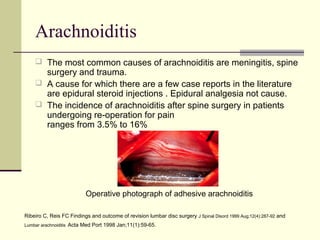
     The most common causes of arachnoiditis are meningitis, spine
      surgery and trauma.
     A cause for which there are a few case reports in the literature
      are epidural steroid injections . Epidural analgesia not cause.
     The incidence of arachnoiditis after spine surgery in patients
      undergoing re-operation for pain
      ranges from 3.5% to 16%


                          Operative photograph of adhesive arachnoiditis

Ribeiro C, Reis FC Findings and outcome of revision lumbar disc surgery J Spinal Disord 1999 Aug;12(4):287-92 and
Lumbar arachnoiditis Acta Med Port 1998 Jan;11(1):59-65.
CLASSIFICATION OF FAILURE

 Temporary relief but recurrence of pain
  3) Longer-term failures (within months to years)
     1)   Recurrent stenosis or development of lateral
          stenosis from disc space collapse
     2)   Instability
Disc space collapse
          A number of relapses are due to disc space collapse.
           Although the disc height is often decreased in the
           preoperative patient with a herniated nucleus
           pulposus, it is an exceedingly common occurrence
           following surgical discectomy.
          Disc space narrowing is very important in terms of
           decreasing the size of the neural foramina and
           altering facet loading and function.
          The entire process predisposes to the development
           of hypertrophic changes of the articular processes.

Hanley EN, Shapiro DE. The development of low-back pain after excision of a lumbar disc. J Bone Joint Surg 1989;71A:719-721
Schneck CD. The anatomy of lumbar spondylosis. Clin Orthop 1985;193:20-37. .
JUXTAFACIT (JFC) CYSTS

   CYSTS ADJACENT                       Term originated by Kao
     TO THE FACET                        et al in 1974
   JOINT, OR ARISING                    First reported by von
                                         Gruker in 1880 during
       FROM THE
                                         autopsy
 LIGAMENTUM FLAVUM                      First diagnosed
                                         clinically in 1968


Kao C.C., Winkler S.S., Turner J.H: Synovial Cyst of Spinal Facet. J
Neurosurg 41:372-6,1974.
Kao C.C., Uihlein A., Bickelr W.H: Lumbar Intraspinal Extradural
Ganglion Cyst. J Neurosurg 29:168-72,1968.
TYPES

 SYNOVIAL CYSTS               GANGLION CYSTS
   (those having a synovial     (those lacking lining
      lining membrane)             membrane)
ETIOLOGY
 Unknown
 Possibilities
    Synovial fluid extrusion from the joint
    Latent growth of a developmental rest
    Myxoid degeneration and cyst formation in
     collagenous connective tissue
    Increased motion plays a role in some cases
INCIDENCE
 Rare (2 in 1000 CT Spine)
 Frequency of diagnosis is rising due to:
    Frequent use of MRI
    Clinical awareness


Mercader J. Gomez J.M., Cardinal C.: Intraspinal Synovial Cysts:
Diagnosis by CT. Follow up and spontaneous remission.
Neuroradiology 27:346-8, 1985.
CLINICAL PRESENTATION
 May be asymptomatic
 Average age 60
 More in females
 In patients with severe spondylosis, facet joint
  degeneration and spondylolisthesis.
 L4/5 is the commonest level
 May be bilateral
 Radicular pain is the commonest symptom
CLINICAL PRESENTATION
 May contribute to canal stenosis and produce
  intermittent claudication
 May present as a quada equina lesion
 Symptoms are more intermittent than with
  firm compressing lesions like HID
 A sudden increase in symptoms may indicate
  hemorrhage in the cyst
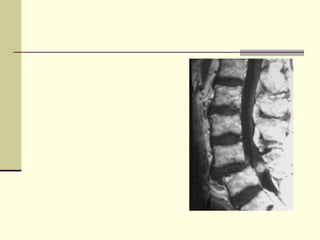
IMAGING


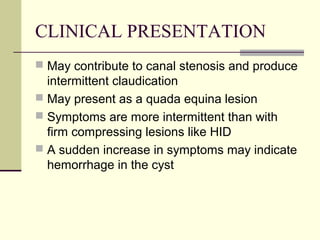
  PRE OPERATIVE TI   WEEKS POST OP T1 8
IMAGING


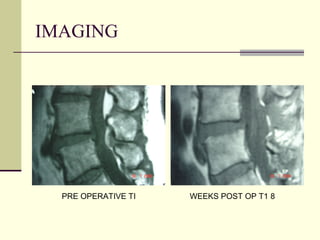
                         SYNOVIAL CYST


  PRE OPERATIVE TI   WEEKS POST OP T1 8
IMAGING


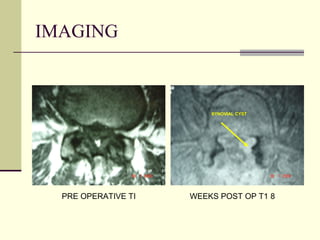
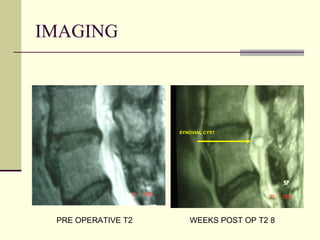
                    SYNOVIAL CYST


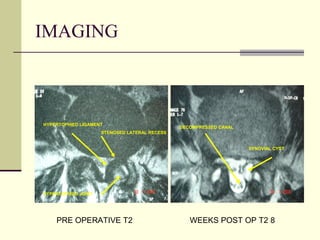
 PRE OPERATIVE T2      WEEKS POST OP T2 8
IMAGING


HYPERTOPHIED LIGAMENT
                                               DECOMPRESSED CANAL
                     STENOSED LATERAL RECESS


                                                                    SYNOVIAL CYST


HYPERTOPHIED JOINT


    PRE OPERATIVE T2                              WEEKS POST OP T2 8
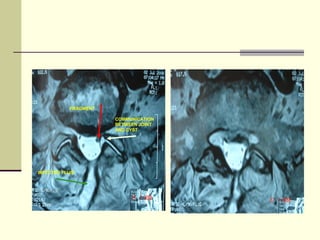
FRAGMENT

                       COMMUNICATION
                       BETWEEN JOINT
                       AND CYST


INFECTED FLUID
DIFFRENTIAL DIAGNOSIS
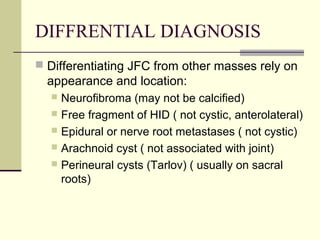
 Differentiating JFC from other masses rely on
  appearance and location:
   Neurofibroma (may not be calcified)
   Free fragment of HID ( not cystic, anterolateral)
   Epidural or nerve root metastases ( not cystic)
   Arachnoid cyst ( not associated with joint)
   Perineural cysts (Tarlov) ( usually on sacral
    roots)

Failed Back Syndrome

  • 1.
    THE FAILED BACK SYNDROME PROF.WALID MAANI JORDAN UNIVERSITY HOSPITAL
  • 2.
    DEFINITION Any condition wherethere is failure to improve satisfactorily following back surgery
  • 3.
    Vert Mooney in1988  We in the industrialized societies have a significant burden. We must explain why the problem of chronic back disability in third world countries is virtually unknown. Have we the sophisticated, scientific physicians created our own monster, the failed back syndrome?  Mooney V. (1988): The failed back. Int Disabil Stud 10:32-36
  • 4.
    CLASSIFICATION OF FAILURE No improvement immediately after surgery with outright failure to improve mono- or polyradiculopathy  Temporary relief but recurrence of pain  Early recurrence of symptoms (within weeks)  Mid-term (within weeks to months)  Longer-term failures (within months to years)
  • 5.
    CLASSIFICATION OF FAILURE No improvement immediately after surgery with outright failure to improve mono- or polyradiculopathy 1) Wrong pre-operative diagnosis 2) Technical error
  • 6.
    CLASSIFICATION OF FAILURE No improvement immediately after surgery with outright failure to improve mono- or polyradiculopathy 1) Wrong pre-operative diagnosis 1) Tumor 2) Infection 3) Metabolic Disease 4) Psychosocial 5) Discogenic pain (IDD,IDR) 6) Decompression done too late for disc sequestration
  • 7.
    CLASSIFICATION OF FAILURE No improvement immediately after surgery with outright failure to improve mono- or polyradiculopathy 2) Technical error 1) Missed level or levels 2) Failure to perform adequate decompression 1) Missed fragment including foraminal disc 2) Failure to recognize canal stenosis 3) Conjoined nerve root
  • 8.
    CLASSIFICATION OF FAILURE Temporary relief but recurrence of pain 1) Early recurrence of symptoms (within weeks) 2) Mid-term (within weeks to months) 3) Longer-term failures (within months to years)
  • 9.
    CLASSIFICATION OF FAILURE Temporary relief but recurrence of pain 1) Early recurrence of symptoms (within weeks) 1) Infection 2) Meningeal cyst 3) Juxtafacet cyst 1) Synovial cyst 2) Ganglion cyst
  • 10.
    CLASSIFICATION OF FAILURE Temporary relief but recurrence of pain 2) Mid-term (within weeks to months)  Recurrent disc prolapse  Battered root  Arachnoiditis  Patient expectations
  • 11.
    Battered root syndrome The permanent radiculopathy caused by surgical trauma was first called the battered root problem by Bertrand in 1975. It is the reappearance of radicular pain after the relief of sciatica by operation. The pain is constant, burning, increased by motion or Valsalva. At that time rhizotomy was suggested as the treatment. Since it is considered now as a type of peripheral neuropathy, the treatment shifted to spinal cord stimulation (SCS). Bertrand G. The battered root problem Orthop Clin North Am. 1975 Jan;6(1):305-10
  • 12.
    Arachnoiditis  Arachnoiditis isa disease of the spine which results in the clumping or sticking of nerve Clumping of roots roots together inside the spinal fluid. The nerves adhere together therefore the technical name of the condition is "adhesive arachnoiditis".  Arachnoiditis occurs intradurally whereas peridural fibrosis occurs extradurally in the epidural space.
  • 13.
    Arachnoiditis  The most common causes of arachnoiditis are meningitis, spine surgery and trauma.  A cause for which there are a few case reports in the literature are epidural steroid injections . Epidural analgesia not cause.  The incidence of arachnoiditis after spine surgery in patients undergoing re-operation for pain ranges from 3.5% to 16% Operative photograph of adhesive arachnoiditis Ribeiro C, Reis FC Findings and outcome of revision lumbar disc surgery J Spinal Disord 1999 Aug;12(4):287-92 and Lumbar arachnoiditis Acta Med Port 1998 Jan;11(1):59-65.
  • 14.
    CLASSIFICATION OF FAILURE Temporary relief but recurrence of pain 3) Longer-term failures (within months to years) 1) Recurrent stenosis or development of lateral stenosis from disc space collapse 2) Instability
  • 15.
    Disc space collapse  A number of relapses are due to disc space collapse. Although the disc height is often decreased in the preoperative patient with a herniated nucleus pulposus, it is an exceedingly common occurrence following surgical discectomy.  Disc space narrowing is very important in terms of decreasing the size of the neural foramina and altering facet loading and function.  The entire process predisposes to the development of hypertrophic changes of the articular processes. Hanley EN, Shapiro DE. The development of low-back pain after excision of a lumbar disc. J Bone Joint Surg 1989;71A:719-721 Schneck CD. The anatomy of lumbar spondylosis. Clin Orthop 1985;193:20-37. .
  • 16.
    JUXTAFACIT (JFC) CYSTS CYSTS ADJACENT  Term originated by Kao TO THE FACET et al in 1974 JOINT, OR ARISING  First reported by von Gruker in 1880 during FROM THE autopsy LIGAMENTUM FLAVUM  First diagnosed clinically in 1968 Kao C.C., Winkler S.S., Turner J.H: Synovial Cyst of Spinal Facet. J Neurosurg 41:372-6,1974. Kao C.C., Uihlein A., Bickelr W.H: Lumbar Intraspinal Extradural Ganglion Cyst. J Neurosurg 29:168-72,1968.
  • 17.
    TYPES  SYNOVIAL CYSTS  GANGLION CYSTS (those having a synovial (those lacking lining lining membrane) membrane)
  • 18.
    ETIOLOGY  Unknown  Possibilities  Synovial fluid extrusion from the joint  Latent growth of a developmental rest  Myxoid degeneration and cyst formation in collagenous connective tissue  Increased motion plays a role in some cases
  • 19.
    INCIDENCE  Rare (2in 1000 CT Spine)  Frequency of diagnosis is rising due to:  Frequent use of MRI  Clinical awareness Mercader J. Gomez J.M., Cardinal C.: Intraspinal Synovial Cysts: Diagnosis by CT. Follow up and spontaneous remission. Neuroradiology 27:346-8, 1985.
  • 20.
    CLINICAL PRESENTATION  Maybe asymptomatic  Average age 60  More in females  In patients with severe spondylosis, facet joint degeneration and spondylolisthesis.  L4/5 is the commonest level  May be bilateral  Radicular pain is the commonest symptom
  • 21.
    CLINICAL PRESENTATION  Maycontribute to canal stenosis and produce intermittent claudication  May present as a quada equina lesion  Symptoms are more intermittent than with firm compressing lesions like HID  A sudden increase in symptoms may indicate hemorrhage in the cyst
  • 22.
    IMAGING PREOPERATIVE TI WEEKS POST OP T1 8
  • 23.
    IMAGING SYNOVIAL CYST PRE OPERATIVE TI WEEKS POST OP T1 8
  • 24.
    IMAGING SYNOVIAL CYST PRE OPERATIVE T2 WEEKS POST OP T2 8
  • 25.
    IMAGING HYPERTOPHIED LIGAMENT DECOMPRESSED CANAL STENOSED LATERAL RECESS SYNOVIAL CYST HYPERTOPHIED JOINT PRE OPERATIVE T2 WEEKS POST OP T2 8
  • 27.
    FRAGMENT COMMUNICATION BETWEEN JOINT AND CYST INFECTED FLUID
  • 28.
    DIFFRENTIAL DIAGNOSIS  DifferentiatingJFC from other masses rely on appearance and location:  Neurofibroma (may not be calcified)  Free fragment of HID ( not cystic, anterolateral)  Epidural or nerve root metastases ( not cystic)  Arachnoid cyst ( not associated with joint)  Perineural cysts (Tarlov) ( usually on sacral roots)