Downloaded 64 times






![HUMANISTIC PSYCHOTHERAPY AND COUNSELING26
What clients are actually engaged in as they undergo counseling is a process of self-
exploration, which leads to the eventual understanding of and coming to grips with one‟s
essential freedom. The client‟s task within the counseling context is to explore his/her feelings
and behavior, to discover, with a sense of wonder, new aspects of self, and to blend these new
aspects into the image of self that holds together the range of his/her perceptions.
The client may not, however, be immediately capable of this difficult task. Because of
previous experiences with a counselor or therapist, or because of erroneous preconceptions about
counseling, the client may regard the counseling experience as, “one where he will be labeled,
looked upon as abnormal, hurt, treated with little respect [or] look upon the counselor as an
extension of the authority which has referred him for help” (Rogers, 1951). He or she may feel
threatened by the counseling setting, self-conscious, ashamed. In such a case, it is the counselor‟s
job to communicate to the client the non-judgmental, warm, an accepting reality of the situation.
This type of communication will help clients begin to help themselves (Belkin.1988).
The client-centered counselor
The primary job of the counselor is to develop a facilitative relationship with the client.
This is accomplished not by formal techniques and procedures, but rather by the counselor‟s total
attitude toward the client and toward the counseling interaction (Belkin.1988).
The counselor must, an experience along with him or her manifold feelings and
perceptions. As Rogers described it, the counselor‟s task is to assume “the internal frame of
reference of the client, to perceive the world as the client sees it, to perceive the client as he is
seen by himself, to lay aside all perceptions from the external frame of reference while doing so,
and to communicate something of the empathic understanding to the client” (Rogers, 1951). By
doing so, the counselor helps the client overcome his or her frightening or negative feelings](https://image.slidesharecdn.com/humanisitcpsychotherapyandnacounseling-130610104041-phpapp02/85/Humanisitc-psychotherapy-and-counseling-26-320.jpg)



![HUMANISTIC PSYCHOTHERAPY AND COUNSELING41
psychodrama and so on (Jones, 2007; Karp et al., 1998). Again some versions of these are
humanistic, others are not. Some, like the person-centered therapy of Carl Rogers‟s daughter
Natalie Rogers (1993), are direct descendants of a specific humanistic school (Totton, n.d.).
Blends, integrations and in-betweeners
In keeping with the tendency to spontaneity of humanistic therapy, there are many groups
or individual practitioners working with a combination of some or all of the above approaches,
often also including a psychodynamic input and sometimes a cognitive behavioral one. When
there has been an attempt to order and synthesize these various elements, the approach is
generally termed „integrative‟; when therapy is seen more as a matter of choosing the best tool
for a particular situation, the approach is often called „eclectic‟ (Norcross, 2005;Lazarus,2005a in
cited Totton, n.d.). The psychoanalyst Christopher Bollas argues eloquently for the value of an
eclectic approach, which he terms „pluralistic‟:
If one has more ways of seeing mental life and human behavior then, in my view, it follows
logically that one is going to be more effective . . . If your preconscious stores multiple
models of the mind and behavior, to be activated by work with a particular patient in a
particular moment, then you will find that you are either consciously or unconsciously
envisioning the patient through one or another of these lenses.
(Bollas, 2007, p. 7)]](https://image.slidesharecdn.com/humanisitcpsychotherapyandnacounseling-130610104041-phpapp02/85/Humanisitc-psychotherapy-and-counseling-41-320.jpg)
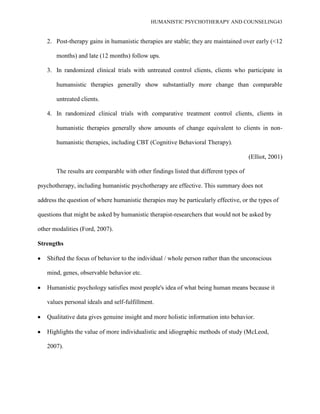
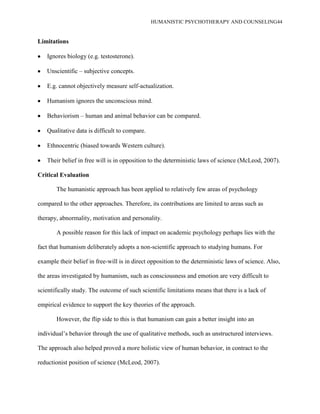
![HUMANISTIC PSYCHOTHERAPY AND COUNSELING45
References
Belkin, G. S. (1988). Introduction to Counseling. (3rd
ed.) Iowa: Wm C. Brown Publishers.
Blocher, D. H. (2000).The Evolution of Counseling Psychology.[Google Books version].
Retrieved from
http://books.google.com.pk/books?id=ePSs3DFPBKcC&pg=PA228&dq=humanistic+ap
proaches+to+counseling&hl=en&sa=X&ei=1u5LUZqVMc6v7Abft4GwDQ&ved=0CDc
Q6AEwAjgo#v=onepage&q=humanistic%20approaches%20to%20counseling&f=false
Burnard, P. (2005). Counseling Skills for Health Professionals: Fourth Edition.[Google Books
version]. Retrieved from
http://books.google.com.pk/books?id=xQIqC_49wEC&pg=PA46&dq=HUMANISTIC+
COUNSELING+IN+HEALTH+PSYCHOLOGY&hl=en&sa=X&ei=XlJDUcG9MZDb7
AbIn4CQDg&ved=0CD4Q6AEwAw#v=onepage&q=HUMANISTIC%20COUNSELIN
G%20IN%20HEALTH%20PSYCHOLOGY&f=false
Chan, F., Berven, N. L., & Thomas, K. R. (2004).Counseling Theories and Techniques for
Rehabilitation Health Professionals.[Google Books version]. Retrieved
fromhttp://books.google.com.pk/books?id=HhWBQjS7uwC&pg=PA13&dq=humanistic
+therapies+and+counseling+techniques&hl=en&sa=X&ei=gaVGUY7_MKqE4ATNv4H
4Bw&ved=0CCEQ6AEwAA#v=onepage&q=humanistic%20therapies%20and%20couns
eling%20techniques&f=false](https://image.slidesharecdn.com/humanisitcpsychotherapyandnacounseling-130610104041-phpapp02/85/Humanisitc-psychotherapy-and-counseling-45-320.jpg)
![HUMANISTIC PSYCHOTHERAPY AND COUNSELING46
Corsini, R. J., & Wedding, D. (2011).Current Psychotherapies.[Google Books version].
Retrieved from
http://books.google.com.pk/books?id=67yuMhJ5ieQC&pg=PA192&dq=humanistic+cou
nseling+and+therapies&hl=en&sa=X&ei=YvxLUZKIIdKV7AaJnYGYBg&ved=0CDA
Q6AEwAThG#v=onepage&q=humanistic%20counseling%20and%20therapies&f=false
Fall, K. A., Holden, J. M., & Marquis, A. (2010).Theoretical Models of Counseling and
Psychotherapy.[Google Books version].Retrieved
from.http://books.google.com.pk/books?id=ONRinP14nI8C&printsec=frontcover&dq=T
heoretical+Models+of+Counseling+and+Psychotherapy++By+Kevin+A.+Fall,+Janice+
Miner+Holden,+Andre+Marquis&hl=en&sa=X&ei=cvhLUfT3BuOR7AaU_4HIBw&ve
d=0CCoQ6AEwAA
Flasher, L. V., &Fogle, P. T. Counseling Skills for Speech-Language Pathologists and
Audiologists.[Google Books version]. Retrieved
fromhttp://books.google.com.pk/books?id=BBy4PmK5dwsC&pg=PA40&dq=humanistic
+counseling&hl=en&sa=X&ei=I7lCUYSzN8itO4WUgMgL&ved=0CD8Q6AEwBA#v=
onepage&q=humanistic%20counseling&f=false
Guindon, M. H. (2011). A Counseling Primer: An Introduction to the Profession. [Google Books
version]. Retrieved from
http://books.google.com.pk/books?id=uquvlPjYyuwC&pg=PA76&dq=humanistic++counseling
&hl=en&sa=X&ei=EElDUY2qF5D07Abv7oCwBQ&ved=0CDoQ6AEwBg#v=onepage
&q=humanistic%20%20counseling&f=false](https://image.slidesharecdn.com/humanisitcpsychotherapyandnacounseling-130610104041-phpapp02/85/Humanisitc-psychotherapy-and-counseling-46-320.jpg)
![HUMANISTIC PSYCHOTHERAPY AND COUNSELING47
Kalat, J. W. (2010). Introduction to Psychology.[Google Books version]. Retrieved
fromhttp://books.google.com.pk/books?id=0osIVpxvlv0C&pg=PA559&dq=effectiveness
+of+HUMANISTIC+COUNSELING&hl=en&sa=X&ei=R0xDUdDwN8GO7Aa9nIHID
A&ved=0CEcQ6AEwBQ#v=onepage&q=effectiveness%20of%20HUMANISTIC%20C
OUNSELING&f=false
Kottler, J. A., & Shepard, D. S. (2012).Introduction to Counseling: Voices from the Field.
[Google Books version].Retrieved
from.http://books.google.com.pk/books?id=iUwId2xVe0kC&pg=PR8&dq=humanistic+c
ounseling+techniques+and+stages&hl=en&sa=X&ei=jvVLUZaeMcfb7AbD34D4Aw&v
ed=0CGQQ6AEwCQ#v=onepage&q=humanistic%20counseling%20techniques%20and
%20stages&f=false
Lister-Ford, C. (2007). A Short Introduction to Psychotherapy.[Google Books version].
Retrieved
fromhttp://books.google.com.pk/books?id=R2vsDgDZijsC&pg=PA54&dq=HUMANIST
IC+THERAPIES&hl=en&sa=X&ei=MsBCUfv1Osq-
PampgdAO&ved=0CDoQ6AEwAjgK#v=onepage&q=HUMANISTIC%20THERAPIES
&f=false
McLeod, J. (2009).An Introduction to Counseling. (4th
ed.). England: McGraw Hill Publishers
Rowan, J. (1998).The Reality Game: A Guide to Humanistic Counseling and Therapy. [Google
Books version]. Retrieved from
http://books.google.com.pk/books?id=s9v3OktW2X8C&printsec=frontcover&dq=techni](https://image.slidesharecdn.com/humanisitcpsychotherapyandnacounseling-130610104041-phpapp02/85/Humanisitc-psychotherapy-and-counseling-47-320.jpg)
![HUMANISTIC PSYCHOTHERAPY AND COUNSELING48
ques+in+humanistic+counseling+and+therapy&hl=en&sa=X&ei=t1RDUdb6GayA7Qbw
u4Bo&ved=0CC0Q6AEwAA#v=onepage&q=techniques%20in%20humanistic%20coun
seling%20and%20therapy&f=false
Sharf, R. S. (2000). Theories of Psychotherapy and Counseling: Concepts and Cases. (2nd
ed.).
USA: Craig Barth
Stricker, G., &Widiger, T. A. (2003).Handbook of Psychology, Clinical Psychology.[Google
Books version]. Retrieved from
http://books.google.com.pk/books?id=0z0PV9JacWUC&pg=PA321&dq=HUMANISTIC
+THERAPIES&hl=en&sa=X&ei=rqtCUfahK8GL7AbI1oCwCg&ved=0CEkQ6AEwCQ
#v=onepage&q=HUMANISTIC%20THERAPIES&f=false
Sue, D. & Sue, D. M. (2008).Foundations of Counseling and Psychotherapy: Evidence-Based
Practices for a Diverse Society.[Google Books version]. Retrieved
fromhttp://books.google.com.pk/books?id=gxN_OqctghoC&pg=PA154&dq=effectivenes
s+of+HUMANISTIC+COUNSELING&hl=en&sa=X&ei=R0xDUdDwN8GO7Aa9nIHI
DA&ved=0CCoQ6AEwAA#v=onepage&q=effectiveness%20of%20HUMANISTIC%20
COUNSELING&f=false
Totton, N. (2010). The Problem with Humanistic Therapies.[Google Books version]. Retrieved
fromhttp://books.google.com.pk/books?id=YJFkEYBWtVEC&printsec=frontcover&dq=
humanistic+counseling&hl=en&sa=X&ei=g8BCUarLNtCw7AbIu4DoBg&ved=0CDAQ
6AEwAQ#v=onepage&q&f=false](https://image.slidesharecdn.com/humanisitcpsychotherapyandnacounseling-130610104041-phpapp02/85/Humanisitc-psychotherapy-and-counseling-48-320.jpg)
![HUMANISTIC PSYCHOTHERAPY AND COUNSELING49
Wilkins, P. (2003). Person-Centred Therapy in Focus.[Google Books version]. Retrieved from
http://books.google.com.pk/books?id=nx4xR9zXn8C&pg=PA26&dq=HUMANISTIC+T
HERAPIES&hl=en&sa=X&ei=rqtCUfahK8GL7AbI1oCwCg&ved0CEUQ6AEwCA#v=
onepage&q=HUMANISTIC%20THERAPIES&f=false](https://image.slidesharecdn.com/humanisitcpsychotherapyandnacounseling-130610104041-phpapp02/85/Humanisitc-psychotherapy-and-counseling-49-320.jpg)

This document provides an overview of humanistic psychotherapy and counseling. It discusses the origins of humanistic psychology in phenomenology and existentialism. Key figures discussed include Carl Rogers, who developed client-centered therapy, and Abraham Maslow, who proposed the theory of self-actualization. The document also outlines common assumptions of humanistic theories, such as viewing people as having an innate tendency toward self-actualization. It describes necessary conditions for therapeutic change, including genuineness, empathy, and unconditional positive regard from the therapist. A variety of humanistic therapies are mentioned, such as gestalt therapy and transactional analysis.


![EXISTENTIAL-THERAPY-REPORT[1].pptx](https://cdn.slidesharecdn.com/ss_thumbnails/existential-therapy-report1-220904103417-0088e91a-thumbnail.jpg?width=640&height=640&fit=bounds)


