Humanistic and Existential
Theories
A project by
Fatima Tul Zahra
Zainab
Bisma
Sammia
Alishba
Humanistic
Click icon to add picture
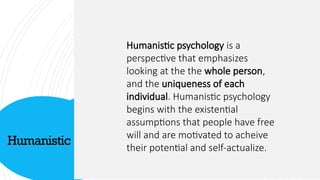
Humanistic psychology is a
perspective that emphasizes
looking at the the whole person,
and the uniqueness of each
individual. Humanistic psychology
begins with the existential
assumptions that people have free
will and are motivated to acheive
their potential and self-actualize.
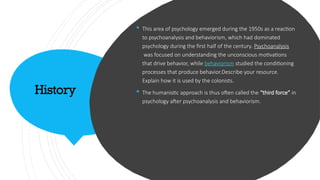
History
 This area of psychology emerged during the 1950s as a reaction
to psychoanalysis and behaviorism, which had dominated
psychology during the first half of the century. Psychoanalysis
was focused on understanding the unconscious motivations
that drive behavior, while behaviorism studied the conditioning
processes that produce behavior.Describe your resource.
Explain how it is used by the colonists.
 The humanistic approach is thus often called the “third force” in
psychology after psychoanalysis and behaviorism.
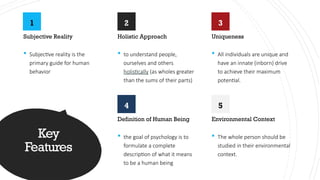
Key
Features
1
Subjective Reality
 Subjective reality is the
primary guide for human
behavior
2
Holistic Approach
 to understand people,
ourselves and others
holistically (as wholes greater
than the sums of their parts)
3
Uniqueness
 All individuals are unique and
have an innate (inborn) drive
to achieve their maximum
potential.
4
Definition of Human Being
 the goal of psychology is to
formulate a complete
description of what it means
to be a human being
5
Environmental Context
 The whole person should be
studied in their environmental
context.
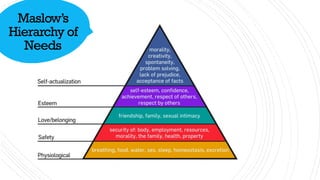
Maslow’s
Hierarchy of
Needs
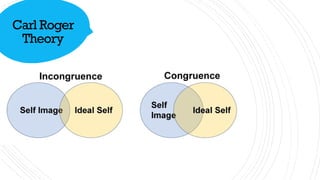
Carl Roger
Theory
Existentialism
Click icon to add picture
Existentialism is a philosophical
perspective that focuses on the
human experience and how
people create meaning in their
lives. It emphasizes the
importance of personal
responsibility, and the idea that
people are free to choose their
own path in life.
History
 Søren Kierkegaard was a Danish philosopher from the 1800s
who is considered the father of existentialism. He was critical of
Christianity and religious philosophy, emphasizing living as an
individual within reality rather than abstract thought
experiments.
 Friedrich Nietzche and Fyodor Dostoevsky, wrote about creating
one’s own identity to give meaning to existence. The inability to
identify meaning in one’s life causes anxiety, known as an
existential crisis.
Key
Features
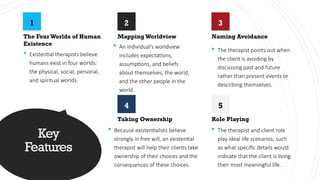
1
The Four Worlds of Human
Existence
 Existential therapists believe
humans exist in four worlds:
the physical, social, personal,
and spiritual worlds.
2
Mapping Worldview
 An individual’s worldview
includes expectations,
assumptions, and beliefs
about themselves, the world,
and the other people in the
world.
3
Naming Avoidance
 The therapist points out when
the client is avoiding by
discussing past and future
rather than present events or
describing themselves.
4
Taking Ownership
 Because existentialists believe
strongly in free will, an existential
therapist will help their clients take
ownership of their choices and the
consequences of these choices.
5
Role Playing
 The therapist and client role
play ideal life scenarios, such
as what specific details would
indicate that the client is living
their most meaningful life.
Present State Of
Theories
Existential
 Existential psychology focuses on big life questions, like what
gives life meaning and how we deal with challenges like death
and freedom. Today, existential ideas are still used in therapy,
especially in dealing with difficult life situations.
 Existential Therapy: This type of therapy helps people face
difficult questions about life, freedom, and meaning. It’s useful
for people going through tough times, like grief or a
crisis of purpose.
 Logotherapy: Developed by Viktor Frankl, this approach helps
people find meaning in their suffering. It’s still used to help
people cope with trauma or major life changes. Living
Authentically: Existential psychology encourages people to live
true to themselves, which is still a big theme in therapy and
personal growth today.
Humanistic
 Humanistic psychology, which focuses on personal growth and
the idea that people can achieve their best selves, is still widely
used, especially in therapy
 Positive Psychology: This field, which looks at happiness,
strengths, and well-being, is heavily influenced by humanistic
ideas. It focuses on helping people live fulfilling lives.
 Person-Centered Therapy: Created by Carl Rogers, this approach
focuses on creating a supportive, non-judgmental environment
in therapy, where people can feel safe and understood. It's still
widely used today.
 Self-Help: Humanistic ideas are often found in self-help books
and personal development programs that encourage people to
reach their potential and live meaningful lives.
Concept Of
Personality
Concept
Of
Personality
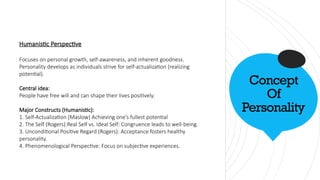
Humanistic Perspective
Focuses on personal growth, self-awareness, and inherent goodness.
Personality develops as individuals strive for self-actualization (realizing
potential).
Central idea:
People have free will and can shape their lives positively.
Major Constructs (Humanistic):
1. Self-Actualization (Maslow) Achieving one’s fullest potential
2. The Self (Rogers):Real Self vs. Ideal Self: Congruence leads to well-being.
3. Unconditional Positive Regard (Rogers): Acceptance fosters healthy
personality.
4. Phenomenological Perspective: Focus on subjective experiences.
Concept
Of
Personality
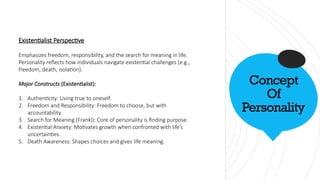
Existentialist Perspective
Emphasizes freedom, responsibility, and the search for meaning in life.
Personality reflects how individuals navigate existential challenges (e.g.,
freedom, death, isolation).
Major Constructs (Existentialist):
1. Authenticity: Living true to oneself.
2. Freedom and Responsibility: Freedom to choose, but with
accountability.
3. Search for Meaning (Frankl): Core of personality is finding purpose.
4. Existential Anxiety: Motivates growth when confronted with life’s
uncertainties.
5. Death Awareness: Shapes choices and gives life meaning.
Assessments
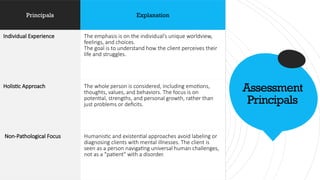
Principals Explanation
Individual Experience The emphasis is on the individual’s unique worldview,
feelings, and choices.
The goal is to understand how the client perceives their
life and struggles.
Holistic Approach The whole person is considered, including emotions,
thoughts, values, and behaviors. The focus is on
potential, strengths, and personal growth, rather than
just problems or deficits.
Non-Pathological Focus Humanistic and existential approaches avoid labeling or
diagnosing clients with mental illnesses. The client is
seen as a person navigating universal human challenges,
not as a "patient" with a disorder.
Assessment
Principals
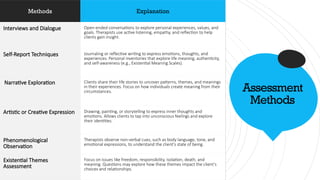
Methods Explanation
Interviews and Dialogue Open-ended conversations to explore personal experiences, values, and
goals. Therapists use active listening, empathy, and reflection to help
clients gain insight.
Self-Report Techniques Journaling or reflective writing to express emotions, thoughts, and
experiences. Personal inventories that explore life meaning, authenticity,
and self-awareness (e.g., Existential Meaning Scales).
Narrative Exploration Clients share their life stories to uncover patterns, themes, and meanings
in their experiences. Focus on how individuals create meaning from their
circumstances.
Artistic or Creative Expression Drawing, painting, or storytelling to express inner thoughts and
emotions. Allows clients to tap into unconscious feelings and explore
their identities.
Phenomenological
Observation
Therapists observe non-verbal cues, such as body language, tone, and
emotional expressions, to understand the client's state of being.
Existential Themes
Assessment
Focus on issues like freedom, responsibility, isolation, death, and
meaning. Questions may explore how these themes impact the client’s
choices and relationships.
Assessment
Methods
Criticism
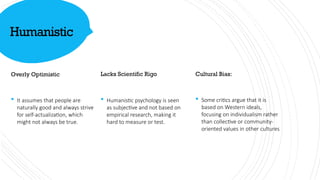
Humanistic
Overly Optimistic
 It assumes that people are
naturally good and always strive
for self-actualization, which
might not always be true.
Lacks Scientific Rigo
 Humanistic psychology is seen
as subjective and not based on
empirical research, making it
hard to measure or test.
Cultural Bias:
 Some critics argue that it is
based on Western ideals,
focusing on individualism rather
than collective or community-
oriented values in other cultures
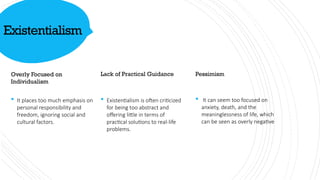
Existentialism
Overly Focused on
Individualism
 It places too much emphasis on
personal responsibility and
freedom, ignoring social and
cultural factors.
Lack of Practical Guidance
 Existentialism is often criticized
for being too abstract and
offering little in terms of
practical solutions to real-life
problems.
Pessimism
 It can seem too focused on
anxiety, death, and the
meaninglessness of life, which
can be seen as overly negative
Conclusion
 Humanistic and existential psychology are still relevant and used
today. They focus on personal growth, meaning, and facing life’s
big questions, and they continue to influence therapy, personal
development, and how people think about living a fulfilling life.
Transportation
Consider the geography of
your colony.
 What transportation works
best? Why?
 Does this differ by geographic
area?
Do colonists need to travel to
other colonies for any reason?
 If so, what is the best method?
What is the cheapest method?
 Do different social groups travel
in different ways? Why?
How?
 How does transportation relate
to trade? Are certain means of
transportation only used to
move resources?
Colony
Song
<Name of Song>
<Insert song lyrics and/or an audio file of the song>
Colony
Symbols
Insert image of colony flower
Colony Flower Insert image of colony bird
Colony Bird
Insert image of colony tree
Colony Tree
Insert image of famous person
Colony Famous
Person
Insert image of colony flag
Colony Flag
Customize
this
Template
Template Editing Instructions
and Feedback

Humanistic and Existential Theories.pptx

  • 1.
    Humanistic and Existential Theories Aproject by Fatima Tul Zahra Zainab Bisma Sammia Alishba
  • 2.
    Humanistic Click icon toadd picture Humanistic psychology is a perspective that emphasizes looking at the the whole person, and the uniqueness of each individual. Humanistic psychology begins with the existential assumptions that people have free will and are motivated to acheive their potential and self-actualize.
  • 3.
    History  This areaof psychology emerged during the 1950s as a reaction to psychoanalysis and behaviorism, which had dominated psychology during the first half of the century. Psychoanalysis was focused on understanding the unconscious motivations that drive behavior, while behaviorism studied the conditioning processes that produce behavior.Describe your resource. Explain how it is used by the colonists.  The humanistic approach is thus often called the “third force” in psychology after psychoanalysis and behaviorism.
  • 4.
    Key Features 1 Subjective Reality  Subjectivereality is the primary guide for human behavior 2 Holistic Approach  to understand people, ourselves and others holistically (as wholes greater than the sums of their parts) 3 Uniqueness  All individuals are unique and have an innate (inborn) drive to achieve their maximum potential. 4 Definition of Human Being  the goal of psychology is to formulate a complete description of what it means to be a human being 5 Environmental Context  The whole person should be studied in their environmental context.
  • 5.
  • 6.
  • 7.
    Existentialism Click icon toadd picture Existentialism is a philosophical perspective that focuses on the human experience and how people create meaning in their lives. It emphasizes the importance of personal responsibility, and the idea that people are free to choose their own path in life.
  • 8.
    History  Søren Kierkegaardwas a Danish philosopher from the 1800s who is considered the father of existentialism. He was critical of Christianity and religious philosophy, emphasizing living as an individual within reality rather than abstract thought experiments.  Friedrich Nietzche and Fyodor Dostoevsky, wrote about creating one’s own identity to give meaning to existence. The inability to identify meaning in one’s life causes anxiety, known as an existential crisis.
  • 9.
    Key Features 1 The Four Worldsof Human Existence  Existential therapists believe humans exist in four worlds: the physical, social, personal, and spiritual worlds. 2 Mapping Worldview  An individual’s worldview includes expectations, assumptions, and beliefs about themselves, the world, and the other people in the world. 3 Naming Avoidance  The therapist points out when the client is avoiding by discussing past and future rather than present events or describing themselves. 4 Taking Ownership  Because existentialists believe strongly in free will, an existential therapist will help their clients take ownership of their choices and the consequences of these choices. 5 Role Playing  The therapist and client role play ideal life scenarios, such as what specific details would indicate that the client is living their most meaningful life.
  • 10.
  • 11.
    Existential  Existential psychologyfocuses on big life questions, like what gives life meaning and how we deal with challenges like death and freedom. Today, existential ideas are still used in therapy, especially in dealing with difficult life situations.  Existential Therapy: This type of therapy helps people face difficult questions about life, freedom, and meaning. It’s useful for people going through tough times, like grief or a crisis of purpose.  Logotherapy: Developed by Viktor Frankl, this approach helps people find meaning in their suffering. It’s still used to help people cope with trauma or major life changes. Living Authentically: Existential psychology encourages people to live true to themselves, which is still a big theme in therapy and personal growth today.
  • 12.
    Humanistic  Humanistic psychology,which focuses on personal growth and the idea that people can achieve their best selves, is still widely used, especially in therapy  Positive Psychology: This field, which looks at happiness, strengths, and well-being, is heavily influenced by humanistic ideas. It focuses on helping people live fulfilling lives.  Person-Centered Therapy: Created by Carl Rogers, this approach focuses on creating a supportive, non-judgmental environment in therapy, where people can feel safe and understood. It's still widely used today.  Self-Help: Humanistic ideas are often found in self-help books and personal development programs that encourage people to reach their potential and live meaningful lives.
  • 13.
  • 14.
    Concept Of Personality Humanistic Perspective Focuses onpersonal growth, self-awareness, and inherent goodness. Personality develops as individuals strive for self-actualization (realizing potential). Central idea: People have free will and can shape their lives positively. Major Constructs (Humanistic): 1. Self-Actualization (Maslow) Achieving one’s fullest potential 2. The Self (Rogers):Real Self vs. Ideal Self: Congruence leads to well-being. 3. Unconditional Positive Regard (Rogers): Acceptance fosters healthy personality. 4. Phenomenological Perspective: Focus on subjective experiences.
  • 15.
    Concept Of Personality Existentialist Perspective Emphasizes freedom,responsibility, and the search for meaning in life. Personality reflects how individuals navigate existential challenges (e.g., freedom, death, isolation). Major Constructs (Existentialist): 1. Authenticity: Living true to oneself. 2. Freedom and Responsibility: Freedom to choose, but with accountability. 3. Search for Meaning (Frankl): Core of personality is finding purpose. 4. Existential Anxiety: Motivates growth when confronted with life’s uncertainties. 5. Death Awareness: Shapes choices and gives life meaning.
  • 16.
  • 17.
    Principals Explanation Individual ExperienceThe emphasis is on the individual’s unique worldview, feelings, and choices. The goal is to understand how the client perceives their life and struggles. Holistic Approach The whole person is considered, including emotions, thoughts, values, and behaviors. The focus is on potential, strengths, and personal growth, rather than just problems or deficits. Non-Pathological Focus Humanistic and existential approaches avoid labeling or diagnosing clients with mental illnesses. The client is seen as a person navigating universal human challenges, not as a "patient" with a disorder. Assessment Principals
  • 18.
    Methods Explanation Interviews andDialogue Open-ended conversations to explore personal experiences, values, and goals. Therapists use active listening, empathy, and reflection to help clients gain insight. Self-Report Techniques Journaling or reflective writing to express emotions, thoughts, and experiences. Personal inventories that explore life meaning, authenticity, and self-awareness (e.g., Existential Meaning Scales). Narrative Exploration Clients share their life stories to uncover patterns, themes, and meanings in their experiences. Focus on how individuals create meaning from their circumstances. Artistic or Creative Expression Drawing, painting, or storytelling to express inner thoughts and emotions. Allows clients to tap into unconscious feelings and explore their identities. Phenomenological Observation Therapists observe non-verbal cues, such as body language, tone, and emotional expressions, to understand the client's state of being. Existential Themes Assessment Focus on issues like freedom, responsibility, isolation, death, and meaning. Questions may explore how these themes impact the client’s choices and relationships. Assessment Methods
  • 19.
  • 20.
    Humanistic Overly Optimistic  Itassumes that people are naturally good and always strive for self-actualization, which might not always be true. Lacks Scientific Rigo  Humanistic psychology is seen as subjective and not based on empirical research, making it hard to measure or test. Cultural Bias:  Some critics argue that it is based on Western ideals, focusing on individualism rather than collective or community- oriented values in other cultures
  • 21.
    Existentialism Overly Focused on Individualism It places too much emphasis on personal responsibility and freedom, ignoring social and cultural factors. Lack of Practical Guidance  Existentialism is often criticized for being too abstract and offering little in terms of practical solutions to real-life problems. Pessimism  It can seem too focused on anxiety, death, and the meaninglessness of life, which can be seen as overly negative
  • 22.
    Conclusion  Humanistic andexistential psychology are still relevant and used today. They focus on personal growth, meaning, and facing life’s big questions, and they continue to influence therapy, personal development, and how people think about living a fulfilling life.
  • 23.
    Transportation Consider the geographyof your colony.  What transportation works best? Why?  Does this differ by geographic area? Do colonists need to travel to other colonies for any reason?  If so, what is the best method? What is the cheapest method?  Do different social groups travel in different ways? Why? How?  How does transportation relate to trade? Are certain means of transportation only used to move resources?
  • 24.
    Colony Song <Name of Song> <Insertsong lyrics and/or an audio file of the song>
  • 25.
    Colony Symbols Insert image ofcolony flower Colony Flower Insert image of colony bird Colony Bird Insert image of colony tree Colony Tree Insert image of famous person Colony Famous Person Insert image of colony flag Colony Flag
  • 26.

Editor's Notes

  • #1 When listing all project collaborators, either use commas or bullets
  • #2 Insert a map of your colony (draw it, ink it, or create it in PPT- be creative!) Insert -> Pictures for photos Draw for digital inking Insert -> Shapes if you want to create it in PPT All mountains, towns/villages, bodies of water/waterways, landmarks, etc. should be clearly labeled
  • #4 What are the rules and laws of your colony? Think about what helps the colonists stay safe and maintain a healthy, happy colony. In each shape… Name the rule/law Describe why it’s important for the colony/colonists Explain the consequences for not following this rule/law To add more shapes, click on the last shape, then on SmartArt Tools -> Design -> Add Shape After
  • #5 Use the SmartArt to determine the flow of government/leadership: Who leads the colony (executive)? What is that person/are those people’s duties? Who makes the rules (legislature)? Who ensures the rules are followed (judicial)? Are there any other branches of government? If so, who are they and what is their job? To add more shapes, click on the left shape first, then on SmartArt Tools -> Design -> Add Shape After Do the same for the shape to the right Feel free to rename the branches!
  • #6 Use the SmartArt to determine the flow of government/leadership: Who leads the colony (executive)? What is that person/are those people’s duties? Who makes the rules (legislature)? Who ensures the rules are followed (judicial)? Are there any other branches of government? If so, who are they and what is their job? To add more shapes, click on the left shape first, then on SmartArt Tools -> Design -> Add Shape After Do the same for the shape to the right Feel free to rename the branches!
  • #7 Insert a map of your colony (draw it, ink it, or create it in PPT- be creative!) Insert -> Pictures for photos Draw for digital inking Insert -> Shapes if you want to create it in PPT All mountains, towns/villages, bodies of water/waterways, landmarks, etc. should be clearly labeled
  • #9 What are the rules and laws of your colony? Think about what helps the colonists stay safe and maintain a healthy, happy colony. In each shape… Name the rule/law Describe why it’s important for the colony/colonists Explain the consequences for not following this rule/law To add more shapes, click on the last shape, then on SmartArt Tools -> Design -> Add Shape After
  • #17 *OPTIONAL SLIDE* If you are interested in learning more about social groups, look up the caste or class system.
  • #18 *OPTIONAL SLIDE* If you are interested in learning more about social groups, look up the caste or class system.
  • #20 Think about the questions listed above and answer them. Can you think of anything else in regards to economy and trade that you would like to add?
  • #21 Think about the questions listed above and answer them. Can you think of anything else in regards to economy and trade that you would like to add?
  • #23 Think about the questions/situations listed above and answer them. Can you think of anything else in regards to transportation that you would like to add?
  • #24 What is the name of your colony song? Write lyrics to the song and, if you are feeling creative, use a computer program or instruments to create the music that goes along with it! To insert an audio file, click on Recording -> Audio -> Audio on My PC and choose your file
  • #25 Have fun with this slide! Use drawing paper or inking to create your colony’s flag, flower, bird, tree, and its most famous person! If you use drawing paper, take a photo and insert the image If you choose to use digital inking, click on the Draw tab and ink away!