Human Reproductive System   Dr. Avinash Bhondwe
Men & Women
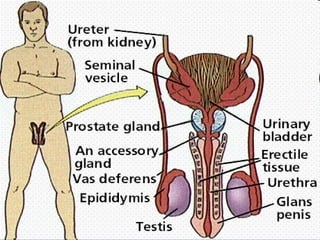
Male Reproductive System  The  human male reproductive system  consists of a number of sex organs that are a part of the  human reproductive  process. In the case of men, these sex organs are located outside a  man 's body, around the  pelvic  region .
 
Male Reproductive System Contents Penis Testicles( Scrotum) Epididymis
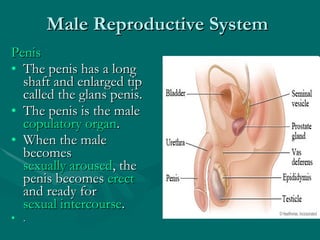
Male Reproductive System Penis The penis has a long shaft and enlarged tip called the glans penis.  The penis is the male  copulatory organ .  When the male becomes  sexually aroused , the penis becomes  erect  and ready for  sexual intercourse . .
Male Reproductive System Erection is achieved because blood sinuses within the erectile tissue of the penis become filled with blood. The arteries of the penis are dilated while the veins are passively compressed so that blood flows into the erectile cartilage under pressure. The male penis is made of two different tissues,and soft spongey tissue.  Cartlidge is not in the penis
Testicles
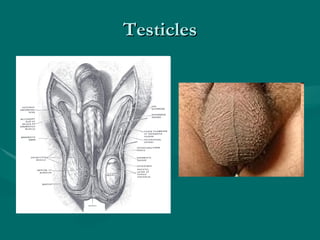
Testicles The testes hang outside the abdominal cavity of the male within the  scrotum . They begin their development in the abdominal cavity but descend into the scrotal sacs during the last 2 months of fetal development. This is required for the production of  sperm  because internal body temperatures are too high to produce viable sperm.
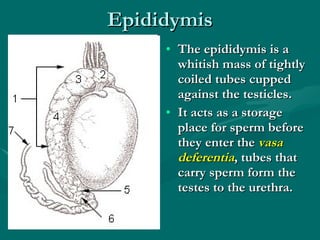
Epididymis The epididymis is a whitish mass of tightly coiled tubes cupped against the testicles.  It acts as a storage place for sperm before they enter the  vasa deferentia , tubes that carry sperm form the testes to the urethra.
Female reproductive system
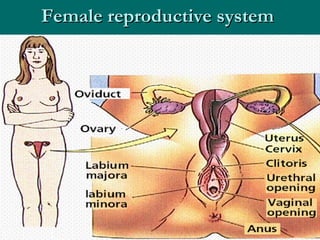
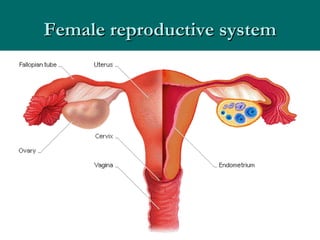
Contents 1 Vagina   2 Cervix   3 Uterus   4 Oviducts   5 Ovaries   Female reproductive system
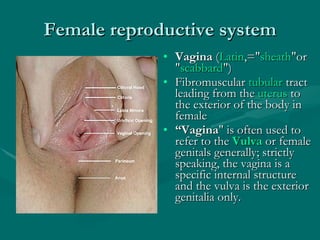
Female reproductive system Vagina  ( Latin ,=" sheath "or " scabbard ")  Fibromuscular  tubular  tract leading from the  uterus  to the exterior of the body in female  “ Vagina " is often used to refer to the  Vulva  or female genitals generally; strictly speaking, the vagina is a specific internal structure and the vulva is the exterior genitalia only.
Female reproductive system The  vagina  is the place where  semen  from the male is deposited into the female's body at the climax of  sexual intercourse , commonly known as  ejaculation . Around the vagina, pubic hair protects the vagina from infection and is a sign of puberty
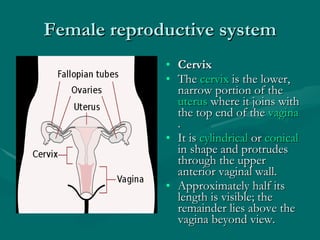
Female reproductive system Cervix The  cervix  is the lower, narrow portion of the  uterus  where it joins with the top end of the  vagina .  It is  cylindrical  or  conical  in shape and protrudes through the upper anterior vaginal wall.  Approximately half its length is visible; the remainder lies above the vagina beyond view.
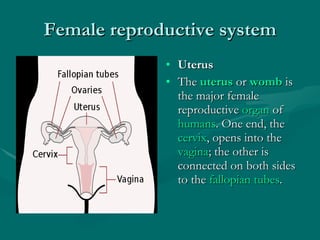
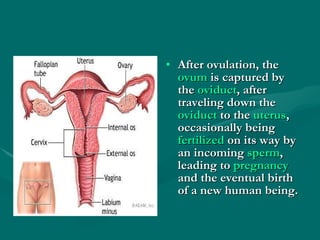
Female reproductive system Uterus The  uterus  or  womb  is the major female reproductive  organ  of  humans . One end, the  cervix , opens into the  vagina ; the other is connected on both sides to the  fallopian tubes .
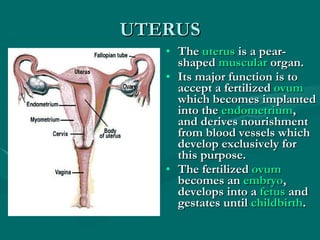
UTERUS The  uterus  is a pear-shaped  muscular  organ.  Its major function is to accept a fertilized  ovum  which becomes implanted into the  endometrium , and derives nourishment from blood vessels which develop exclusively for this purpose.  The fertilized  ovum  becomes an  embryo , develops into a  fetus  and gestates until  childbirth .
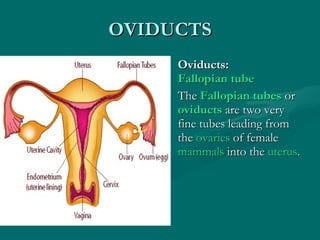
OVIDUCTS Oviducts:  Fallopian tube The  Fallopian tubes  or  oviducts  are two very fine tubes leading from the  ovaries  of female  mammals  into the  uterus .
OVIDUCTS On maturity of an  ovum , the follicle and the  ovary 's wall rupture, allowing the ovum to escape and enter the  Fallopian tube .  There it travels toward the uterus, pushed along by movements of  cilia  on the inner lining of the tubes. This trip takes hours or days.  If the ovum is  fertilized  while in the  Fallopian tube , then it normally implants in the  endometrium  when it reaches the uterus, which signals the beginning of  pregnancy
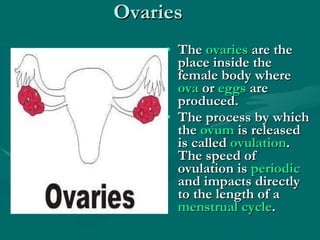
Ovaries The  ovaries  are the place inside the female body where  ova  or  eggs  are produced.  The process by which the  ovum  is released is called  ovulation . The speed of ovulation is  periodic  and impacts directly to the length of a  menstrual cycle .
After ovulation, the  ovum  is captured by the  oviduct , after traveling down the  oviduct  to the  uterus , occasionally being  fertilized  on its way by an incoming  sperm , leading to  pregnancy  and the eventual birth of a new human being.
 
 
Male Secondary Sex Characters Male   Growth of  body hair , including  underarm ,  abdominal ,  chest , and  pubic hair . Loss of scalp hair  androgenic alopecia  can also occur  Greater mass of thigh muscles in front of the femur, rather than behind it as is typical in mature females  Growth of  facial hair   waist
Male Secondary Sex Characters Enlargement of larynx and deepening of  voice   Increased  stature ; adult males taller than adult females, on average  Heavier  skull  and  bone  structure  Increased  muscle  mass and strength  Broadening of  shoulders  and chest; shoulders wider than hips
Male Secondary Sex Characters Increased secretions of oil and sweat glands, often causing acne and body odor  [3]   Coarsening or rigidity of skin texture, due to less subcutaneous fat  A prominent  Adam's apple   Fat  deposits mainly around the  abdomen  and
Male Secondary Sex Characters Higher  waist to hip ratio  than prepubescent or adult females or prepubescent males, on average  On average, larger hands and feet than prepubescent or adult females or prepubescent males[ citation needed ]  Lower  digit ratio , on average
Female Secondary Sex Characters Enlargement of  breasts Growth of  body hair , most prominently  underarm  and  pubic hair   Greater development of thigh muscles in back (behind the  femur ) than in front of it  Vaginal  and  uterine  growth
Female Secondary Sex Characters Decreased stature; adult females shorter  stature  than adult males, on average  Widening of  hips [5] ; lower  waist to hip ratio  than adult males, on average  Upper arms approximately 1" longer, on average, for a given height [6]   Changed distribution in weight and fat; more  subcutaneous fat  and  fat  deposits mainly around the  buttocks ,  thighs  and  hips   Higher  digit ratio , on average
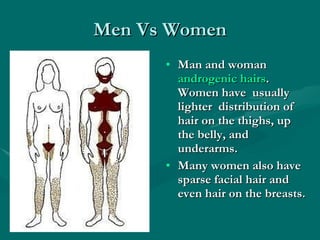
Men Vs Women Man and woman  androgenic hairs . Women have  usually lighter  distribution of hair on the thighs, up the belly, and underarms.  Many women also have sparse facial hair and even hair on the breasts.
Men Vs Women On average, men are taller than women [1]  ( See  sexual dimorphism ).  On average, men have a larger waist in comparison to their hips (see  waist-hip ratio ) than women.  On average, men have longer canine teeth than women.  On average, men have a greater capacity for cardiovascular endurance. This is due to the enlargement of the lungs of boys during puberty, characterized by a more prominent chest .
Men Vs Women On average, men are stronger than women. This is due to a greater capacity for muscular hypertrophy as a result of men's higher levels of testosterone.  On average, women have more endurance than men.  On average, men have more body hair than women.  Men’s skin is thicker (more  collagen ), oilier (more  sebum ) than women’s skin
Men Vs Women Women's skin is warmer on average than men's.  In men, the second digit (index finger) tends to be shorter than the fourth digit (ring finger), while in women the second digit tends to be longer than the fourth  On average, women tend to have skin that is 3-4% lighter than men. One scientist (Rebato, 1999) hypothesized this is an adaptation required for increased production of Vitamin D during pregnancy. Vitamin D is necessary to help the body absorb calcium and deposit it in the bones of fast growing embryos. Lighter pigmentation allows more of the sun's UV radiation to penetrate the skin, and increases a woman's ability to produce vitamin D.
Men Vs Women Women have a larger hip section than men, probably an adaptation for giving birth to infants with large skulls.  Men have a more pronounced 'Adam's Apple' or thyroid cartilage due to larger vocal cords (and deeper voices). [4]   Studies examining the leg/trunk ratio between men and women have had conflicting results. In adolescents, there may be no significant gender difference
Men Vs Women Overall rates of mental illness are similar for men and women. There is no significant gender difference in rates of  schizophrenia  and  bipolar depression . Women are more likely to suffer from  unipolar depression ,  anxiety ,  eating disorders , and  post-traumatic stress disorder . Men are more likely to suffer from  alcoholism  and  antisocial personality disorder .
Men Vs Women Worldwide, more men than women are infected with  HIV . The exception is  sub-Saharan Africa , where more women than men are infected.  Adult males are more likely to be diagnosed with  tuberculosis .  Before  menopause , women are less likely to suffer from  cardiovascular disease . However, after age 60, the risk for both men and women is the same.
THANK YOU

Human reproductive system

  • 1.
    Human Reproductive System Dr. Avinash Bhondwe
  • 2.
  • 3.
    Male Reproductive System The human male reproductive system consists of a number of sex organs that are a part of the human reproductive process. In the case of men, these sex organs are located outside a man 's body, around the pelvic region .
  • 4.
  • 5.
    Male Reproductive SystemContents Penis Testicles( Scrotum) Epididymis
  • 6.
    Male Reproductive SystemPenis The penis has a long shaft and enlarged tip called the glans penis. The penis is the male copulatory organ . When the male becomes sexually aroused , the penis becomes erect and ready for sexual intercourse . .
  • 7.
    Male Reproductive SystemErection is achieved because blood sinuses within the erectile tissue of the penis become filled with blood. The arteries of the penis are dilated while the veins are passively compressed so that blood flows into the erectile cartilage under pressure. The male penis is made of two different tissues,and soft spongey tissue. Cartlidge is not in the penis
  • 8.
  • 9.
    Testicles The testeshang outside the abdominal cavity of the male within the scrotum . They begin their development in the abdominal cavity but descend into the scrotal sacs during the last 2 months of fetal development. This is required for the production of sperm because internal body temperatures are too high to produce viable sperm.
  • 10.
    Epididymis The epididymisis a whitish mass of tightly coiled tubes cupped against the testicles. It acts as a storage place for sperm before they enter the vasa deferentia , tubes that carry sperm form the testes to the urethra.
  • 11.
  • 12.
  • 13.
    Contents 1 Vagina 2 Cervix 3 Uterus 4 Oviducts 5 Ovaries Female reproductive system
  • 14.
    Female reproductive systemVagina ( Latin ,=" sheath "or " scabbard ") Fibromuscular tubular tract leading from the uterus to the exterior of the body in female “ Vagina " is often used to refer to the Vulva or female genitals generally; strictly speaking, the vagina is a specific internal structure and the vulva is the exterior genitalia only.
  • 15.
    Female reproductive systemThe vagina is the place where semen from the male is deposited into the female's body at the climax of sexual intercourse , commonly known as ejaculation . Around the vagina, pubic hair protects the vagina from infection and is a sign of puberty
  • 16.
    Female reproductive systemCervix The cervix is the lower, narrow portion of the uterus where it joins with the top end of the vagina . It is cylindrical or conical in shape and protrudes through the upper anterior vaginal wall. Approximately half its length is visible; the remainder lies above the vagina beyond view.
  • 17.
    Female reproductive systemUterus The uterus or womb is the major female reproductive organ of humans . One end, the cervix , opens into the vagina ; the other is connected on both sides to the fallopian tubes .
  • 18.
    UTERUS The uterus is a pear-shaped muscular organ. Its major function is to accept a fertilized ovum which becomes implanted into the endometrium , and derives nourishment from blood vessels which develop exclusively for this purpose. The fertilized ovum becomes an embryo , develops into a fetus and gestates until childbirth .
  • 19.
    OVIDUCTS Oviducts: Fallopian tube The Fallopian tubes or oviducts are two very fine tubes leading from the ovaries of female mammals into the uterus .
  • 20.
    OVIDUCTS On maturityof an ovum , the follicle and the ovary 's wall rupture, allowing the ovum to escape and enter the Fallopian tube . There it travels toward the uterus, pushed along by movements of cilia on the inner lining of the tubes. This trip takes hours or days. If the ovum is fertilized while in the Fallopian tube , then it normally implants in the endometrium when it reaches the uterus, which signals the beginning of pregnancy
  • 21.
    Ovaries The ovaries are the place inside the female body where ova or eggs are produced. The process by which the ovum is released is called ovulation . The speed of ovulation is periodic and impacts directly to the length of a menstrual cycle .
  • 22.
    After ovulation, the ovum is captured by the oviduct , after traveling down the oviduct to the uterus , occasionally being fertilized on its way by an incoming sperm , leading to pregnancy and the eventual birth of a new human being.
  • 23.
  • 24.
  • 25.
    Male Secondary SexCharacters Male Growth of body hair , including underarm , abdominal , chest , and pubic hair . Loss of scalp hair androgenic alopecia can also occur Greater mass of thigh muscles in front of the femur, rather than behind it as is typical in mature females Growth of facial hair waist
  • 26.
    Male Secondary SexCharacters Enlargement of larynx and deepening of voice Increased stature ; adult males taller than adult females, on average Heavier skull and bone structure Increased muscle mass and strength Broadening of shoulders and chest; shoulders wider than hips
  • 27.
    Male Secondary SexCharacters Increased secretions of oil and sweat glands, often causing acne and body odor [3] Coarsening or rigidity of skin texture, due to less subcutaneous fat A prominent Adam's apple Fat deposits mainly around the abdomen and
  • 28.
    Male Secondary SexCharacters Higher waist to hip ratio than prepubescent or adult females or prepubescent males, on average On average, larger hands and feet than prepubescent or adult females or prepubescent males[ citation needed ] Lower digit ratio , on average
  • 29.
    Female Secondary SexCharacters Enlargement of breasts Growth of body hair , most prominently underarm and pubic hair Greater development of thigh muscles in back (behind the femur ) than in front of it Vaginal and uterine growth
  • 30.
    Female Secondary SexCharacters Decreased stature; adult females shorter stature than adult males, on average Widening of hips [5] ; lower waist to hip ratio than adult males, on average Upper arms approximately 1" longer, on average, for a given height [6] Changed distribution in weight and fat; more subcutaneous fat and fat deposits mainly around the buttocks , thighs and hips Higher digit ratio , on average
  • 31.
    Men Vs WomenMan and woman androgenic hairs . Women have usually lighter distribution of hair on the thighs, up the belly, and underarms. Many women also have sparse facial hair and even hair on the breasts.
  • 32.
    Men Vs WomenOn average, men are taller than women [1] ( See sexual dimorphism ). On average, men have a larger waist in comparison to their hips (see waist-hip ratio ) than women. On average, men have longer canine teeth than women. On average, men have a greater capacity for cardiovascular endurance. This is due to the enlargement of the lungs of boys during puberty, characterized by a more prominent chest .
  • 33.
    Men Vs WomenOn average, men are stronger than women. This is due to a greater capacity for muscular hypertrophy as a result of men's higher levels of testosterone. On average, women have more endurance than men. On average, men have more body hair than women. Men’s skin is thicker (more collagen ), oilier (more sebum ) than women’s skin
  • 34.
    Men Vs WomenWomen's skin is warmer on average than men's. In men, the second digit (index finger) tends to be shorter than the fourth digit (ring finger), while in women the second digit tends to be longer than the fourth On average, women tend to have skin that is 3-4% lighter than men. One scientist (Rebato, 1999) hypothesized this is an adaptation required for increased production of Vitamin D during pregnancy. Vitamin D is necessary to help the body absorb calcium and deposit it in the bones of fast growing embryos. Lighter pigmentation allows more of the sun's UV radiation to penetrate the skin, and increases a woman's ability to produce vitamin D.
  • 35.
    Men Vs WomenWomen have a larger hip section than men, probably an adaptation for giving birth to infants with large skulls. Men have a more pronounced 'Adam's Apple' or thyroid cartilage due to larger vocal cords (and deeper voices). [4] Studies examining the leg/trunk ratio between men and women have had conflicting results. In adolescents, there may be no significant gender difference
  • 36.
    Men Vs WomenOverall rates of mental illness are similar for men and women. There is no significant gender difference in rates of schizophrenia and bipolar depression . Women are more likely to suffer from unipolar depression , anxiety , eating disorders , and post-traumatic stress disorder . Men are more likely to suffer from alcoholism and antisocial personality disorder .
  • 37.
    Men Vs WomenWorldwide, more men than women are infected with HIV . The exception is sub-Saharan Africa , where more women than men are infected. Adult males are more likely to be diagnosed with tuberculosis . Before menopause , women are less likely to suffer from cardiovascular disease . However, after age 60, the risk for both men and women is the same.
  • 38.