DVD, “Earth Watch” by Paul EhrlichProduced for HRM by NBC News Productions 		MCMXCI NATIONAL BROADCASTING Company, Inc.	Edison  State  College Library; QH 541 .E38 1990
Costs of Rapid Population Growth Rapid population growth impedes economic development, helping to keep a country poor, and thus further promoting rapid population growth
 Rapid population growth reduces health and welfare, especially of women and children. 
 Rapid growth implies women giving birth from a younger age, experiencing more pregnancies throughout their lives, and bearing children well into their later years. All three are known to cause higher rates of infant and maternal mortality.
Costs of Rapid Population GrowthThe first impact of reducing fertility is increasing the health and welfare of women and children.
Rapid population growth increases number and proportion of young people in the society.
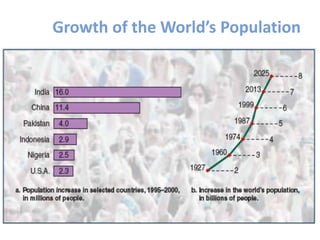
This increases the demand for education and jobs. Where education and jobs are not available, young people, especially young males, who constitute a highly volatile population,  can easily be swayed to violence by demagogic leaders. Growth of the World’s Population
By INVESTOR'S BUSINESS DAILY | Posted Monday, February 02, 2009 4:20 PM PT Climate Change: A member of Britain's government says couples should be limited to two children to save the Earth from global warming. It's discouraging that such muddle-headed people are in positions of power.
Last year, the government issued a news release that noted: "The proportion of live births to mothers born outside the United Kingdom continued to rise. In 2007, 23% (160,358) of live births were to mothers born outside the United Kingdom compared with 22% (146,956) in 2006."
Jonathon Porritt, chairman of the government's Sustainable Development Commission, doesn't have the power to set a two-child limit on British couples — at least not yet. But he's nevertheless "unapologetic about asking people to connect up their own responsibility for their total environmental footprint and how they decide to procreate and how many children they think are appropriate.""I think we will work our way toward a position that says that having more than two children is irresponsible,“;Porritt,  favors contraceptionand abortion
Some Britons don't seem to be at all concerned about the bleak future of the English way. There are, though, a few who understand what is occurring around them. Irish-born British reporter Ruth Dudley Edwards worried in the Daily Mail nearly two years ago that "we have a large Muslim population with a high birth rate.“"Indeed," she wrote, "Muslims are outbreeding non-Muslims throughout Europe.“Before writing off her recitation of the facts as an ugly example of Western hegemony or racism, consider that in 2007 a Norwegian imam gloatingly noted that in Europe "the number of Muslims is expanding like mosquitoes. Every Western woman in the EU is producing an average of 1.4 children. Every Muslim woman in the same countries is producing 3.5 children. Our way of thinking will prove more powerful than yours."
Population PyramidKendall, pg. 636
Population Pyramid
FertilityFecundity is the potential number of children who could be born if every woman reproduced at her maximum biological capacity.
The most basic measure of fertility is the crude birth rate - the number of live births per 1,000 people in a population in a given year.Country Summary: United States
MortalityThe incidence of death    in a population.The simplest measure of mortality is the crude death rate - the number of deaths per 1,000 people in a population in a given year.
In 2004 the U.S. crude death rate was 8.3 per 1,000.Country Summary: United States
Migration Two types of movement:Immigration is the movement  of people into a geographic area to  take up residency.Emigration is the movement of  people out of a geographic area to  take up residency elsewhere.
Country Summary: United StatesU.S. Population

Population Class, Section 1 B

  • 1.
    DVD, “Earth Watch” by Paul EhrlichProduced for HRM by NBC News Productions MCMXCI NATIONAL BROADCASTING Company, Inc. Edison State College Library; QH 541 .E38 1990
  • 2.
    Costs of RapidPopulation Growth Rapid population growth impedes economic development, helping to keep a country poor, and thus further promoting rapid population growth
  • 3.
    Rapid populationgrowth reduces health and welfare, especially of women and children. 
  • 4.
    Rapid growthimplies women giving birth from a younger age, experiencing more pregnancies throughout their lives, and bearing children well into their later years. All three are known to cause higher rates of infant and maternal mortality.
  • 5.
    Costs of RapidPopulation GrowthThe first impact of reducing fertility is increasing the health and welfare of women and children.
  • 6.
    Rapid population growthincreases number and proportion of young people in the society.
  • 7.
    This increases thedemand for education and jobs. Where education and jobs are not available, young people, especially young males, who constitute a highly volatile population,  can easily be swayed to violence by demagogic leaders. Growth of the World’s Population
  • 8.
    By INVESTOR'S BUSINESSDAILY | Posted Monday, February 02, 2009 4:20 PM PT Climate Change: A member of Britain's government says couples should be limited to two children to save the Earth from global warming. It's discouraging that such muddle-headed people are in positions of power.
  • 9.
    Last year, thegovernment issued a news release that noted: "The proportion of live births to mothers born outside the United Kingdom continued to rise. In 2007, 23% (160,358) of live births were to mothers born outside the United Kingdom compared with 22% (146,956) in 2006."
  • 10.
    Jonathon Porritt, chairmanof the government's Sustainable Development Commission, doesn't have the power to set a two-child limit on British couples — at least not yet. But he's nevertheless "unapologetic about asking people to connect up their own responsibility for their total environmental footprint and how they decide to procreate and how many children they think are appropriate.""I think we will work our way toward a position that says that having more than two children is irresponsible,“;Porritt, favors contraceptionand abortion
  • 11.
    Some Britons don'tseem to be at all concerned about the bleak future of the English way. There are, though, a few who understand what is occurring around them. Irish-born British reporter Ruth Dudley Edwards worried in the Daily Mail nearly two years ago that "we have a large Muslim population with a high birth rate.“"Indeed," she wrote, "Muslims are outbreeding non-Muslims throughout Europe.“Before writing off her recitation of the facts as an ugly example of Western hegemony or racism, consider that in 2007 a Norwegian imam gloatingly noted that in Europe "the number of Muslims is expanding like mosquitoes. Every Western woman in the EU is producing an average of 1.4 children. Every Muslim woman in the same countries is producing 3.5 children. Our way of thinking will prove more powerful than yours."
  • 12.
  • 13.
  • 14.
    FertilityFecundity is thepotential number of children who could be born if every woman reproduced at her maximum biological capacity.
  • 15.
    The most basicmeasure of fertility is the crude birth rate - the number of live births per 1,000 people in a population in a given year.Country Summary: United States
  • 16.
    MortalityThe incidence ofdeath in a population.The simplest measure of mortality is the crude death rate - the number of deaths per 1,000 people in a population in a given year.
  • 17.
    In 2004 theU.S. crude death rate was 8.3 per 1,000.Country Summary: United States
  • 18.
    Migration Two typesof movement:Immigration is the movement of people into a geographic area to take up residency.Emigration is the movement of people out of a geographic area to take up residency elsewhere.
  • 19.
    Country Summary: UnitedStatesU.S. Population

Editor's Notes

  • #3 The demographic transition generally occurs in four stages. In the initial stage, both birth and death rates are high, causing only slow and steady population growth. In the next stage, death rates begin to decline and birth rates remain high, resulting in faster population growth. In stage three, the birth rate begins to decline, and in the final stage, birth rates balance death rates.  Population growth stabilizes in this final stage.  In some cases, such as Italy, population growth may cease altogether.
  • #4 The demographic transition generally occurs in four stages. In the initial stage, both birth and death rates are high, causing only slow and steady population growth. In the next stage, death rates begin to decline and birth rates remain high, resulting in faster population growth. In stage three, the birth rate begins to decline, and in the final stage, birth rates balance death rates.  Population growth stabilizes in this final stage.  In some cases, such as Italy, population growth may cease altogether.
  • #5 Demographers examine aspects of the population composition through the use of graphs, like this one.The so-called population pyramid represents 5-year cohort groupings. The left side of the pyramid represents the number of men while the right side shows the number of women. Such countries as Mexico and Iran, classified as low-income countries, have high fertility and mortality rates; hence their population is proportionately much younger on average, while, NEXT SLIDE……
  • #6 Compared with such developed nations, like the U.S. the shape of this population distribution is not pyramidal shaped, rather is rectangular or barrel in appearance.. Representing what
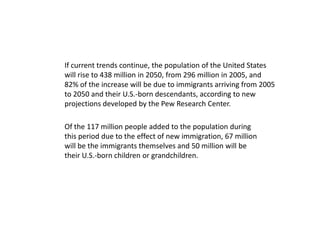
  • #9 Because immigrants on average have more children than native-born U.S. residents, the share of U.S. children who are children of immigrants—the first and second generations combined—will increase. In 2050, one child in three (34%) will be an immigrant or the son or daughter of an immigrant, compared with almost one in four (23%) in 2005. The share of children who are Hispanic will rise markedly, from 20% in 2005 to 35% in 2050. Non-Hispanic whites, who made up 59% of children in 2005, are projected to be 40% of children in 2050. (Figure 20)