POPULATION Jonathan S. Rubio DLSU-D
Objectives Understand what is population and its properties Identify the properties of population Determine the advantages and disadvantages of being the member of populations.
POPULATIONS Population -all of the individuals of a species that live together in one place at one time. Demography -the statistical study of populations.  It is used to predict how the size of a population will change.
Properties of Population  Size Density Growth Dispersion Population Organization Population Interaction
Population Size 1.  Population size is the number of individuals in a population. has an important effect on the ability of the population to survive. A small population is more likely to become extinct: in the case of random events or natural disaster due to inbreeding where the population is more genetically alike.  Recessive traits are more likely to appear. with reduced variability it is harder to adapt to changes.
Population Density –  the number of individuals in a given area. –  if they are too far apart they may only rarely encounter one another resulting in little reproduction.
Population Density is limited by: density-dependent factors Disease Competition Predators Parasites Food  Crowding The greater the population, the greater effect these factors have. Ex. Black plague in the Middle Ages – more deaths in cities density-independent factors Volcanic eruptions Temperature Storms Floods Drought Chemical pesticides Major habitat disruption (as in the New Orleans flooding) Most are abiotic factors
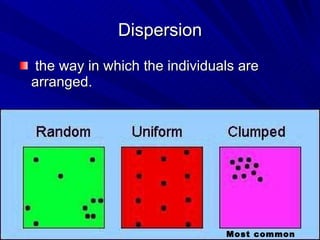
Dispersion the way in which the individuals are arranged. Most common
POPULATION GROWTH Model:   A hypothetical population that has key characteristics of the real population being studied. Used by demographers to predict how a population will grow.
PREDICTING POPULATION GROWTH, con’t Nearly all populations will tend to grow  exponentially  as long as there are resources available.  Two of the most basic factors that affect the rate of population growth are the birth rate, and the death rate.  r (rate of growth)=birth rate – death rate
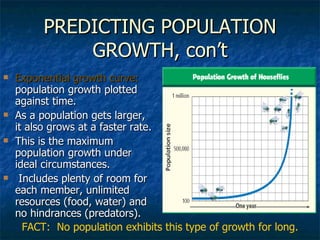
PREDICTING POPULATION GROWTH, con’t Exponential growth curve:  population growth plotted against time. As a population gets larger, it also grows at a faster rate.  This is the maximum population growth under ideal circumstances.  Includes plenty of room for each member, unlimited resources (food, water) and no hindrances (predators).  FACT:  No population exhibits this type of growth for long.
PREDICTING POPULATION GROWTH, con’t Logistic model:   This model accounts for the declining resources available to populations as they grow. It assumes the birth and death rates are not constant. As the population grows, births decline and death rises.  Eventually birth=death so the population stops growing. Carrying capacity (K):  The number of organisms of one species that an environment can support indefinitely.
PREDICTING POPULATION GROWTH, con’t   Two modes of population growth.   The Exponential curve (also known as a J-curve)  occurs when there is no limit to population size.  The Logistic curve (also known as an S-curve)  shows the effect of a  limiting factor  (in this case the  carrying capacity  of the environment).
POPULATION GROWTH STRATEGIES There are 2 ways a population can prosper: Depends on the rate of growth (r) Influenced by the carrying capacity (K)
POPULATION GROWTH STRATEGIES, con’t r -strategists:  characterized by exponential growth, which results in temporarily large populations, followed by sudden crashes in population size.  Ex. Insects, bacteria, some plants live in unpredictable and rapidly changing environments Reproduce quickly when conditions are favorable Many offspring: small, mature rapidly, no parental care r  = rate of growth
POPULATION GROWTH STRATEGIES, con’t K- strategists:  characterized by a high degree of specialization.  Ex. Trees, whales, tigers, etc. Live in stable and predictable environments Can compete effectively Reproduce late in life Few offspring: large, mature slowly, often much parental care K  = carrying capacity
POPULATION GROWTH STRATEGIES, con’t Human Populations: K-  strategist characteristics In recent times however, man has learned to expand the carrying capacity of his environment by increasing food supply, combating pests and curing diseases. Can Earth support this increase? Damage to the planet will eventually reduce the carrying capacity for humanity and slow the growth of the human population.
Factors Affecting Human Population Socio-economic poverty, lack of recreation, lack of Education,  Political Cultural
Population Organization hierarchy or status of individuals in the given population Social Insects have hierarchy e.g. Queen, Drone, Maiden, Workers, Soldiers Principle of Superiority and Inferiority e.g. head pecking in chicken, Harem system in Lion
Population Interaction interrelationship among the members of the population social interaction e.g. social insects like bees, ants in which there are queen, drone, workers, soldiers intraspecific competition e.g competition in terms of mate, food and territory Intraspecific Predation (cannibalism) e.g female praying mantis eating the male mate Altruism- sacrificing individual for the entire population e.g Sentinel bird
Altruism e.g. Lapwing –a sentinel bird The northern lapwing,  Vanellus vanellus,  is a well-known bird of the plover family that inhabits the grasslands of Eurasia. The name  lapwing  refers to the slow wing beat of the bird. Microsoft ® Encarta ® 2007. © 1993-2006 Microsoft Corporation. All rights reserved.
Advantages of Being a Member of Population Genetic variability protection e.g. gregariousness survival of the fittest
Disadvantages of Being a member of the Population Social stress Intra-specific competition  elimination of the unfit
Student Activity Classify the Filipino population in terms of the population characteristics e.g size density etc.
 

Population Characteristics

  • 1.
  • 2.
    Objectives Understand whatis population and its properties Identify the properties of population Determine the advantages and disadvantages of being the member of populations.
  • 3.
    POPULATIONS Population -allof the individuals of a species that live together in one place at one time. Demography -the statistical study of populations. It is used to predict how the size of a population will change.
  • 4.
    Properties of Population Size Density Growth Dispersion Population Organization Population Interaction
  • 5.
    Population Size 1. Population size is the number of individuals in a population. has an important effect on the ability of the population to survive. A small population is more likely to become extinct: in the case of random events or natural disaster due to inbreeding where the population is more genetically alike. Recessive traits are more likely to appear. with reduced variability it is harder to adapt to changes.
  • 6.
    Population Density – the number of individuals in a given area. – if they are too far apart they may only rarely encounter one another resulting in little reproduction.
  • 7.
    Population Density islimited by: density-dependent factors Disease Competition Predators Parasites Food Crowding The greater the population, the greater effect these factors have. Ex. Black plague in the Middle Ages – more deaths in cities density-independent factors Volcanic eruptions Temperature Storms Floods Drought Chemical pesticides Major habitat disruption (as in the New Orleans flooding) Most are abiotic factors
  • 8.
    Dispersion the wayin which the individuals are arranged. Most common
  • 9.
    POPULATION GROWTH Model: A hypothetical population that has key characteristics of the real population being studied. Used by demographers to predict how a population will grow.
  • 10.
    PREDICTING POPULATION GROWTH,con’t Nearly all populations will tend to grow exponentially as long as there are resources available. Two of the most basic factors that affect the rate of population growth are the birth rate, and the death rate. r (rate of growth)=birth rate – death rate
  • 11.
    PREDICTING POPULATION GROWTH,con’t Exponential growth curve: population growth plotted against time. As a population gets larger, it also grows at a faster rate. This is the maximum population growth under ideal circumstances. Includes plenty of room for each member, unlimited resources (food, water) and no hindrances (predators). FACT: No population exhibits this type of growth for long.
  • 12.
    PREDICTING POPULATION GROWTH,con’t Logistic model: This model accounts for the declining resources available to populations as they grow. It assumes the birth and death rates are not constant. As the population grows, births decline and death rises. Eventually birth=death so the population stops growing. Carrying capacity (K): The number of organisms of one species that an environment can support indefinitely.
  • 13.
    PREDICTING POPULATION GROWTH,con’t Two modes of population growth. The Exponential curve (also known as a J-curve) occurs when there is no limit to population size. The Logistic curve (also known as an S-curve) shows the effect of a limiting factor (in this case the carrying capacity of the environment).
  • 14.
    POPULATION GROWTH STRATEGIESThere are 2 ways a population can prosper: Depends on the rate of growth (r) Influenced by the carrying capacity (K)
  • 15.
    POPULATION GROWTH STRATEGIES,con’t r -strategists: characterized by exponential growth, which results in temporarily large populations, followed by sudden crashes in population size. Ex. Insects, bacteria, some plants live in unpredictable and rapidly changing environments Reproduce quickly when conditions are favorable Many offspring: small, mature rapidly, no parental care r = rate of growth
  • 16.
    POPULATION GROWTH STRATEGIES,con’t K- strategists: characterized by a high degree of specialization. Ex. Trees, whales, tigers, etc. Live in stable and predictable environments Can compete effectively Reproduce late in life Few offspring: large, mature slowly, often much parental care K = carrying capacity
  • 17.
    POPULATION GROWTH STRATEGIES,con’t Human Populations: K- strategist characteristics In recent times however, man has learned to expand the carrying capacity of his environment by increasing food supply, combating pests and curing diseases. Can Earth support this increase? Damage to the planet will eventually reduce the carrying capacity for humanity and slow the growth of the human population.
  • 18.
    Factors Affecting HumanPopulation Socio-economic poverty, lack of recreation, lack of Education, Political Cultural
  • 19.
    Population Organization hierarchyor status of individuals in the given population Social Insects have hierarchy e.g. Queen, Drone, Maiden, Workers, Soldiers Principle of Superiority and Inferiority e.g. head pecking in chicken, Harem system in Lion
  • 20.
    Population Interaction interrelationshipamong the members of the population social interaction e.g. social insects like bees, ants in which there are queen, drone, workers, soldiers intraspecific competition e.g competition in terms of mate, food and territory Intraspecific Predation (cannibalism) e.g female praying mantis eating the male mate Altruism- sacrificing individual for the entire population e.g Sentinel bird
  • 21.
    Altruism e.g. Lapwing–a sentinel bird The northern lapwing, Vanellus vanellus, is a well-known bird of the plover family that inhabits the grasslands of Eurasia. The name lapwing refers to the slow wing beat of the bird. Microsoft ® Encarta ® 2007. © 1993-2006 Microsoft Corporation. All rights reserved.
  • 22.
    Advantages of Beinga Member of Population Genetic variability protection e.g. gregariousness survival of the fittest
  • 23.
    Disadvantages of Beinga member of the Population Social stress Intra-specific competition elimination of the unfit
  • 24.
    Student Activity Classifythe Filipino population in terms of the population characteristics e.g size density etc.
  • 25.