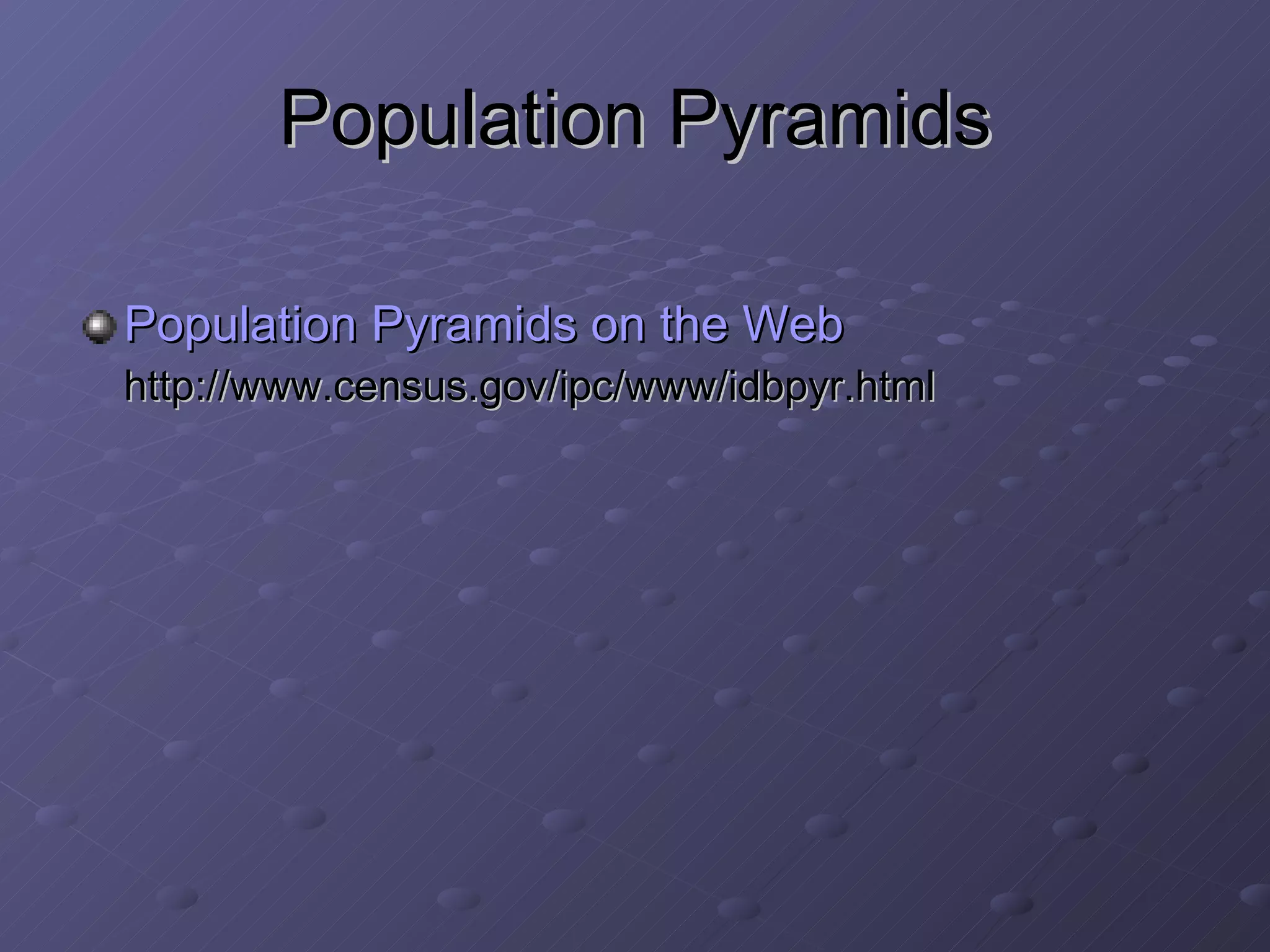
World Population Dynamics
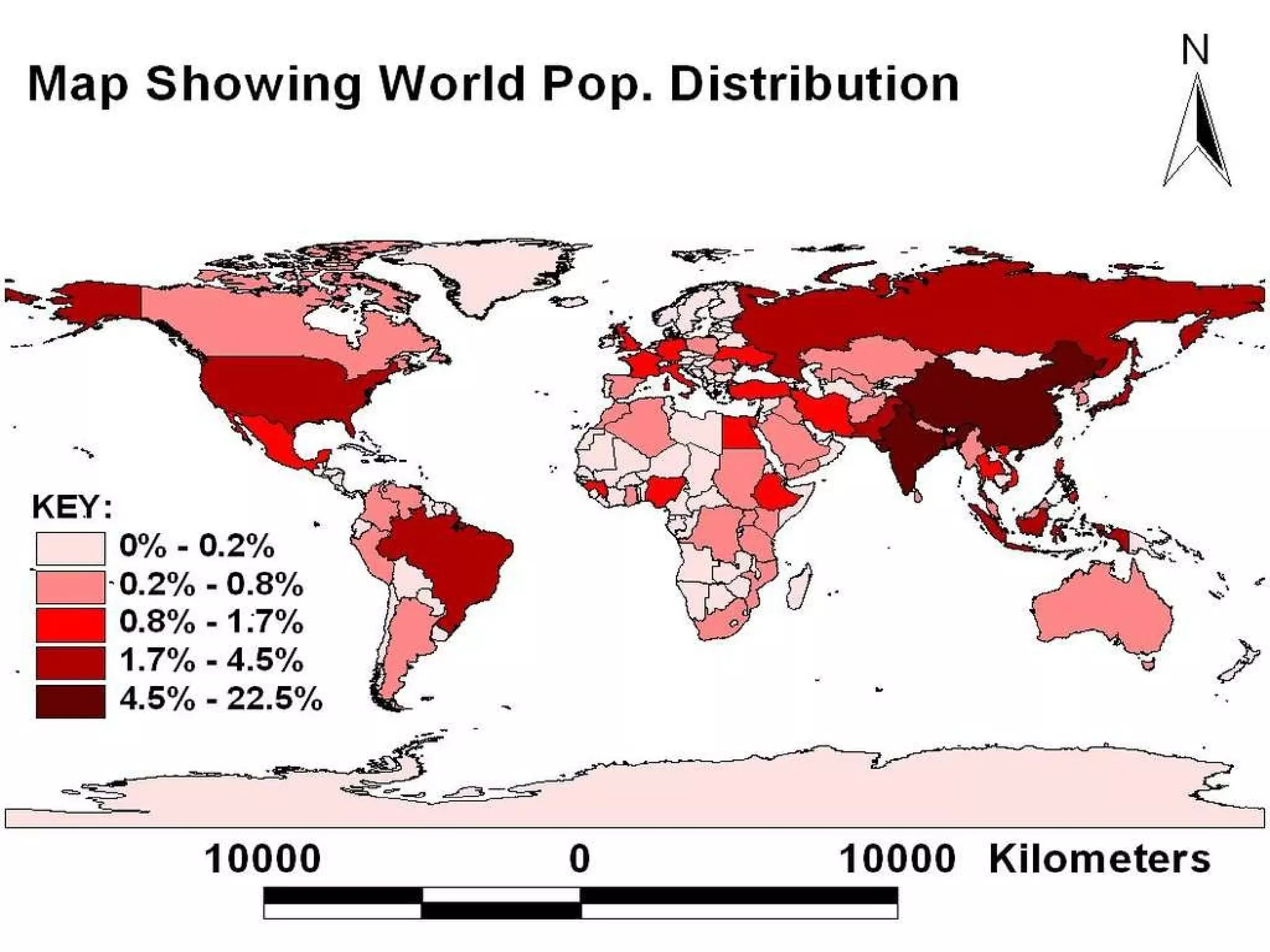
Population Distribution   Population distribution is where people live, this can be on a global, regional or local scale. Places with lots of people usually have habitable environments they either:  wealthy and industrial e.g. Europe, Japan etc. poor with rapidly growing populations e.g. India, Ethiopia  Places with few people are usually hostile environments, e.g. Antarctica, Sahara Deserts, Alaska etc.
 
Areas of Large Population River Valleys.   e.g. Ganges valley in India, Rhine valley in Germany, Indus Valley in Pakistan. Lowlands Plains. e.g. Denmark (very low lying and famous for dairy farms), East Anglia in the UK (good location for growing cereals) Area  rich in natural resources. Coastal Plains. e.g. New York in the U.S.A.
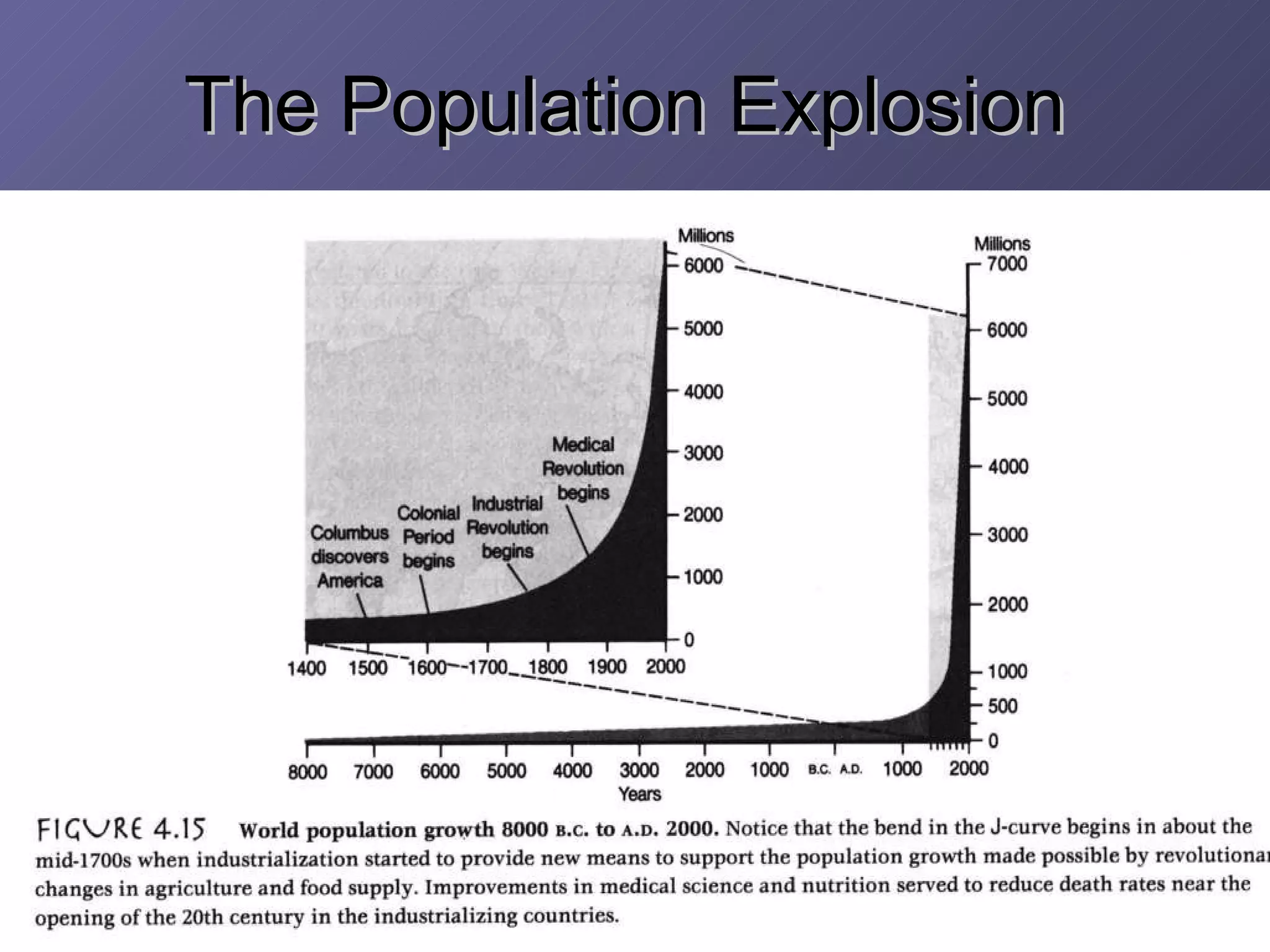
The Population Explosion
Population Explosion a recent event Last 200 years or less for MDCs  Industrial Revolution Improvement in sanitation and medicine Last 50 years or less for LDCs Transfer of technology, i.e. medical, agricultural (Green Revolution)
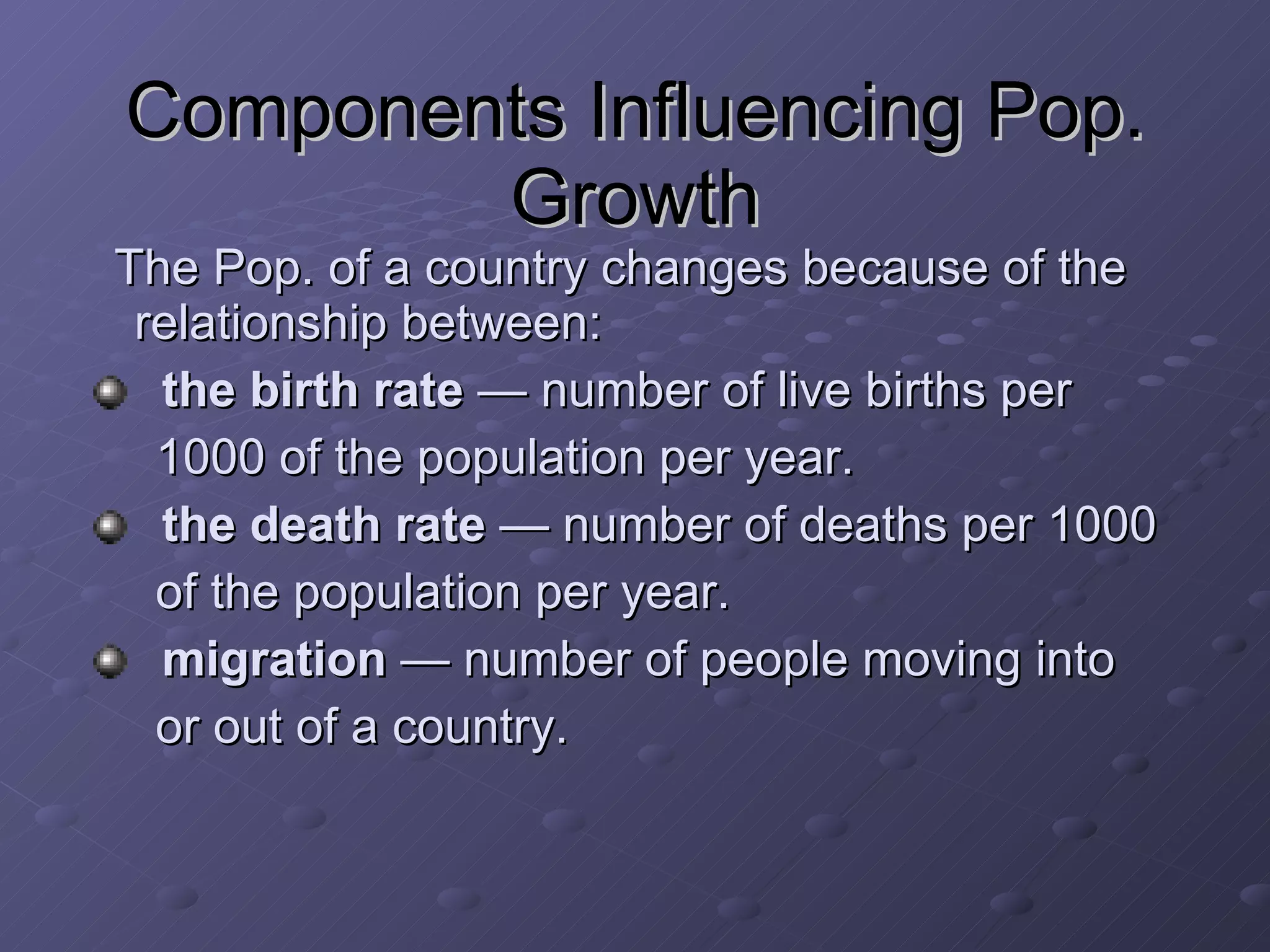
Components Influencing Pop. Growth The Pop. of a country changes because of the relationship between: the birth rate  — number of live births per  1000 of the population per year.  the death rate  — number of deaths per 1000 of the population per year. migration  — number of people moving into  or out of a country.
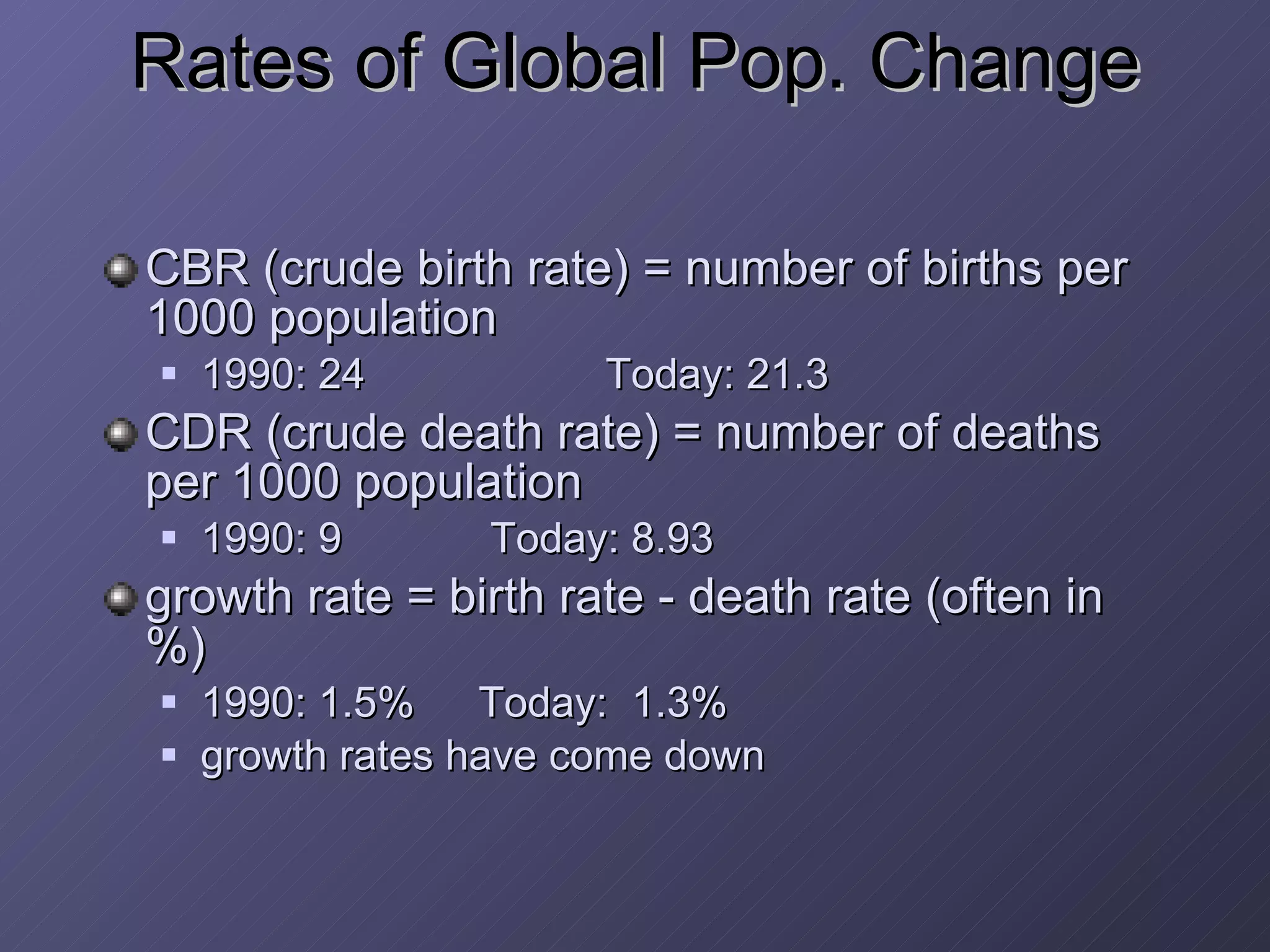
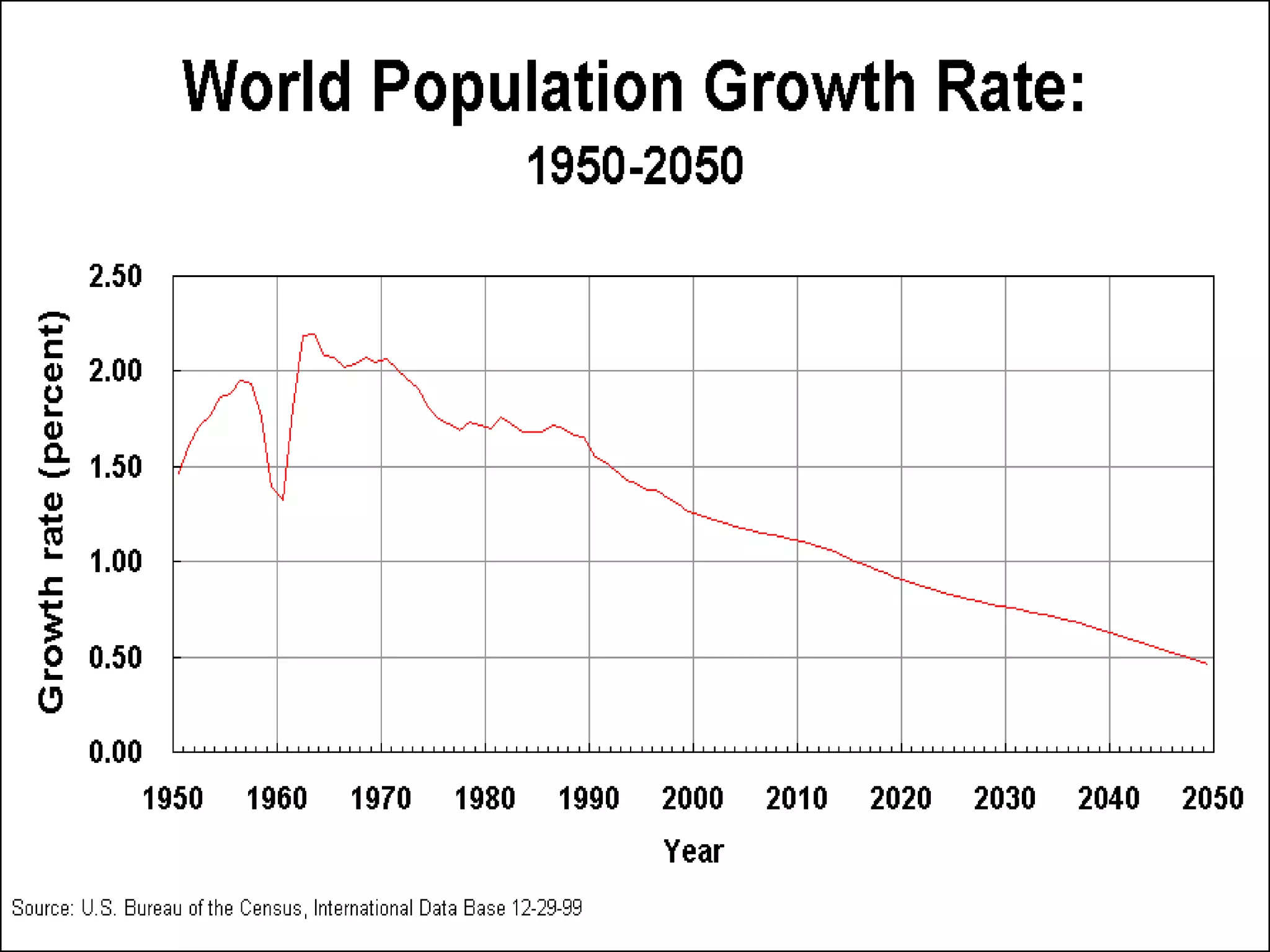
Rates of Global Pop. Change CBR (crude birth rate) = number of births per 1000 population 1990: 24 Today: 21.3 CDR (crude death rate) = number of deaths per 1000 population 1990: 9  Today: 8.93 growth rate = birth rate - death rate (often in %) 1990: 1.5% Today:  1.3% growth rates have come down
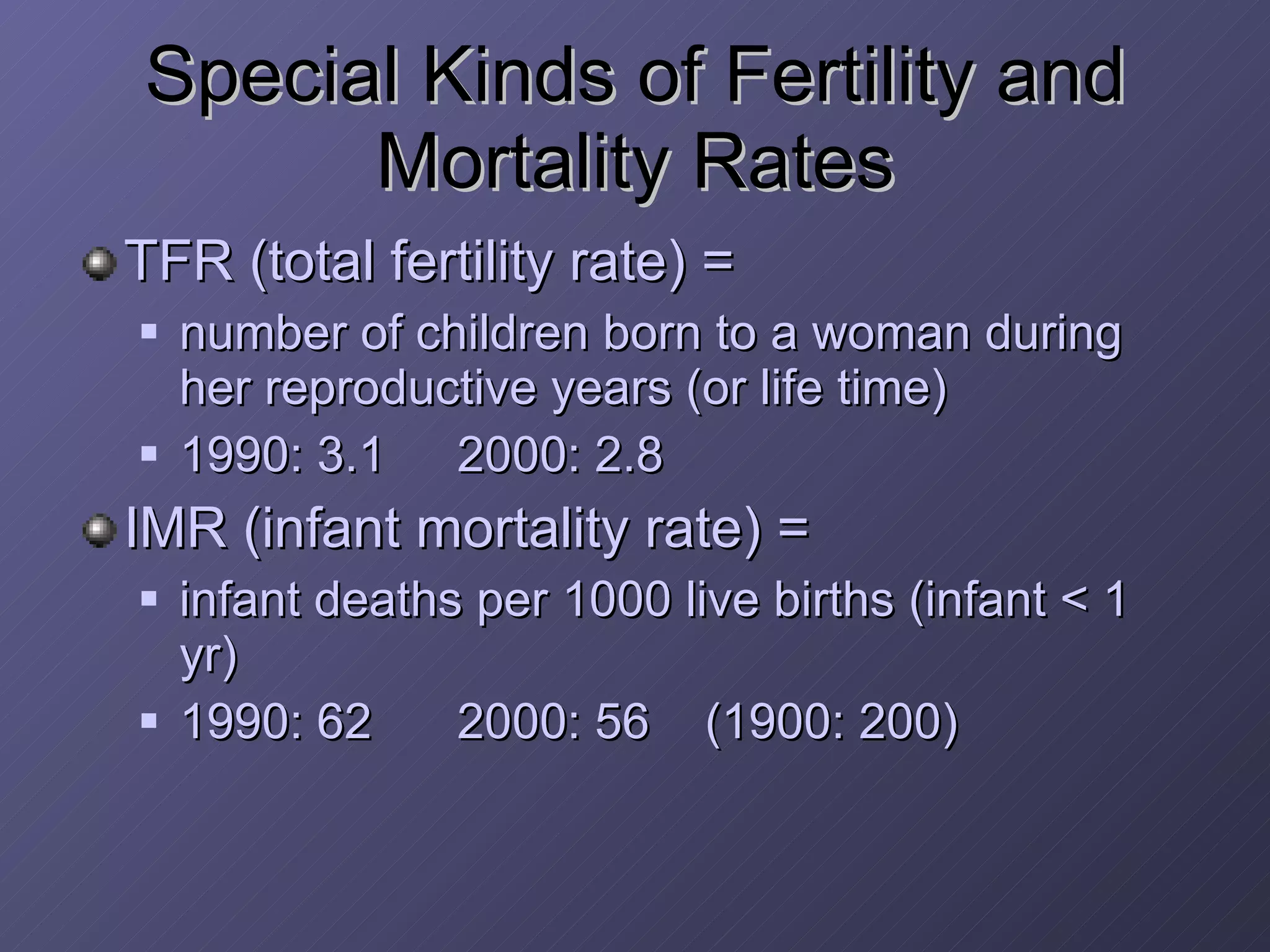
Special Kinds of Fertility and Mortality Rates TFR (total fertility rate) =  number of children born to a woman during her reproductive years (or life time) 1990: 3.1 2000: 2.8 IMR (infant mortality rate) =  infant deaths per 1000 live births (infant < 1 yr) 1990: 62 2000: 56  (1900: 200)
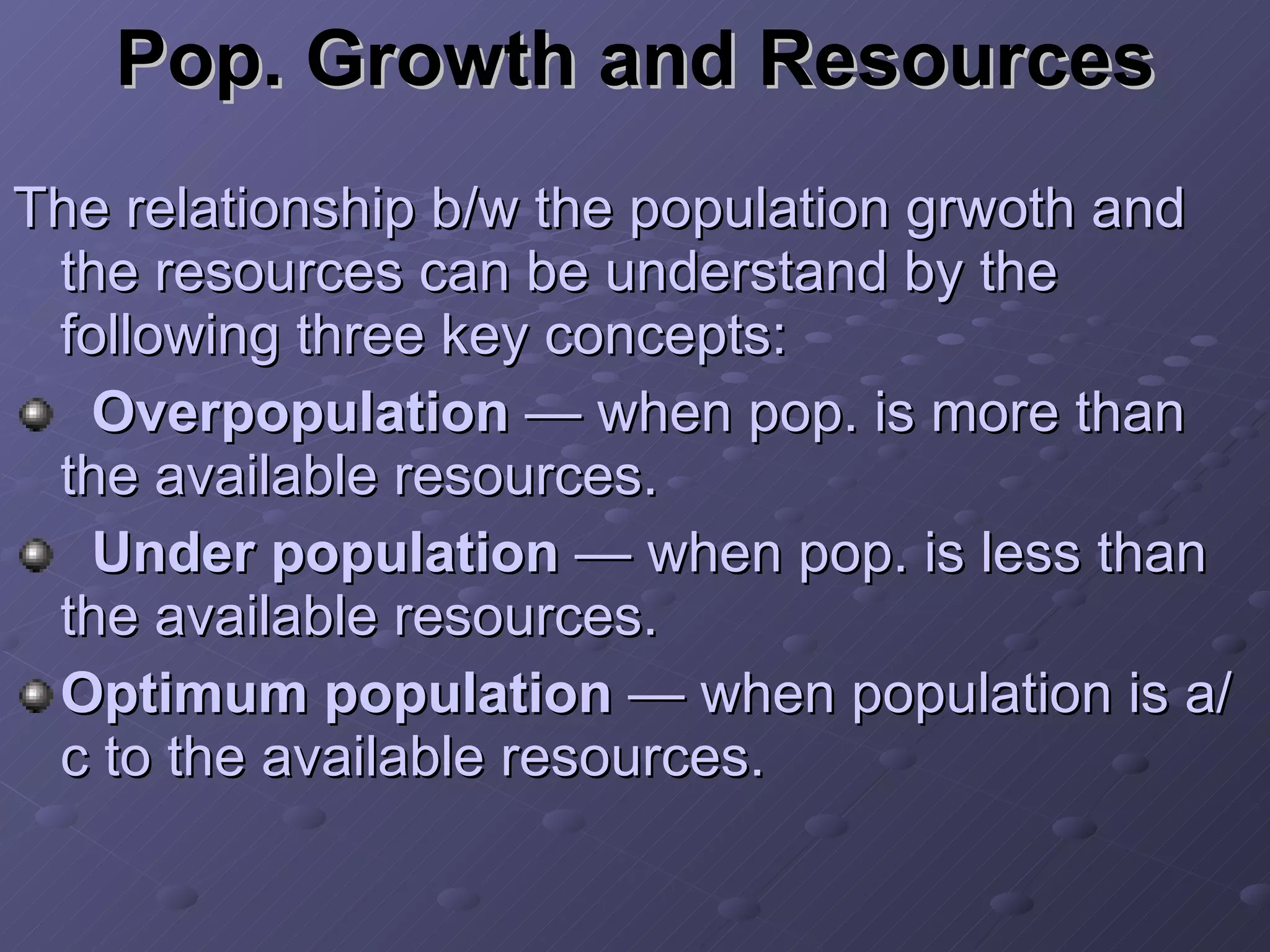
Pop. Growth and Resources The relationship b/w the population grwoth and the resources can be understand by the following three key concepts: Overpopulation  — when pop. is more than the available resources. Under population  — when pop. is less than the available resources. Optimum population  — when population is a/c to the available resources.
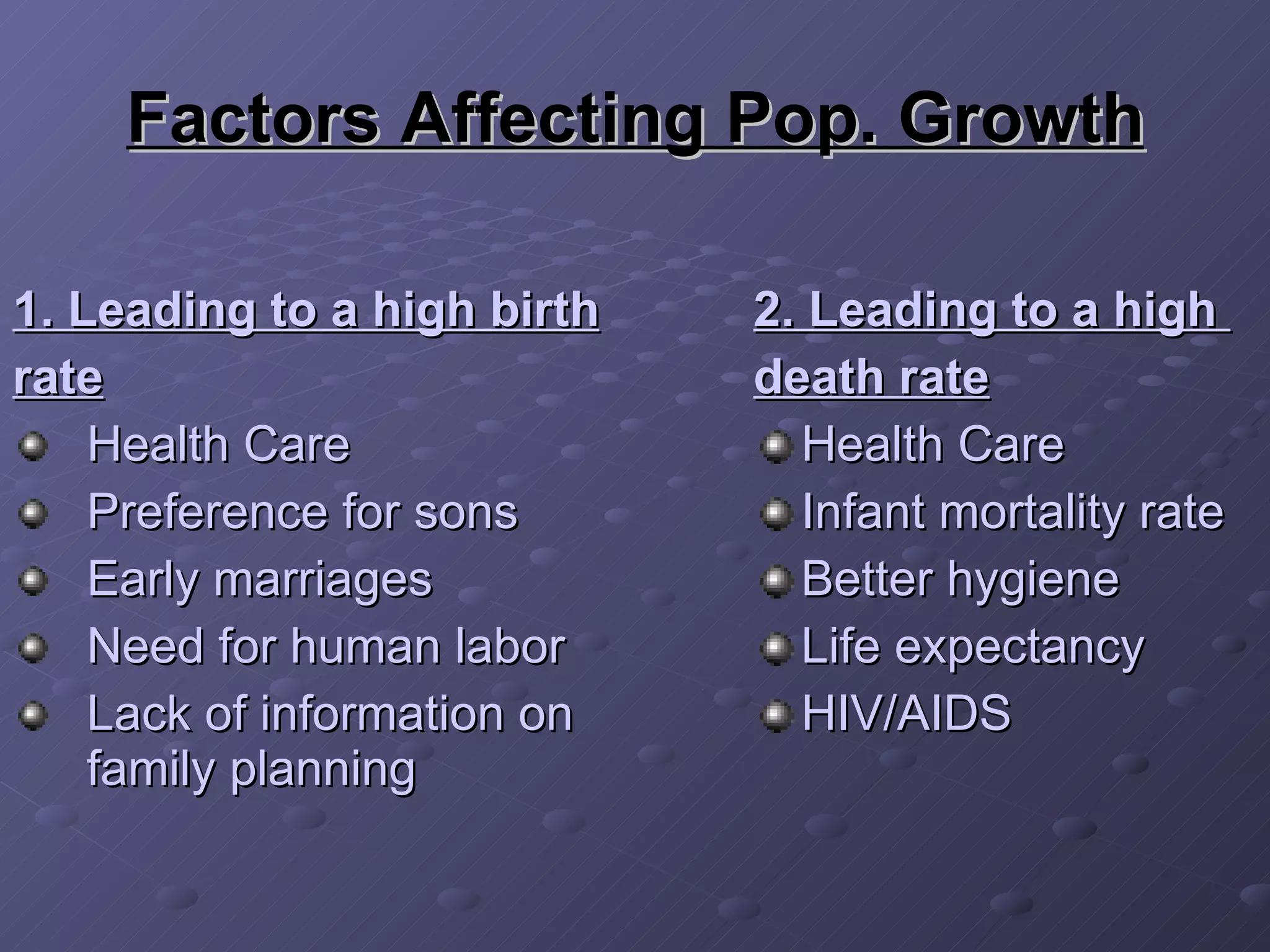
Factors Affecting Pop. Growth 2. Leading to a high  death rate Health Care Infant mortality rate Better hygiene Life expectancy HIV/AIDS 1. Leading to a high birth rate Health Care Preference for sons Early marriages Need for human labor Lack of information on family planning
3. Migration
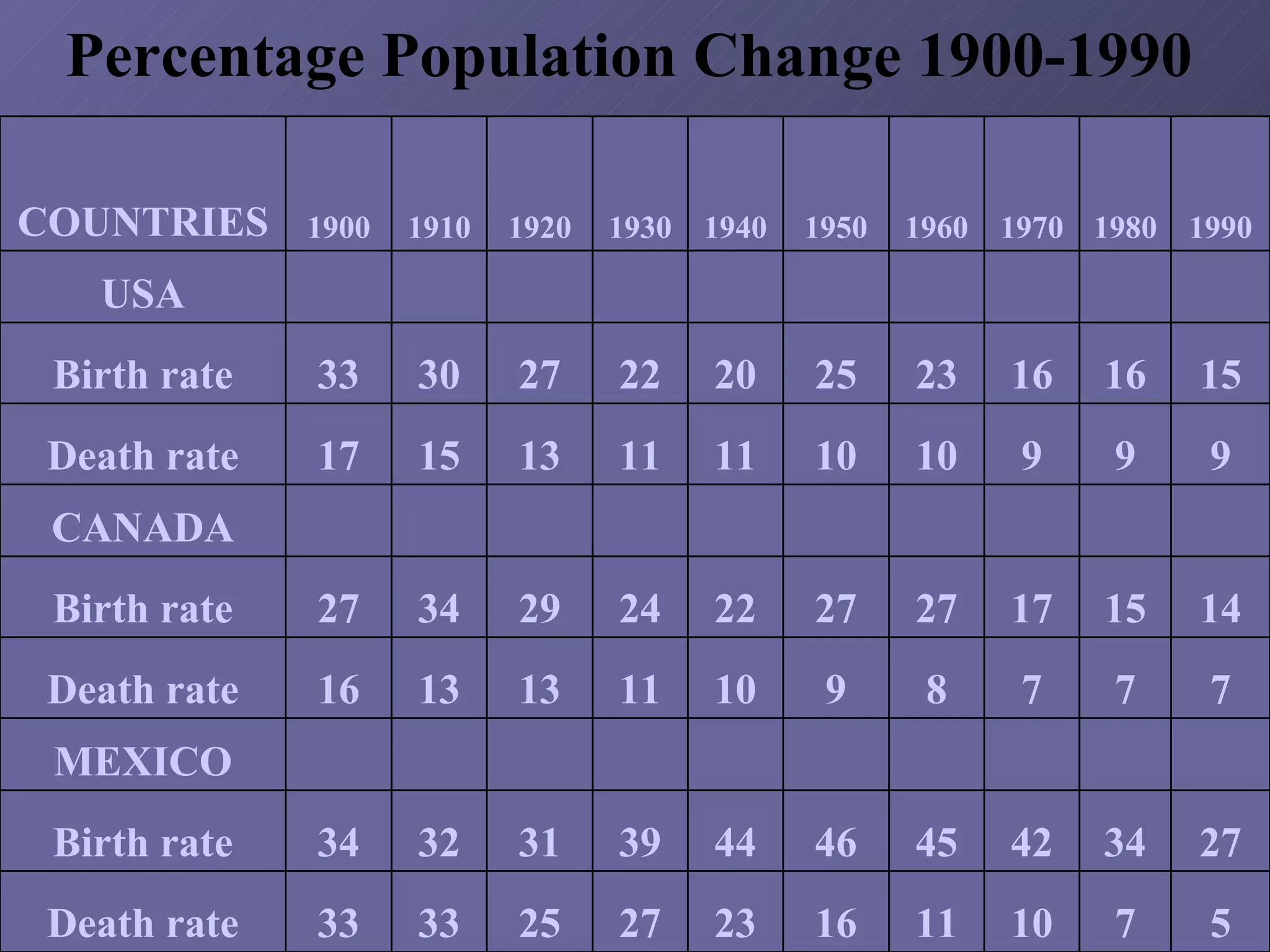
Percentage Population Change 1900-1990 5 7 10 11 16 23 27 25 33 33 Death rate 27 34 42 45 46 44 39 31 32 34 Birth rate                     MEXICO 7 7 7 8 9 10 11 13 13 16 Death rate 14 15 17 27 27 22 24 29 34 27 Birth rate                     CANADA 9 9 9 10 10 11 11 13 15 17 Death rate 15 16 16 23 25 20 22 27 30 33 Birth rate                     USA 1990 1980 1970 1960 1950 1940 1930 1920 1910 1900 COUNTRIES
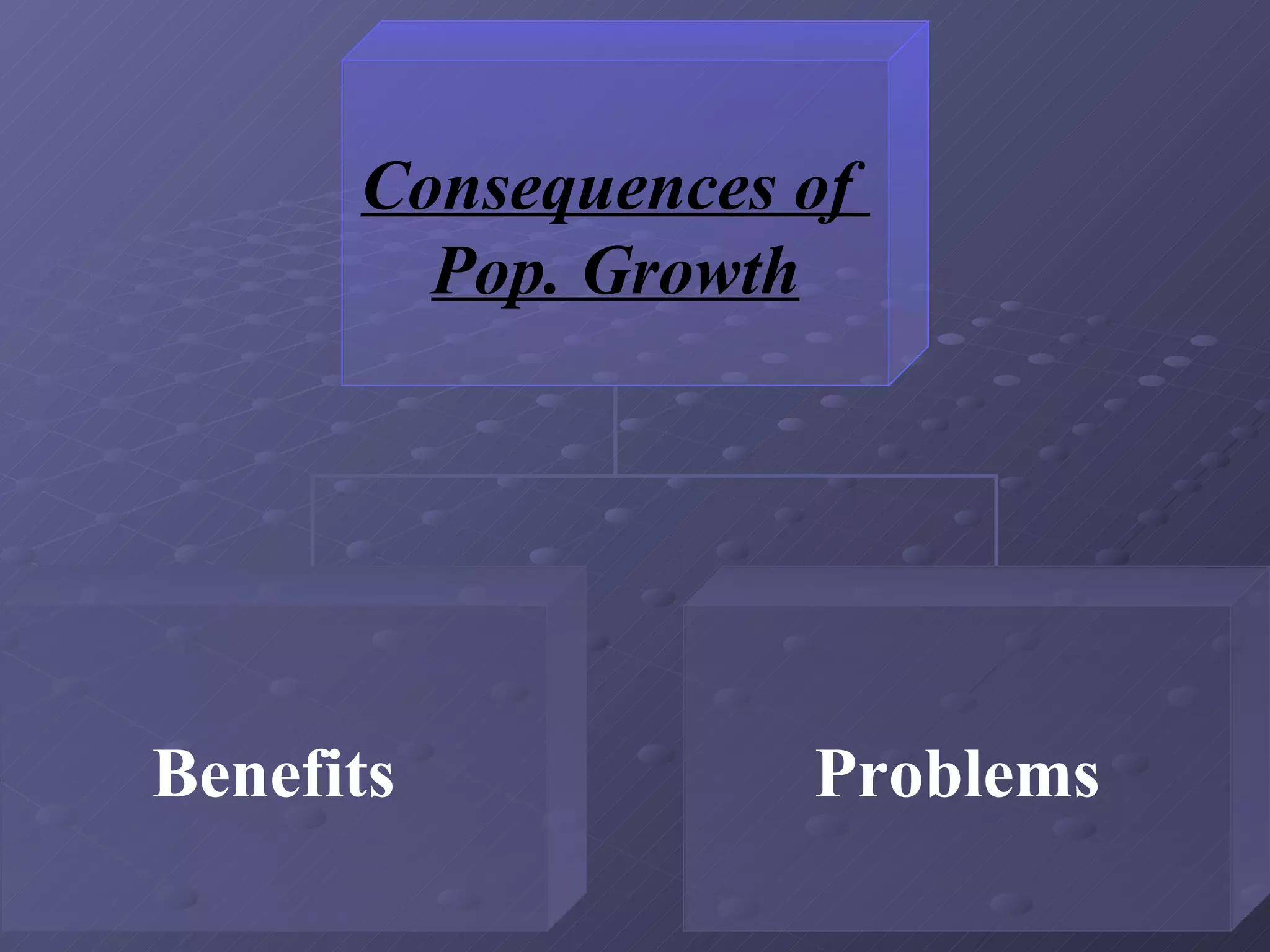
Consequences of  Pop. Growth Benefits Problems
Benefits:   Problems:   Competition for jobs Competition for housing Educational opportunities Shortage of food supply Sanitation and sewage Transportation Health care Controls: Incentives and penalties Family planning
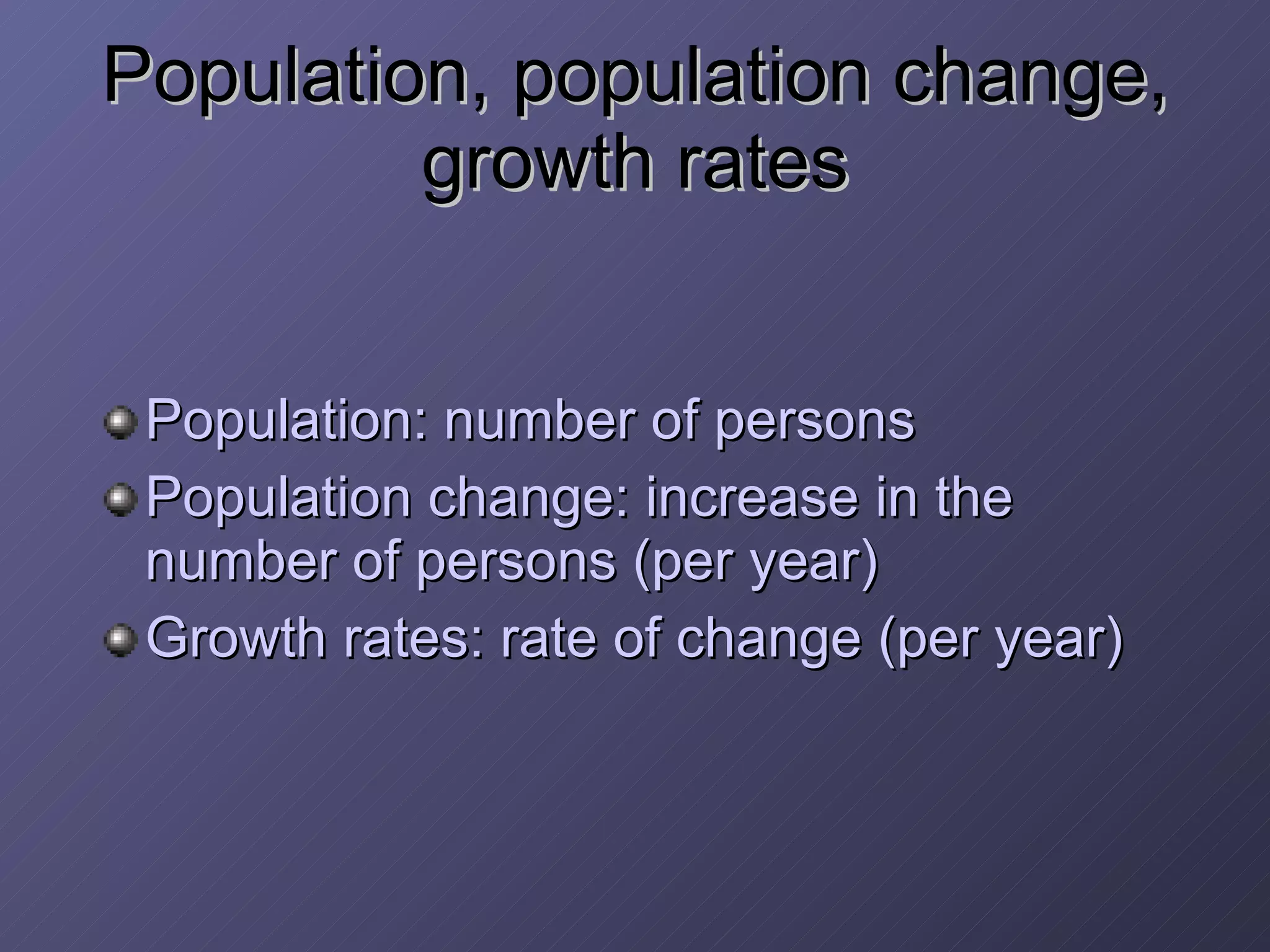
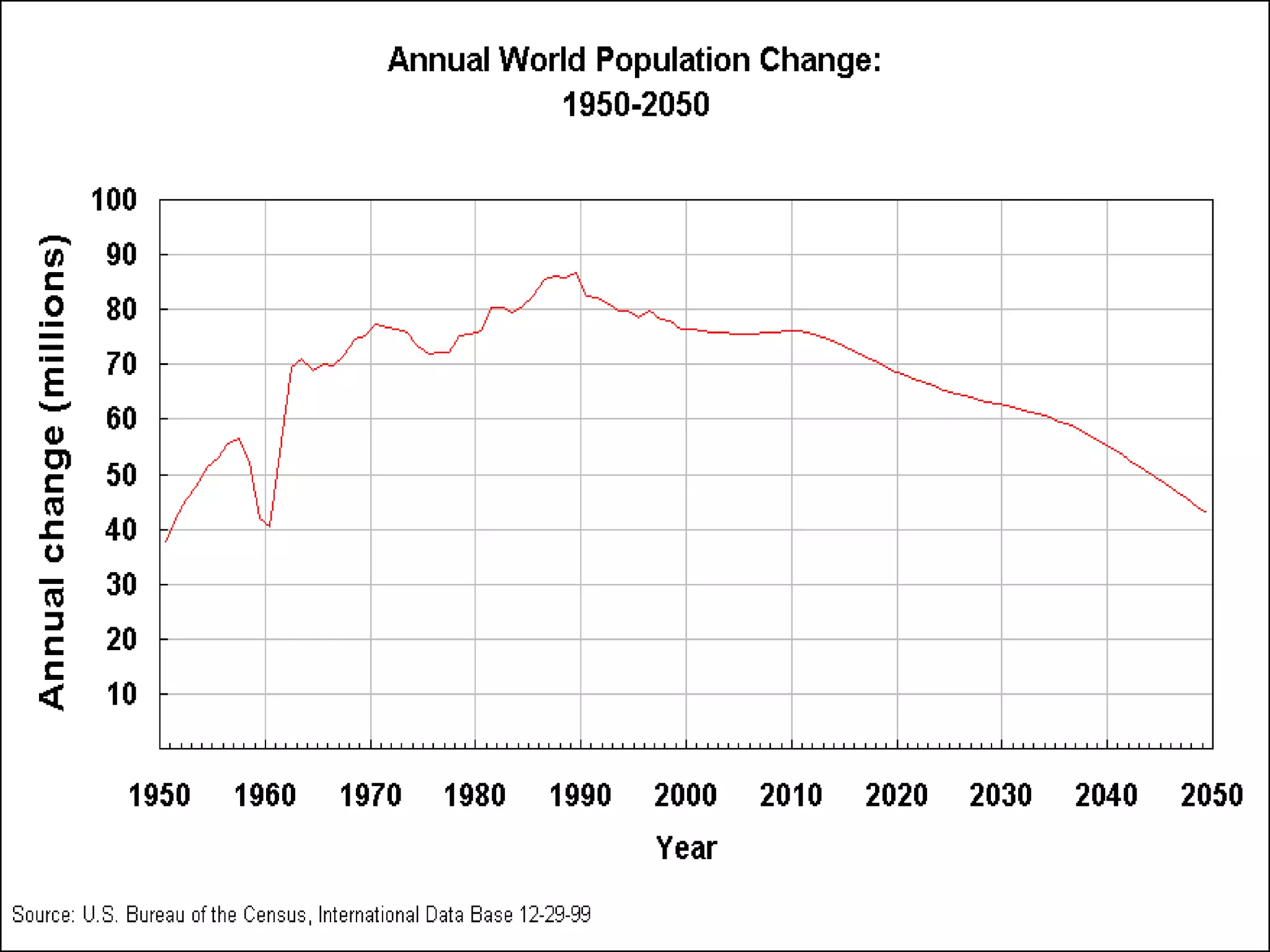
Population, population change, growth rates Population: number of persons Population change: increase in the number of persons (per year) Growth rates: rate of change (per year)


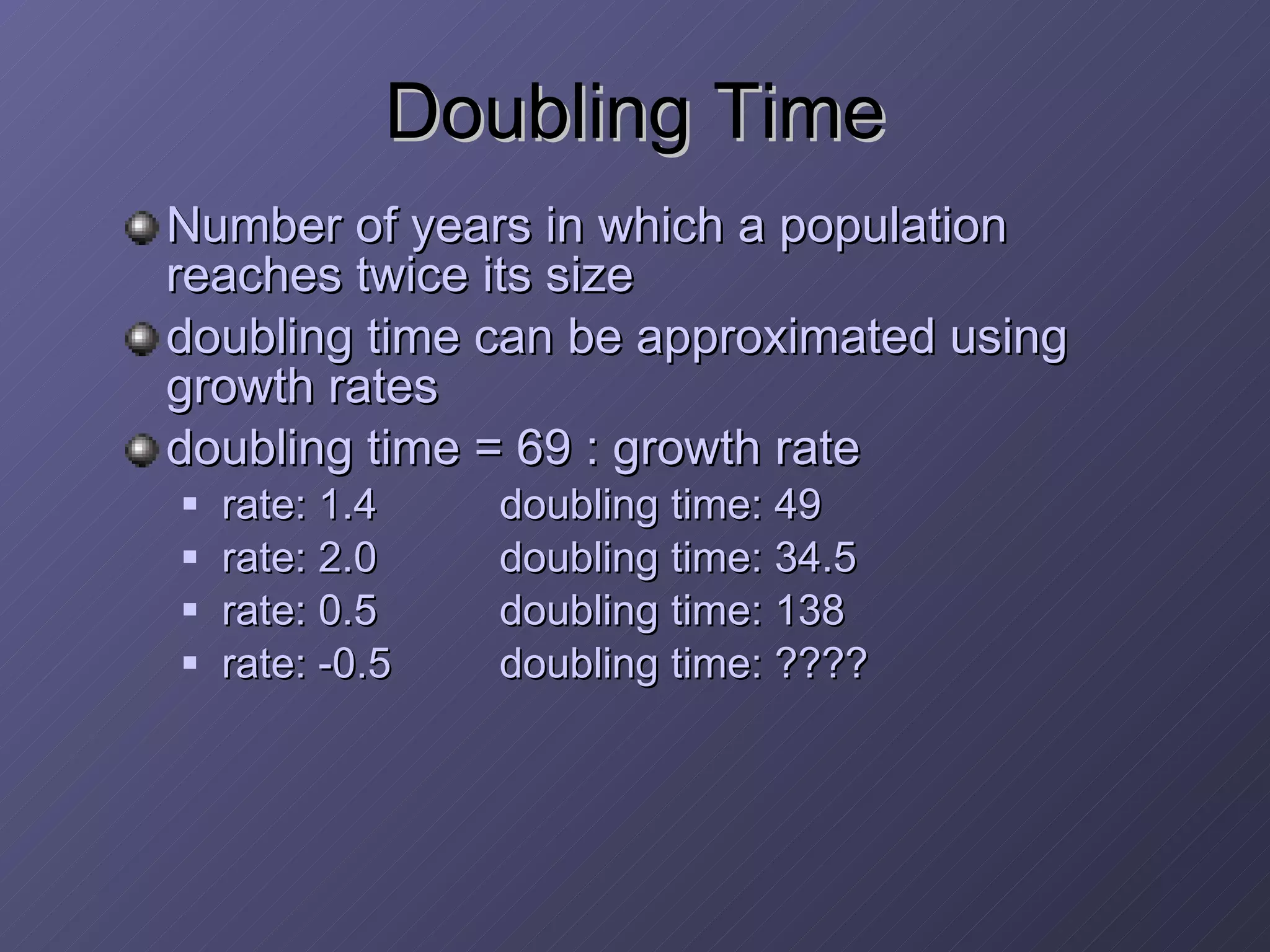
Doubling Time  Number of years in which a population reaches twice its size doubling time can be approximated using growth rates doubling time = 69 : growth rate rate: 1.4 doubling time: 49 rate: 2.0 doubling time: 34.5 rate: 0.5 doubling time: 138 rate: -0.5 doubling time: ????
Population Pyramids Graphic device: bar graph shows the age and gender composition of a region horizontal axis: gender male: left-hand female: right-hand absolute number of people or % vertical axis: age 5-year or 10-year age groups
The Demographic Transition
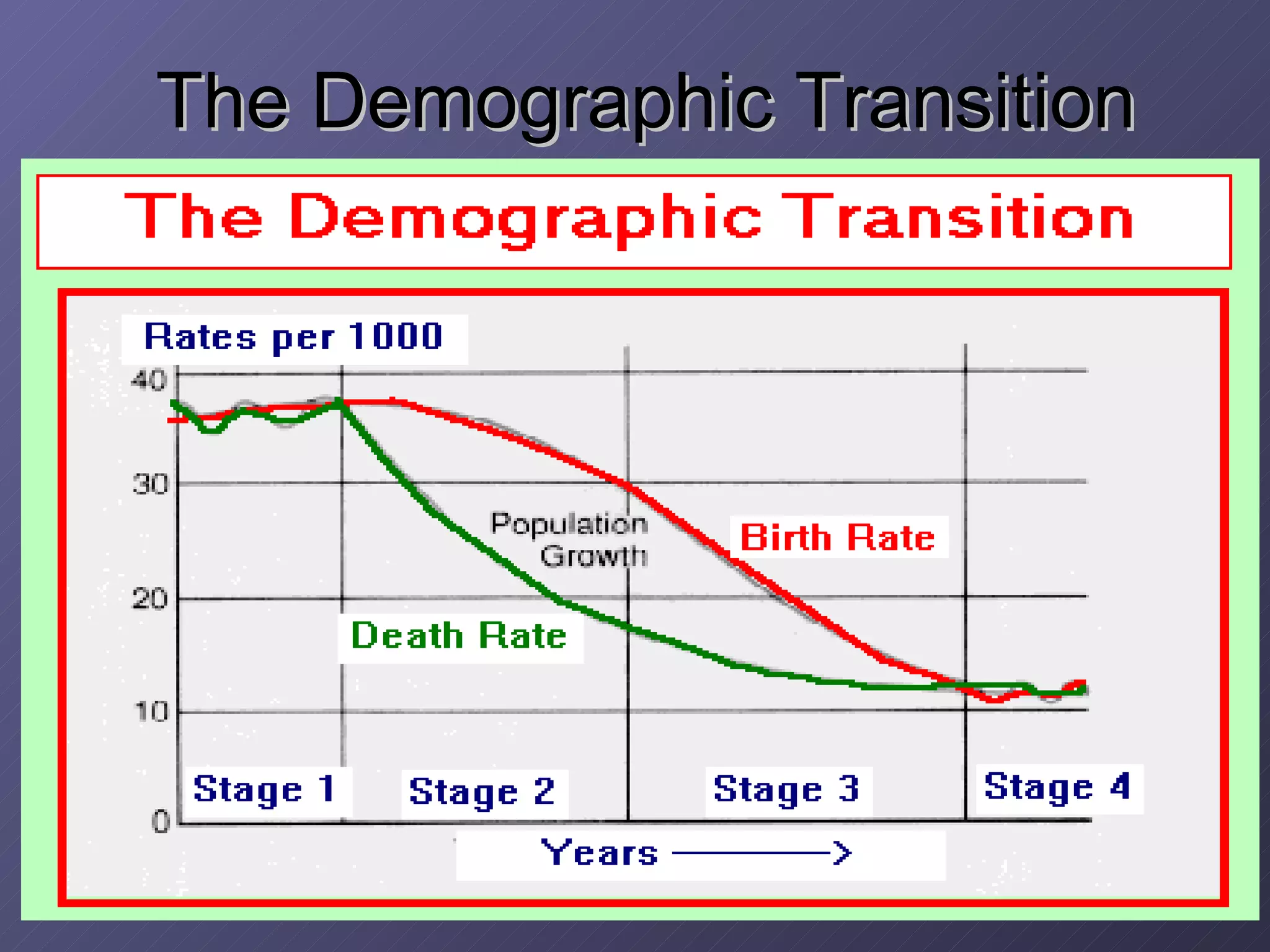
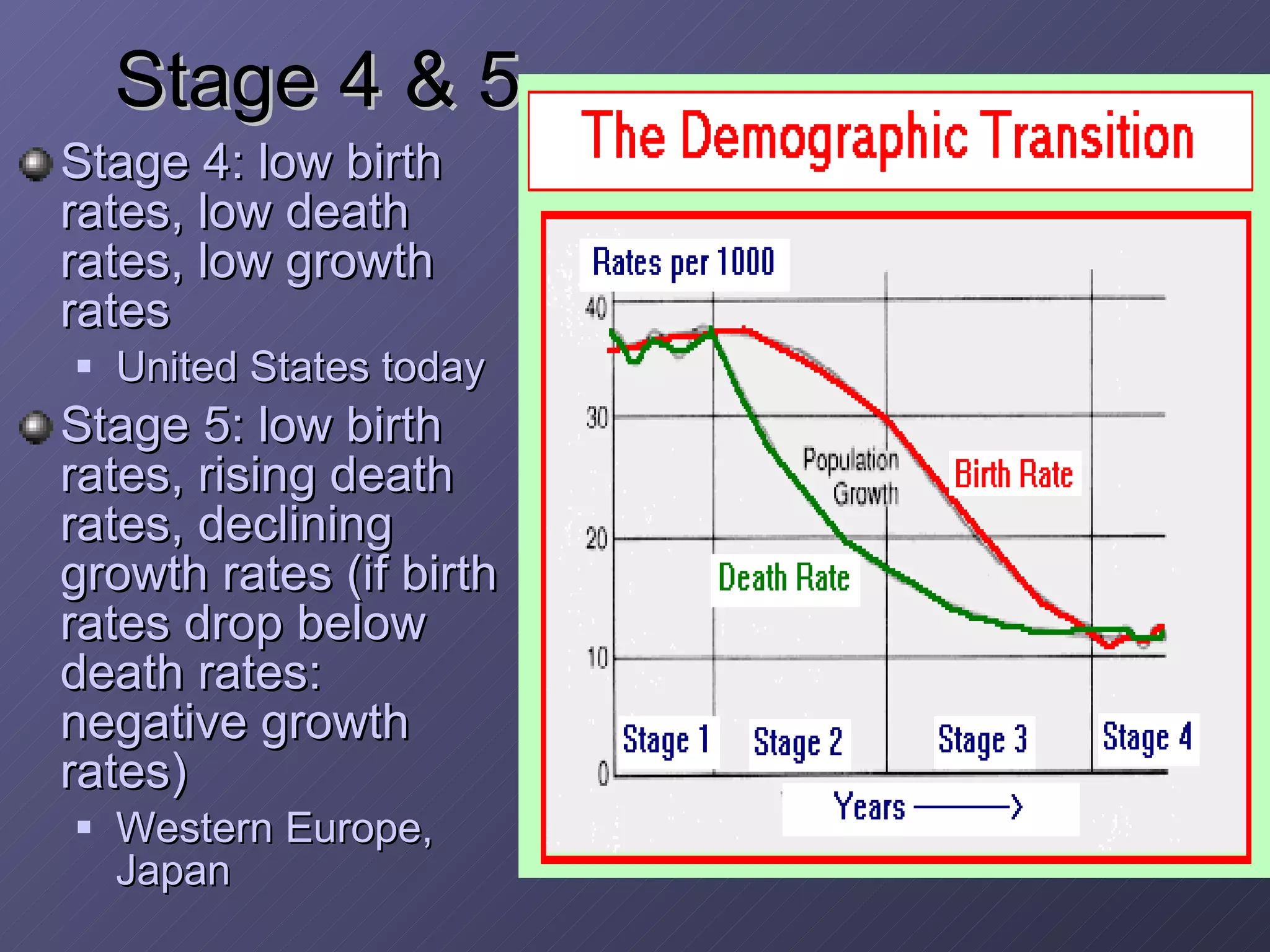
Five Stages of the Demographic Transition birth rates, death rates and growth rates systematically change through time as societies change: modernize, urbanize gain access to technology
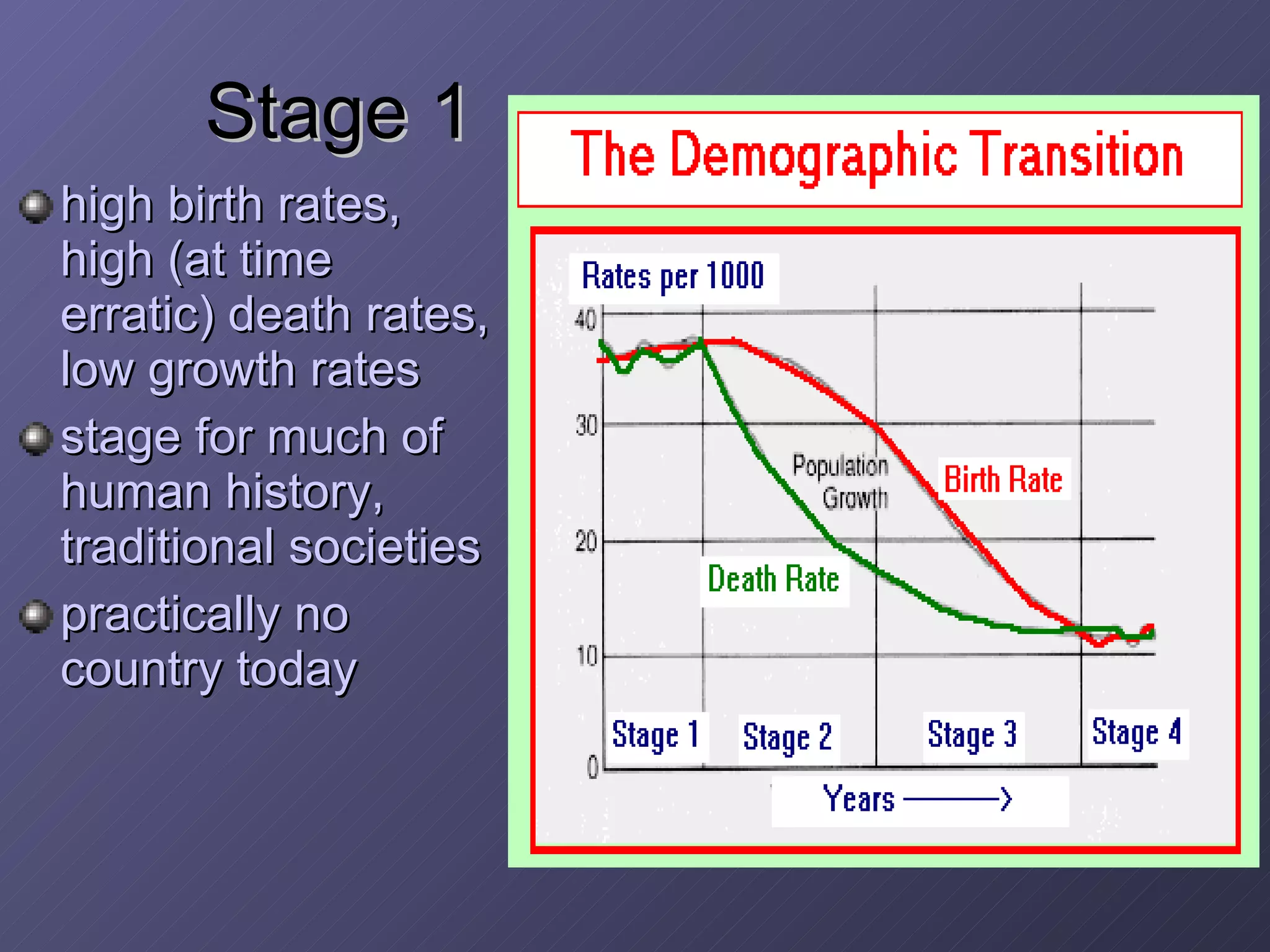
Stage 1 high birth rates, high (at time erratic) death rates, low growth rates stage for much of human history, traditional societies practically no country today
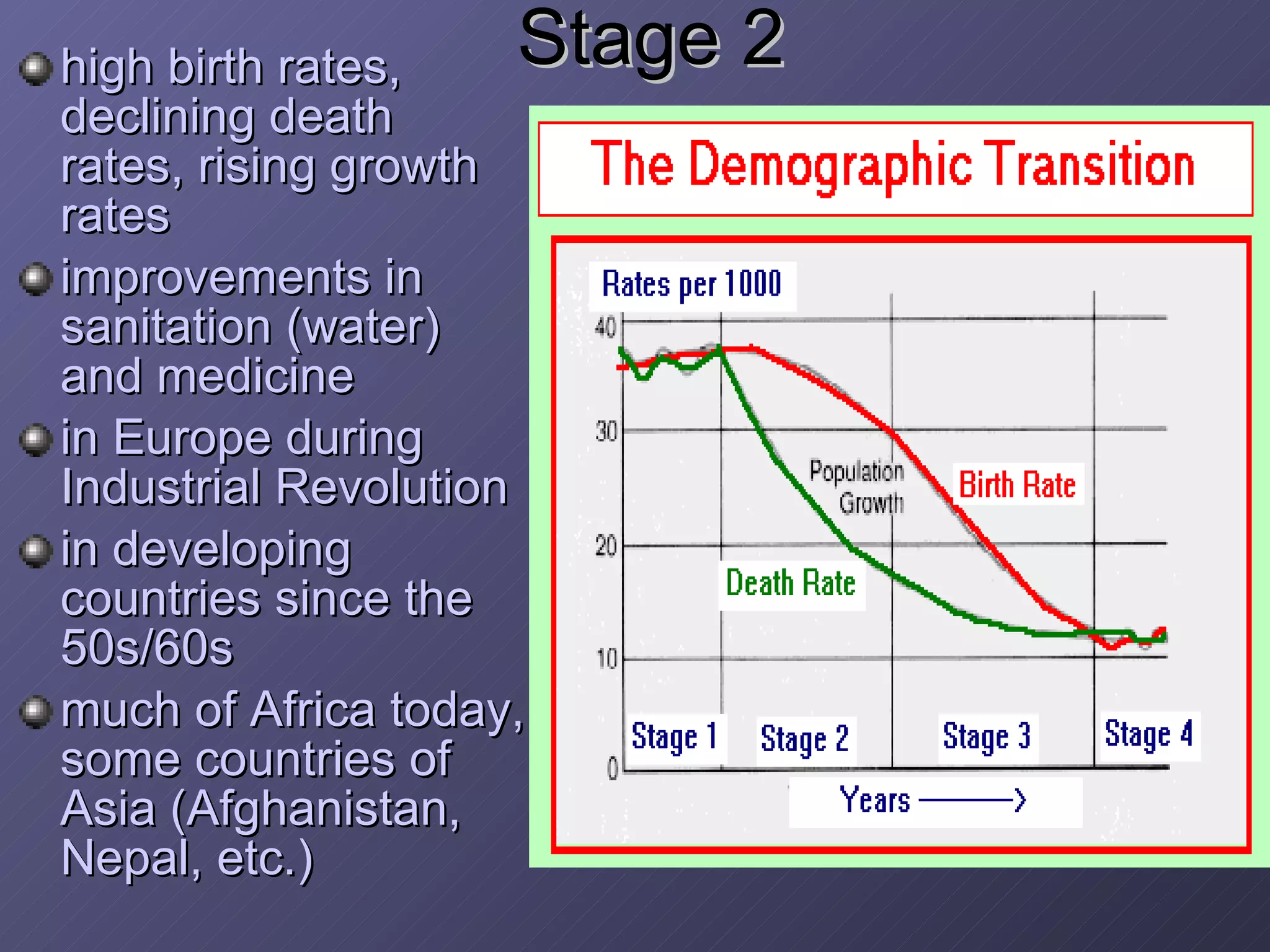
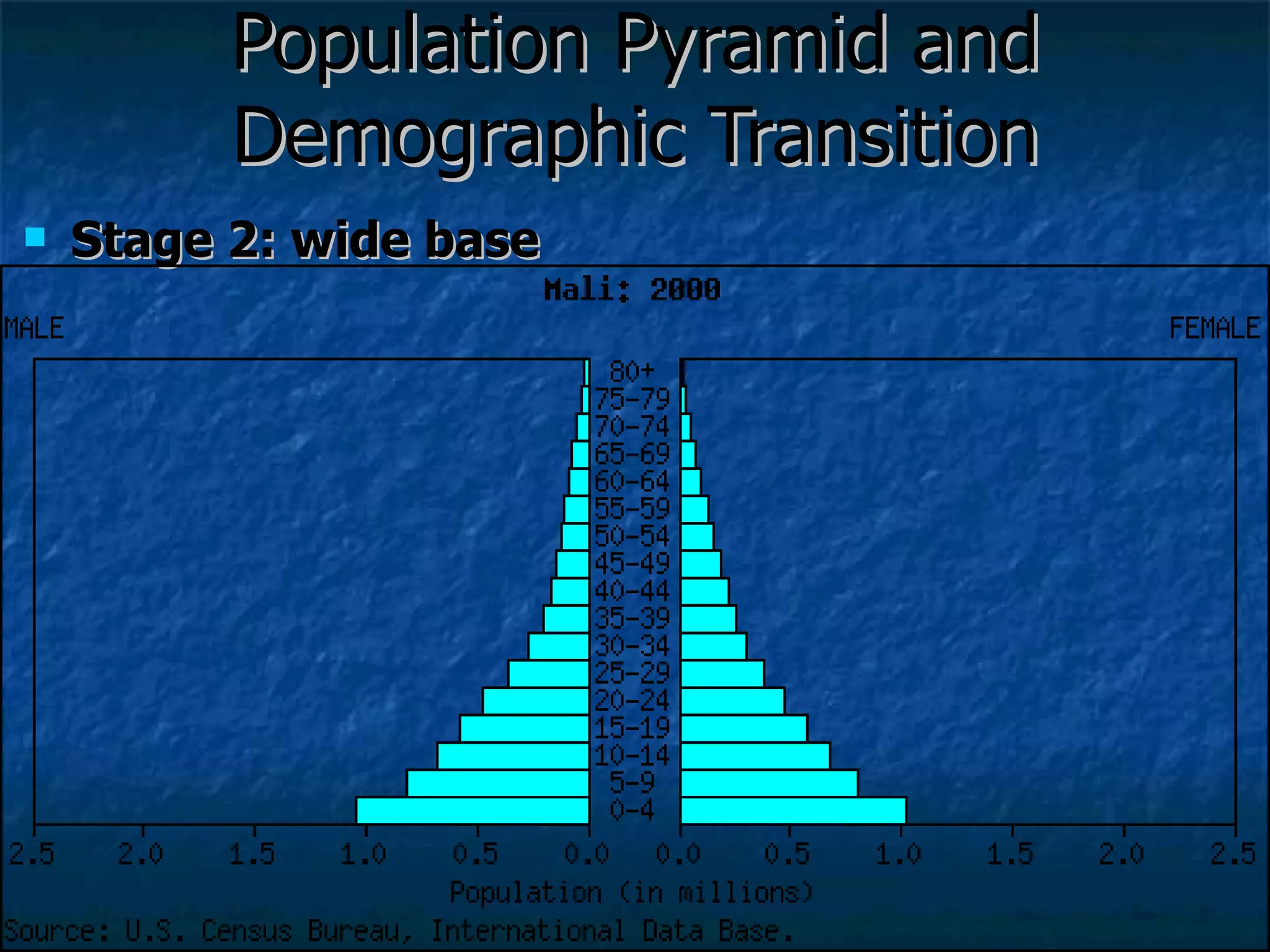
Stage 2 high birth rates, declining death rates, rising growth rates improvements in sanitation (water) and medicine in Europe during Industrial Revolution in developing countries since the 50s/60s much of Africa today, some countries of Asia (Afghanistan, Nepal, etc.)
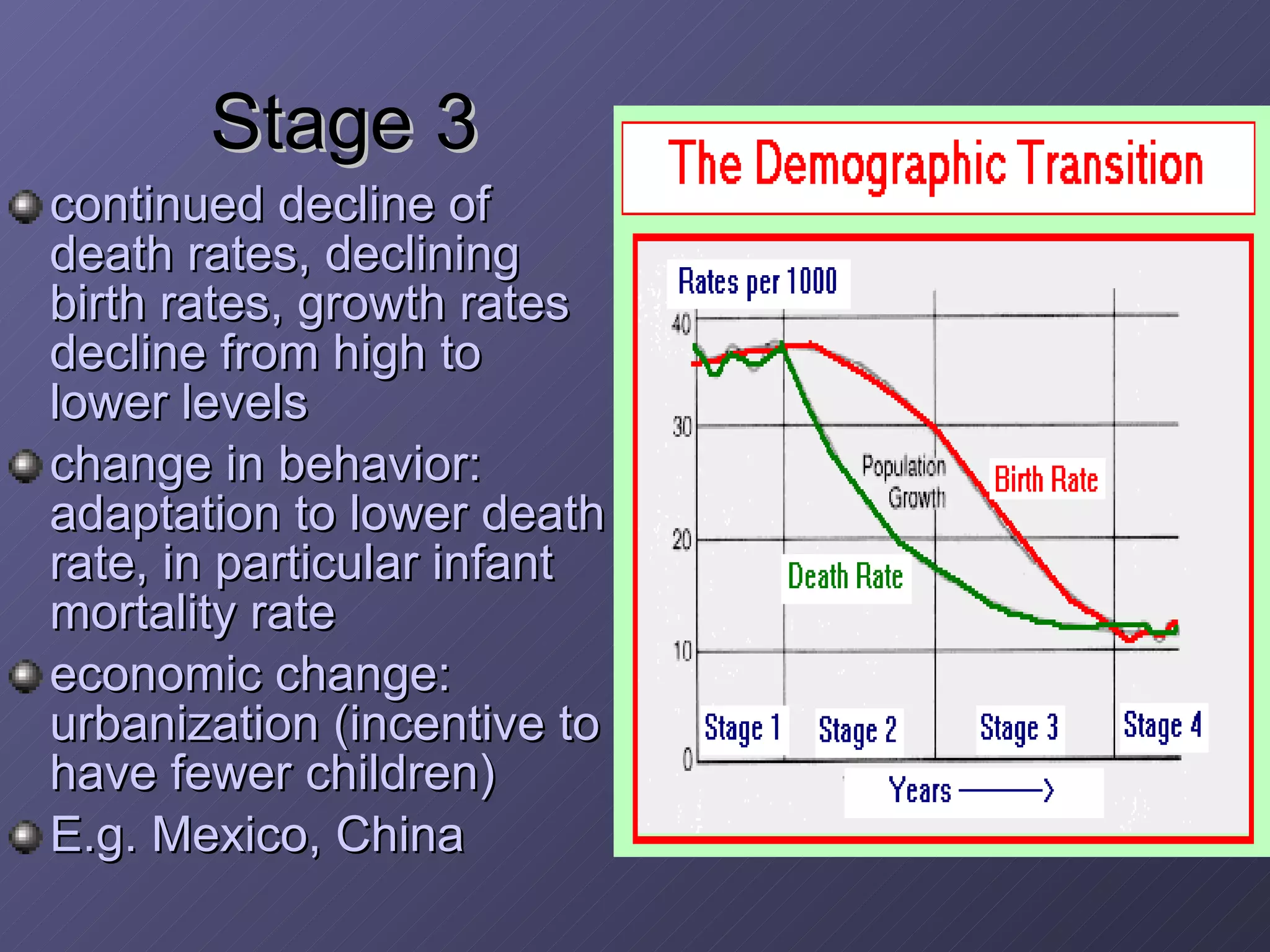
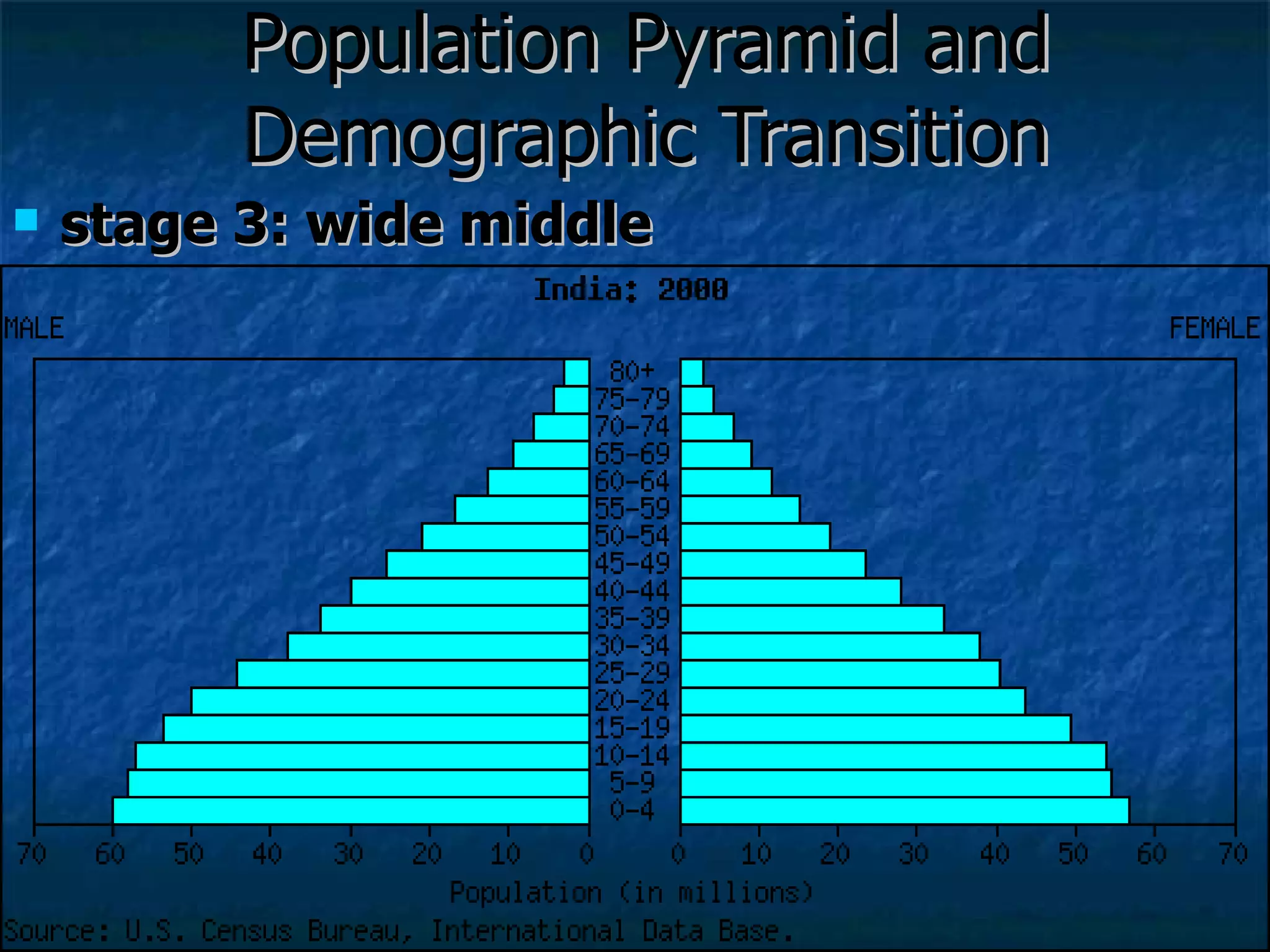
Stage 3 continued decline of death rates, declining birth rates, growth rates decline from high to lower levels change in behavior: adaptation to lower death rate, in particular infant mortality rate economic change: urbanization (incentive to have fewer children) E.g. Mexico, China
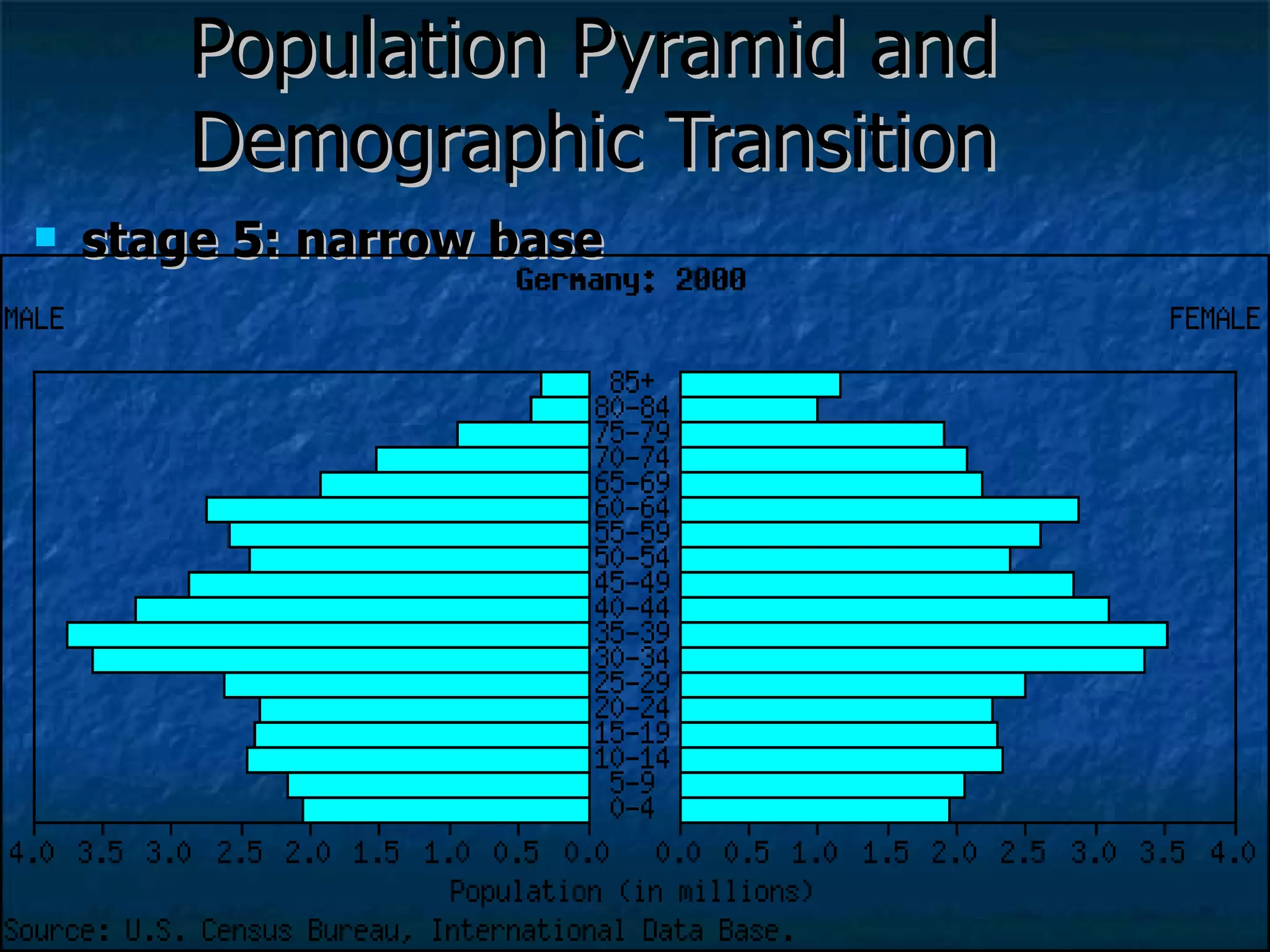
Stage 4 & 5 Stage 4: low birth rates, low death rates, low growth rates United States today Stage 5: low birth rates, rising death rates, declining growth rates (if birth rates drop below death rates: negative growth rates) Western Europe, Japan
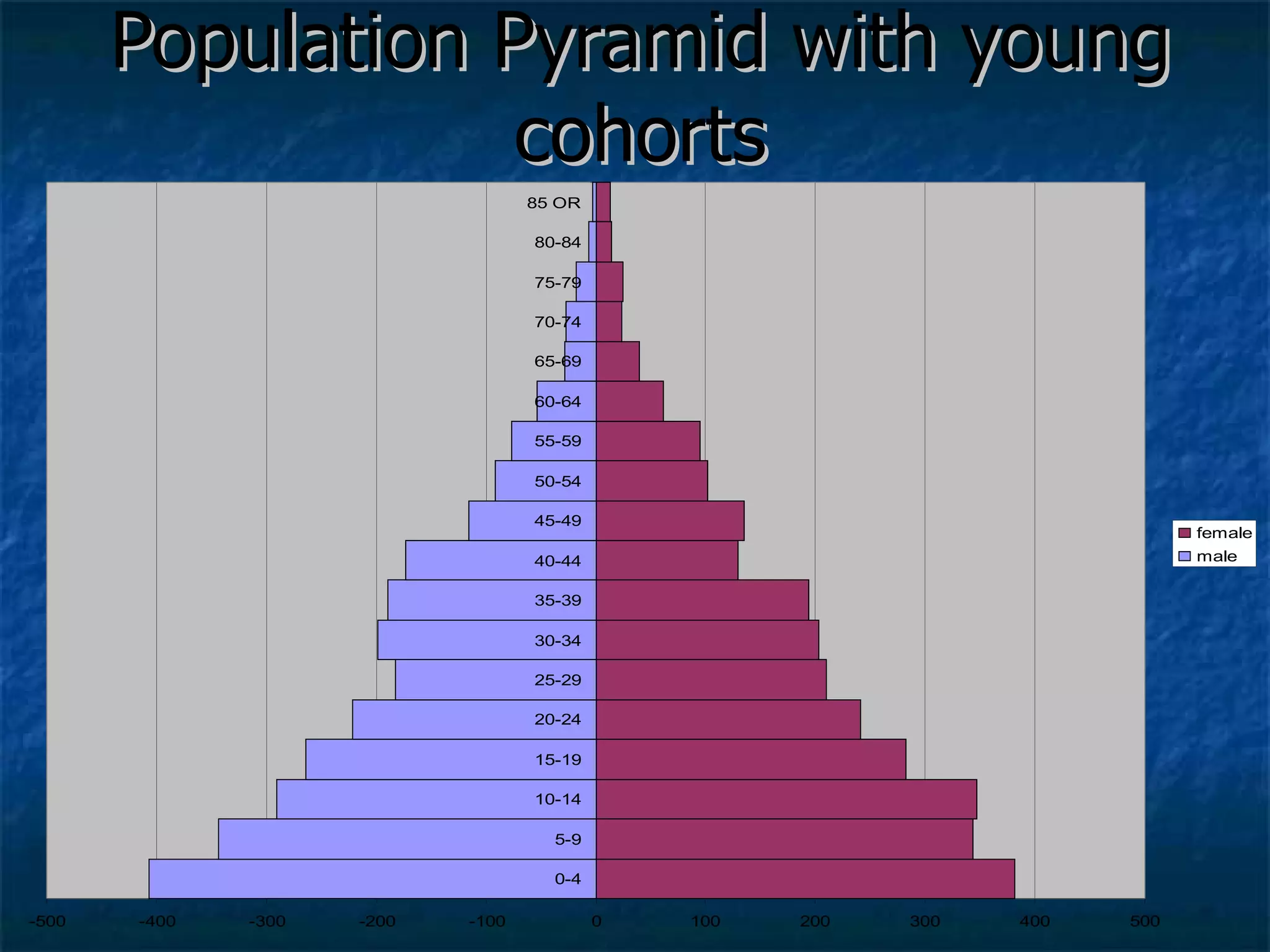
Population Pyramid with young cohorts
Population Pyramids and Demographic Stages characteristics shapes of ‘pyramids’ wide base (true pyramid) wide middle (bulge), somewhat wider base urn- or  bottle-shaped reversed pyramid different shapes--different dynamics
Population Pyramid and Demographic Transition Stage 2: wide base
Population Pyramid and Demographic Transition stage 3: wide middle
Population Pyramid and Demographic Transition stage 4: slender
Population Pyramid and Demographic Transition stage 5: narrow base
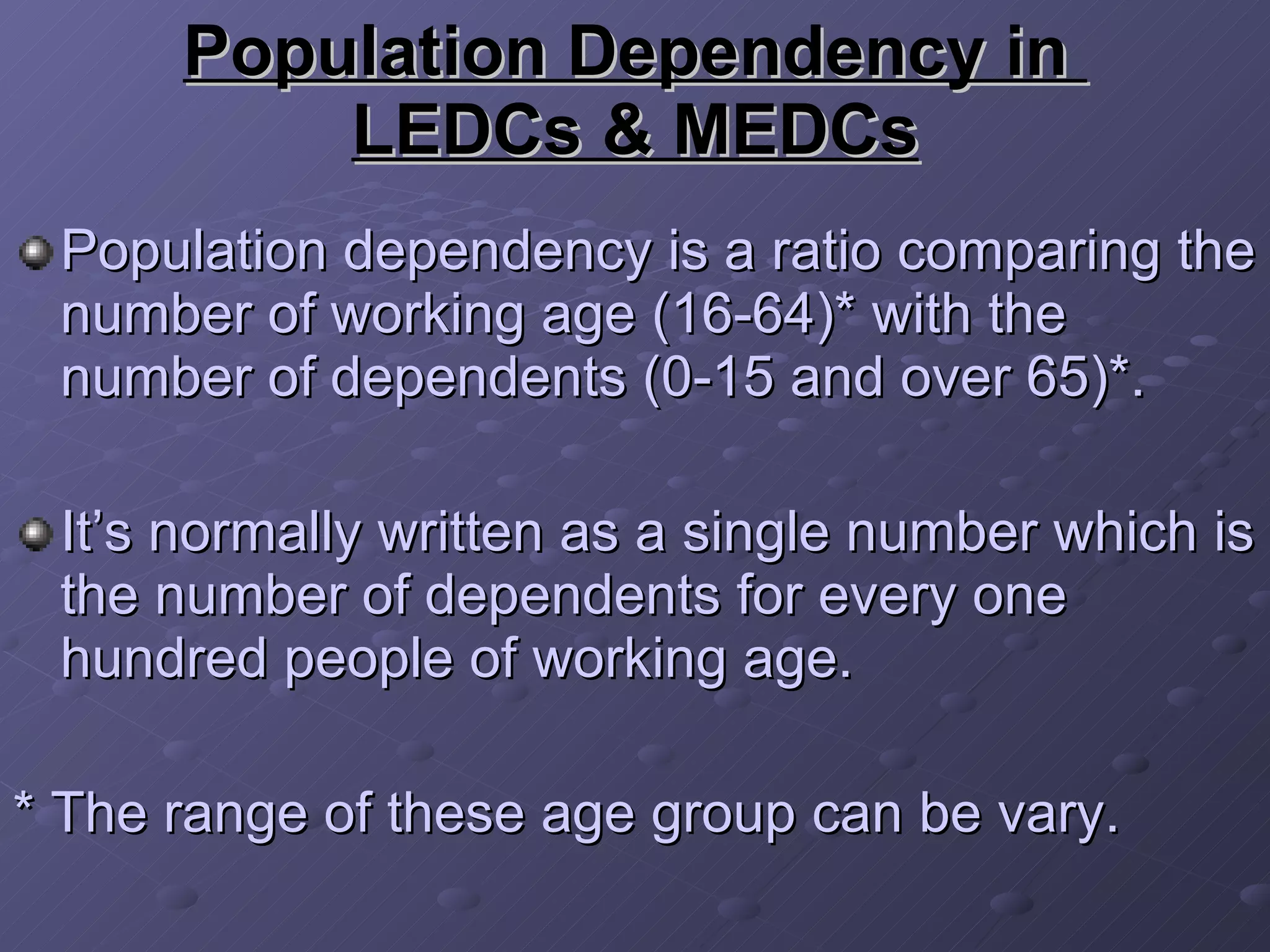
Population Dependency in  LEDCs & MEDCs Population dependency is a ratio comparing the number of working age (16-64)* with the number of dependents (0-15 and over 65)*. It’s normally written as a single number which is the number of dependents for every one hundred people of working age.  * The range of these age group can be vary.
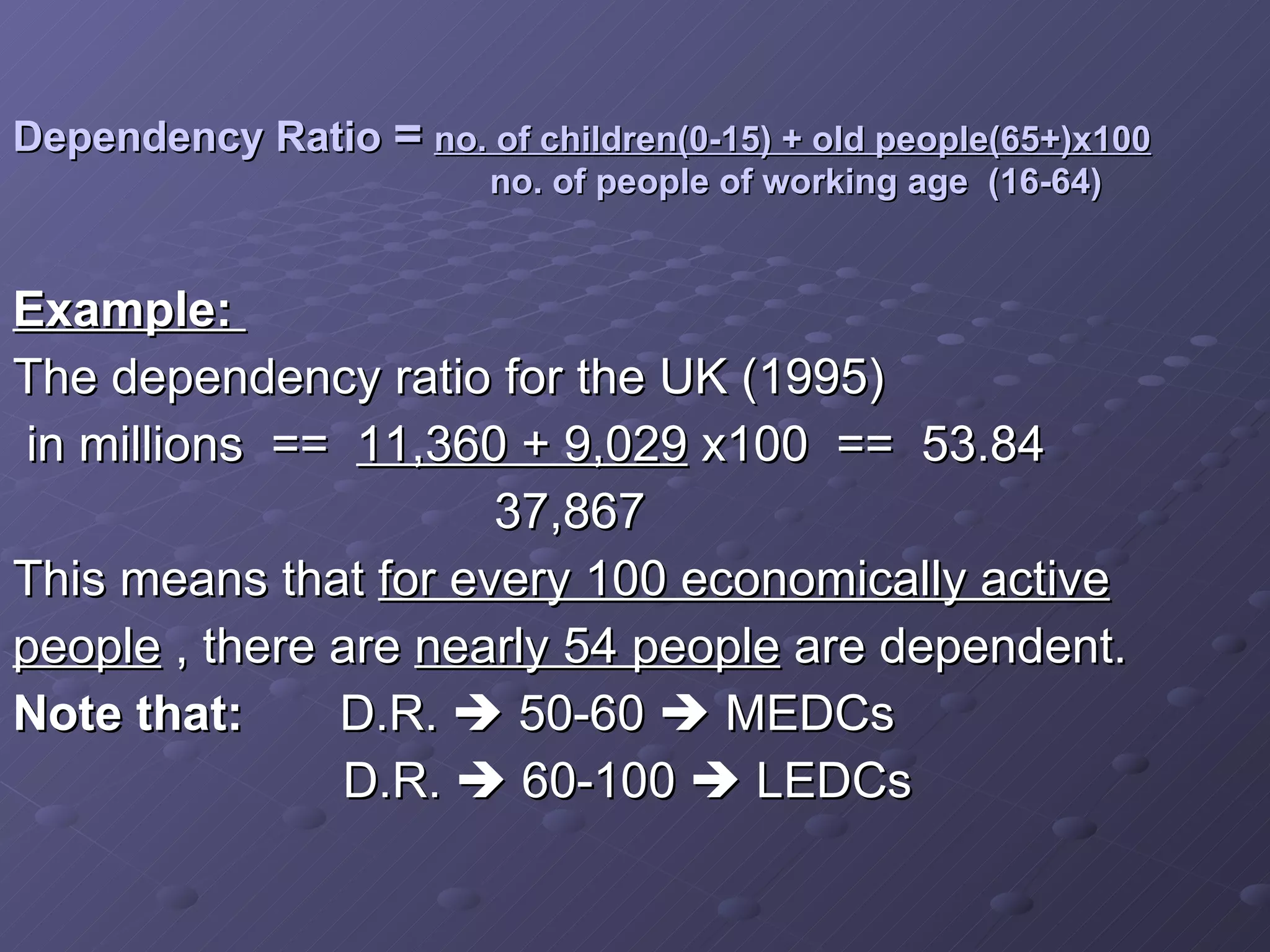
Dependency Ratio  =   no. of children(0-15) + old people(65+)x100     no. of people of working age  (16-64) Example:  The dependency ratio for the UK (1995) in millions  ==  11,360 + 9,029  x100  ==  53.84 37,867 This means that  for every 100 economically active people  , there are  nearly 54 people  are dependent. Note that:   D.R.    50-60    MEDCs D.R.    60-100    LEDCs
 
use: International Data Base  http:// www.census.gov/ipc/www/idbnew.html ,  then Online Demographic Aggregation
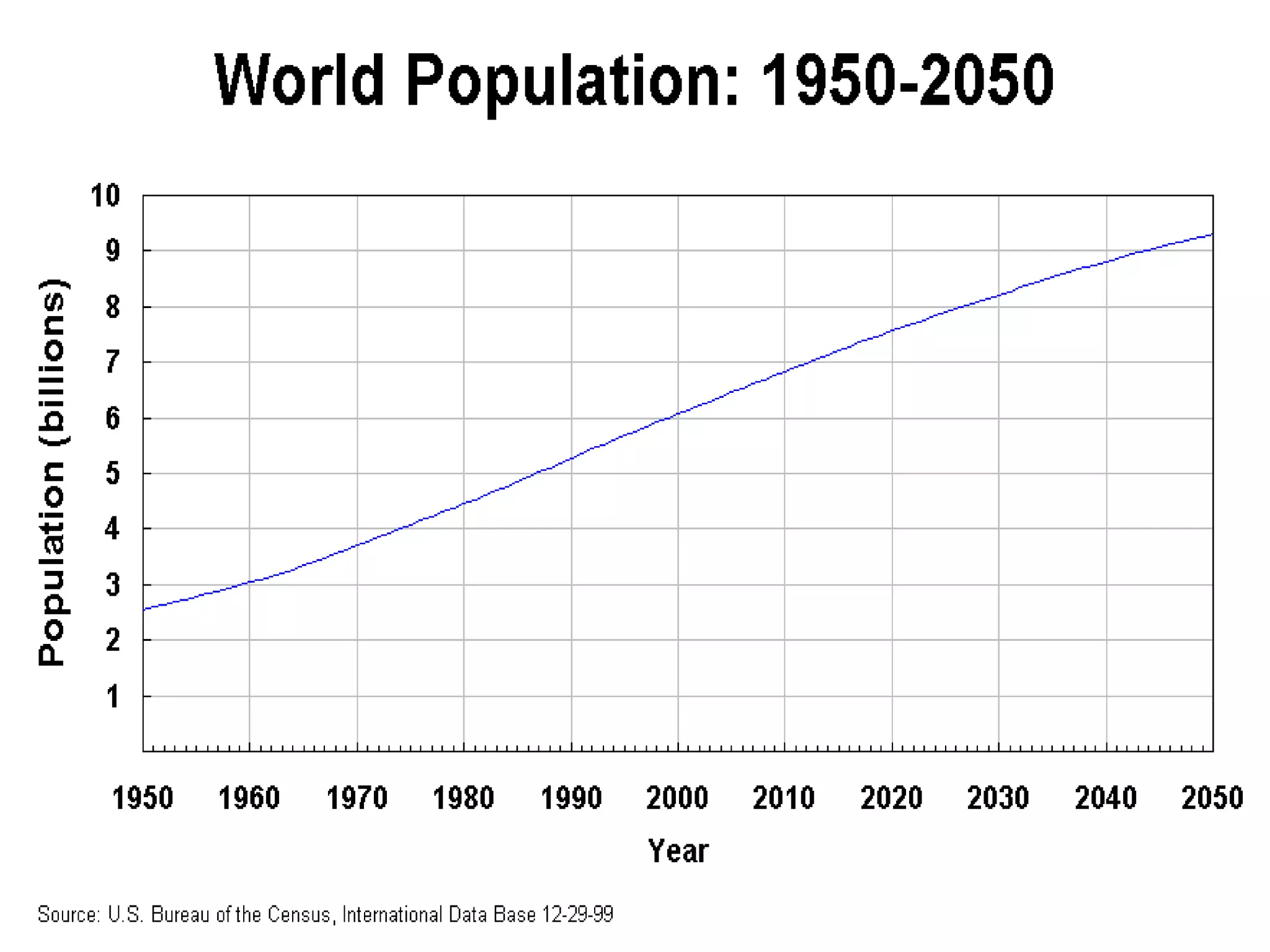
Frequency of Vital Events:  The Population Clock Population Clock http://www.census.gov/main/www/popclock.html Vital Events (per time unit) http://www.census.gov/cgi-bin/ipc/pcwe The global population reached 6 billion in fall of 1999
Population Pyramids Population Pyramids on the Web http://www.census.gov/ipc/www/idbpyr.html

Pop. Dynamics

  • 1.
  • 2.
    Population Distribution Population distribution is where people live, this can be on a global, regional or local scale. Places with lots of people usually have habitable environments they either: wealthy and industrial e.g. Europe, Japan etc. poor with rapidly growing populations e.g. India, Ethiopia Places with few people are usually hostile environments, e.g. Antarctica, Sahara Deserts, Alaska etc.
  • 3.
  • 4.
    Areas of LargePopulation River Valleys. e.g. Ganges valley in India, Rhine valley in Germany, Indus Valley in Pakistan. Lowlands Plains. e.g. Denmark (very low lying and famous for dairy farms), East Anglia in the UK (good location for growing cereals) Area rich in natural resources. Coastal Plains. e.g. New York in the U.S.A.
  • 5.
  • 6.
    Population Explosion arecent event Last 200 years or less for MDCs Industrial Revolution Improvement in sanitation and medicine Last 50 years or less for LDCs Transfer of technology, i.e. medical, agricultural (Green Revolution)
  • 7.
    Components Influencing Pop.Growth The Pop. of a country changes because of the relationship between: the birth rate — number of live births per 1000 of the population per year. the death rate — number of deaths per 1000 of the population per year. migration — number of people moving into or out of a country.
  • 8.
    Rates of GlobalPop. Change CBR (crude birth rate) = number of births per 1000 population 1990: 24 Today: 21.3 CDR (crude death rate) = number of deaths per 1000 population 1990: 9 Today: 8.93 growth rate = birth rate - death rate (often in %) 1990: 1.5% Today: 1.3% growth rates have come down
  • 9.
    Special Kinds ofFertility and Mortality Rates TFR (total fertility rate) = number of children born to a woman during her reproductive years (or life time) 1990: 3.1 2000: 2.8 IMR (infant mortality rate) = infant deaths per 1000 live births (infant < 1 yr) 1990: 62 2000: 56 (1900: 200)
  • 10.
    Pop. Growth andResources The relationship b/w the population grwoth and the resources can be understand by the following three key concepts: Overpopulation — when pop. is more than the available resources. Under population — when pop. is less than the available resources. Optimum population — when population is a/c to the available resources.
  • 11.
    Factors Affecting Pop.Growth 2. Leading to a high death rate Health Care Infant mortality rate Better hygiene Life expectancy HIV/AIDS 1. Leading to a high birth rate Health Care Preference for sons Early marriages Need for human labor Lack of information on family planning
  • 12.
  • 13.
    Percentage Population Change1900-1990 5 7 10 11 16 23 27 25 33 33 Death rate 27 34 42 45 46 44 39 31 32 34 Birth rate                     MEXICO 7 7 7 8 9 10 11 13 13 16 Death rate 14 15 17 27 27 22 24 29 34 27 Birth rate                     CANADA 9 9 9 10 10 11 11 13 15 17 Death rate 15 16 16 23 25 20 22 27 30 33 Birth rate                     USA 1990 1980 1970 1960 1950 1940 1930 1920 1910 1900 COUNTRIES
  • 14.
    Consequences of Pop. Growth Benefits Problems
  • 15.
    Benefits: Problems: Competition for jobs Competition for housing Educational opportunities Shortage of food supply Sanitation and sewage Transportation Health care Controls: Incentives and penalties Family planning
  • 16.
    Population, population change,growth rates Population: number of persons Population change: increase in the number of persons (per year) Growth rates: rate of change (per year)
  • 17.
  • 18.
  • 19.
  • 20.
    Doubling Time Number of years in which a population reaches twice its size doubling time can be approximated using growth rates doubling time = 69 : growth rate rate: 1.4 doubling time: 49 rate: 2.0 doubling time: 34.5 rate: 0.5 doubling time: 138 rate: -0.5 doubling time: ????
  • 21.
    Population Pyramids Graphicdevice: bar graph shows the age and gender composition of a region horizontal axis: gender male: left-hand female: right-hand absolute number of people or % vertical axis: age 5-year or 10-year age groups
  • 22.
  • 23.
    Five Stages ofthe Demographic Transition birth rates, death rates and growth rates systematically change through time as societies change: modernize, urbanize gain access to technology
  • 24.
    Stage 1 highbirth rates, high (at time erratic) death rates, low growth rates stage for much of human history, traditional societies practically no country today
  • 25.
    Stage 2 highbirth rates, declining death rates, rising growth rates improvements in sanitation (water) and medicine in Europe during Industrial Revolution in developing countries since the 50s/60s much of Africa today, some countries of Asia (Afghanistan, Nepal, etc.)
  • 26.
    Stage 3 continueddecline of death rates, declining birth rates, growth rates decline from high to lower levels change in behavior: adaptation to lower death rate, in particular infant mortality rate economic change: urbanization (incentive to have fewer children) E.g. Mexico, China
  • 27.
    Stage 4 &5 Stage 4: low birth rates, low death rates, low growth rates United States today Stage 5: low birth rates, rising death rates, declining growth rates (if birth rates drop below death rates: negative growth rates) Western Europe, Japan
  • 28.
  • 29.
    Population Pyramids andDemographic Stages characteristics shapes of ‘pyramids’ wide base (true pyramid) wide middle (bulge), somewhat wider base urn- or bottle-shaped reversed pyramid different shapes--different dynamics
  • 30.
    Population Pyramid andDemographic Transition Stage 2: wide base
  • 31.
    Population Pyramid andDemographic Transition stage 3: wide middle
  • 32.
    Population Pyramid andDemographic Transition stage 4: slender
  • 33.
    Population Pyramid andDemographic Transition stage 5: narrow base
  • 34.
    Population Dependency in LEDCs & MEDCs Population dependency is a ratio comparing the number of working age (16-64)* with the number of dependents (0-15 and over 65)*. It’s normally written as a single number which is the number of dependents for every one hundred people of working age. * The range of these age group can be vary.
  • 35.
    Dependency Ratio = no. of children(0-15) + old people(65+)x100 no. of people of working age (16-64) Example: The dependency ratio for the UK (1995) in millions == 11,360 + 9,029 x100 == 53.84 37,867 This means that for every 100 economically active people , there are nearly 54 people are dependent. Note that: D.R.  50-60  MEDCs D.R.  60-100  LEDCs
  • 36.
  • 37.
    use: International DataBase http:// www.census.gov/ipc/www/idbnew.html , then Online Demographic Aggregation
  • 38.
    Frequency of VitalEvents: The Population Clock Population Clock http://www.census.gov/main/www/popclock.html Vital Events (per time unit) http://www.census.gov/cgi-bin/ipc/pcwe The global population reached 6 billion in fall of 1999
  • 39.
    Population Pyramids PopulationPyramids on the Web http://www.census.gov/ipc/www/idbpyr.html