In Chapter 1 you have learnt that early human beings
depended entirely on nature for food, clothing and                       Do you know?
shelter; but with time they learnt new skills to grow food,
build homes and develop better means of transport and            The place where a
communication. In this way they modified the                     building or a
environment where they lived.                                    settlement develops is
    Settlements are places where people build their              called its site.
homes. Early human beings lived on trees and in caves.               The natural
When they started to grow crops it became necessary to           conditions for
have a permanent home. The settlements grew near the             selection of an ideal
river valleys as water was available and land was fertile.       site are-
                                                                 1. favourable climate
With the development of trade, commerce and
                                                                 2. availability of
manufacturing, human settlements became larger.
                                                                     water
Settlement flourished and civilizations developed near           3. suitable land
river valleys. Do you recall the names of civilization that      4. fertile soil
grew along the banks of rivers Indus, Tigris, Nile and
Hwang-He.
    Settlements can be
permanent or temporary.
Settlements which are
occupied for a short time
are called temporary
settlements. The people
living in deep forests, hot and
cold deserts and mountains
often dwell in such temporary
settlements. They practice
hunting, gathering, shifting
cultivation and transhumance.
However more and more
settlements today are
permanent settlements. In
these settlements, people
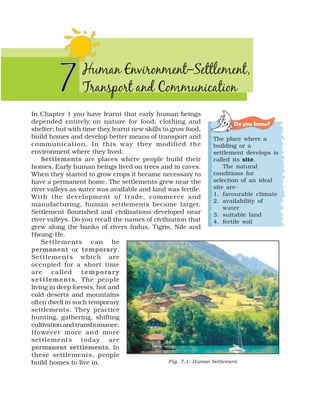
build homes to live in.                         Fig. 7.1: Human Settlement
Glossary                 It was Mary’s birthday party. She and her friends
                               were waiting for Gurpreet to arrive so that Mary could
Transhumance: It is            cut the cake. At last Gurpreet arrived- tired, coughing
a seasonal movement            and wheezing. She explained that the traffic jam was
of people. People who          terrible. Mary’s mother Mrs.Thomas patted Gurpreet’s
rear animals move in           back and sighed, “Oof! The pollution in our city!” Prasad
search of new
                               had recently come from his village. He asked, “Why do
pastures according to
                               we have such traffic jams and such pollution in the
changes in seasons.
                               cities?” “The number of vehicles is increasing day by
                               day due to the growing population in the cities”, Mary’s
                               father, Mr. Thomas replied. Mary asked, “Then why
                               are people coming to the cities?” Her mother replied,
                               “They come looking for jobs, better education and
                               medical facilities.” Mary further enquired, “If so many
                               people keep coming to cities, where will all the people
                               live?” Mr. Thomas said, “That is why you see so many
                               slums and squatter settlements where people stay in
                               congested and unhygienic conditions. Shortage of
                               power and water supply are common problems in the
                               cities”. Prasad said, “Our villages may not have big
                               cinema halls, well-equipped schools and good hospitals,
                               but we have lot of open spaces and fresh air to breathe
                                                  in. When my grandfather was sick we
                                                  had to rush him to the city hospital.”
                                                   From the above conversation we
                                                can identify two different pictures of
                                                settlements – the rural and the urban
                                                settlements. The villages are rural
                                                settlement where people are engaged
                                                in activities like agriculture, fishing,
                                                forestry, crafts work and trading etc.
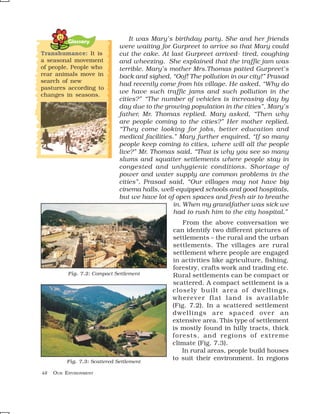
          Fig. 7.2: Compact Settlement          Rural settlements can be compact or
                                                scattered. A compact settlement is a
                                                closely built area of dwellings,
                                                wherever flat land is available
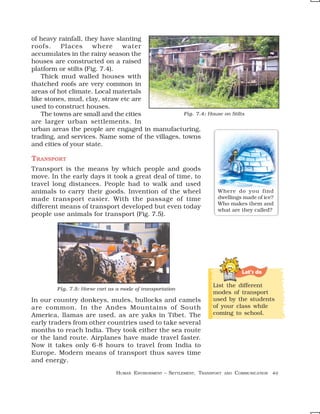
                                                (Fig. 7.2). In a scattered settlement
                                                dwellings are spaced over an
                                                extensive area. This type of settlement
                                                is mostly found in hilly tracts, thick
                                                forests, and regions of extreme
                                                climate (Fig. 7.3).
                                                   In rural areas, people build houses
          Fig. 7.3: Scattered Settlement
                                                to suit their environment. In regions

48   OUR ENVIRONMENT
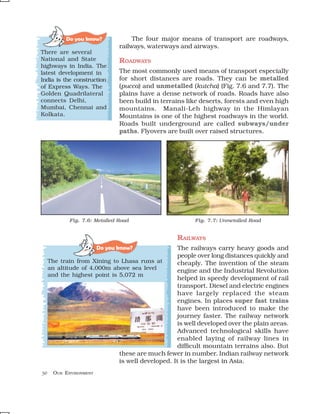
of heavy rainfall, they have slanting
roofs.    Places      where    water
accumulates in the rainy season the
houses are constructed on a raised
platform or stilts (Fig. 7.4).
    Thick mud walled houses with
thatched roofs are very common in
areas of hot climate. Local materials
like stones, mud, clay, straw etc are
used to construct houses.
    The towns are small and the cities            Fig. 7.4: House on Stilts
are larger urban settlements. In
urban areas the people are engaged in manufacturing,
trading, and services. Name some of the villages, towns
and cities of your state.

TRANSPORT
Transport is the means by which people and goods
move. In the early days it took a great deal of time, to
travel long distances. People had to walk and used
animals to carry their goods. Invention of the wheel                    Where do you find
made transport easier. With the passage of time                         dwellings made of ice?
                                                                        Who makes them and
different means of transport developed but even today                   what are they called?
people use animals for transport (Fig. 7.5).


                                                                                     Let’s do

                                                                      List the different
         Fig. 7.5: Horse cart as a mode of transportation
                                                                      modes of transport
In our country donkeys, mules, bullocks and camels                    used by the students
are common. In the Andes Mountains of South                           of your class while
America, llamas are used, as are yaks in Tibet. The                   coming to school.
early traders from other countries used to take several
months to reach India. They took either the sea route
or the land route. Airplanes have made travel faster.
Now it takes only 6-8 hours to travel from India to
Europe. Modern means of transport thus saves time
and energy.
                                 HUMAN ENVIRONMENT – SETTLEMENT, TRANSPORT   AND   COMMUNICATION 49
Do you know?             The four major means of transport are roadways,
                               railways, waterways and airways.
There are several
National and State             ROADWAYS
highways in India. The
latest development in          The most commonly used means of transport especially
India is the construction      for short distances are roads. They can be metalled
of Express Ways. The           (pucca) and unmetalled (kutcha) (Fig. 7.6 and 7.7). The
Golden Quadrilateral           plains have a dense network of roads. Roads have also
connects Delhi,                been build in terrains like deserts, forests and even high
Mumbai, Chennai and            mountains. Manali-Leh highway in the Himlayan
Kolkata.                       Mountains is one of the highest roadways in the world.
                               Roads built underground are called subways/under
                               paths. Flyovers are built over raised structures.


            Fig. 7.6: Metalled Road                     Fig. 7.7: Unmetalled Road


                                                  RAILWAYS
                        Do you know?              The railways carry heavy goods and
                                                  people over long distances quickly and
     The train from Xining to Lhasa runs at       cheaply. The invention of the steam
     an altitude of 4,000m above sea level        engine and the Industrial Revolution
     and the highest point is 5,072 m
                                                  helped in speedy development of rail
                                                  transport. Diesel and electric engines
                                                  have largely replaced the steam
                                                  engines. In places super fast trains
                                                  have been introduced to make the
                                                  journey faster. The railway network
                                                  is well developed over the plain areas.
                                                  Advanced technological skills have
                                                  enabled laying of railway lines in
                                                  difficult mountain terrains also. But
                              these are much fewer in number. Indian railway network
                              is well developed. It is the largest in Asia.
50    OUR ENVIRONMENT
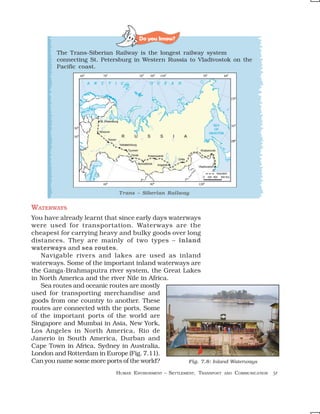
Do you know?

        The Trans-Siberian Railway is the longest railway system
        connecting St. Petersburg in Western Russia to Vladivostok on the
        Pacific coast.


                              Trans – Siberian Railway


WATERWAYS
You have already learnt that since early days waterways
were used for transportation. Waterways are the
cheapest for carrying heavy and bulky goods over long
distances. They are mainly of two types – inland
waterways and sea routes.
   Navigable rivers and lakes are used as inland
waterways. Some of the important inland waterways are
the Ganga-Brahmaputra river system, the Great Lakes
in North America and the river Nile in Africa.
   Sea routes and oceanic routes are mostly
used for transporting merchandise and
goods from one country to another. These
routes are connected with the ports. Some
of the important ports of the world are
Singapore and Mumbai in Asia, New York,
Los Angeles in North America, Rio de
Janerio in South America, Durban and
Cape Town in Africa, Sydney in Australia,
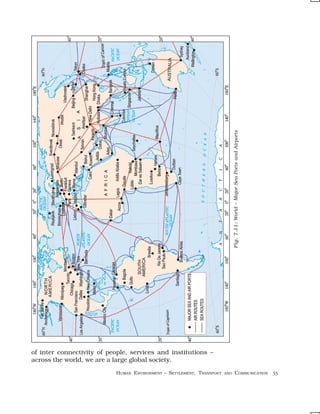
London and Rotterdam in Europe (Fig. 7.11).
Can you name some more ports of the world?          Fig. 7.8: Inland Waterways

                             HUMAN ENVIRONMENT – SETTLEMENT, TRANSPORT   AND   COMMUNICATION   51
AIRWAYS
                              This is the fastest way of transport developed in the early
                              twentieth century. It is also the most expensive due to
                              high cost of fuels. Air traffic is adversely affected by bad
                              weather like fog and storms. It is the only mode of
                              transport to reach the most remote and distant areas
                              especially where there are no roads and railways.
                              Helicopters are extremely useful in most inaccessible
                              areas and in time of calamities for rescuing people and
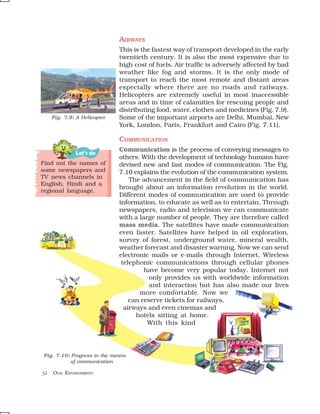
                              distributing food, water, clothes and medicines (Fig. 7.9).
     Fig. 7.9: A Helicopter   Some of the important airports are Delhi, Mumbai, New
                              York, London, Paris, Frankfurt and Cairo (Fig. 7.11).

                              COMMUNICATION
                              Communication is the process of conveying messages to
              Let’s do
                              others. With the development of technology humans have
Find out the names of         devised new and fast modes of communication. The Fig.
some newspapers and           7.10 explains the evolution of the communication system.
TV news channels in
                                  The advancement in the field of communication has
English, Hindi and a
                              brought about an information revolution in the world.
regional language.
                              Different modes of communication are used to provide
                              information, to educate as well as to entertain. Through
                              newspapers, radio and television we can communicate
                              with a large number of people. They are therefore called
                              mass media. The satellites have made communication
                              even faster. Satellites have helped in oil exploration,
                              survey of forest, underground water, mineral wealth,
                              weather forecast and disaster warning. Now we can send
                              electronic mails or e-mails through Internet. Wireless
                               telephonic communications through cellular phones
                                       have become very popular today. Internet not
                                         only provides us with worldwide information
                                         and interaction but has also made our lives
                                     more comfortable. Now we
                                  can reserve tickets for railways,
                                airways and even cinemas and
                                    hotels sitting at home.
                                        With this kind


Fig. 7.10: Progress in the means
           of communication

52   OUR ENVIRONMENT
Fig. 7.11: World – Major Sea Ports and Airports


of inter connectivity of people, services and institutions –
across the world, we are a large global society.

                           HUMAN ENVIRONMENT – SETTLEMENT, TRANSPORT   AND           COMMUNICATION 53
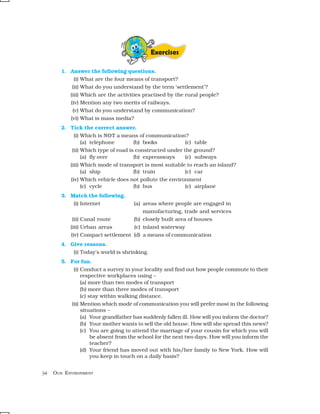
Exercises

        1. Answer the following questions.
             (i) What are the four means of transport?
            (ii) What do you understand by the term ‘settlement’?
           (iii) Which are the activities practised by the rural people?
           (iv) Mention any two merits of railways.
            (v) What do you understand by communication?
           (vi) What is mass media?
        2. Tick the correct answer.
             (i) Which is NOT a means of communication?
                 (a) telephone        (b) books           (c) table
            (ii) Which type of road is constructed under the ground?
                 (a) fly over         (b) expressways     (c) subways
           (iii) Which mode of transport is most suitable to reach an island?
                 (a) ship             (b) train           (c) car
           (iv) Which vehicle does not pollute the environment
                 (c) cycle            (b) bus             (c) airplane
        3. Match the following.
            (i) Internet           (a) areas where people are engaged in
                                       manufacturing, trade and services
            (ii) Canal route       (b) closely built area of houses
           (iii) Urban areas       (c) inland waterway
           (iv) Compact settlement (d) a means of communication
        4. Give reasons.
            (i) Today’s world is shrinking.
        5. For fun.
            (i) Conduct a survey in your locality and find out how people commute to their
                respective workplaces using –
                (a) more than two modes of transport
                (b) more than three modes of transport
                (c) stay within walking distance.
           (ii) Mention which mode of communication you will prefer most in the following
                situations –
                (a) Your grandfather has suddenly fallen ill. How will you inform the doctor?
                (b) Your mother wants to sell the old house. How will she spread this news?
                (c) You are going to attend the marriage of your cousin for which you will
                     be absent from the school for the next two days. How will you inform the
                     teacher?
                (d) Your friend has moved out with his/her family to New York. How will
                     you keep in touch on a daily basis?


54   OUR ENVIRONMENT

Human environment settlement, transportation and communication

  • 1.
    In Chapter 1you have learnt that early human beings depended entirely on nature for food, clothing and Do you know? shelter; but with time they learnt new skills to grow food, build homes and develop better means of transport and The place where a communication. In this way they modified the building or a environment where they lived. settlement develops is Settlements are places where people build their called its site. homes. Early human beings lived on trees and in caves. The natural When they started to grow crops it became necessary to conditions for have a permanent home. The settlements grew near the selection of an ideal river valleys as water was available and land was fertile. site are- 1. favourable climate With the development of trade, commerce and 2. availability of manufacturing, human settlements became larger. water Settlement flourished and civilizations developed near 3. suitable land river valleys. Do you recall the names of civilization that 4. fertile soil grew along the banks of rivers Indus, Tigris, Nile and Hwang-He. Settlements can be permanent or temporary. Settlements which are occupied for a short time are called temporary settlements. The people living in deep forests, hot and cold deserts and mountains often dwell in such temporary settlements. They practice hunting, gathering, shifting cultivation and transhumance. However more and more settlements today are permanent settlements. In these settlements, people build homes to live in. Fig. 7.1: Human Settlement
  • 2.
    Glossary It was Mary’s birthday party. She and her friends were waiting for Gurpreet to arrive so that Mary could Transhumance: It is cut the cake. At last Gurpreet arrived- tired, coughing a seasonal movement and wheezing. She explained that the traffic jam was of people. People who terrible. Mary’s mother Mrs.Thomas patted Gurpreet’s rear animals move in back and sighed, “Oof! The pollution in our city!” Prasad search of new had recently come from his village. He asked, “Why do pastures according to we have such traffic jams and such pollution in the changes in seasons. cities?” “The number of vehicles is increasing day by day due to the growing population in the cities”, Mary’s father, Mr. Thomas replied. Mary asked, “Then why are people coming to the cities?” Her mother replied, “They come looking for jobs, better education and medical facilities.” Mary further enquired, “If so many people keep coming to cities, where will all the people live?” Mr. Thomas said, “That is why you see so many slums and squatter settlements where people stay in congested and unhygienic conditions. Shortage of power and water supply are common problems in the cities”. Prasad said, “Our villages may not have big cinema halls, well-equipped schools and good hospitals, but we have lot of open spaces and fresh air to breathe in. When my grandfather was sick we had to rush him to the city hospital.” From the above conversation we can identify two different pictures of settlements – the rural and the urban settlements. The villages are rural settlement where people are engaged in activities like agriculture, fishing, forestry, crafts work and trading etc. Fig. 7.2: Compact Settlement Rural settlements can be compact or scattered. A compact settlement is a closely built area of dwellings, wherever flat land is available (Fig. 7.2). In a scattered settlement dwellings are spaced over an extensive area. This type of settlement is mostly found in hilly tracts, thick forests, and regions of extreme climate (Fig. 7.3). In rural areas, people build houses Fig. 7.3: Scattered Settlement to suit their environment. In regions 48 OUR ENVIRONMENT
  • 3.
    of heavy rainfall,they have slanting roofs. Places where water accumulates in the rainy season the houses are constructed on a raised platform or stilts (Fig. 7.4). Thick mud walled houses with thatched roofs are very common in areas of hot climate. Local materials like stones, mud, clay, straw etc are used to construct houses. The towns are small and the cities Fig. 7.4: House on Stilts are larger urban settlements. In urban areas the people are engaged in manufacturing, trading, and services. Name some of the villages, towns and cities of your state. TRANSPORT Transport is the means by which people and goods move. In the early days it took a great deal of time, to travel long distances. People had to walk and used animals to carry their goods. Invention of the wheel Where do you find made transport easier. With the passage of time dwellings made of ice? Who makes them and different means of transport developed but even today what are they called? people use animals for transport (Fig. 7.5). Let’s do List the different Fig. 7.5: Horse cart as a mode of transportation modes of transport In our country donkeys, mules, bullocks and camels used by the students are common. In the Andes Mountains of South of your class while America, llamas are used, as are yaks in Tibet. The coming to school. early traders from other countries used to take several months to reach India. They took either the sea route or the land route. Airplanes have made travel faster. Now it takes only 6-8 hours to travel from India to Europe. Modern means of transport thus saves time and energy. HUMAN ENVIRONMENT – SETTLEMENT, TRANSPORT AND COMMUNICATION 49
  • 4.
    Do you know? The four major means of transport are roadways, railways, waterways and airways. There are several National and State ROADWAYS highways in India. The latest development in The most commonly used means of transport especially India is the construction for short distances are roads. They can be metalled of Express Ways. The (pucca) and unmetalled (kutcha) (Fig. 7.6 and 7.7). The Golden Quadrilateral plains have a dense network of roads. Roads have also connects Delhi, been build in terrains like deserts, forests and even high Mumbai, Chennai and mountains. Manali-Leh highway in the Himlayan Kolkata. Mountains is one of the highest roadways in the world. Roads built underground are called subways/under paths. Flyovers are built over raised structures. Fig. 7.6: Metalled Road Fig. 7.7: Unmetalled Road RAILWAYS Do you know? The railways carry heavy goods and people over long distances quickly and The train from Xining to Lhasa runs at cheaply. The invention of the steam an altitude of 4,000m above sea level engine and the Industrial Revolution and the highest point is 5,072 m helped in speedy development of rail transport. Diesel and electric engines have largely replaced the steam engines. In places super fast trains have been introduced to make the journey faster. The railway network is well developed over the plain areas. Advanced technological skills have enabled laying of railway lines in difficult mountain terrains also. But these are much fewer in number. Indian railway network is well developed. It is the largest in Asia. 50 OUR ENVIRONMENT
  • 5.
    Do you know? The Trans-Siberian Railway is the longest railway system connecting St. Petersburg in Western Russia to Vladivostok on the Pacific coast. Trans – Siberian Railway WATERWAYS You have already learnt that since early days waterways were used for transportation. Waterways are the cheapest for carrying heavy and bulky goods over long distances. They are mainly of two types – inland waterways and sea routes. Navigable rivers and lakes are used as inland waterways. Some of the important inland waterways are the Ganga-Brahmaputra river system, the Great Lakes in North America and the river Nile in Africa. Sea routes and oceanic routes are mostly used for transporting merchandise and goods from one country to another. These routes are connected with the ports. Some of the important ports of the world are Singapore and Mumbai in Asia, New York, Los Angeles in North America, Rio de Janerio in South America, Durban and Cape Town in Africa, Sydney in Australia, London and Rotterdam in Europe (Fig. 7.11). Can you name some more ports of the world? Fig. 7.8: Inland Waterways HUMAN ENVIRONMENT – SETTLEMENT, TRANSPORT AND COMMUNICATION 51
  • 6.
    AIRWAYS This is the fastest way of transport developed in the early twentieth century. It is also the most expensive due to high cost of fuels. Air traffic is adversely affected by bad weather like fog and storms. It is the only mode of transport to reach the most remote and distant areas especially where there are no roads and railways. Helicopters are extremely useful in most inaccessible areas and in time of calamities for rescuing people and distributing food, water, clothes and medicines (Fig. 7.9). Fig. 7.9: A Helicopter Some of the important airports are Delhi, Mumbai, New York, London, Paris, Frankfurt and Cairo (Fig. 7.11). COMMUNICATION Communication is the process of conveying messages to Let’s do others. With the development of technology humans have Find out the names of devised new and fast modes of communication. The Fig. some newspapers and 7.10 explains the evolution of the communication system. TV news channels in The advancement in the field of communication has English, Hindi and a brought about an information revolution in the world. regional language. Different modes of communication are used to provide information, to educate as well as to entertain. Through newspapers, radio and television we can communicate with a large number of people. They are therefore called mass media. The satellites have made communication even faster. Satellites have helped in oil exploration, survey of forest, underground water, mineral wealth, weather forecast and disaster warning. Now we can send electronic mails or e-mails through Internet. Wireless telephonic communications through cellular phones have become very popular today. Internet not only provides us with worldwide information and interaction but has also made our lives more comfortable. Now we can reserve tickets for railways, airways and even cinemas and hotels sitting at home. With this kind Fig. 7.10: Progress in the means of communication 52 OUR ENVIRONMENT
  • 7.
    Fig. 7.11: World– Major Sea Ports and Airports of inter connectivity of people, services and institutions – across the world, we are a large global society. HUMAN ENVIRONMENT – SETTLEMENT, TRANSPORT AND COMMUNICATION 53
  • 8.
    Exercises 1. Answer the following questions. (i) What are the four means of transport? (ii) What do you understand by the term ‘settlement’? (iii) Which are the activities practised by the rural people? (iv) Mention any two merits of railways. (v) What do you understand by communication? (vi) What is mass media? 2. Tick the correct answer. (i) Which is NOT a means of communication? (a) telephone (b) books (c) table (ii) Which type of road is constructed under the ground? (a) fly over (b) expressways (c) subways (iii) Which mode of transport is most suitable to reach an island? (a) ship (b) train (c) car (iv) Which vehicle does not pollute the environment (c) cycle (b) bus (c) airplane 3. Match the following. (i) Internet (a) areas where people are engaged in manufacturing, trade and services (ii) Canal route (b) closely built area of houses (iii) Urban areas (c) inland waterway (iv) Compact settlement (d) a means of communication 4. Give reasons. (i) Today’s world is shrinking. 5. For fun. (i) Conduct a survey in your locality and find out how people commute to their respective workplaces using – (a) more than two modes of transport (b) more than three modes of transport (c) stay within walking distance. (ii) Mention which mode of communication you will prefer most in the following situations – (a) Your grandfather has suddenly fallen ill. How will you inform the doctor? (b) Your mother wants to sell the old house. How will she spread this news? (c) You are going to attend the marriage of your cousin for which you will be absent from the school for the next two days. How will you inform the teacher? (d) Your friend has moved out with his/her family to New York. How will you keep in touch on a daily basis? 54 OUR ENVIRONMENT