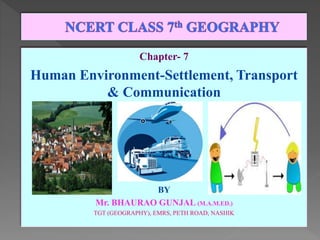
1) Diesel and electric engines have largely replaced the steam engines. Settlements can be permanent or temporary. Transport is the means by which people and goods move. The plains have a dense network of roads.
We havealready learnt that early human beings depended entirely on
nature for food, clothing & shelter.
But as society progressed, humans learned the art & new skills to grow
food, build homes, develop better modes of transport & means of
communication.
In this way they modify the environment where they lived.
Objectives
Explain the relationship between natural environment and human
habitation
Appreciate the need of transport and communication for development of
the community
Learn about the new developments making today’s world a global society
4.
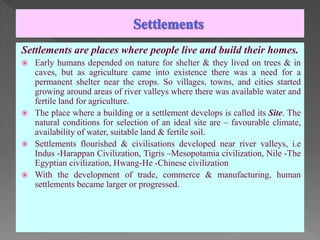
Settlements are placeswhere people live and build their homes.
Early humans depended on nature for shelter & they lived on trees & in
caves, but as agriculture came into existence there was a need for a
permanent shelter near the crops. So villages, towns, and cities started
growing around areas of river valleys where there was available water and
fertile land for agriculture.
The place where a building or a settlement develops is called its Site. The
natural conditions for selection of an ideal site are – favourable climate,
availability of water, suitable land & fertile soil.
Settlements flourished & civilisations developed near river valleys, i.e
Indus -Harappan Civilization, Tigris –Mesopotamia civilization, Nile -The
Egyptian civilization, Hwang-He -Chinese civilization
With the development of trade, commerce & manufacturing, human
settlements became larger or progressed.
5.
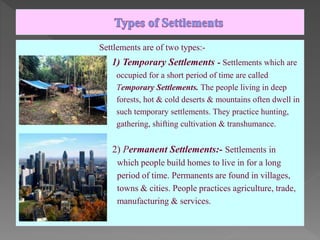
Settlements are oftwo types:-
1) Temporary Settlements - Settlements which are
occupied for a short period of time are called
Temporary Settlements. The people living in deep
forests, hot & cold deserts & mountains often dwell in
such temporary settlements. They practice hunting,
gathering, shifting cultivation & transhumance.
2) Permanent Settlements:- Settlements in
which people build homes to live in for a long
period of time. Permanents are found in villages,
towns & cities. People practices agriculture, trade,
manufacturing & services.
6.
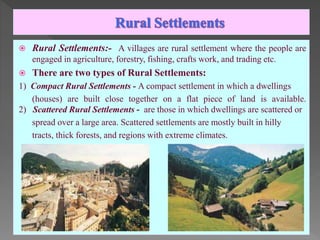
Rural Settlements:-A villages are rural settlement where the people are
engaged in agriculture, forestry, fishing, crafts work, and trading etc.
There are two types of Rural Settlements:
1) Compact Rural Settlements - A compact settlement in which a dwellings
(houses) are built close together on a flat piece of land is available.
2) Scattered Rural Settlements - are those in which dwellings are scattered or
spread over a large area. Scattered settlements are mostly built in hilly
tracts, thick forests, and regions with extreme climates.
7.
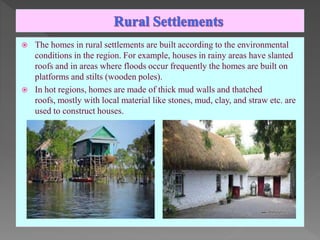
The homesin rural settlements are built according to the environmental
conditions in the region. For example, houses in rainy areas have slanted
roofs and in areas where floods occur frequently the homes are built on
platforms and stilts (wooden poles).
In hot regions, homes are made of thick mud walls and thatched
roofs, mostly with local material like stones, mud, clay, and straw etc. are
used to construct houses.
8.
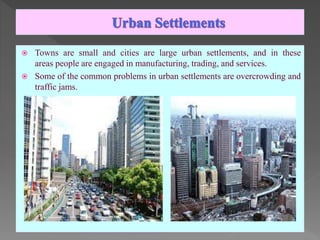
Towns aresmall and cities are large urban settlements, and in these
areas people are engaged in manufacturing, trading, and services.
Some of the common problems in urban settlements are overcrowding and
traffic jams.
9.
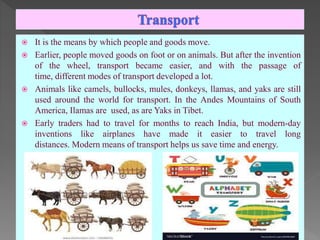
It isthe means by which people and goods move.
Earlier, people moved goods on foot or on animals. But after the invention
of the wheel, transport became easier, and with the passage of
time, different modes of transport developed a lot.
Animals like camels, bullocks, mules, donkeys, llamas, and yaks are still
used around the world for transport. In the Andes Mountains of South
America, Ilamas are used, as are Yaks in Tibet.
Early traders had to travel for months to reach India, but modern-day
inventions like airplanes have made it easier to travel long
distances. Modern means of transport helps us save time and energy.
10.
The fourmajor means of transport are Roadways, Railways, waterways &
Airways
Roadways:- The most commonly used mode of transport over short
distances is roads, and roads are of two types: Metalled (pucca) Road &
Unmetalled (kutcha) Road
There is a dense network of roads in the plains, and roads have also been
built in forests, deserts, hilly regions, mountains, etc. The Manali-Leh
highway in the Himalayas is the highest road in the world.
Roads built underground are called subways or underpasses and flyovers
are roads built over raised structures.
11.
Railways:- Theyare used to carry people and goods over long distances
quickly and cheaply. The invention of the steam engine and the Industrial
Revolution helped in speedy development of rail transport around the
world.
Today, diesel and electric engines have widely replaced the steam engine,
and modern-day super-fast trains have made travelling faster than ever
before.
Railway networks are well developed in the plains, and advanced
technology has been used to lay down railway lines in mountains and hilly
regions. But those are much fewer in number.
The Indian railway network is well-developed and the largest in Asia.
12.
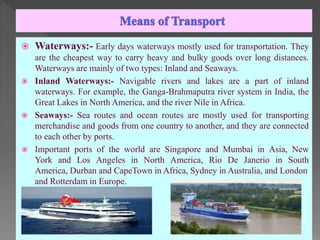
Waterways:- Earlydays waterways mostly used for transportation. They
are the cheapest way to carry heavy and bulky goods over long distances.
Waterways are mainly of two types: Inland and Seaways.
Inland Waterways:- Navigable rivers and lakes are a part of inland
waterways. For example, the Ganga-Brahmaputra river system in India, the
Great Lakes in North America, and the river Nile in Africa.
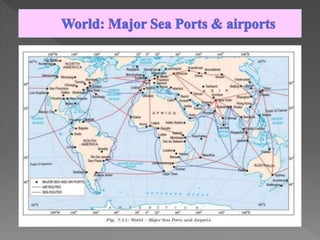
Seaways:- Sea routes and ocean routes are mostly used for transporting
merchandise and goods from one country to another, and they are connected
to each other by ports.
Important ports of the world are Singapore and Mumbai in Asia, New
York and Los Angeles in North America, Rio De Janerio in South
America, Durban and CapeTown in Africa, Sydney in Australia, and London
and Rotterdam in Europe.
14.
Airways:- Theyare not only the fastest way of transport in the modern
world but also the most expensive due to the high cost of fuels.
Air transport is usually affected by bad weather like fog and storms, but it
is the only way to reach the remote areas of the world where roads and
railways do not go.
Helicopters are useful in inaccessible areas and are used in times of
calamities (natural disasters) to save people and distributing food, water,
clothes, & medicines.
Some of the busiest and most important airports in the world
are Mumbai, New York, London, Paris, Frankfurt, Cairo, etc.
15.
Communication isthe process of sharing/conveying messages to others.
With the development of technology human have devised new and fast
modes of communication.
The progress of communication systems has resulted in an information
revolution in the world; communication now
provides information, education, and it entertainment.
Through Mass Media such as newspapers, radio, cinema and television,
we can quickly communicate with people anywhere and anytime.
Satellites have made communication easier by helping with exploring
oil, minerals, and other resources such as underground water,
with surveying forests, and also with weather forecasting and disaster
warning.
16.
We caneasily send electronic messages, voice, and video through
the internet and wireless electronic systems like cellular/mobile phones.
The Internet not only provides us with worldwide information but also
makes our life comfortable, for example, by allowing us to book tickets for
buses, railways, airways, cinemas and hotel rooms online.
With this kind of inter connectivity of people, services & institutions across
the world, we are a large global society.
17.
1) ______ and_____ engines have largely replaced the steam engines.
2) Settlements can be _________ or _________.
3) ________ is the means by which people and goods move.
4) The _______ have a dense network of roads.
5) Bus does not pollute the environment. (True/False)
6) Andes Mountains is in North America. (True/False)
7) The satellites have made communication even faster. (True/False)
8) Which Asian country has the largest railway network?
9) Why air travel is so expensive?
10) What are the four means of transport?
11) Which is the highest roadway in the world?
12) What are the materials used in building houses in rural areas?