INDO ARYAN – FOUNDATION OF VEDIC AGE
ARCHITECTURAL CHARATERISTICS AND TOWN PLANNING
Deepak Kumar
Asst. Professor, Department of Architecture,
SPAV
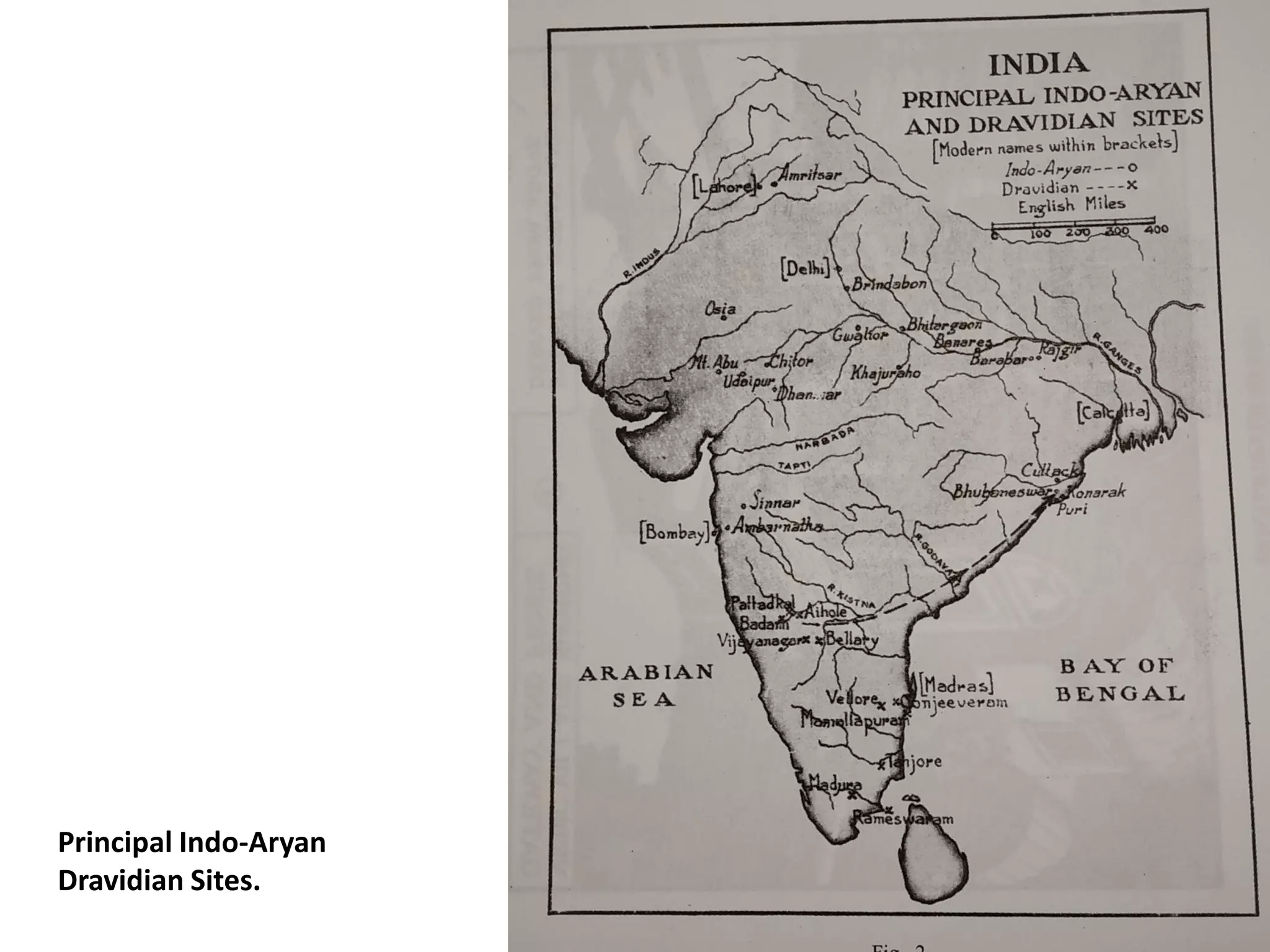
Principal Indo-Aryan
Dravidian Sites.
The outstanding quality of the architecture in India is its spiritual
content. The fundamental purpose of the building art was to
represent the prevailing religious consciousness of the
people.
It is mind materializing in terms of rock, brick or stone. The main
characteristic is emphasized by treatment of wall surfaces. Carved in high
and low relief are depicted all age old mythology of the country in form of
God and goddesses. Depicting ‘Ocean of Story’
Middle of first millennium BC (Era of Timber Construction)
1. Traditional structure of village was reproduced on larger scale in a more
substantial forms.
2. Owing to the rivalry that sprung between various states and groups, the towns
which were of capital of states were strongly fortified.
3. They were surrounded by a rampart and wooden palisades while this enclosure
the buildings were also almost entirely made of wood.
The Vedic civilization enters into era of ‘Timber Construction’
In Rig veda carpenter is recorded as holding the place of honor amongst all
the artisans.
According to Dhammapala, the great Buddhist commentator they were
planned by an Architect named ‘Maha-Govinda’ who is stated to have been
responsible for layout of several of the capital so fnorth indian in 5th centurey
BC.
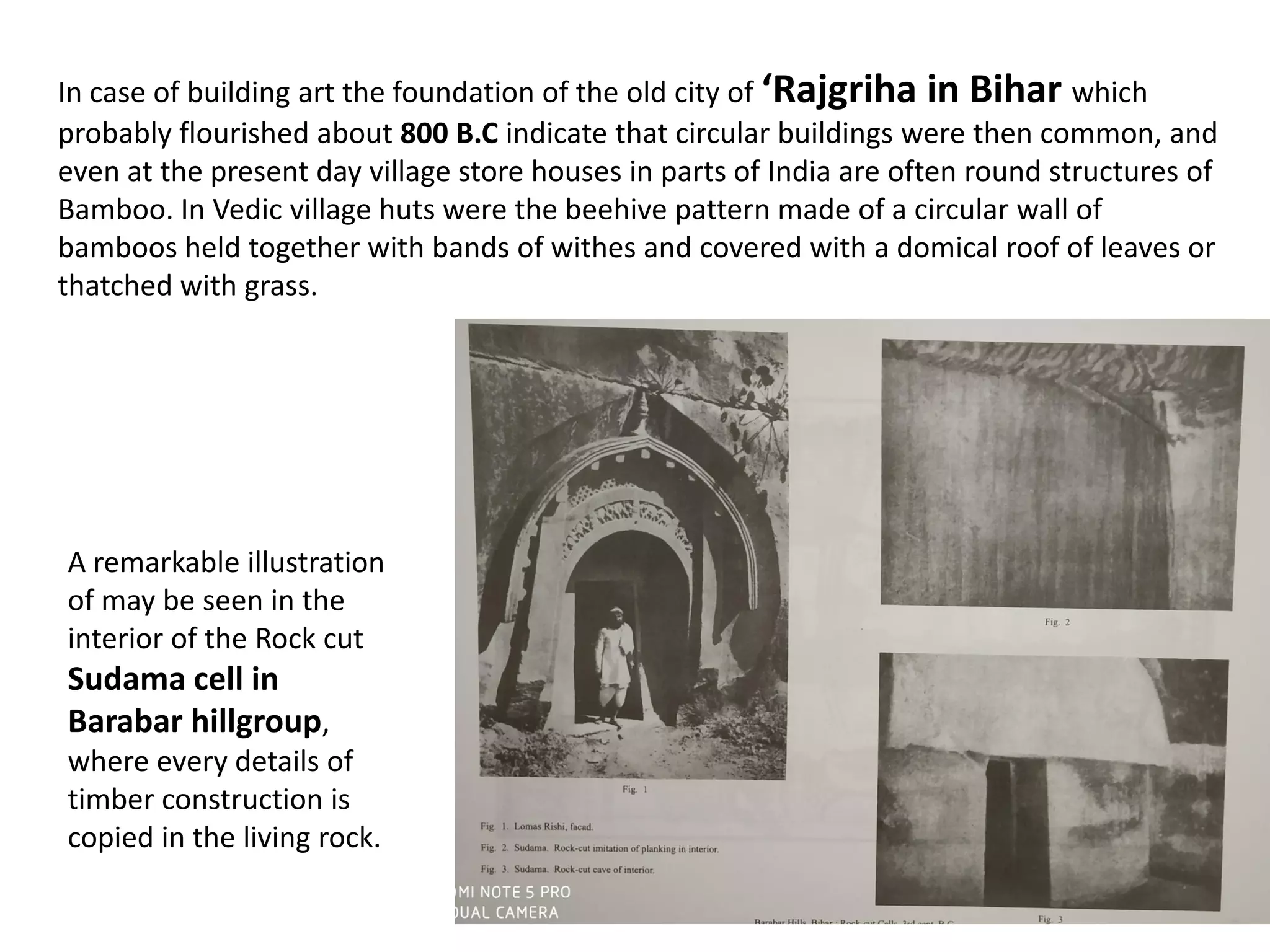
In case of building art the foundation of the old city of ‘Rajgriha in Bihar which
probably flourished about 800 B.C indicate that circular buildings were then common, and
even at the present day village store houses in parts of India are often round structures of
Bamboo. In Vedic village huts were the beehive pattern made of a circular wall of
bamboos held together with bands of withes and covered with a domical roof of leaves or
thatched with grass.
A remarkable illustration
of may be seen in the
interior of the Rock cut
Sudama cell in
Barabar hillgroup,
where every details of
timber construction is
copied in the living rock.
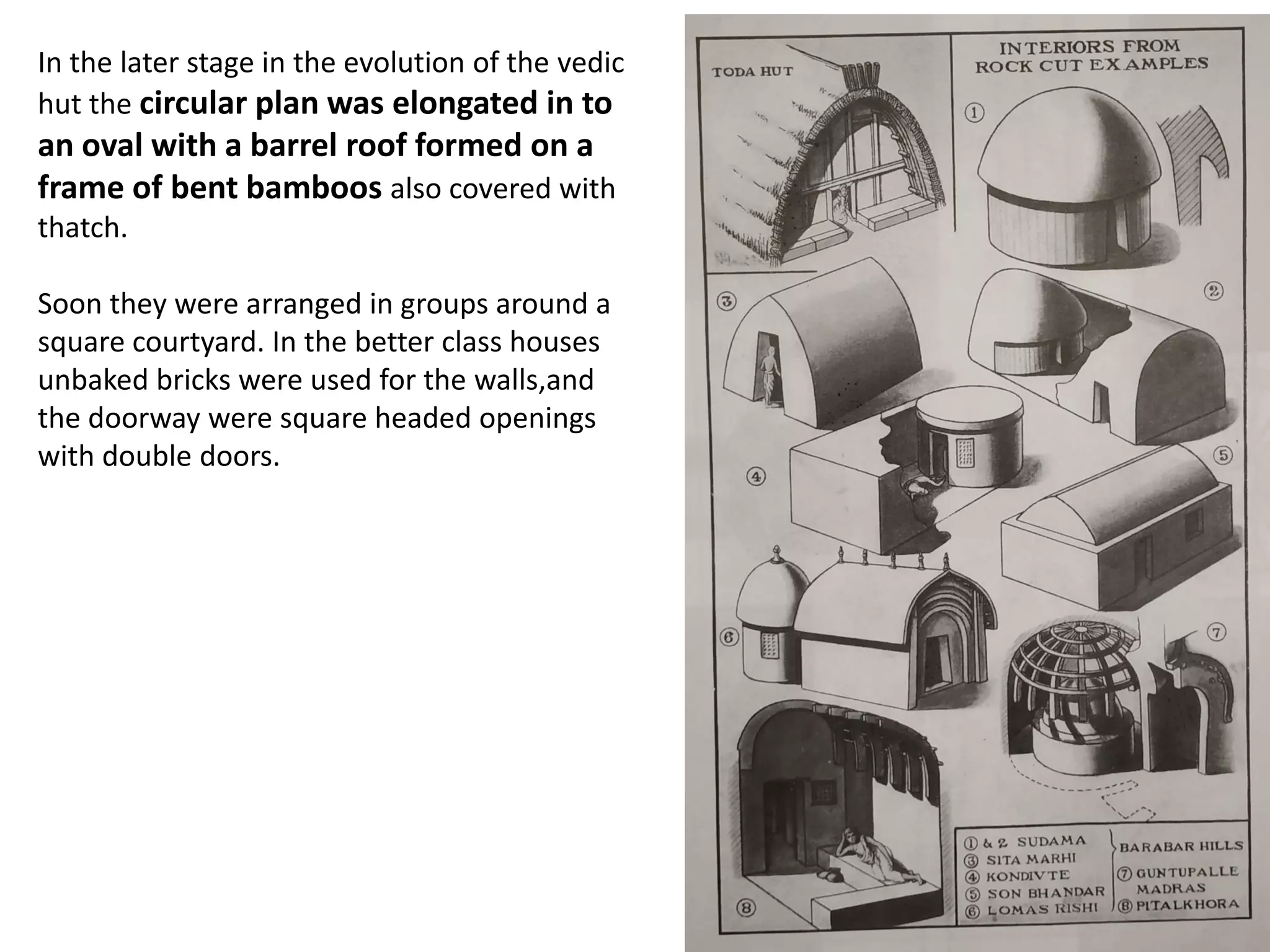
In the later stage in the evolution of the vedic
hut the circular plan was elongated in to
an oval with a barrel roof formed on a
frame of bent bamboos also covered with
thatch.
Soon they were arranged in groups around a
square courtyard. In the better class houses
unbaked bricks were used for the walls,and
the doorway were square headed openings
with double doors.
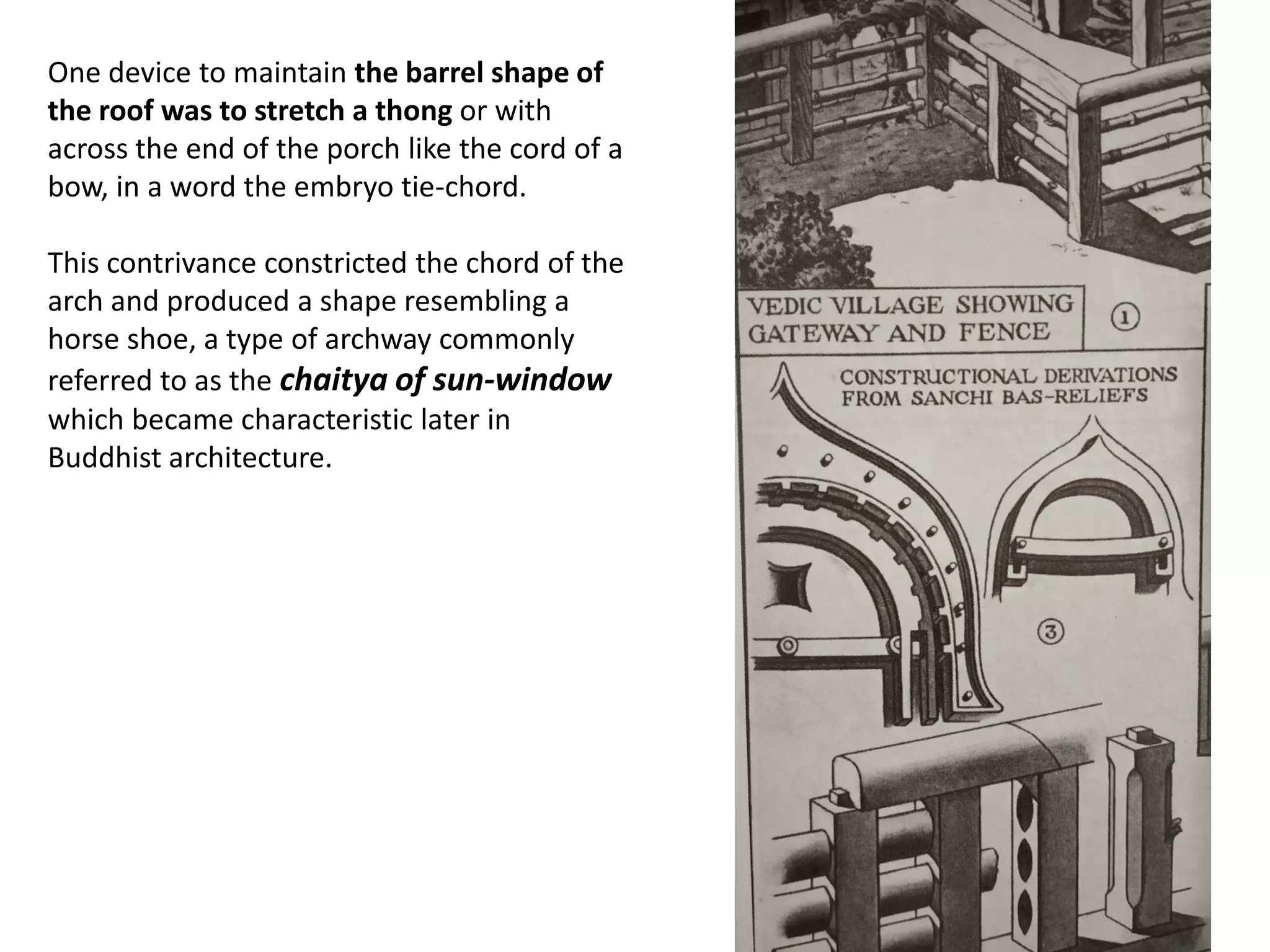
One device to maintain the barrel shape of
the roof was to stretch a thong or with
across the end of the porch like the cord of a
bow, in a word the embryo tie-chord.
This contrivance constricted the chord of the
arch and produced a shape resembling a
horse shoe, a type of archway commonly
referred to as the chaitya of sun-window
which became characteristic later in
Buddhist architecture.
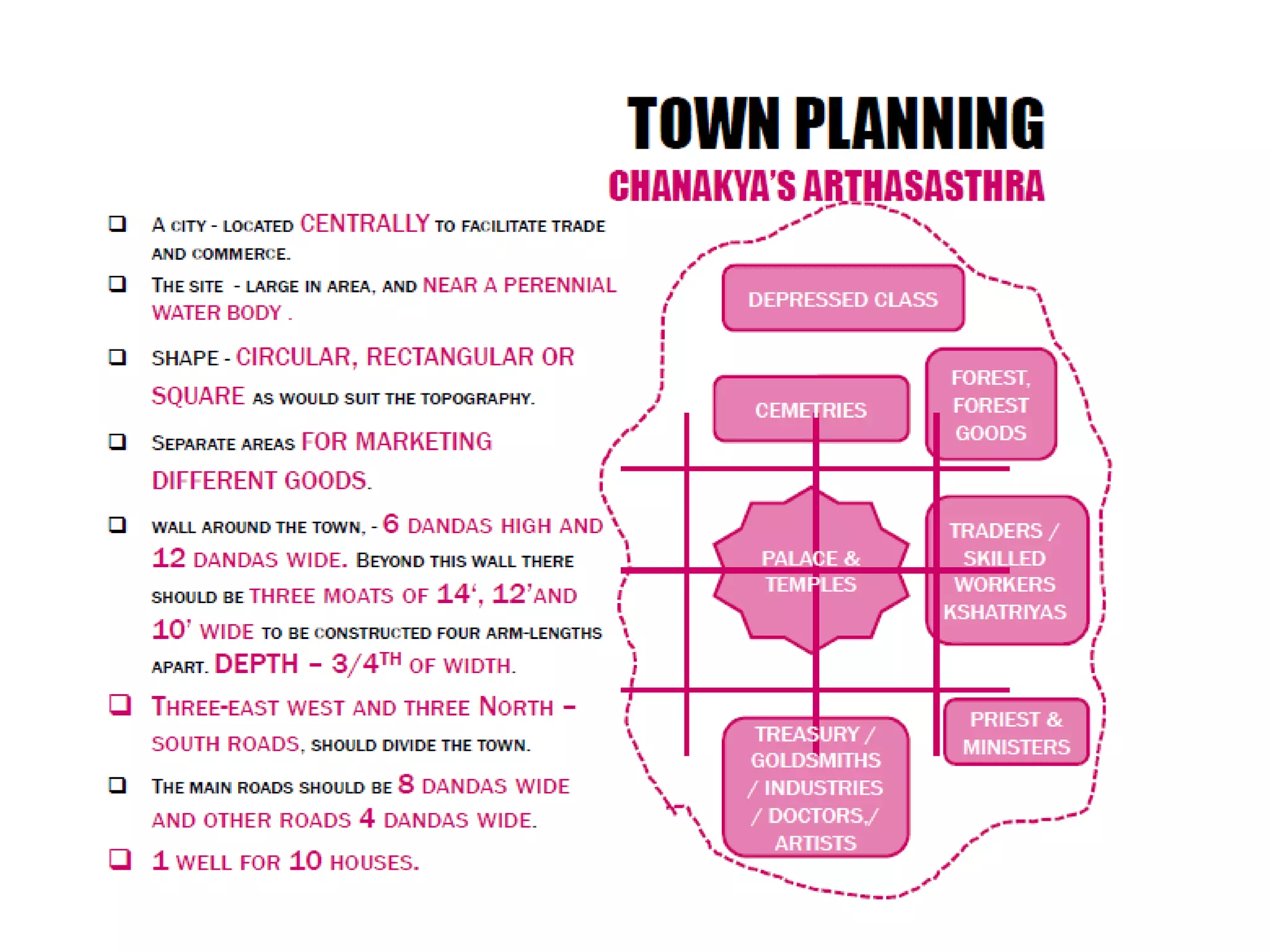
The Indian town-planning seems to have been systematically pursued.
Aryan traditions trace its origin to Brahma, the creator-aspect of God. In
town planning, we have to deal with what is technically designated above as
vdhara’ (ground) and incidentally with 'harmya’ (building).
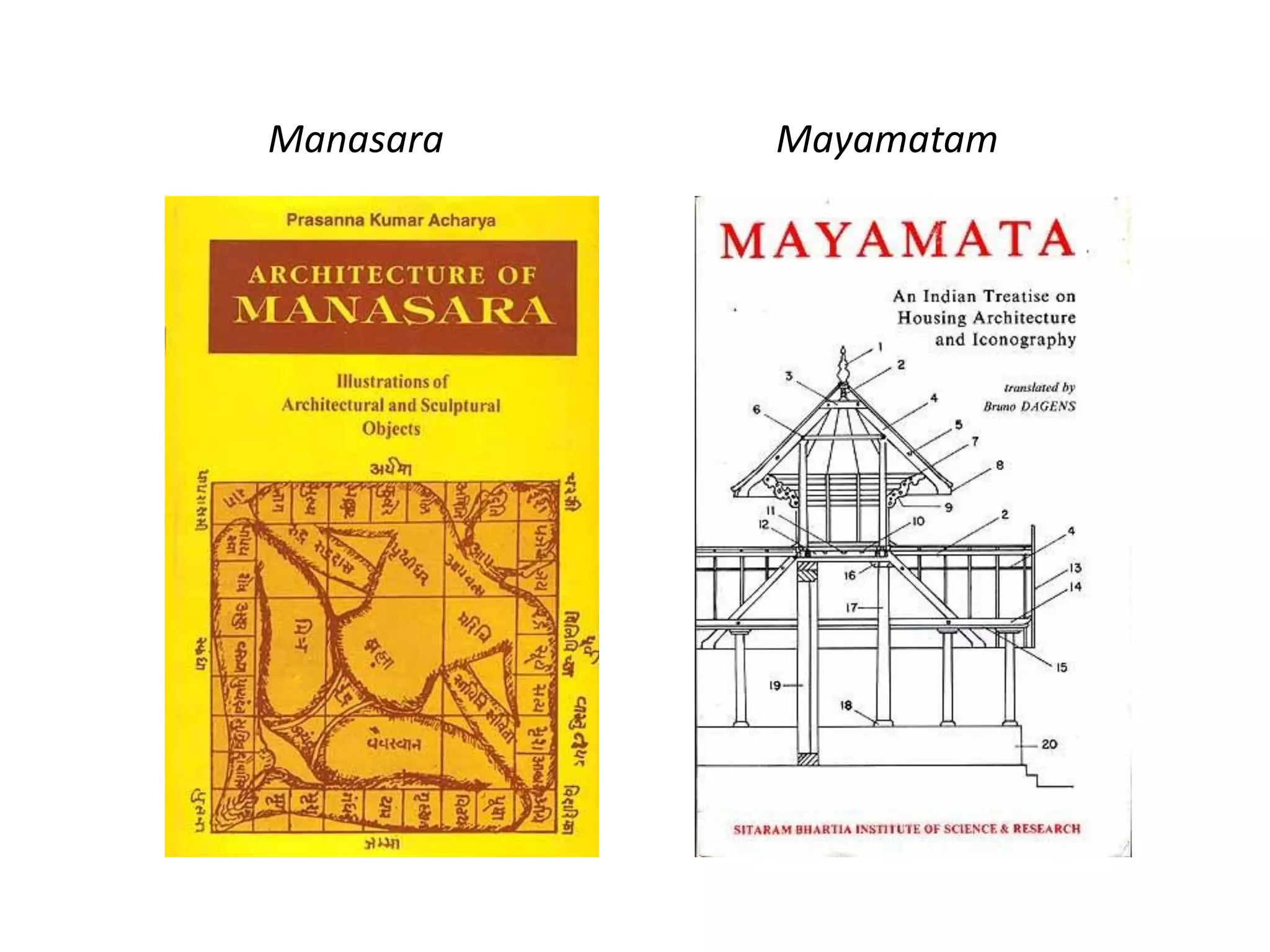
Manasara Mayamatam
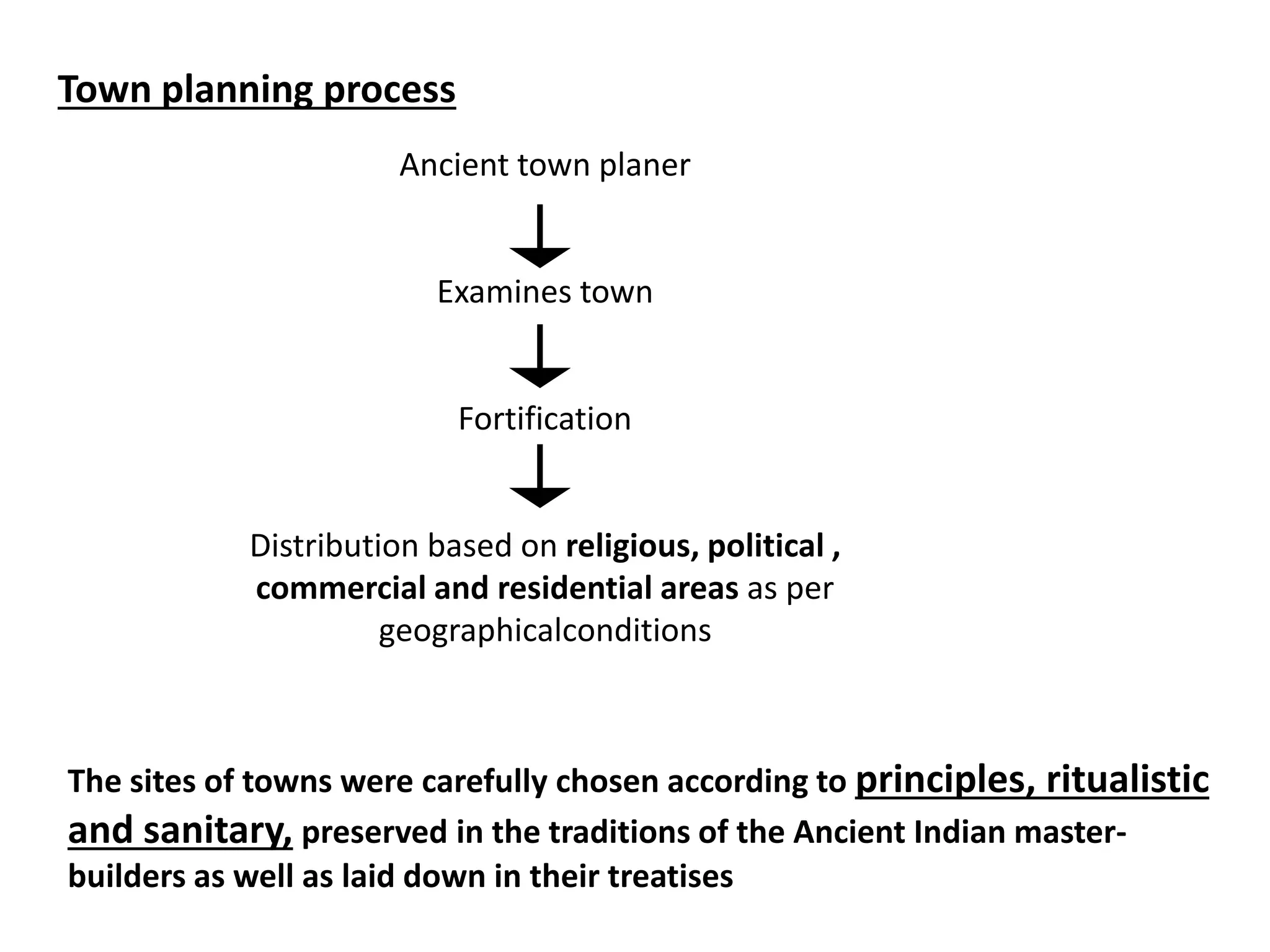
Ancient town planer
Examines town
Fortification
Distribution based on religious, political ,
commercial and residential areas as per
geographicalconditions
The sites of towns were carefully chosen according to principles, ritualistic
and sanitary, preserved in the traditions of the Ancient Indian master-
builders as well as laid down in their treatises
Town planning process
WAYS TO ASCERTAIN THE SOLIDITY OF THE GROUND
“Dig out a pit one cubit deep in the ground and again return the
earth into it. If the earth more than fills up the pit, then the
ground is good; if it is just sufficient then it is middling or
indifferent while if it falls short, the ground is bad. The good and
indifferent varieties are acceptable, but the bad should on no
account be accepted.”
Mayamuni’s examination of the rule is slightly different. He
would fill up the pit with water in the evening and examine it
early next morning. If there is remnant of water in the pit, then
the ground should be welcome for all purposes. If the pit is
found moist and muddy, then the ground will spell ruin for
human habitation, and the aridity of the pit signifies lose of
grains and wealth.
Sutradhara Mandana, in his Vastu Rajavallabha4, differentiates and enumerates
the qualities as follows :-
“The plot fit for the Brahmanas is white, emanating fragrance like ghee and
agreeable to the taste; that suited to the warrior class is red smelling like blood,
astringent in taste; the ground suited to the Vaishyas is yellow emitting smell like
seasum oil and sour to the taste; while the ground which is black, gives out a fish-
like odour, and is pungent becomes the Sudras.”
Wards in a town which were exclusively inhabited by people
of the same caste
VILLAGES
A group of villages gives rise to a big town. Village is a town in miniature and hence in
India from the standpoint of planning there is no difference between a village and a
town.
Visvakarama-Vastusastra describes 12 type of villages.
1. Mandaka
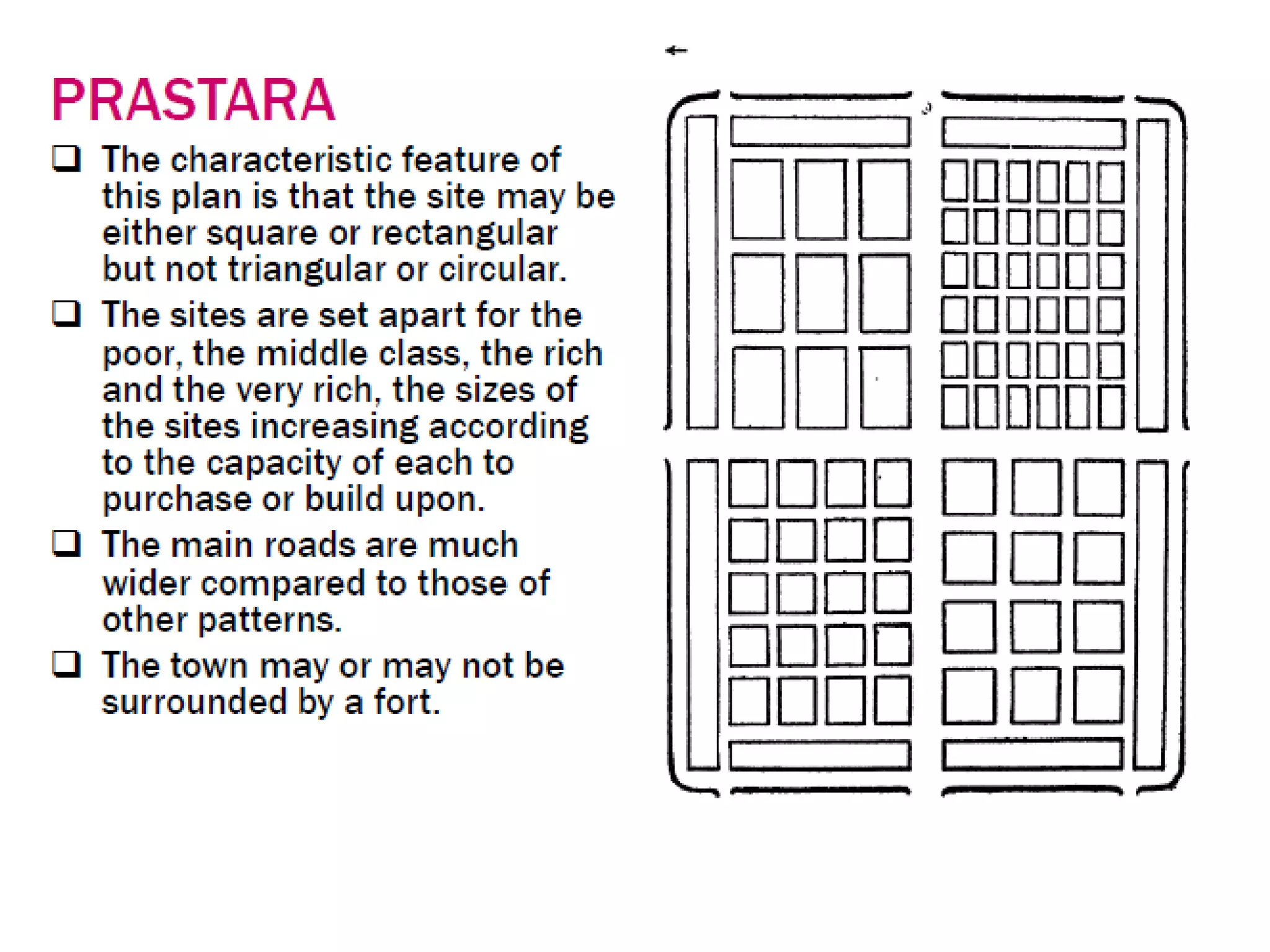
2. Prastara
3. Bahulika
4. Paraka
5. Caturmukha
6. Purva mukha
7. Mangala
8. Viswakarmaka – Large village may be called town
9. Devarat – Temple Village
10. Visvesa- Commercial Village
11. Kailasa- directed to be laid out on the sea coast or on the slopes of a hill and it is
also protected by ramparts
12. Nitya-Mangala- big village with 6000 people.
Fortified and surrounded by ramparts and may
be deemed as special habitations
TOWNS
Its population is denser than in rural area and is settled in restricted area and
is predominantly in non agricultural in occupation. Town is
dependent on
rural areas for the supply of food and raw materials.
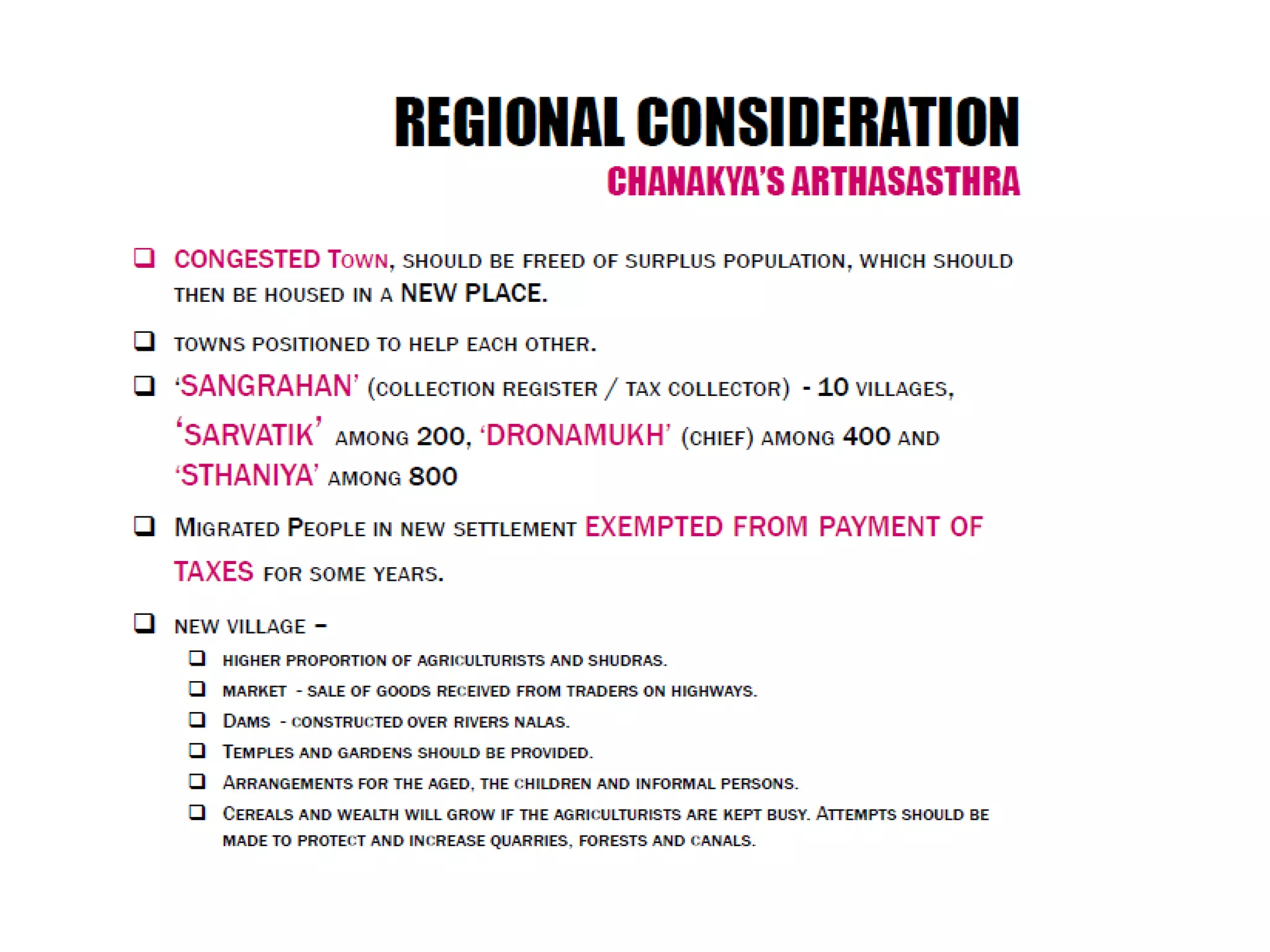
The following are ten abstract criteria to distinguish the earliest city from any older or
contemporary village
1. In point of size the first towns must have been more extensive and more densely
populated than any other previous settlements, although considerably smaller than
many villages of today.
2. While there might be peasants cultivating lands outside the town. All towns must
have accommodated in addition non-food producing ' classes-full-time specialist
craftsmen, transport-workers, merchants, officials and priests-supported by the
surplus produced by peasants.
3. Each primary producer paid over his tiny surplus to a deity or divine king who thus
concentrated the surplus.
4. Truly monumental buildings not only distinguish each known town from the village
but also symbolize the concentration of social surplus.
5. All those not engaged in food-production were supported in the first instance by the
surplus concentrated in temples or royal granaries and were dependent on the temple
or court. But naturally, priests, civil and military leaders and officials absorbed a major
share of the concentrated surplus and thus formed the ‘ruling class’ which did confer
substantial benefits upon their subjects in the way of planning and organization.
6. The ruling class was compelled to invert systems of recording and exact, but
practically useful, sciences.
7. The invention of writing enabled the leisured clerks to proceed to the elaboration of
exact and predictive sciences-arithmetic, geometry and
Astronomy.
TOWNS
8. Other specialists gave a new direction to artistic expressions. Artist craftsmen-full-
time sculptors, printers or seal engravers-began to carve, model or draw according
to conceptualized and sophisticated styles.
9. A further part of the concentrated surplus was used to pay for the importation of
raw materials needed for industry or cult and not available locally. Regular “Foreign
trade” over quite long distances was a feature of all early civilizations.
10. So in the town specialist - craftsmen were provided with raw materials needed
for the employment of their skill and also guaranteed security in a state organization
based on residence rather than kinship. The town was a community to which a
craftsmen could belong politically as well as economically.
TOWNS
Mandan’s ‘Rajvallabha’11 describes 20 types of town :
1. Mahendra : It is square town.
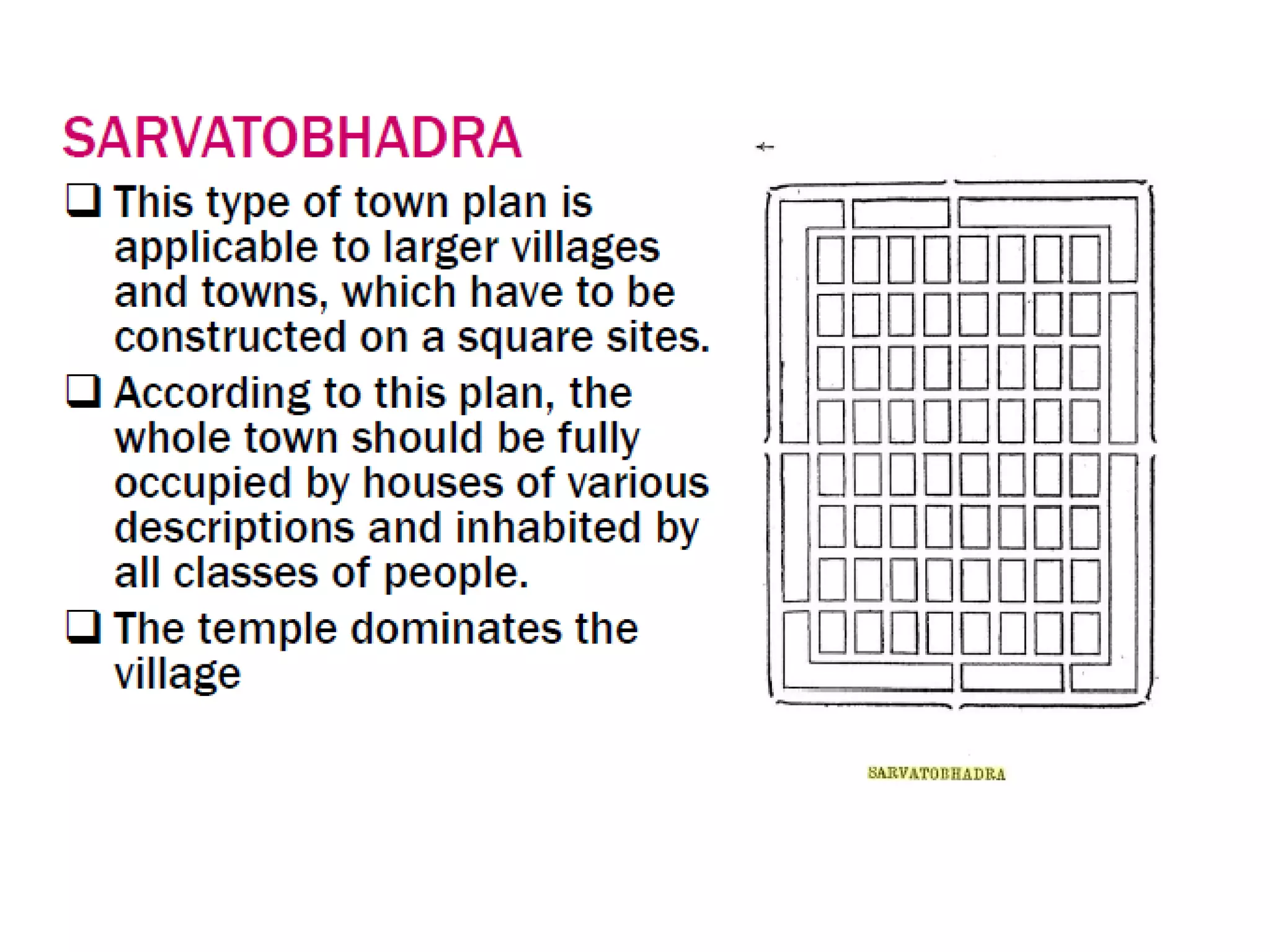
2. Sarvatobhadra : It is a rectangular shaped town
3. Simha : Circular town
4. Varuna : Optical or oblong shaped town
5. Nand : It is a town with empty comer
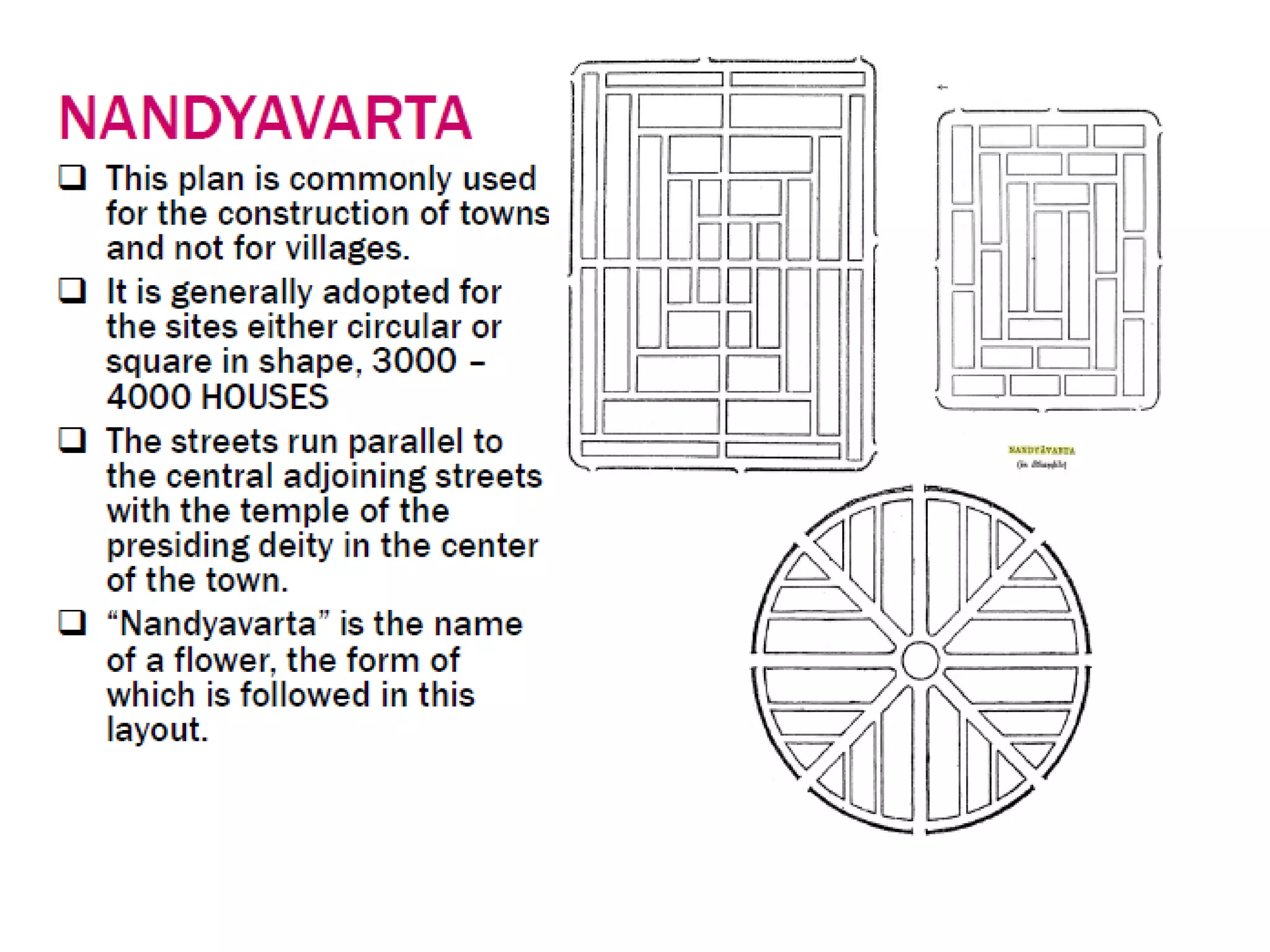
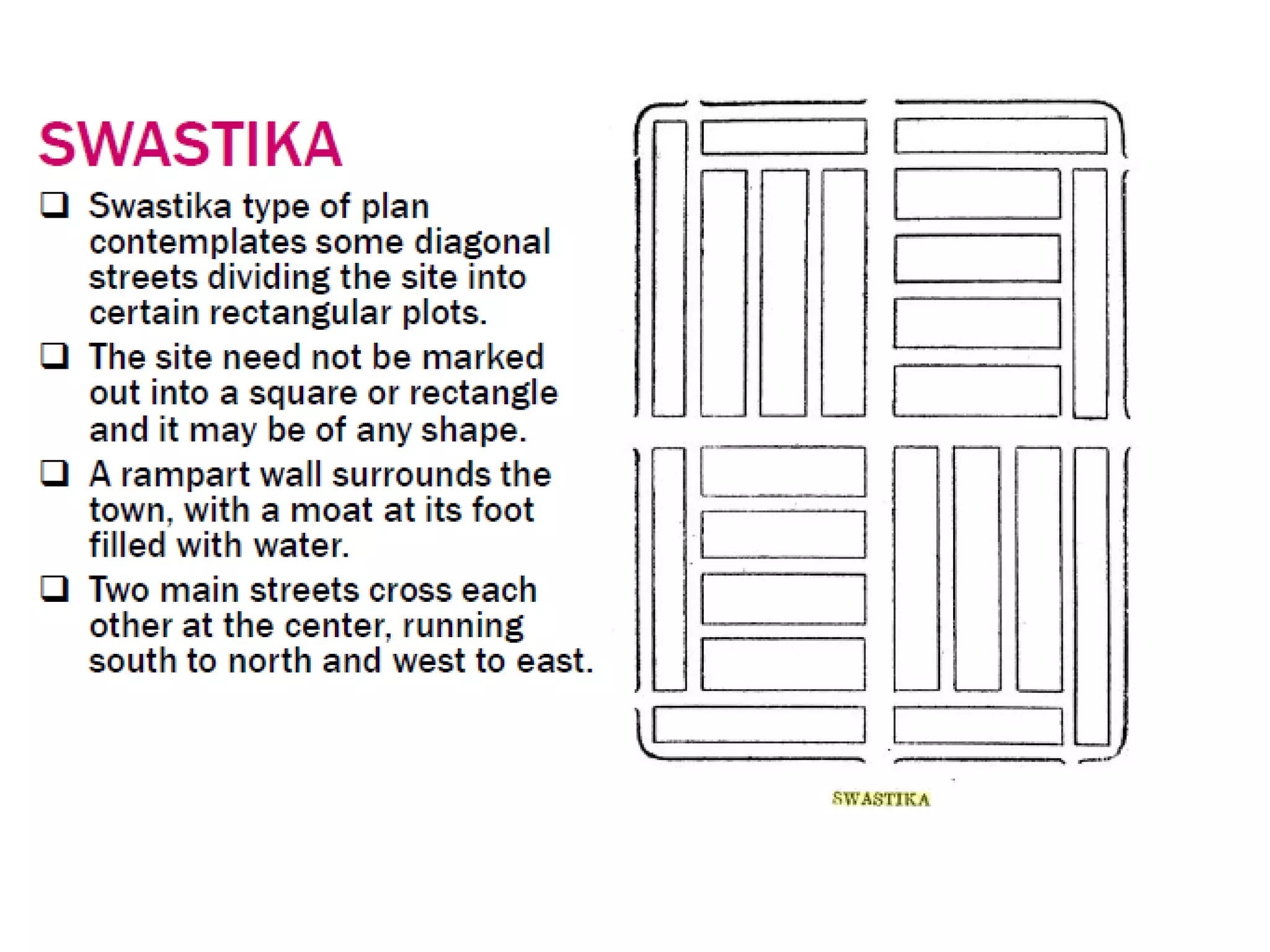
6. Nandyavartak: It is of swastika form.
7. Jayant: Wheat or oat form
8. Divya : It is a town situated at top of mountain
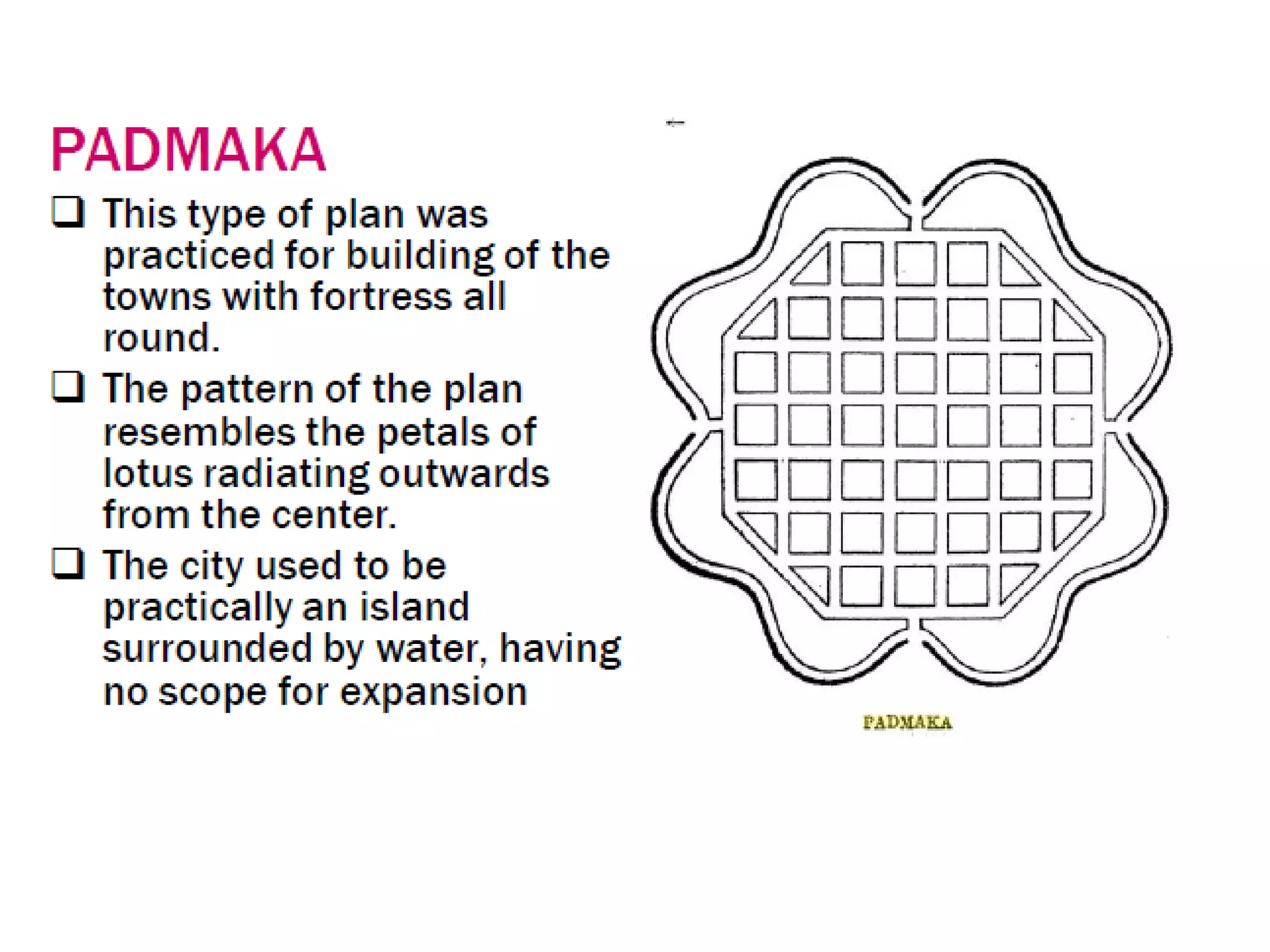
9. Puspapur : Eight petals like lotus form town.
10. Paurusha: A town with male form
11. Snaha : The town situated in the valley of mountain
12. Dandanagar : It is a ribbon form town
13. Sakrapur : The town is situated on the east of river side
14. Kamalpur: The town is situated on the west of river side
15. Dharmikpur : The town is situated on the south side of river
16. Mahajaya : The town is placed between two river
17. Saumya : The town is situated on north side of river.
18. Srinagar : The town a is surrounded by one fort.
19. Ripughna : The town is surrounded by two forts.
20. Svastika : The town is with eight corners.
According to Manasara15 towns are divided in to eight class as
1. Rajadhani-nagara
2. Kevala-nagara
3. Pura
4. Nagari
5. Kheta
6. Kharvata
7. Kubjaka
8. Pattana
It may be noted that the town called pattana is a big commercial port.
It is situated on the banks of the sea or river and is always engaged in
exchange and commerce with foreigners.
As regards the classifications given in the Mayamata16 and Silparatna, there is not
much difference with Manasara.
FORTS
Visvakarma - Vastusastra17 describes the following twelve type of forts. Forts are
of 12kinds according to the site chosen
1. Giridurga 7. Dvimukhadurga
2. Vanadurga 8. Chaturmukhadurga
3. Jaladurga 9. Kurmadurga
4. - Irinadurga 10. Paravata
5. Daivadurga 11. Prabhu
6. Ekamukhadurga 12. Vuddha
1. Giridurga: The first is hill fort.
2. Vanadurga: The second is protected by forests underground passage are
provided for this class of for.
3. Jaladurga: The third type is either in the midst of the sea or large rivers. 4.
4. Irinadurga: The fourth is the fort in the desert country.
5. Daiva durga: Fifth is a natural fort i.e., a place in which formation like
ramparts have been formed by nature. It is called Daivata fort.
6. Ekamukha durga:
7. Dvimukha durga:
8. Chaturmukhadurga: These three types are built on the bank of rivers or at the sea-
coast. They are provided either with a single gate, two gates or four gates as safety will
allow.
9. Kurmadurga: The ninth is called the tortoise fort. It is generally intended as a trap
for the enemy. The site is either the middle of a forest or the foot of a hill. It is provided
with concealed approaches and spring traps work by concealed machinery. Five or six
ramparts protect the place and it is studded with concealed marshes and mire. This
type of forts is generally constructed at short notice to entrap the enemy and is
demolished soon after.
10. Parvata durga: The tenth is a well-defended place of safety for temporary rest in
the midst or fierce battle.
11 .Prabhudurga: The eleventh is well-provided fort with strong defence in
unapproachable ground either in the midst of a forest, a hill or other place with natural
defence. It has but a single gate and is protected by series of a dozen prakaras (walled-
enclosures).
12.Yuddha durga: The twelfth type is called war fort. It is especially intended as a place
of safety from which to attack the enemy and it has all structures for offense and
defense with various weapons. Hidden pathways, and underground passages with stair
cases abound.
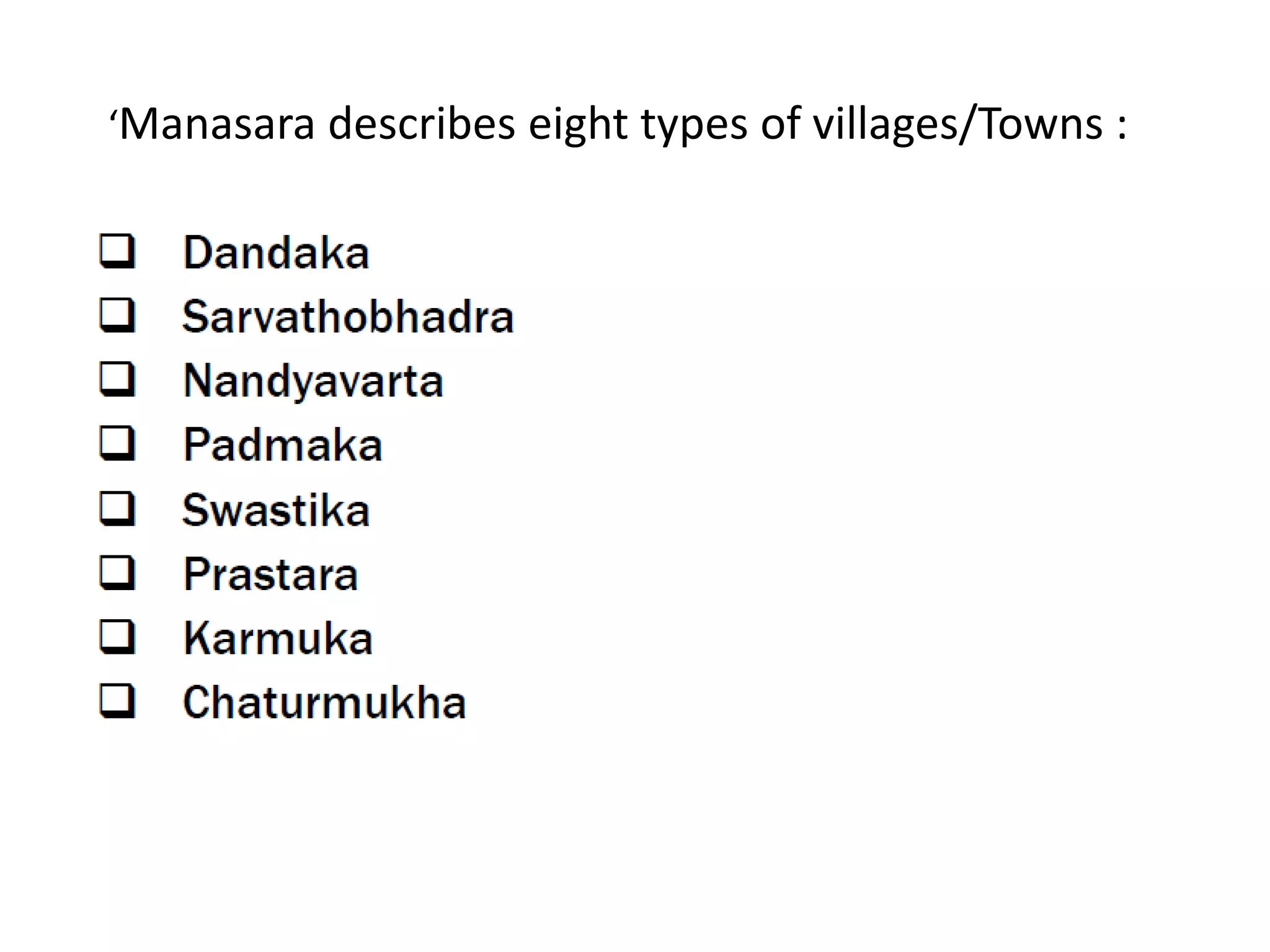
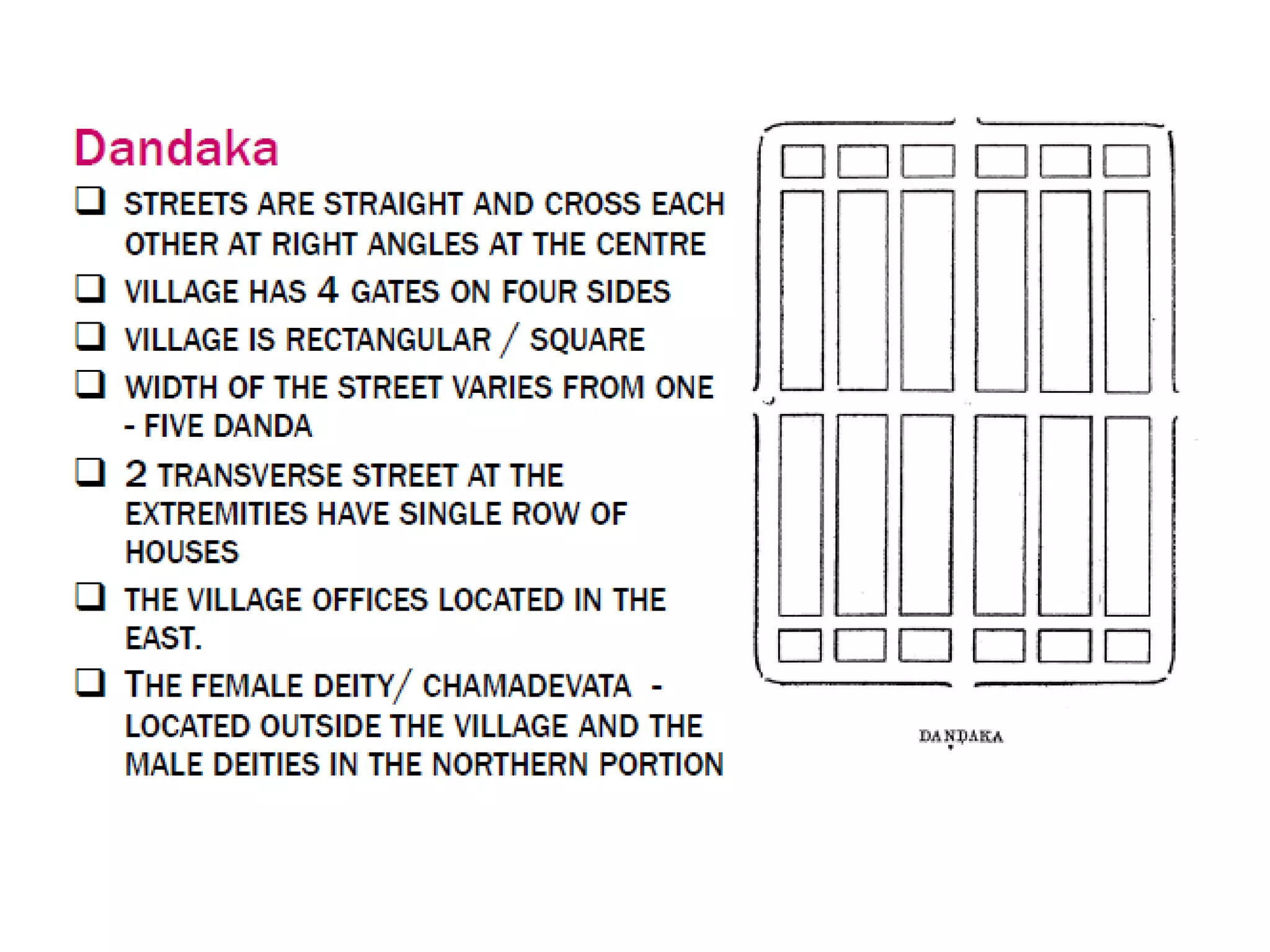
‘Manasara describes eight types of villages/Towns :
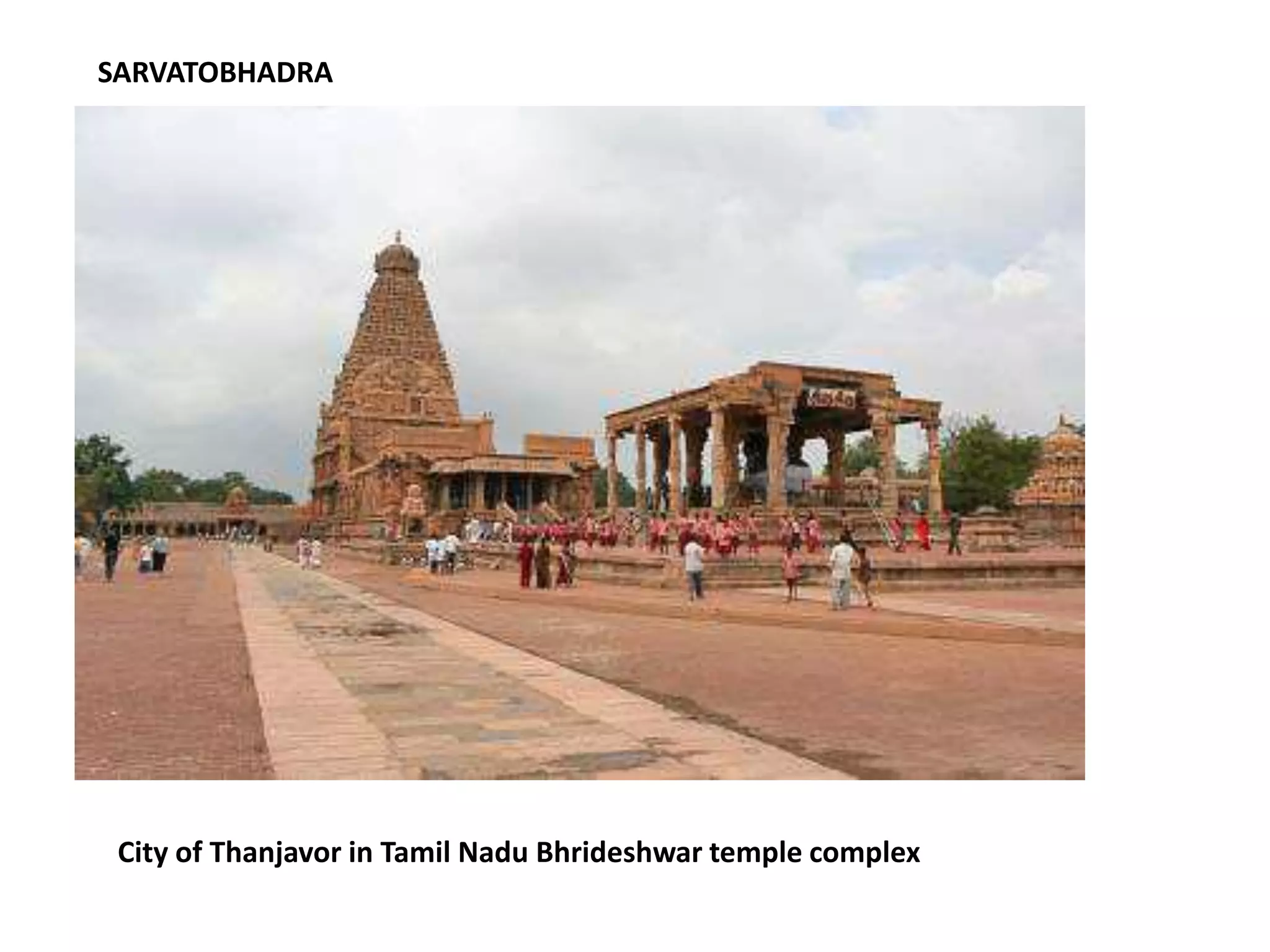
SARVATOBHADRA
City of Thanjavor in Tamil Nadu Bhrideshwar temple complex
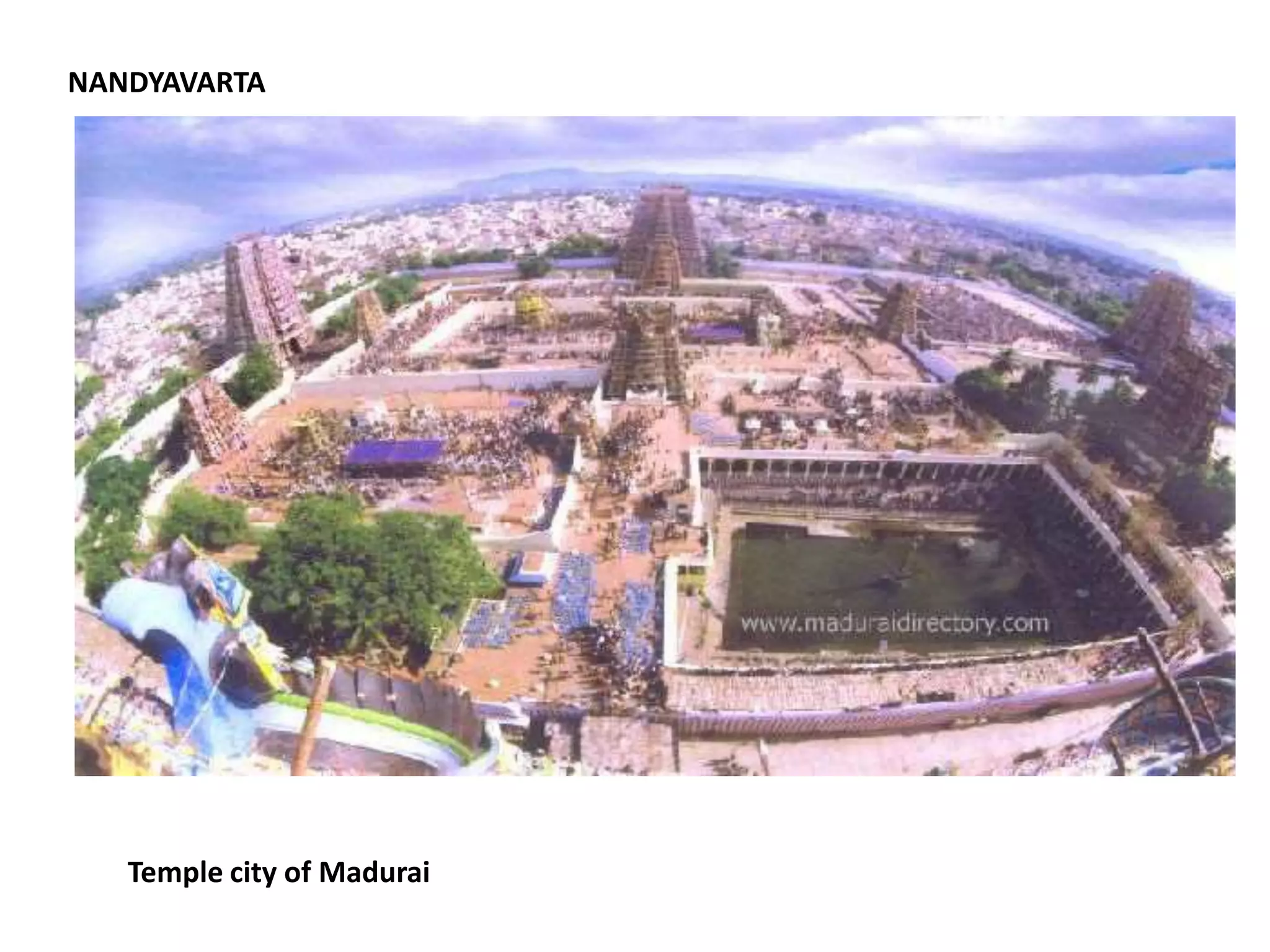
NANDYAVARTA
Temple city of Madurai
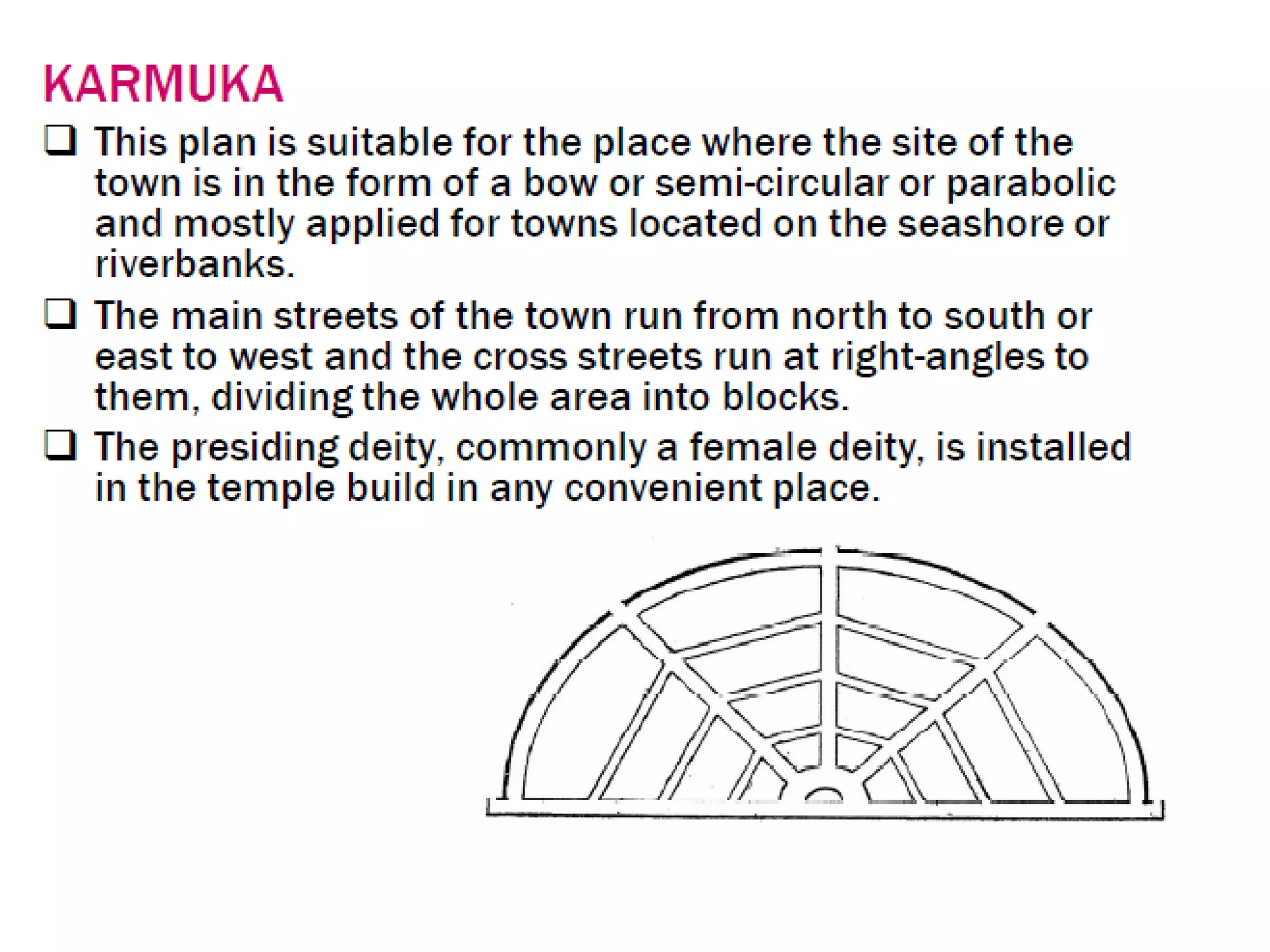
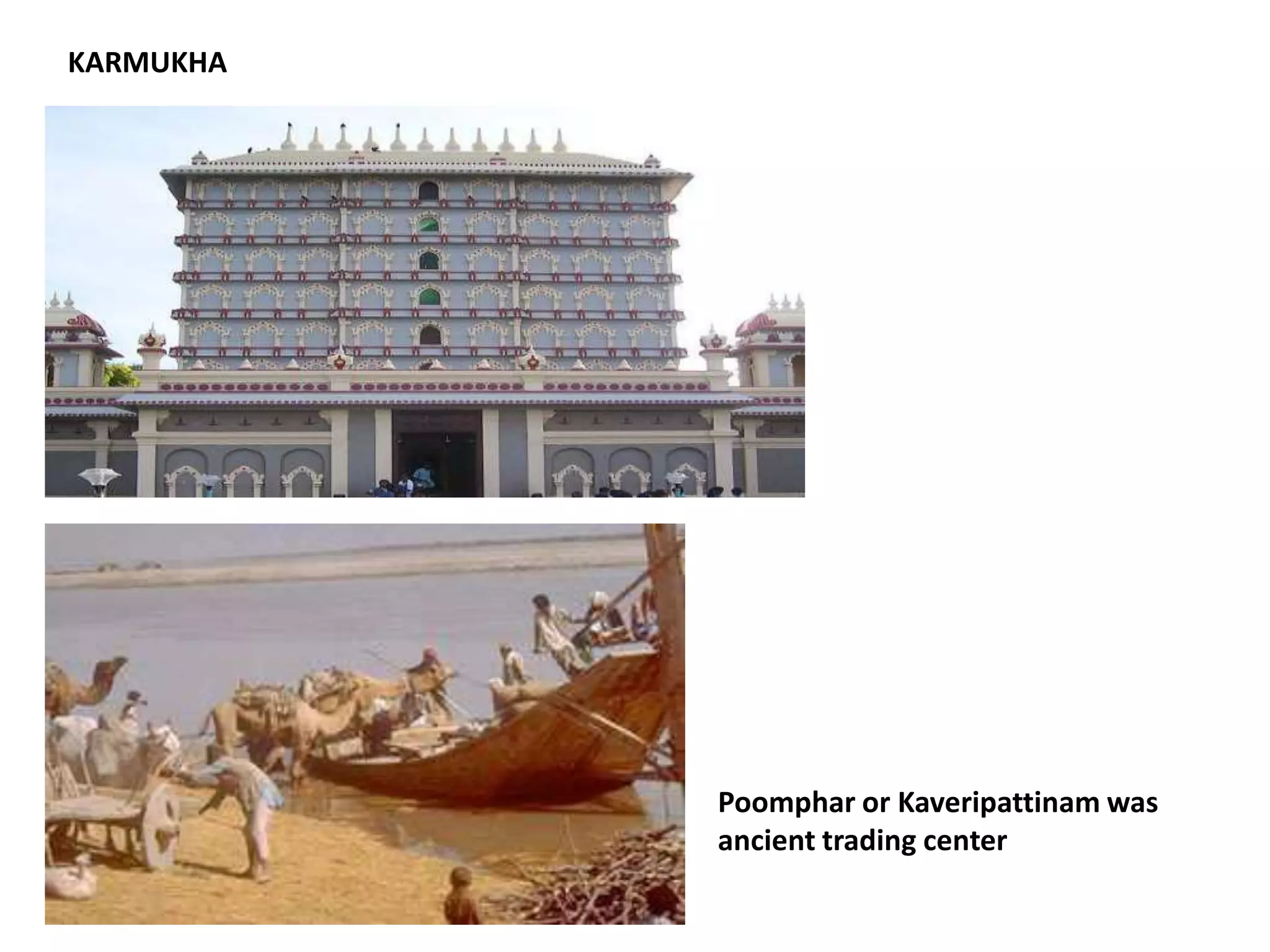
KARMUKHA
Poomphar or Kaveripattinam was
ancient trading center
Lecture HOA Indo Aryan.pdf

Lecture HOA Indo Aryan.pdf

  • 1.
    INDO ARYAN –FOUNDATION OF VEDIC AGE ARCHITECTURAL CHARATERISTICS AND TOWN PLANNING Deepak Kumar Asst. Professor, Department of Architecture, SPAV
  • 2.
  • 3.
    The outstanding qualityof the architecture in India is its spiritual content. The fundamental purpose of the building art was to represent the prevailing religious consciousness of the people. It is mind materializing in terms of rock, brick or stone. The main characteristic is emphasized by treatment of wall surfaces. Carved in high and low relief are depicted all age old mythology of the country in form of God and goddesses. Depicting ‘Ocean of Story’
  • 4.
    Middle of firstmillennium BC (Era of Timber Construction) 1. Traditional structure of village was reproduced on larger scale in a more substantial forms. 2. Owing to the rivalry that sprung between various states and groups, the towns which were of capital of states were strongly fortified. 3. They were surrounded by a rampart and wooden palisades while this enclosure the buildings were also almost entirely made of wood. The Vedic civilization enters into era of ‘Timber Construction’ In Rig veda carpenter is recorded as holding the place of honor amongst all the artisans. According to Dhammapala, the great Buddhist commentator they were planned by an Architect named ‘Maha-Govinda’ who is stated to have been responsible for layout of several of the capital so fnorth indian in 5th centurey BC.
  • 5.
    In case ofbuilding art the foundation of the old city of ‘Rajgriha in Bihar which probably flourished about 800 B.C indicate that circular buildings were then common, and even at the present day village store houses in parts of India are often round structures of Bamboo. In Vedic village huts were the beehive pattern made of a circular wall of bamboos held together with bands of withes and covered with a domical roof of leaves or thatched with grass. A remarkable illustration of may be seen in the interior of the Rock cut Sudama cell in Barabar hillgroup, where every details of timber construction is copied in the living rock.
  • 6.
    In the laterstage in the evolution of the vedic hut the circular plan was elongated in to an oval with a barrel roof formed on a frame of bent bamboos also covered with thatch. Soon they were arranged in groups around a square courtyard. In the better class houses unbaked bricks were used for the walls,and the doorway were square headed openings with double doors.
  • 7.
    One device tomaintain the barrel shape of the roof was to stretch a thong or with across the end of the porch like the cord of a bow, in a word the embryo tie-chord. This contrivance constricted the chord of the arch and produced a shape resembling a horse shoe, a type of archway commonly referred to as the chaitya of sun-window which became characteristic later in Buddhist architecture.
  • 8.
    The Indian town-planningseems to have been systematically pursued. Aryan traditions trace its origin to Brahma, the creator-aspect of God. In town planning, we have to deal with what is technically designated above as vdhara’ (ground) and incidentally with 'harmya’ (building).
  • 9.
  • 10.
    Ancient town planer Examinestown Fortification Distribution based on religious, political , commercial and residential areas as per geographicalconditions The sites of towns were carefully chosen according to principles, ritualistic and sanitary, preserved in the traditions of the Ancient Indian master- builders as well as laid down in their treatises Town planning process
  • 11.
    WAYS TO ASCERTAINTHE SOLIDITY OF THE GROUND “Dig out a pit one cubit deep in the ground and again return the earth into it. If the earth more than fills up the pit, then the ground is good; if it is just sufficient then it is middling or indifferent while if it falls short, the ground is bad. The good and indifferent varieties are acceptable, but the bad should on no account be accepted.” Mayamuni’s examination of the rule is slightly different. He would fill up the pit with water in the evening and examine it early next morning. If there is remnant of water in the pit, then the ground should be welcome for all purposes. If the pit is found moist and muddy, then the ground will spell ruin for human habitation, and the aridity of the pit signifies lose of grains and wealth.
  • 12.
    Sutradhara Mandana, inhis Vastu Rajavallabha4, differentiates and enumerates the qualities as follows :- “The plot fit for the Brahmanas is white, emanating fragrance like ghee and agreeable to the taste; that suited to the warrior class is red smelling like blood, astringent in taste; the ground suited to the Vaishyas is yellow emitting smell like seasum oil and sour to the taste; while the ground which is black, gives out a fish- like odour, and is pungent becomes the Sudras.” Wards in a town which were exclusively inhabited by people of the same caste
  • 13.
    VILLAGES A group ofvillages gives rise to a big town. Village is a town in miniature and hence in India from the standpoint of planning there is no difference between a village and a town. Visvakarama-Vastusastra describes 12 type of villages. 1. Mandaka 2. Prastara 3. Bahulika 4. Paraka 5. Caturmukha 6. Purva mukha 7. Mangala 8. Viswakarmaka – Large village may be called town 9. Devarat – Temple Village 10. Visvesa- Commercial Village 11. Kailasa- directed to be laid out on the sea coast or on the slopes of a hill and it is also protected by ramparts 12. Nitya-Mangala- big village with 6000 people. Fortified and surrounded by ramparts and may be deemed as special habitations
  • 14.
    TOWNS Its population isdenser than in rural area and is settled in restricted area and is predominantly in non agricultural in occupation. Town is dependent on rural areas for the supply of food and raw materials. The following are ten abstract criteria to distinguish the earliest city from any older or contemporary village 1. In point of size the first towns must have been more extensive and more densely populated than any other previous settlements, although considerably smaller than many villages of today. 2. While there might be peasants cultivating lands outside the town. All towns must have accommodated in addition non-food producing ' classes-full-time specialist craftsmen, transport-workers, merchants, officials and priests-supported by the surplus produced by peasants.
  • 15.
    3. Each primaryproducer paid over his tiny surplus to a deity or divine king who thus concentrated the surplus. 4. Truly monumental buildings not only distinguish each known town from the village but also symbolize the concentration of social surplus. 5. All those not engaged in food-production were supported in the first instance by the surplus concentrated in temples or royal granaries and were dependent on the temple or court. But naturally, priests, civil and military leaders and officials absorbed a major share of the concentrated surplus and thus formed the ‘ruling class’ which did confer substantial benefits upon their subjects in the way of planning and organization. 6. The ruling class was compelled to invert systems of recording and exact, but practically useful, sciences. 7. The invention of writing enabled the leisured clerks to proceed to the elaboration of exact and predictive sciences-arithmetic, geometry and Astronomy. TOWNS
  • 16.
    8. Other specialistsgave a new direction to artistic expressions. Artist craftsmen-full- time sculptors, printers or seal engravers-began to carve, model or draw according to conceptualized and sophisticated styles. 9. A further part of the concentrated surplus was used to pay for the importation of raw materials needed for industry or cult and not available locally. Regular “Foreign trade” over quite long distances was a feature of all early civilizations. 10. So in the town specialist - craftsmen were provided with raw materials needed for the employment of their skill and also guaranteed security in a state organization based on residence rather than kinship. The town was a community to which a craftsmen could belong politically as well as economically. TOWNS
  • 17.
    Mandan’s ‘Rajvallabha’11 describes20 types of town : 1. Mahendra : It is square town. 2. Sarvatobhadra : It is a rectangular shaped town 3. Simha : Circular town 4. Varuna : Optical or oblong shaped town 5. Nand : It is a town with empty comer 6. Nandyavartak: It is of swastika form. 7. Jayant: Wheat or oat form 8. Divya : It is a town situated at top of mountain 9. Puspapur : Eight petals like lotus form town. 10. Paurusha: A town with male form 11. Snaha : The town situated in the valley of mountain 12. Dandanagar : It is a ribbon form town 13. Sakrapur : The town is situated on the east of river side 14. Kamalpur: The town is situated on the west of river side 15. Dharmikpur : The town is situated on the south side of river 16. Mahajaya : The town is placed between two river 17. Saumya : The town is situated on north side of river. 18. Srinagar : The town a is surrounded by one fort. 19. Ripughna : The town is surrounded by two forts. 20. Svastika : The town is with eight corners.
  • 18.
    According to Manasara15towns are divided in to eight class as 1. Rajadhani-nagara 2. Kevala-nagara 3. Pura 4. Nagari 5. Kheta 6. Kharvata 7. Kubjaka 8. Pattana It may be noted that the town called pattana is a big commercial port. It is situated on the banks of the sea or river and is always engaged in exchange and commerce with foreigners. As regards the classifications given in the Mayamata16 and Silparatna, there is not much difference with Manasara.
  • 19.
    FORTS Visvakarma - Vastusastra17describes the following twelve type of forts. Forts are of 12kinds according to the site chosen 1. Giridurga 7. Dvimukhadurga 2. Vanadurga 8. Chaturmukhadurga 3. Jaladurga 9. Kurmadurga 4. - Irinadurga 10. Paravata 5. Daivadurga 11. Prabhu 6. Ekamukhadurga 12. Vuddha 1. Giridurga: The first is hill fort. 2. Vanadurga: The second is protected by forests underground passage are provided for this class of for. 3. Jaladurga: The third type is either in the midst of the sea or large rivers. 4. 4. Irinadurga: The fourth is the fort in the desert country. 5. Daiva durga: Fifth is a natural fort i.e., a place in which formation like ramparts have been formed by nature. It is called Daivata fort.
  • 20.
    6. Ekamukha durga: 7.Dvimukha durga: 8. Chaturmukhadurga: These three types are built on the bank of rivers or at the sea- coast. They are provided either with a single gate, two gates or four gates as safety will allow. 9. Kurmadurga: The ninth is called the tortoise fort. It is generally intended as a trap for the enemy. The site is either the middle of a forest or the foot of a hill. It is provided with concealed approaches and spring traps work by concealed machinery. Five or six ramparts protect the place and it is studded with concealed marshes and mire. This type of forts is generally constructed at short notice to entrap the enemy and is demolished soon after. 10. Parvata durga: The tenth is a well-defended place of safety for temporary rest in the midst or fierce battle. 11 .Prabhudurga: The eleventh is well-provided fort with strong defence in unapproachable ground either in the midst of a forest, a hill or other place with natural defence. It has but a single gate and is protected by series of a dozen prakaras (walled- enclosures). 12.Yuddha durga: The twelfth type is called war fort. It is especially intended as a place of safety from which to attack the enemy and it has all structures for offense and defense with various weapons. Hidden pathways, and underground passages with stair cases abound.
  • 23.
    ‘Manasara describes eighttypes of villages/Towns :
  • 26.
    SARVATOBHADRA City of Thanjavorin Tamil Nadu Bhrideshwar temple complex
  • 28.
  • 33.
    KARMUKHA Poomphar or Kaveripattinamwas ancient trading center