TAHSEEN MAZHAR HUSSAIN . K
HOD : Dept of Social Science
VELAMMAL BODHI CAMPUS
POSTED – 23/5/19
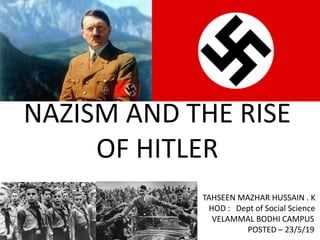
NAZISM AND THE RISE
OF HITLER
CONTENTS
•Birth Of The Weimer Republic
- Treaty of Versailles
•The Effects of the War
•Political Radicalism and Economic Crisis
•The Years of Depression
-Defects of Weimar Republic
•Hitler’s Rise To Power
•The Destruction of Democracy
-Police force
CONTENTS
•Reconstruction
•The Nazi World View
•The Racial Utopia
•Youth In Nazi Germany
•The Nazi Cult of Motherhood
•The Art of Propaganda
•Crimes against Humanity
•Knowledge about the Holocaust
Introduction
This lesson explains the Rise of
Hitler and his art propaganda.
The areas on which he
concentrated to make Germany
a world power
BIRTH OF
THE WEIMER REPUBLIC
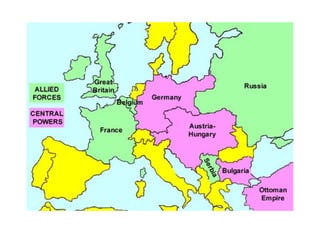
• Germany fought the First World War
(1914–1918) along with the Austrian
empire and against the Allies
(England, France, and Russia).
• Germany initially made gains by
occupying France and Belgium.
• Allies won defeating Germany and
the Central Powers in 1918.
• The defeat of Imperial Germany gave an
opportunity to parliamentary parties to
recast German polity.
• A National Assembly met at Weimer and
established a democratic constitution
with a federal structure.
• The Republic, however, was not received
well by its own people because of the
terms its forced terms.
Treaty of Versailles
• Germany lost its overseas colonies, a
tenth of its population, 13% of its
territories,
• 75% of its iron and 26% of its coal to
France, Poland, Denmark and
Lithuania.
• To weaken its power, the Allied
Powers demilitarized Germany.
• The War Guilt Clause forced
Germany to pay compensation
amounting to £6 billion(Pound).
• The resource rich Rhineland
was occupied by the Allied
armies for much of the 1920s.
The Effects of the War
• The war had a devastating impact on
the entire continent both
psychologically and financially.
• From being a creditor, Europe
became a debtor.
• The supporters of the Weimer
Republic were criticized.
• Soldiers came to be placed above
civilians.
• Aggressive war propaganda and
national honor became
important.
• The fragile democracy could not
survive and led to instability in
Europe.
Political Radicalism and Economic Crisis:
• The birth of the Weimer
Republic and the Spartacist
League went hand in hand.
• The Spartacists founded the
Communist Party of Germany.
• The political instability in
Germany paved the way for
Hitler.
•Political radicalization was
heightened by the
economic crisis of 1923.
• Germany had to pay war reparations in
gold which led to depletion of gold
reserve.
• Hence , Germany refused to pay the war
reparations, France occupied its leading
industrial area, Ruhr.
• Germany retaliated with printing paper
currency recklessly.
•The value of the mark
collapsed.
•Prices of goods soared.
There was
hyperinflation.
The Years of Depression
• 1924–1928 saw some
stability, yet it was built on
sand.
• Germany was totally
dependent on short-term
loans, largely from the USA.
• This support was withdrawn with the
crash in 1929 of the Wall Street
Exchange.
• The German economy was hit badly.
It led to social unrest.
• The middle class and working
population were filled with the fear
of proletarianization.
The Weimer Republic - defects :
• Proportional Representation.
• Article 48 — gave the
President the powers to
impose emergency, suspend
civil rights and rule by decree.
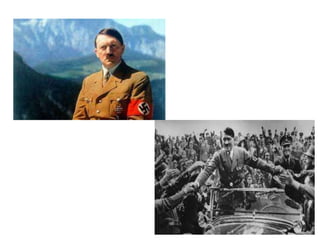
HITLER’S RISE TO POWER
• Hitler was born in Austria in
1889.
• He earned many medals for
bravery in the First World War.
• The German defeat horrified
him.
• The Treaty of Versailles made him
furious.
• He joined the German Workers Party
and renamed it National Socialist
German Workers’ Party.
• This later came to be known as the
Nazi Party.
• Nazism became a mass movement
only during the Great Depression.
• The Nazi propaganda stirred hopes of a
better future.
• Hitler was a powerful and effective
speaker.
• He promised the people a strong nation
where all would get employment.
• His politics included the significant
rituals and spectacle in mass
mobilization.
• Hitler understood the significance of
rituals and spectacle in mass
mobilization.
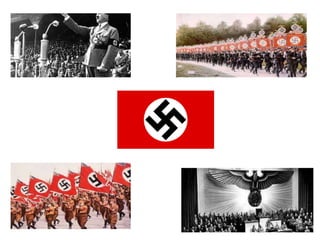
• He used the Swastika symbol, red
banners, pamphlets and ritualized rounds
of applause to great effect during his
massive rallies.
• Nazi propaganda skillfully projected
Hitler as a messiah, a savior.
The Destruction of Democracy
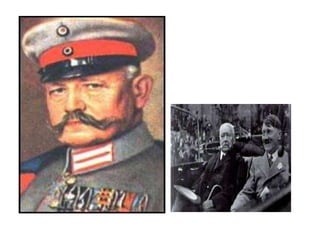
•On 30 January 1933, Hitler
was offered the
Chancellorship by
President Hindenburg.
• Hitler achieved the highest position
in the cabinet of ministries on 30
January 1933.
• Hitler now set out to dismantle the
structures of democratic rule.
• The Fire Decree of 28 February 1933
suspended civic rights like freedom
of speech, press, and assembly.
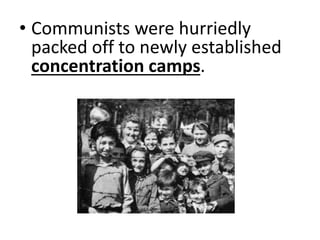
• Communists were hurriedly
packed off to newly established
concentration camps.
• All political parties were banned.
Special surveillance and security
forces were created to control the
people and rule with impunity.
• The famous Enabling Act was passed
on 3 March 1933.
• This Act gave all powers to Hitler and
established dictatorship in Germany.
Police Forces
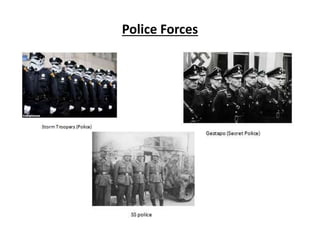
• The regular police in green uniform
and the SA or the Storm Troopers were the
existing police forces.
• Additional police forces were also raised;
the Gestapo (secret state police), the SS (the
protection squad), criminal police and the
Security Service (SD).
Reconstruction
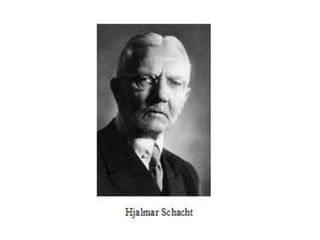
• Economist Hjalmar Schacht was given the
responsibility of economic recovery.
• He initiated a state-funded work-creation
programme to ensure full production and full
employment.
•The famous Autobahn
and Volkswagen were
the results of this
period.
• He aimed at full production
and full employment through a
state-funded work creation
programme.
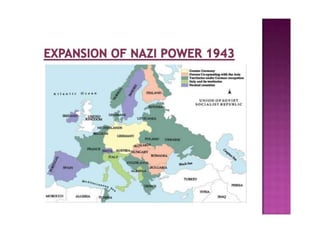
• Hitler pulled out of the League
of Nations in 1933.
• Reoccupied the Rhineland in
1936.
• Integrated Austria and Germany
in 1938 under the slogan : One
people, One empire, One leader.
• He then took Sudetenland from
Czechoslovakia.
• Hitler had the unspoken support
of England.
• He chose war as a way out of the
Economic Crisis.
• Resources were to be
accumulated through expansion
of territory.
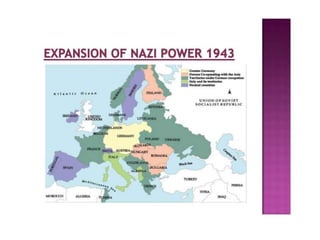
• In September 1940 Germany
invaded Poland.
• This started a war with France
and England.
• USA resisted involvement in the
war.
• But when Japan extended its
support to Hitler and bombarded
Pearl Harbour, the USA entered
the war.
• The war ended in 1945 with
Hitler’s defeat and the US
bombing of Hiroshima and
Nagasaki in Japan.
THE NAZI WORLD VIEW
• According to Nazi ideology, there was no
equality between people, but only racial
hierarchy.
• The Nazis began creating an exclusive
racial community of pure Germans by
physically eliminating those who were
considered undesirable.
• They wanted a society of pure and
healthy Nordic Aryans.
• Jews, Gypsies, blacks, Russian, Poles,
even certain Germans and abnormal
were considered undesirable.
• The other aspect of Hitler’s ideology
related to the geopolitical concept of
Lebensraum, or living space.
• Jews were the worst sufferers in
Nazi Germany.
• Hitler believed in pseudo-
scientific theories of the race
which said that conversion was
no solution to the Jewish
problem. It had to be solved
through their total elimination.
• From 1933–1938 — the Nazis
terrorized, pauperized and
segregated the Jews, compelling
them to leave the country.
• The next phase, 1939–1945,
aimed at concentrating them in
certain areas and then killing
them in gas chambers in Poland.
The Racial Utopia
•Genocide and war
became two sides of the
same coin.
•Occupied Poland was
divided.
•Poles were forced to leave
their homes and properties
behind to be occupied by
ethnic Germans brought in
from occupied Europe.
YOUTH IN NAZI GERMANY
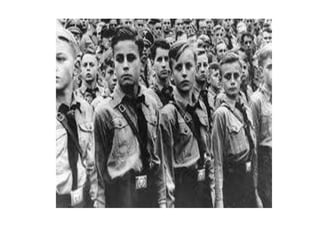
• Hitler felt that a strong Nazi
society could be established by
teaching Nazi ideology to
children.
• All schools were given German
teachers.
• Children were divided into two
groups — desirable and
undesirable.
• Textbooks were rewritten,
functions of sports in schools
was to nurture the spirit of
violence and aggression.
• Ten-year-olds had to enter
Jungvolk.
•At 14, all boys joined ‘Hitler
Youth’, they joined the
Labour Service at 18.
The Nazi Cult of Motherhood
• The boys were taught to be
aggressive, masculine and steel
hearted.
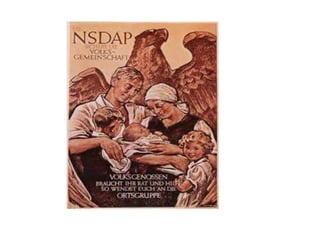
• Women were told to be good
mothers and rear pure-blooded
Aryan children.
• They were encouraged to produce
many children.
• They were given special
treatment in hospitals and also
got concessions in shops,
theatres and railways.
• Honor Crosses were awarded to
encourage women to produce
more children.
•A bronze cross was given
for four children, silver
cross for six and golden
cross for eight or more.
•They had to be the bearers
of the Aryan culture and
race.
The Art of Propaganda
• The Nazi regime used
language and media with care
and often to great effect.
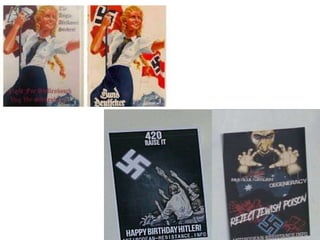
• They used films, pictures,
radio, posters, etc. to spread
hatred for Jews.
•Nazism worked on the
minds of the people,
tapped their emotions, and
turned their hatred and
anger at those marked as
‘undesirable’.
Crimes against Humanity
• People saw the world through
Nazi eyes and spoke the Nazi
language.
• At times even the Jews began to
believe in the Nazi stereotypes
about them.
Knowledge about the Holocaust
• It was only after the war ended
that people came to know about
what had happened.
• The Jews wanted the world to
know about the atrocities and
sufferings they had endured
during the Nazi killing operations.
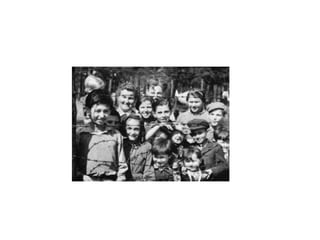
• They just wanted to live, even
if it was for a few hours, to tell
the world about the
Holocaust.
Presented by
Nazima Rahman K
AHM – VELAMMAL BODHI CAMPUS
Mcom.,Mphil.,B.Ed.,GNIIT.,PGDCA.,
MA(Eng).,MA(His).,BA(Hin)