Safety Management
Prepared By: Jayanta Sen
Importance of safety.
Causes of accidents.
Risk & Hazards.
Basic idea about safety control & PPE.
Benefits of safety.
Approaches to improve safety in construction.
Objectives of the chapter:
Importance of Construction Safety in India
Construction industry is the second largest economy
activity in India after agriculture and it has accounted 40%
of the development investment during last 40 years.
The Indian construction industry employs over 35 million
people (Around 16 per cent of the nation's working
population).
In Indian construction sector, The average yearly rate of
accident is somewhat 4 to 5 times higher then other
sector with count of people dying could be anywhere
from 11,614 to 22,080.
The fatality rate in construction sector (fatal
accidents/1000 workers) of UK, Singapore, and Taiwan are
reported to be 0.02 in 2013, 0.05 in 2012, and 0.125 in
2011 respectively while in India fatality rate is 0.22 as per
2016 estimate. (Patel and Jha, 2016)
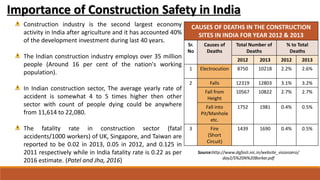
CAUSES OF DEATHS IN THE CONSTRUCTION
SITES IN INDIA FOR YEAR 2012 & 2013
Sr.
No
Causes of
Deaths
Total Number of
Deaths
% to Total
Deaths
2012 2013 2012 2013
1 Electrocution 8750 10218 2.2% 2.6%
2 Falls 12319 12803 3.1% 3.2%
Fall from
Height
10567 10822 2.7% 2.7%
Fall into
Pit/Manhole
etc.
1752 1981 0.4% 0.5%
3 Fire
(Short
Circuit)
1439 1690 0.4% 0.5%
Source:http://www.dgfasli.nic.in/website_visionzero/
day2/S%20N%20Borkar.pdf
Causes of Accidents
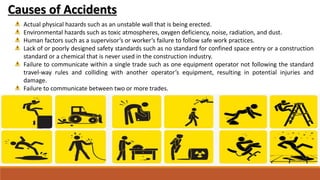
Actual physical hazards such as an unstable wall that is being erected.
Environmental hazards such as toxic atmospheres, oxygen deficiency, noise, radiation, and dust.
Human factors such as a supervisor’s or worker’s failure to follow safe work practices.
Lack of or poorly designed safety standards such as no standard for confined space entry or a construction
standard or a chemical that is never used in the construction industry.
Failure to communicate within a single trade such as one equipment operator not following the standard
travel-way rules and colliding with another operator’s equipment, resulting in potential injuries and
damage.
Failure to communicate between two or more trades.
Risk & Hazards
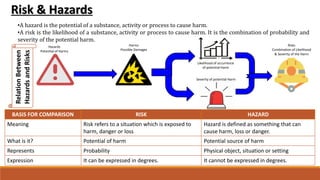
•A hazard is the potential of a substance, activity or process to cause harm.
•A risk is the likelihood of a substance, activity or process to cause harm. It is the combination of probability and
severity of the potential harm.
BASIS FOR COMPARISON RISK HAZARD
Meaning Risk refers to a situation which is exposed to
harm, danger or loss
Hazard is defined as something that can
cause harm, loss or danger.
What is it? Potential of harm Potential source of harm
Represents Probability Physical object, situation or setting
Expression It can be expressed in degrees. It cannot be expressed in degrees.
Hazards
Potential of Harms
Harms
Possible Damages
Risks
Combination of Likelihood
& Severity of the Harm
Likelihood of occurrence
of potential Harm
Severity of potential Harm
RelationBetween
HazardsandRisks
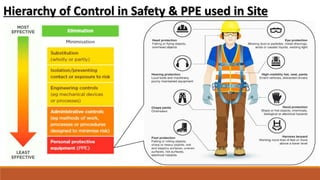
Hierarchy of Control in Safety & PPE used in Site
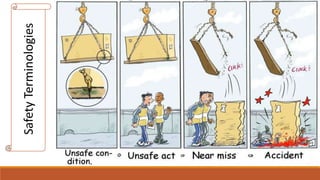
SafetyTerminologies
Benefits of safety
Reduction of indirect costs of accidents & industrial insurance premiums/costs.
Fewer compliance inspections and penalties.
Avoidance of adverse publicity from deaths or major accidents.
Less litigation and fewer legal settlements.
Lower employee payroll deductions for industrial insurance.
Less pain and suffering by injured workers.
Fewer long-term or permanent disability cases.
Increased acceptance of bids — more jobs for companies.
Improved morale and loyalty from individual workers.
Increased productivity from work crews.
Increased pride in company personnel.
Greater potential of success for incentive programs.
Communications shall be established for emergency purposes.
–Telephone, Two-way radio.
Emergency numbers shall be posted.
–Doctor, Ambulance, Fire, State agencies, Hospital etc.
An emergency plan shall be developed, posted, and practiced. All workers should be trained in emergency
procedures.
Personal safety protection shall be worn in and around the operations.
Someone shall always be delegated to be in charge in the event the usual supervisor is absent for any reason.
No person shall be assigned to work in any area alone, unless they can be seen or their cries for help can be
heard.
Maintenance shall not be performed on machinery until the machinery is stopped and a positive lock-out
procedure is followed. A written procedure should be established that is understood by all employees.
Approaches to Improve Safety in construction
Continue…
When a guard is removed from machinery for repair and/or maintenance purposes, the guard shall be
replaced before the machinery is started and/or energized. Tags stating removal of guard may be used.
Vehicles shall be checked for safety prior to starting a shift. If a malfunction occurs during the shift, the
operator shall have the vehicle repaired immediately. An equipment checklist good for this purpose for each
piece of equipment shall be provided.
No person shall work near or under improperly supported (soil) or stored materials (pipe).
Areas requiring special protective devices shall be posted, and rules for using equipment shall be strictly
enforced.
Roadway signs regarding speed and specific driving problems shall be posted to inform drivers of road
conditions.
Electrical problems shall not be worked on and adjustments shall not be made by anyone other than a person
qualified to do the work.
The storage of explosives in or around an operation must meet the requirements of the Indian Explosive Act
1884. No person shall be assigned to or allowed to handle explosives for initiating blasts unless they are
competent to do so.
Keys to Motivating Safety Practices at Site
 EXPLAIN safety performance expectations.
 INVOLVE people in decision making and problem-solving.
 Describe the CONSEQUENCES of unsafe performance.
 Establish attitudinal safety GOALS.
 Provide FEEDBACK on safety performance.
 Provide a SELF-MONITORING system.
 RECOGNIZE and REINFORCE good safety performance.
 Develop a REWARD system.
Safety management for civil engineering

Safety management for civil engineering

  • 1.
  • 2.
    Importance of safety. Causesof accidents. Risk & Hazards. Basic idea about safety control & PPE. Benefits of safety. Approaches to improve safety in construction. Objectives of the chapter:
  • 3.
    Importance of ConstructionSafety in India Construction industry is the second largest economy activity in India after agriculture and it has accounted 40% of the development investment during last 40 years. The Indian construction industry employs over 35 million people (Around 16 per cent of the nation's working population). In Indian construction sector, The average yearly rate of accident is somewhat 4 to 5 times higher then other sector with count of people dying could be anywhere from 11,614 to 22,080. The fatality rate in construction sector (fatal accidents/1000 workers) of UK, Singapore, and Taiwan are reported to be 0.02 in 2013, 0.05 in 2012, and 0.125 in 2011 respectively while in India fatality rate is 0.22 as per 2016 estimate. (Patel and Jha, 2016) CAUSES OF DEATHS IN THE CONSTRUCTION SITES IN INDIA FOR YEAR 2012 & 2013 Sr. No Causes of Deaths Total Number of Deaths % to Total Deaths 2012 2013 2012 2013 1 Electrocution 8750 10218 2.2% 2.6% 2 Falls 12319 12803 3.1% 3.2% Fall from Height 10567 10822 2.7% 2.7% Fall into Pit/Manhole etc. 1752 1981 0.4% 0.5% 3 Fire (Short Circuit) 1439 1690 0.4% 0.5% Source:http://www.dgfasli.nic.in/website_visionzero/ day2/S%20N%20Borkar.pdf
  • 4.
    Causes of Accidents Actualphysical hazards such as an unstable wall that is being erected. Environmental hazards such as toxic atmospheres, oxygen deficiency, noise, radiation, and dust. Human factors such as a supervisor’s or worker’s failure to follow safe work practices. Lack of or poorly designed safety standards such as no standard for confined space entry or a construction standard or a chemical that is never used in the construction industry. Failure to communicate within a single trade such as one equipment operator not following the standard travel-way rules and colliding with another operator’s equipment, resulting in potential injuries and damage. Failure to communicate between two or more trades.
  • 5.
    Risk & Hazards •Ahazard is the potential of a substance, activity or process to cause harm. •A risk is the likelihood of a substance, activity or process to cause harm. It is the combination of probability and severity of the potential harm. BASIS FOR COMPARISON RISK HAZARD Meaning Risk refers to a situation which is exposed to harm, danger or loss Hazard is defined as something that can cause harm, loss or danger. What is it? Potential of harm Potential source of harm Represents Probability Physical object, situation or setting Expression It can be expressed in degrees. It cannot be expressed in degrees. Hazards Potential of Harms Harms Possible Damages Risks Combination of Likelihood & Severity of the Harm Likelihood of occurrence of potential Harm Severity of potential Harm RelationBetween HazardsandRisks
  • 6.
    Hierarchy of Controlin Safety & PPE used in Site
  • 7.
  • 8.
    Benefits of safety Reductionof indirect costs of accidents & industrial insurance premiums/costs. Fewer compliance inspections and penalties. Avoidance of adverse publicity from deaths or major accidents. Less litigation and fewer legal settlements. Lower employee payroll deductions for industrial insurance. Less pain and suffering by injured workers. Fewer long-term or permanent disability cases. Increased acceptance of bids — more jobs for companies. Improved morale and loyalty from individual workers. Increased productivity from work crews. Increased pride in company personnel. Greater potential of success for incentive programs.
  • 9.
    Communications shall beestablished for emergency purposes. –Telephone, Two-way radio. Emergency numbers shall be posted. –Doctor, Ambulance, Fire, State agencies, Hospital etc. An emergency plan shall be developed, posted, and practiced. All workers should be trained in emergency procedures. Personal safety protection shall be worn in and around the operations. Someone shall always be delegated to be in charge in the event the usual supervisor is absent for any reason. No person shall be assigned to work in any area alone, unless they can be seen or their cries for help can be heard. Maintenance shall not be performed on machinery until the machinery is stopped and a positive lock-out procedure is followed. A written procedure should be established that is understood by all employees. Approaches to Improve Safety in construction Continue…
  • 10.
    When a guardis removed from machinery for repair and/or maintenance purposes, the guard shall be replaced before the machinery is started and/or energized. Tags stating removal of guard may be used. Vehicles shall be checked for safety prior to starting a shift. If a malfunction occurs during the shift, the operator shall have the vehicle repaired immediately. An equipment checklist good for this purpose for each piece of equipment shall be provided. No person shall work near or under improperly supported (soil) or stored materials (pipe). Areas requiring special protective devices shall be posted, and rules for using equipment shall be strictly enforced. Roadway signs regarding speed and specific driving problems shall be posted to inform drivers of road conditions. Electrical problems shall not be worked on and adjustments shall not be made by anyone other than a person qualified to do the work. The storage of explosives in or around an operation must meet the requirements of the Indian Explosive Act 1884. No person shall be assigned to or allowed to handle explosives for initiating blasts unless they are competent to do so.
  • 11.
    Keys to MotivatingSafety Practices at Site  EXPLAIN safety performance expectations.  INVOLVE people in decision making and problem-solving.  Describe the CONSEQUENCES of unsafe performance.  Establish attitudinal safety GOALS.  Provide FEEDBACK on safety performance.  Provide a SELF-MONITORING system.  RECOGNIZE and REINFORCE good safety performance.  Develop a REWARD system.