Applying Human Factors
Principles
Chapter 10
Section B
Aeronautical Decision
Making
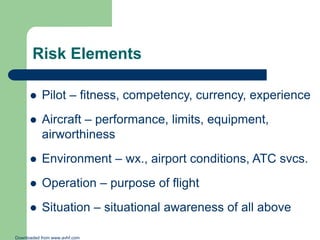
Risk Elements


Pilot – fitness, competency, currency, experience



Aircraft – performance, limits, equipment,
airworthiness



Environment – wx., airport conditions, ATC svcs.



Operation – purpose of flight



Situation – situational awareness of all above

Downloaded from www.avhf.com
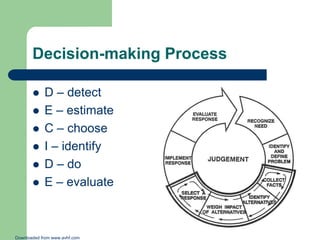
Decision-making Process







D – detect
E – estimate
C – choose
I – identify
D – do
E – evaluate

Downloaded from www.avhf.com
Accidents – Incidents


Accident –
–



An occurrence in which any person on board the
aircraft suffers death or serious injury, or in which
the aircraft receives substantial damage

Incident –
–

An occurrence other than an accident which
affects the safety of operations

Downloaded from www.avhf.com
NTSB


National Transportation Safety Board
–
–
–
–
–

Investigates every U. S. civil aviation accident
Issues safety recommendations
Maintains database
Conducts research on safety issues
www.ntsb.gov

Downloaded from www.avhf.com
Poor Judgment Chain


aka error chain



Accidents and incidents rarely, if ever, are the
result of a single cause



Usually a series of errors occurs which lead
to the accident or incident



Break one link in the chain and sequence of
events would be stopped

Downloaded from www.avhf.com
Risk


Flight activities where accidents are most
likely to occur

Downloaded from www.avhf.com
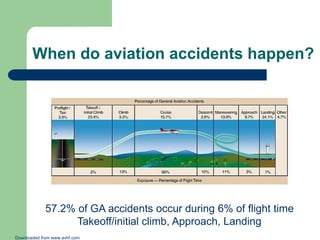
When do aviation accidents happen?

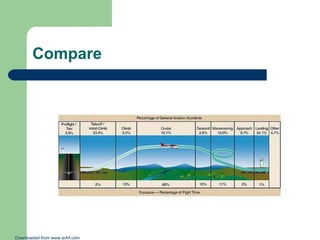
57.2% of GA accidents occur during 6% of flight time
Takeoff/initial climb, Approach, Landing
Downloaded from www.avhf.com
PIC Responsibility


Read top half of page 10-28



Judgment
–

Learned




–

From your mistakes
From other experiences
From the experiences of others

Ability to exercise good judgment affected by


Stressors

Downloaded from www.avhf.com
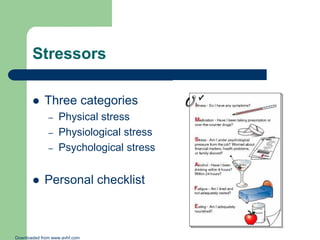
Stressors


Three categories
–

–
–



Physical stress
Physiological stress
Psychological stress

Personal checklist

Downloaded from www.avhf.com
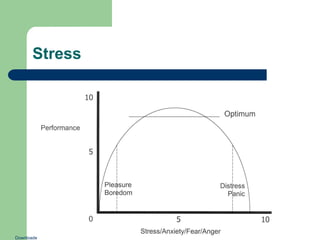
Stress

Downloaded from www.avhf.com
Improving Judgment








Anticipate decisions
Train and practice in critical areas
Match individual skills with the job
Standardize whenever possible
Maintain positive attitudes
Practice effective communications
Be deliberate in decision making

Downloaded from www.avhf.com
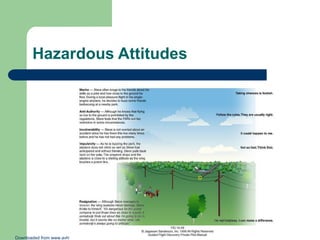
Hazardous Attitudes

Downloaded from www.avhf.com
Communication



Sending
Listening
Feedback



Good ATC radio procedures help




Downloaded from www.avhf.com
Communication
When the rear-seat pilot of a dual-piloted T-33
aircraft attempted to adjust his position, he
inadvertently deployed the life raft in the seat
bucket survival kit. As the raft inflated, it
pushed the stick forward, which caused the
aircraft to pitch nose down. The front seat pilot
attempted to correct the dive, but met
resistance when he pulled the stick back.
Downloaded from www.avhf.com
Communication, continued
Meanwhile, the back seater found and
deployed the raft deflation tool. The front
seater, trying to solve the control problem,
heard an explosion as the cockpit filled with
talcum powder from inside the raft, which
looked very much like smoke. He identified the
problem as an engine failure, closed the throttle
and secured the engine.

Downloaded from www.avhf.com
Communication, continued
As the haze cleared in the back, the back
seater noticed the apparent engine flameout
and ejected. The front seater then deadsticked the aircraft into a field. Throughout this
entire sequence, not a word was spoken.

Downloaded from www.avhf.com
Barriers to Sending









Poor choice of words
Silence
Assumptions
Tone
Over load
Volume

Downloaded from www.avhf.com
Barriers to Listening







Boredom
Complacency
Distractions
Impatience
Anger

Downloaded from www.avhf.com
Feedback









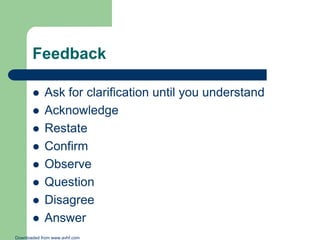
Ask for clarification until you understand
Acknowledge
Restate
Confirm
Observe
Question
Disagree
Answer

Downloaded from www.avhf.com
Double Check When You Hear . . .









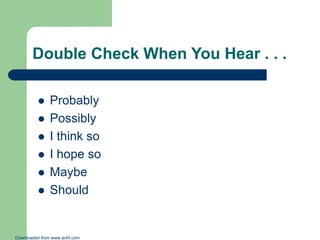
Probably
Possibly
I think so
I hope so
Maybe
Should

Downloaded from www.avhf.com
Internal Barriers to Communication






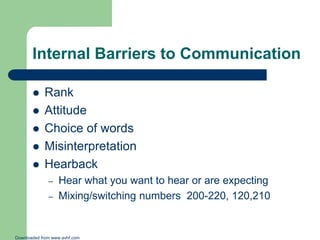
Rank
Attitude
Choice of words
Misinterpretation
Hearback
–
–

Hear what you want to hear or are expecting
Mixing/switching numbers 200-220, 120,210

Downloaded from www.avhf.com
External Barriers to Communications







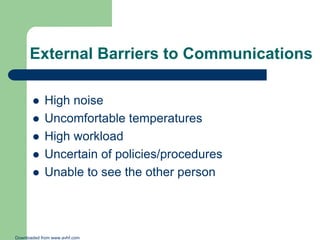
High noise
Uncomfortable temperatures
High workload
Uncertain of policies/procedures
Unable to see the other person

Downloaded from www.avhf.com
Resources


Internal – in the cockpit during flight



External – outside of the cockpit during flight

Downloaded from www.avhf.com
Workload Management




Plan
Prepare
Prioritize

Downloaded from www.avhf.com
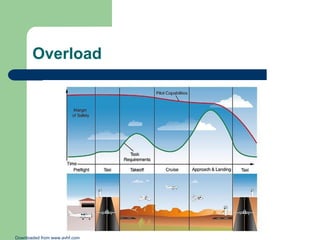
Overload

Downloaded from www.avhf.com
Compare

Downloaded from www.avhf.com
Situational Awareness


An accurate perception of the operational
and environmental factors which affect the
aircraft, pilot, and passengers during a
specific period of time.



Fixating on one thing



Complacency

Downloaded from www.avhf.com
ADM Works!



United Flight 232
Captain Al Haynes
–

“We had 103 Years of flying experience in that
cockpit . . . but not one minute of that 103 years
had been spent operating an airplane the way we
were trying to fly it. If we had not worked
together, with everybody coming up with ideas
and discussing what we should do next and how
we were going to do it, I do not think we would
have made it to Sioux City.”

Downloaded from www.avhf.com

Human Factors Training in Aviation