An Overview of Human Error
Drawn from J. Reason, Human Error, Cambridge, 1990
Aaron Brown
CS 294-4 ROC Seminar
Slide 2
Outline
• Human error and computer system failures
• A theory of human error
• Human error and accident theory
• Addressing human error
Slide 3
Dependability and human error
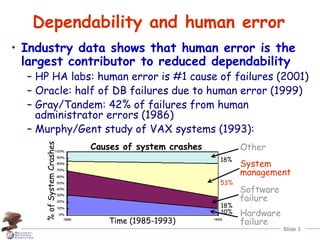
• Industry data shows that human error is the
largest contributor to reduced dependability
– HP HA labs: human error is #1 cause of failures (2001)
– Oracle: half of DB failures due to human error (1999)
– Gray/Tandem: 42% of failures from human
administrator errors (1986)
– Murphy/Gent study of VAX systems (1993):
Causes of system crashes
Time (1985-1993)
%
of
System
Crashes
System
management
Software
failure
Hardware
failure
Other
53%
18%
18%
10%
Slide 4
Learning from other fields: PSTN
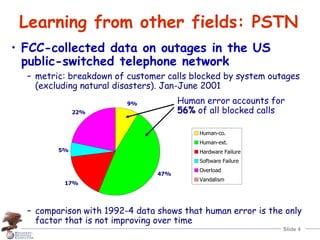
• FCC-collected data on outages in the US
public-switched telephone network
– metric: breakdown of customer calls blocked by system outages
(excluding natural disasters). Jan-June 2001
9%
47%
17%
5%
22%
Human-co.
Human-ext.
Hardware Failure
Software Failure
Overload
Vandalism
Human error accounts for
56% of all blocked calls
– comparison with 1992-4 data shows that human error is the only
factor that is not improving over time
Slide 5
Learning from other fields: PSTN
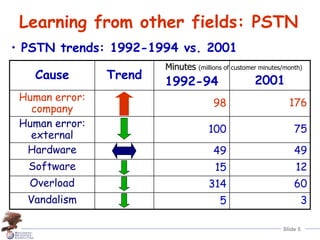
• PSTN trends: 1992-1994 vs. 2001
Cause Trend
1992-94 2001
Human error:
company
98 176
Human error:
external
100 75
Hardware 49 49
Software 15 12
Overload 314 60
Vandalism 5 3
Minutes (millions of customer minutes/month)
Slide 6
Learning from experiments
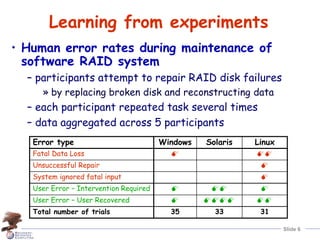
• Human error rates during maintenance of
software RAID system
– participants attempt to repair RAID disk failures
» by replacing broken disk and reconstructing data
– each participant repeated task several times
– data aggregated across 5 participants
Error type Windows Solaris Linux
Fatal Data Loss M MM
Unsuccessful Repair M
System ignored fatal input M
User Error – Intervention Required M MM M
User Error – User Recovered M MMMM MM
Total number of trials 35 33 31
Slide 7
Learning from experiments
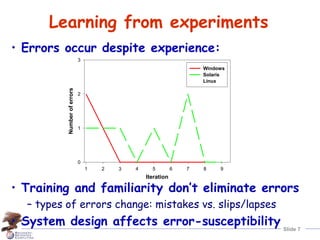
• Errors occur despite experience:
Iteration
1 2 3 4 5 6 7 8 9
Number
of
errors
0
1
2
3
Windows
Solaris
Linux
• Training and familiarity don’t eliminate errors
– types of errors change: mistakes vs. slips/lapses
• System design affects error-susceptibility
Slide 8
Outline
• Human error and computer system failures
• A theory of human error
• Human error and accident theory
• Addressing human error
Slide 9
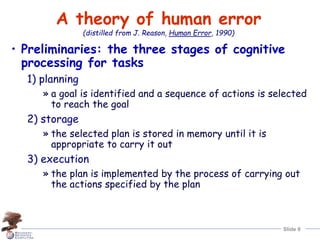
A theory of human error
(distilled from J. Reason, Human Error, 1990)
• Preliminaries: the three stages of cognitive
processing for tasks
1) planning
» a goal is identified and a sequence of actions is selected
to reach the goal
2) storage
» the selected plan is stored in memory until it is
appropriate to carry it out
3) execution
» the plan is implemented by the process of carrying out
the actions specified by the plan
Slide 10
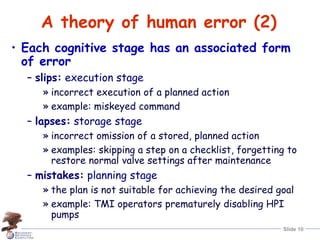
A theory of human error (2)
• Each cognitive stage has an associated form
of error
– slips: execution stage
» incorrect execution of a planned action
» example: miskeyed command
– lapses: storage stage
» incorrect omission of a stored, planned action
» examples: skipping a step on a checklist, forgetting to
restore normal valve settings after maintenance
– mistakes: planning stage
» the plan is not suitable for achieving the desired goal
» example: TMI operators prematurely disabling HPI
pumps
Slide 11
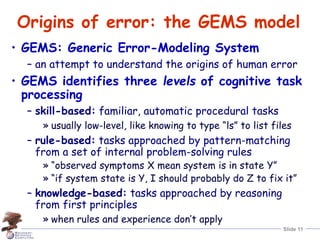
Origins of error: the GEMS model
• GEMS: Generic Error-Modeling System
– an attempt to understand the origins of human error
• GEMS identifies three levels of cognitive task
processing
– skill-based: familiar, automatic procedural tasks
» usually low-level, like knowing to type “ls” to list files
– rule-based: tasks approached by pattern-matching
from a set of internal problem-solving rules
» “observed symptoms X mean system is in state Y”
» “if system state is Y, I should probably do Z to fix it”
– knowledge-based: tasks approached by reasoning
from first principles
» when rules and experience don’t apply
Slide 12
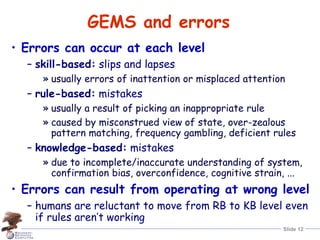
GEMS and errors
• Errors can occur at each level
– skill-based: slips and lapses
» usually errors of inattention or misplaced attention
– rule-based: mistakes
» usually a result of picking an inappropriate rule
» caused by misconstrued view of state, over-zealous
pattern matching, frequency gambling, deficient rules
– knowledge-based: mistakes
» due to incomplete/inaccurate understanding of system,
confirmation bias, overconfidence, cognitive strain, ...
• Errors can result from operating at wrong level
– humans are reluctant to move from RB to KB level even
if rules aren’t working
Slide 13
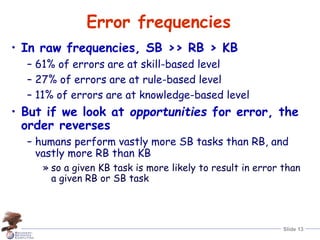
Error frequencies
• In raw frequencies, SB >> RB > KB
– 61% of errors are at skill-based level
– 27% of errors are at rule-based level
– 11% of errors are at knowledge-based level
• But if we look at opportunities for error, the
order reverses
– humans perform vastly more SB tasks than RB, and
vastly more RB than KB
» so a given KB task is more likely to result in error than
a given RB or SB task
Slide 14
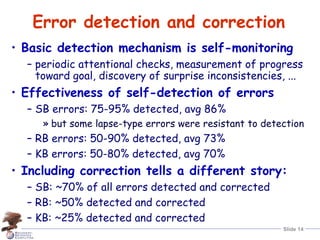
Error detection and correction
• Basic detection mechanism is self-monitoring
– periodic attentional checks, measurement of progress
toward goal, discovery of surprise inconsistencies, ...
• Effectiveness of self-detection of errors
– SB errors: 75-95% detected, avg 86%
» but some lapse-type errors were resistant to detection
– RB errors: 50-90% detected, avg 73%
– KB errors: 50-80% detected, avg 70%
• Including correction tells a different story:
– SB: ~70% of all errors detected and corrected
– RB: ~50% detected and corrected
– KB: ~25% detected and corrected
Slide 15
Outline
• Human error and computer system failures
• A theory of human error
• Human error and accident theory
• Addressing human error
Slide 16
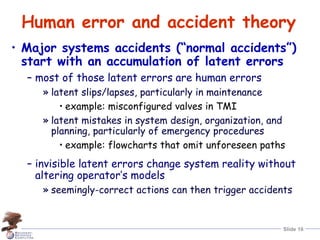
Human error and accident theory
• Major systems accidents (“normal accidents”)
start with an accumulation of latent errors
– most of those latent errors are human errors
» latent slips/lapses, particularly in maintenance
• example: misconfigured valves in TMI
» latent mistakes in system design, organization, and
planning, particularly of emergency procedures
• example: flowcharts that omit unforeseen paths
– invisible latent errors change system reality without
altering operator’s models
» seemingly-correct actions can then trigger accidents
Slide 17
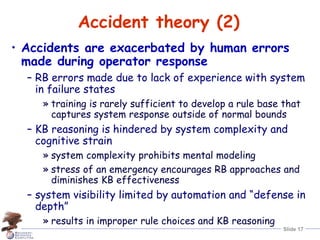
Accident theory (2)
• Accidents are exacerbated by human errors
made during operator response
– RB errors made due to lack of experience with system
in failure states
» training is rarely sufficient to develop a rule base that
captures system response outside of normal bounds
– KB reasoning is hindered by system complexity and
cognitive strain
» system complexity prohibits mental modeling
» stress of an emergency encourages RB approaches and
diminishes KB effectiveness
– system visibility limited by automation and “defense in
depth”
» results in improper rule choices and KB reasoning
Slide 18
Outline
• Human error and computer system failures
• A theory of human error
• Human error and accident theory
• Addressing human error
– general guidelines
– the ROC approach: system-level undo
Slide 19
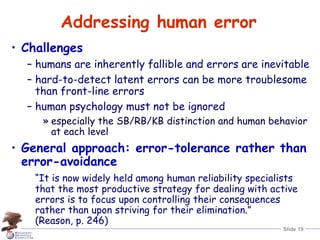
Addressing human error
• Challenges
– humans are inherently fallible and errors are inevitable
– hard-to-detect latent errors can be more troublesome
than front-line errors
– human psychology must not be ignored
» especially the SB/RB/KB distinction and human behavior
at each level
• General approach: error-tolerance rather than
error-avoidance
“It is now widely held among human reliability specialists
that the most productive strategy for dealing with active
errors is to focus upon controlling their consequences
rather than upon striving for their elimination.”
(Reason, p. 246)
Slide 20
The Automation Irony
• Automation is not the cure for human error
– automation addresses the easy SB/RB tasks, leaving
the complex KB tasks for the human
» humans are ill-suited to KB tasks, especially under
stress
– automation hinders understanding and mental modeling
» decreases system visibility and increases complexity
» operators don’t get hands-on control experience
» rule-set for RB tasks and models for KB tasks are weak
– automation shifts the error source from operator
errors to design errors
» harder to detect/tolerate/fix design errors
Slide 21
Building robustness to human error
• Discover and correct latent errors
– must overcome human nature to wait until emergency
to respond
• Increase system visibility
– don’t hide complexity behind automated mechanisms
• Take errors into account in operator training
– include error scenarios
– promote exploratory trial & error approaches
– emphasize positive side of errors: learning from
mistakes
Slide 22
Building robustness to human error
• Reduce opportunities for error (Don Norman):
– get good conceptual model to user by consistent design
– design tasks to match human limits: working memory,
problem solving abilities
– make visible what the options are, and what are the
consequences of actions
– exploit natural mappings: between intentions and possible
actions, actual state and what is perceived, …
– use constraints to guide user to next action/decision
– design for errors. Assume their occurrence. Plan for error
recovery. Make it easy to reverse action and make hard to
perform irreversible ones.
– when all else fails, standardize: ease of use more
important, only standardize as last resort
Slide 23
Building robustness to human error
• Acknowledge human behavior in system design:
– interfaces should allow user to explore via experimentation
– to help at KB level, provide tools do experiments/test
hypotheses without having to do them on high-risk
irreversible plant. Or make system state always reversible.
– provide feedback to increase error observability (RB level)
– at RB level, provide symbolic cues and confidence measures
– for RB, try to give more elaborate, integrated cues to
avoid “strong-but-wrong” RB error
– provide overview displays at edge of periphery to avoid
attentional capture at SB level
– simultaneously present data in forms useful for SB/RB/KB
– provide external memory aids to help at KB level, including
externalized representation of different options/schemas
Slide 24
Human error: the ROC approach
• ROC is focusing on system-level techniques
for human error tolerance
– complimentary to UI innovations
• Goal: provide forgiving operator environment
– expect human error and tolerate it
– allow operator to experiment safely, test hypotheses
– make it possible to detect and fix latent errors
• Approach: undo for system administration
Slide 25
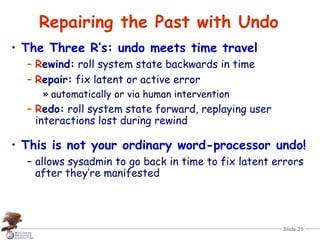
Repairing the Past with Undo
• The Three R’s: undo meets time travel
– Rewind: roll system state backwards in time
– Repair: fix latent or active error
» automatically or via human intervention
– Redo: roll system state forward, replaying user
interactions lost during rewind
• This is not your ordinary word-processor undo!
– allows sysadmin to go back in time to fix latent errors
after they’re manifested
Slide 26
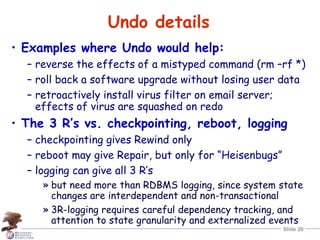
Undo details
• Examples where Undo would help:
– reverse the effects of a mistyped command (rm –rf *)
– roll back a software upgrade without losing user data
– retroactively install virus filter on email server;
effects of virus are squashed on redo
• The 3 R’s vs. checkpointing, reboot, logging
– checkpointing gives Rewind only
– reboot may give Repair, but only for “Heisenbugs”
– logging can give all 3 R’s
» but need more than RDBMS logging, since system state
changes are interdependent and non-transactional
» 3R-logging requires careful dependency tracking, and
attention to state granularity and externalized events
Slide 27
Summary
• Humans are critical to system dependability
– human error is the single largest cause of failures
• Human error is inescapable: “to err is human”
– yet we blame the operator instead of fixing systems
• Human error comes in many forms
– mistakes, slips, lapses at KB/RB/SB levels of operation
– but is nearly always detectable
• Best way to address human error is tolerance
– through mechanisms like undo
– human-aware UI design can help too

human-error.ppt

  • 1.
    An Overview ofHuman Error Drawn from J. Reason, Human Error, Cambridge, 1990 Aaron Brown CS 294-4 ROC Seminar
  • 2.
    Slide 2 Outline • Humanerror and computer system failures • A theory of human error • Human error and accident theory • Addressing human error
  • 3.
    Slide 3 Dependability andhuman error • Industry data shows that human error is the largest contributor to reduced dependability – HP HA labs: human error is #1 cause of failures (2001) – Oracle: half of DB failures due to human error (1999) – Gray/Tandem: 42% of failures from human administrator errors (1986) – Murphy/Gent study of VAX systems (1993): Causes of system crashes Time (1985-1993) % of System Crashes System management Software failure Hardware failure Other 53% 18% 18% 10%
  • 4.
    Slide 4 Learning fromother fields: PSTN • FCC-collected data on outages in the US public-switched telephone network – metric: breakdown of customer calls blocked by system outages (excluding natural disasters). Jan-June 2001 9% 47% 17% 5% 22% Human-co. Human-ext. Hardware Failure Software Failure Overload Vandalism Human error accounts for 56% of all blocked calls – comparison with 1992-4 data shows that human error is the only factor that is not improving over time
  • 5.
    Slide 5 Learning fromother fields: PSTN • PSTN trends: 1992-1994 vs. 2001 Cause Trend 1992-94 2001 Human error: company 98 176 Human error: external 100 75 Hardware 49 49 Software 15 12 Overload 314 60 Vandalism 5 3 Minutes (millions of customer minutes/month)
  • 6.
    Slide 6 Learning fromexperiments • Human error rates during maintenance of software RAID system – participants attempt to repair RAID disk failures » by replacing broken disk and reconstructing data – each participant repeated task several times – data aggregated across 5 participants Error type Windows Solaris Linux Fatal Data Loss M MM Unsuccessful Repair M System ignored fatal input M User Error – Intervention Required M MM M User Error – User Recovered M MMMM MM Total number of trials 35 33 31
  • 7.
    Slide 7 Learning fromexperiments • Errors occur despite experience: Iteration 1 2 3 4 5 6 7 8 9 Number of errors 0 1 2 3 Windows Solaris Linux • Training and familiarity don’t eliminate errors – types of errors change: mistakes vs. slips/lapses • System design affects error-susceptibility
  • 8.
    Slide 8 Outline • Humanerror and computer system failures • A theory of human error • Human error and accident theory • Addressing human error
  • 9.
    Slide 9 A theoryof human error (distilled from J. Reason, Human Error, 1990) • Preliminaries: the three stages of cognitive processing for tasks 1) planning » a goal is identified and a sequence of actions is selected to reach the goal 2) storage » the selected plan is stored in memory until it is appropriate to carry it out 3) execution » the plan is implemented by the process of carrying out the actions specified by the plan
  • 10.
    Slide 10 A theoryof human error (2) • Each cognitive stage has an associated form of error – slips: execution stage » incorrect execution of a planned action » example: miskeyed command – lapses: storage stage » incorrect omission of a stored, planned action » examples: skipping a step on a checklist, forgetting to restore normal valve settings after maintenance – mistakes: planning stage » the plan is not suitable for achieving the desired goal » example: TMI operators prematurely disabling HPI pumps
  • 11.
    Slide 11 Origins oferror: the GEMS model • GEMS: Generic Error-Modeling System – an attempt to understand the origins of human error • GEMS identifies three levels of cognitive task processing – skill-based: familiar, automatic procedural tasks » usually low-level, like knowing to type “ls” to list files – rule-based: tasks approached by pattern-matching from a set of internal problem-solving rules » “observed symptoms X mean system is in state Y” » “if system state is Y, I should probably do Z to fix it” – knowledge-based: tasks approached by reasoning from first principles » when rules and experience don’t apply
  • 12.
    Slide 12 GEMS anderrors • Errors can occur at each level – skill-based: slips and lapses » usually errors of inattention or misplaced attention – rule-based: mistakes » usually a result of picking an inappropriate rule » caused by misconstrued view of state, over-zealous pattern matching, frequency gambling, deficient rules – knowledge-based: mistakes » due to incomplete/inaccurate understanding of system, confirmation bias, overconfidence, cognitive strain, ... • Errors can result from operating at wrong level – humans are reluctant to move from RB to KB level even if rules aren’t working
  • 13.
    Slide 13 Error frequencies •In raw frequencies, SB >> RB > KB – 61% of errors are at skill-based level – 27% of errors are at rule-based level – 11% of errors are at knowledge-based level • But if we look at opportunities for error, the order reverses – humans perform vastly more SB tasks than RB, and vastly more RB than KB » so a given KB task is more likely to result in error than a given RB or SB task
  • 14.
    Slide 14 Error detectionand correction • Basic detection mechanism is self-monitoring – periodic attentional checks, measurement of progress toward goal, discovery of surprise inconsistencies, ... • Effectiveness of self-detection of errors – SB errors: 75-95% detected, avg 86% » but some lapse-type errors were resistant to detection – RB errors: 50-90% detected, avg 73% – KB errors: 50-80% detected, avg 70% • Including correction tells a different story: – SB: ~70% of all errors detected and corrected – RB: ~50% detected and corrected – KB: ~25% detected and corrected
  • 15.
    Slide 15 Outline • Humanerror and computer system failures • A theory of human error • Human error and accident theory • Addressing human error
  • 16.
    Slide 16 Human errorand accident theory • Major systems accidents (“normal accidents”) start with an accumulation of latent errors – most of those latent errors are human errors » latent slips/lapses, particularly in maintenance • example: misconfigured valves in TMI » latent mistakes in system design, organization, and planning, particularly of emergency procedures • example: flowcharts that omit unforeseen paths – invisible latent errors change system reality without altering operator’s models » seemingly-correct actions can then trigger accidents
  • 17.
    Slide 17 Accident theory(2) • Accidents are exacerbated by human errors made during operator response – RB errors made due to lack of experience with system in failure states » training is rarely sufficient to develop a rule base that captures system response outside of normal bounds – KB reasoning is hindered by system complexity and cognitive strain » system complexity prohibits mental modeling » stress of an emergency encourages RB approaches and diminishes KB effectiveness – system visibility limited by automation and “defense in depth” » results in improper rule choices and KB reasoning
  • 18.
    Slide 18 Outline • Humanerror and computer system failures • A theory of human error • Human error and accident theory • Addressing human error – general guidelines – the ROC approach: system-level undo
  • 19.
    Slide 19 Addressing humanerror • Challenges – humans are inherently fallible and errors are inevitable – hard-to-detect latent errors can be more troublesome than front-line errors – human psychology must not be ignored » especially the SB/RB/KB distinction and human behavior at each level • General approach: error-tolerance rather than error-avoidance “It is now widely held among human reliability specialists that the most productive strategy for dealing with active errors is to focus upon controlling their consequences rather than upon striving for their elimination.” (Reason, p. 246)
  • 20.
    Slide 20 The AutomationIrony • Automation is not the cure for human error – automation addresses the easy SB/RB tasks, leaving the complex KB tasks for the human » humans are ill-suited to KB tasks, especially under stress – automation hinders understanding and mental modeling » decreases system visibility and increases complexity » operators don’t get hands-on control experience » rule-set for RB tasks and models for KB tasks are weak – automation shifts the error source from operator errors to design errors » harder to detect/tolerate/fix design errors
  • 21.
    Slide 21 Building robustnessto human error • Discover and correct latent errors – must overcome human nature to wait until emergency to respond • Increase system visibility – don’t hide complexity behind automated mechanisms • Take errors into account in operator training – include error scenarios – promote exploratory trial & error approaches – emphasize positive side of errors: learning from mistakes
  • 22.
    Slide 22 Building robustnessto human error • Reduce opportunities for error (Don Norman): – get good conceptual model to user by consistent design – design tasks to match human limits: working memory, problem solving abilities – make visible what the options are, and what are the consequences of actions – exploit natural mappings: between intentions and possible actions, actual state and what is perceived, … – use constraints to guide user to next action/decision – design for errors. Assume their occurrence. Plan for error recovery. Make it easy to reverse action and make hard to perform irreversible ones. – when all else fails, standardize: ease of use more important, only standardize as last resort
  • 23.
    Slide 23 Building robustnessto human error • Acknowledge human behavior in system design: – interfaces should allow user to explore via experimentation – to help at KB level, provide tools do experiments/test hypotheses without having to do them on high-risk irreversible plant. Or make system state always reversible. – provide feedback to increase error observability (RB level) – at RB level, provide symbolic cues and confidence measures – for RB, try to give more elaborate, integrated cues to avoid “strong-but-wrong” RB error – provide overview displays at edge of periphery to avoid attentional capture at SB level – simultaneously present data in forms useful for SB/RB/KB – provide external memory aids to help at KB level, including externalized representation of different options/schemas
  • 24.
    Slide 24 Human error:the ROC approach • ROC is focusing on system-level techniques for human error tolerance – complimentary to UI innovations • Goal: provide forgiving operator environment – expect human error and tolerate it – allow operator to experiment safely, test hypotheses – make it possible to detect and fix latent errors • Approach: undo for system administration
  • 25.
    Slide 25 Repairing thePast with Undo • The Three R’s: undo meets time travel – Rewind: roll system state backwards in time – Repair: fix latent or active error » automatically or via human intervention – Redo: roll system state forward, replaying user interactions lost during rewind • This is not your ordinary word-processor undo! – allows sysadmin to go back in time to fix latent errors after they’re manifested
  • 26.
    Slide 26 Undo details •Examples where Undo would help: – reverse the effects of a mistyped command (rm –rf *) – roll back a software upgrade without losing user data – retroactively install virus filter on email server; effects of virus are squashed on redo • The 3 R’s vs. checkpointing, reboot, logging – checkpointing gives Rewind only – reboot may give Repair, but only for “Heisenbugs” – logging can give all 3 R’s » but need more than RDBMS logging, since system state changes are interdependent and non-transactional » 3R-logging requires careful dependency tracking, and attention to state granularity and externalized events
  • 27.
    Slide 27 Summary • Humansare critical to system dependability – human error is the single largest cause of failures • Human error is inescapable: “to err is human” – yet we blame the operator instead of fixing systems • Human error comes in many forms – mistakes, slips, lapses at KB/RB/SB levels of operation – but is nearly always detectable • Best way to address human error is tolerance – through mechanisms like undo – human-aware UI design can help too