Understanding Human
Factors
The Origin of Human Factors
 A Program Initially Designed by the Federal
  Aviation Administration (FAA)
 The Focus is on the Employees who Build
  and Maintain All Aircraft Engines and Aircraft
 The Tools & Techniques have been Modified
  for the Needs of ALL Businesses
The Objective
 To characterize the impact of environmental
  (external and internal) and individual factors on
  human performance
 To understand the Chain of Events that cause
  defects or errors in daily business operations
 These events can lead to the endangerment of the
  employee and / or the customer of the product or
  service
 To create awareness and to examine the human
  role in the workplace
Human Factors Definition
Human factors entails a multidisciplinary effort
 to generate information about human
 capabilities and limitations. This information is
 applied to equipment, systems, facilities,
 procedures, and job training, for continual
 and effective human performance.
Human Factors

What characterizes an effective
          employee?
Human Factors Attributes
 Dependable                      Doesn’t like to ask for
     Willing to put in effort     help
      and hours                   Tends to be self-
     High Integrity               sufficient
     Modest                      Like to think things out
                                   on his/her own
     Distrust of words
                                  Doesn’t share thoughts
     Prefers to be allowed
                                   too frequently
      to make his / her own
      decisions
Human Factors – The Dirty
Dozen


 It has been determined by researching mistakes
  caused by people, that one or more of 12
  common denominators (clues) are usually
  present.
 These are referred to as “The Dirty Dozen” root
  causes.
Human Factors – The Dirty Dozen

                                     Daily Pressures
  Communication
                   Awareness            Lack of communication
                                        Complacency
                                        Lack of knowledge
Knowledge              Distraction      Distractions
        Stress    Fatigue               Lack of teamwork
                                        Fatigue
      Resources Norms                   Lack of resources
Pressure                Teamwork
                                        Pressure
                                        Lack of assertiveness
                                        Stress
                                        Lack of awareness
   Complacency     Assertiveness        Norms
Human Factors
 Communication:
   Written
   Verbal
                                       ond
   Tone of Voice                  esp
                               le r nt
   Body Language      P eop fere
                          o  dif of      ion
                                             !
                        t
                              es nicat
                          typ mu
                            com


                    Not always in a positive way!
Human Factors

Does this sound familiar?
 “What you heard and what I said are two
   different things.”

 “And what you think I said is definitely not
   what I meant.”
Human Factors
 To Improve communication:
      Learn to listen
      Ask questions
      Paraphrase
      Make eye contact
      Use positive body language
      Approved process/worksheets
      Discuss open items on paperwork
      NEVER ASSUME ANYTHING!!
Human Factors
 Complacency:
     A conscious or unconscious relaxation of
      one’s usual standards in making decisions
      and taking actions.
Human Factors
 Improving Complacency:
   Train yourself to expect to find a problem
   Tasks are most likely included in the work
    instructions because of potential critical failure
    or past historical failures
   NEVER pass along work without insuring its
    correctness
Human Factors
 Lack of Knowledge
    Failure to provide adequate training
    Lack of confidence to ask questions


   Why do we
  always have
  trouble with
      this?
Human Factors
 Lack of Knowledge:
      Understand each step of what you are doing
       or...
      If you don’t have the knowledge, talk to
       someone who does
      Seek training on the type of work to be
       performed
      Always use current procedures and work
       instructions
      If it’s new- don’t be afraid to ask!
Human Factors
 Lack of Teamwork
      Failure to understand Roles
      No Teamwork Training             You had the
      Not understanding the           instructions
                                      in your hand,
       benefits of working in teams   I thought you
                                       knew what to
                                            do!
Human Factors
 Improving Teamwork:
      Provide instructions for working in teams
      Discuss what, who and how a job is to be
       done
      Be sure that everyone understands and
       agrees
Human Factors
 Distraction:
      To draw one’s attention away
      To confuse by unclear instructions
      Excessive non-work related activities
Human Factors
 Improving Distraction:
      Know where you left off the uncompleted work
      When you return to the job, go back and
       review a few steps in the process
      Use check sheets to avoid errors
      If in doubt…make a write-up of the
       uncompleted tasks
Human Factors
 Fatigue:
      The result of intense physical or mental
       activity at a single task
      Causes:
          Temperature variations
          Excess Noise
          Strong lighting
          Long work hours
Fatigue: Definition

 “Fatigue denotes a state represented by
      a loss in efficiency and a general
            disinclination to work”

   (Grandjean, 1988. Human Factors Journal, 1994)
Human Factors
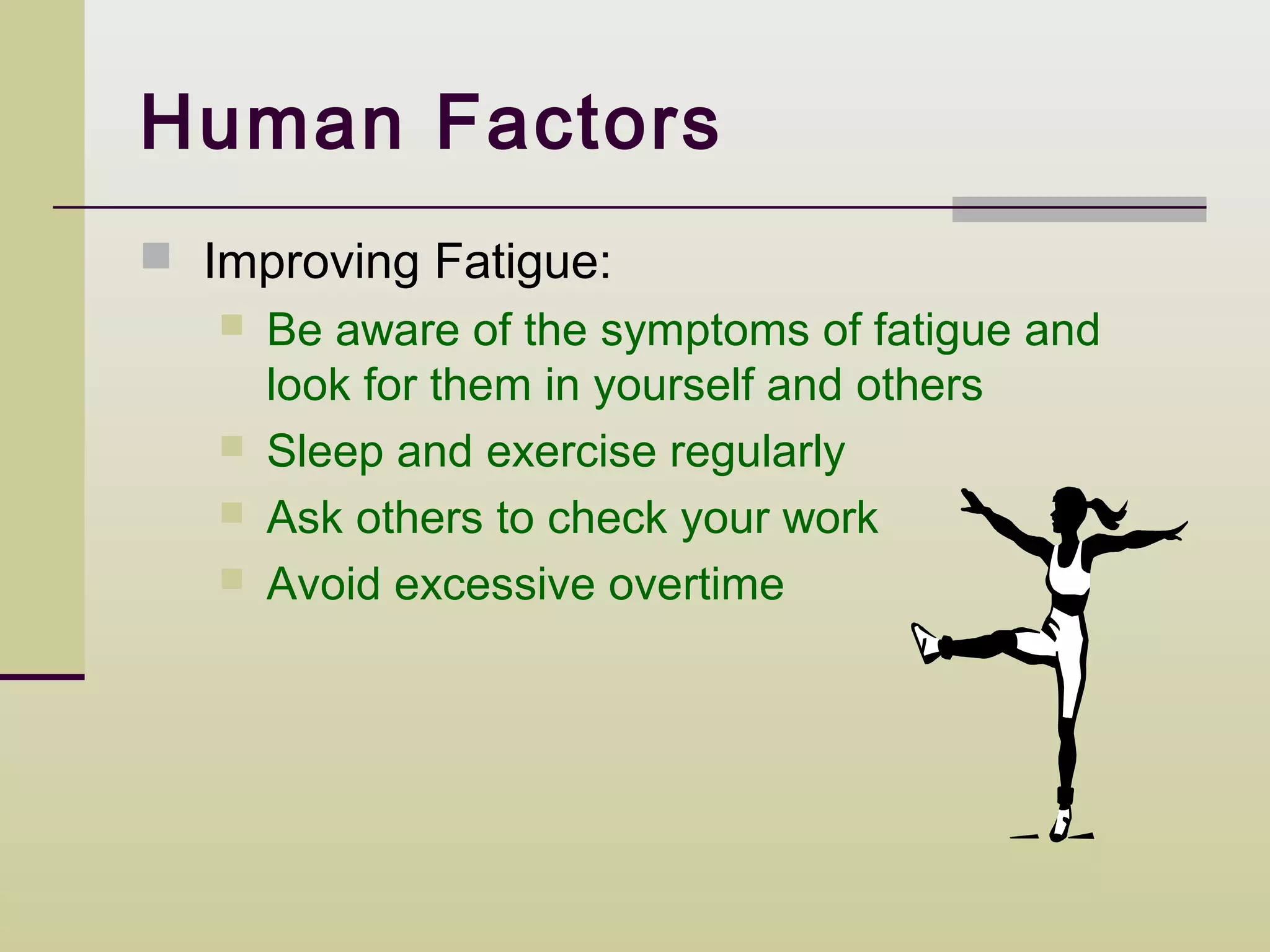
 Improving Fatigue:
      Be aware of the symptoms of fatigue and
       look for them in yourself and others
      Sleep and exercise regularly
      Ask others to check your work
      Avoid excessive overtime
Human Factors
 Resource Pressures:
   Making do with less
      Examples:

         Inexpensive / Inadequate Tools or
          equipment
            Outdated computers or software
            Unreliable Copiers
         Inadequate Lighting
         Outdated Manuals or Process
          Documentation
Human Factors
 Improving Resource Pressures:
     Make a list of required resources that will
      reduce work pressures
         Track the progress
Human Factors

 Pressure:
      To complete the work on-
       time (when expected)
      Most often, the pressure
       comes from within ourselves
Human Factors
 Reducing Work Pressure:
      Ensure the pressure isn’t
       self-induced
      Communicate your
       concerns upward
      Ask for help
Human Factors
 Lack of Assertiveness


                           Listen, I need
                          that report now,
                            just send it!
Human Factors
 Improving Assertiveness:
   Record the incident in a personal log
   Refuse to compromise your standards!
   Clearly communicate the consequences
         Verbally and
         In writing
Human Factors
 Stress
     The non-specific response of the body to any
      demand made upon it.
Human Factors
 Managing Stress
   Don’t make mountains out of mole hills
   Look rationally at a problem
   Break plans down into small steps
   Always be aware how stress personally affects
    your work
   Take a break to clear your mind
   Ask for advice or help from someone you can
    trust (ombudsman)
Human Factors
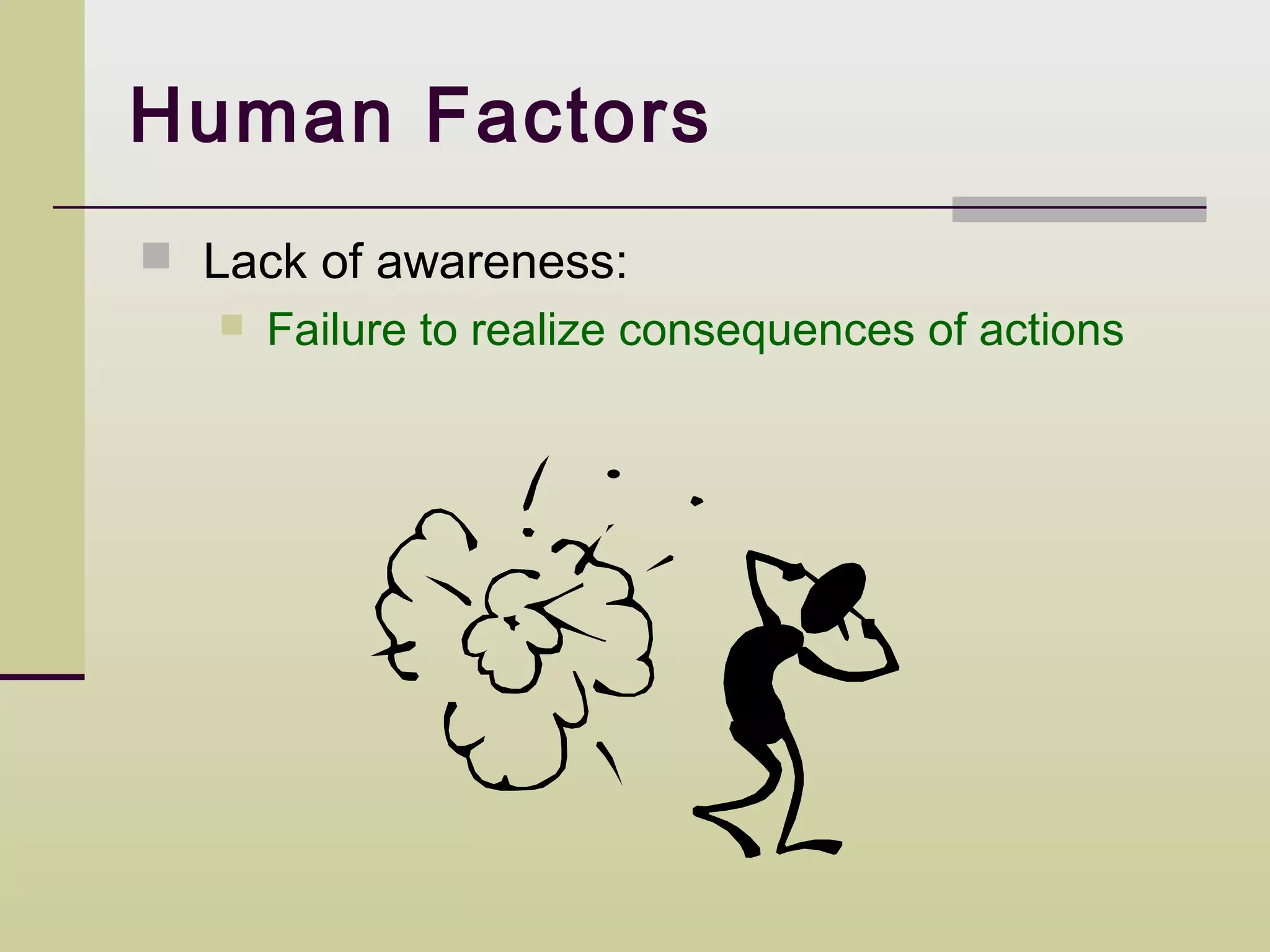
 Lack of awareness:
      Failure to realize consequences of actions
Human Factors
 Improving awareness:
      Think about all the functions required to
       complete the total task
      Will your work conflict with some other
       person or process?
      Ask others if they can see any problems with
       the work – both upstream and downstream
Human Factors
 NORMS:
     “Never mind the “right way”, it’s quicker the
      way I do it…!”
Human Factors
 Improving NORMS:
     Always follow the approved process
     If the process is not documented, then
      document the process by seeking collective
      input
     Be aware that “norms” do not make it right!
Human Factors Summary
 We have a choice..
             Attitude is everything
 Use knowledge, awareness, resources to
  break the chain of events
 Be aware of poor work habits!


    Stay Aware!!
  Our Future Business Depends on It!!

Human factors

  • 1.
  • 2.
    The Origin ofHuman Factors  A Program Initially Designed by the Federal Aviation Administration (FAA)  The Focus is on the Employees who Build and Maintain All Aircraft Engines and Aircraft  The Tools & Techniques have been Modified for the Needs of ALL Businesses
  • 3.
    The Objective  Tocharacterize the impact of environmental (external and internal) and individual factors on human performance  To understand the Chain of Events that cause defects or errors in daily business operations  These events can lead to the endangerment of the employee and / or the customer of the product or service  To create awareness and to examine the human role in the workplace
  • 4.
    Human Factors Definition Humanfactors entails a multidisciplinary effort to generate information about human capabilities and limitations. This information is applied to equipment, systems, facilities, procedures, and job training, for continual and effective human performance.
  • 5.
    Human Factors What characterizesan effective employee?
  • 6.
    Human Factors Attributes Dependable  Doesn’t like to ask for  Willing to put in effort help and hours  Tends to be self-  High Integrity sufficient  Modest  Like to think things out on his/her own  Distrust of words  Doesn’t share thoughts  Prefers to be allowed too frequently to make his / her own decisions
  • 7.
    Human Factors –The Dirty Dozen  It has been determined by researching mistakes caused by people, that one or more of 12 common denominators (clues) are usually present.  These are referred to as “The Dirty Dozen” root causes.
  • 8.
    Human Factors –The Dirty Dozen Daily Pressures Communication Awareness  Lack of communication  Complacency  Lack of knowledge Knowledge Distraction  Distractions Stress Fatigue  Lack of teamwork  Fatigue Resources Norms  Lack of resources Pressure Teamwork  Pressure  Lack of assertiveness  Stress  Lack of awareness Complacency Assertiveness  Norms
  • 9.
    Human Factors  Communication:  Written  Verbal ond  Tone of Voice esp le r nt  Body Language P eop fere o dif of ion ! t es nicat typ mu com Not always in a positive way!
  • 10.
    Human Factors Does thissound familiar?  “What you heard and what I said are two different things.”  “And what you think I said is definitely not what I meant.”
  • 11.
    Human Factors  ToImprove communication:  Learn to listen  Ask questions  Paraphrase  Make eye contact  Use positive body language  Approved process/worksheets  Discuss open items on paperwork  NEVER ASSUME ANYTHING!!
  • 12.
    Human Factors  Complacency:  A conscious or unconscious relaxation of one’s usual standards in making decisions and taking actions.
  • 13.
    Human Factors  ImprovingComplacency:  Train yourself to expect to find a problem  Tasks are most likely included in the work instructions because of potential critical failure or past historical failures  NEVER pass along work without insuring its correctness
  • 14.
    Human Factors  Lackof Knowledge  Failure to provide adequate training  Lack of confidence to ask questions Why do we always have trouble with this?
  • 15.
    Human Factors  Lackof Knowledge:  Understand each step of what you are doing or...  If you don’t have the knowledge, talk to someone who does  Seek training on the type of work to be performed  Always use current procedures and work instructions  If it’s new- don’t be afraid to ask!
  • 16.
    Human Factors  Lackof Teamwork  Failure to understand Roles  No Teamwork Training You had the  Not understanding the instructions in your hand, benefits of working in teams I thought you knew what to do!
  • 17.
    Human Factors  ImprovingTeamwork:  Provide instructions for working in teams  Discuss what, who and how a job is to be done  Be sure that everyone understands and agrees
  • 18.
    Human Factors  Distraction:  To draw one’s attention away  To confuse by unclear instructions  Excessive non-work related activities
  • 19.
    Human Factors  ImprovingDistraction:  Know where you left off the uncompleted work  When you return to the job, go back and review a few steps in the process  Use check sheets to avoid errors  If in doubt…make a write-up of the uncompleted tasks
  • 20.
    Human Factors  Fatigue:  The result of intense physical or mental activity at a single task  Causes:  Temperature variations  Excess Noise  Strong lighting  Long work hours
  • 21.
    Fatigue: Definition “Fatiguedenotes a state represented by a loss in efficiency and a general disinclination to work” (Grandjean, 1988. Human Factors Journal, 1994)
  • 22.
    Human Factors  ImprovingFatigue:  Be aware of the symptoms of fatigue and look for them in yourself and others  Sleep and exercise regularly  Ask others to check your work  Avoid excessive overtime
  • 23.
    Human Factors  ResourcePressures:  Making do with less  Examples:  Inexpensive / Inadequate Tools or equipment  Outdated computers or software  Unreliable Copiers  Inadequate Lighting  Outdated Manuals or Process Documentation
  • 24.
    Human Factors  ImprovingResource Pressures:  Make a list of required resources that will reduce work pressures  Track the progress
  • 25.
    Human Factors  Pressure:  To complete the work on- time (when expected)  Most often, the pressure comes from within ourselves
  • 26.
    Human Factors  ReducingWork Pressure:  Ensure the pressure isn’t self-induced  Communicate your concerns upward  Ask for help
  • 27.
    Human Factors  Lackof Assertiveness Listen, I need that report now, just send it!
  • 28.
    Human Factors  ImprovingAssertiveness:  Record the incident in a personal log  Refuse to compromise your standards!  Clearly communicate the consequences  Verbally and  In writing
  • 29.
    Human Factors  Stress  The non-specific response of the body to any demand made upon it.
  • 30.
    Human Factors  ManagingStress  Don’t make mountains out of mole hills  Look rationally at a problem  Break plans down into small steps  Always be aware how stress personally affects your work  Take a break to clear your mind  Ask for advice or help from someone you can trust (ombudsman)
  • 31.
    Human Factors  Lackof awareness:  Failure to realize consequences of actions
  • 32.
    Human Factors  Improvingawareness:  Think about all the functions required to complete the total task  Will your work conflict with some other person or process?  Ask others if they can see any problems with the work – both upstream and downstream
  • 33.
    Human Factors  NORMS:  “Never mind the “right way”, it’s quicker the way I do it…!”
  • 34.
    Human Factors  ImprovingNORMS:  Always follow the approved process  If the process is not documented, then document the process by seeking collective input  Be aware that “norms” do not make it right!
  • 35.
    Human Factors Summary We have a choice.. Attitude is everything  Use knowledge, awareness, resources to break the chain of events  Be aware of poor work habits! Stay Aware!! Our Future Business Depends on It!!