Accident Investigation  and Reporting
Why do we investigate? Helps us find out what happened. Helps us find ways to prevent the reoccurrence of the incident. Helps us control the claim. Helps us save money for the firm. May keep us out of jail.
Why should supervisors investigate? Know job details / work conditions Assist in training employees Close to employees Increase sense of responsibility Learn about causes Responsible for action and changing  job procedures
Keys to Success: Being Prepared Begin ASAP Investigate all  Near Misses
What is a Near-miss? An accident that  could have caused a death or serious injury, should be investigated just like any other accident.
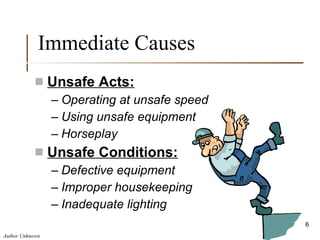
Immediate Causes Unsafe Acts: Operating at unsafe speed Using unsafe equipment Horseplay Unsafe Conditions: Defective equipment Improper housekeeping Inadequate lighting
What should you do when an accident occurs? Assess the situation Assist the injured and call for emergency medical services Secure the accident scene Keep by-standers away. Don’t talk to the media. Find any witnesses (people who actually saw the incident).
Assess the situation Look at the accident scene. Find out what happened. Determine who is injured, what property is damaged, where the fire is, what was spilled (chemical), etc......
Get emergency help Getting emergency help to the scene. Call EMS for injured. Call Fire or Police for fire, crowd control, chemical spills, etc...... Call Safety Department, and appropriate Supervisor Inform Safety Department of what happened and request guidance.
Help the injured, (con’t.) - Have an employee direct emergency services to scene. - Keep traffic out of area of incident scene.
Secure the incident scene Secure the area around the incident scene Have an employee monitor the scene. Photograph the area from all angles
Keep by-standers away Have employees keep by-standers away from the scene. Instruct employees not to talk to by-standers, including media. Use police to help if necessary.
Do not talk to the media When the media shows up do not talk to them. Inform employees not to discuss the incident with media.
Do not talk to the media (con’t ) If a statement is required, tell them that an official of the firm will give them the details as soon as they are assessed. Take the name of the reporter and their firm for future contact.  If necessary, provide them the Safety Director’s name and phone number.
The Investigation Process: Time is crucial...
Benefits of the Accident Investigation? Helps to determine  direct  and  indirect  costs Locate potential problem areas Prevent reoccurrence
Important Note: Always notify the Safety dept. ASAP Never attempt to handle the claim yourself Do not at any time offer a settlement or agree to pay for any repairs or replacement of property
Which Accidents Should be Investigated? All accidents resulting in: Injury, illness or near-miss Property Damage Includes employees, or subcontractors Remember:   when in doubt, investigate and report
Common problems Accident not reported Failure to identify basic causes Accepting inadequate reports Failure to implement corrective actions Failure to report tends to spread and become a common practice
Reasons Some Employees do not Report Accidents: Fear of discipline Concern about record Concern for reputation Fear of medical treatment Desire to keep personal record clean
Concentrate on the facts: Who? What? Where? Why? How?
Professionalism: Search for all the  facts apparent and hidden Remain unbiased, and free from prejudice Fairness and impartiality are essential Do not place blame or pass the buck
A Good Report Provides: Complete information Sequence of events Identification of all causal factors Action Plan
Incident documentation An Incident report form must be completed immediately following an incident. The report should be complete with as much detail as possible. Include photographs and witness statements
Find any witnesses (people who actually saw the incident). Take statements from all witnesses. Have them write down their statements, sign and date the statement. Get these collected within 1 hour of the incident.  Important! Turn over written statements to the Safety Department. Make copies if needed for your project files.
Incident documentation (con’t) Do not leave any entry blanks empty.  If not applicable or none, state “none or N/A”. Provide sketches of the scene if they might help.
Don’t Procrastinate... Forward the original incident report and photos or film to the Safety Department promptly.  (within 24 hours of incident) Keep a copy for job file. If injury is OSHA recordable, enter on the OSHA Form 200.
In Conclusion: Remember if you do the incident investigation and incident report, you place the firm and yourself in a position to control our costs.

Accident Investigation (1)

  • 1.
  • 2.
    Why do weinvestigate? Helps us find out what happened. Helps us find ways to prevent the reoccurrence of the incident. Helps us control the claim. Helps us save money for the firm. May keep us out of jail.
  • 3.
    Why should supervisorsinvestigate? Know job details / work conditions Assist in training employees Close to employees Increase sense of responsibility Learn about causes Responsible for action and changing job procedures
  • 4.
    Keys to Success:Being Prepared Begin ASAP Investigate all Near Misses
  • 5.
    What is aNear-miss? An accident that could have caused a death or serious injury, should be investigated just like any other accident.
  • 6.
    Immediate Causes UnsafeActs: Operating at unsafe speed Using unsafe equipment Horseplay Unsafe Conditions: Defective equipment Improper housekeeping Inadequate lighting
  • 7.
    What should youdo when an accident occurs? Assess the situation Assist the injured and call for emergency medical services Secure the accident scene Keep by-standers away. Don’t talk to the media. Find any witnesses (people who actually saw the incident).
  • 8.
    Assess the situationLook at the accident scene. Find out what happened. Determine who is injured, what property is damaged, where the fire is, what was spilled (chemical), etc......
  • 9.
    Get emergency helpGetting emergency help to the scene. Call EMS for injured. Call Fire or Police for fire, crowd control, chemical spills, etc...... Call Safety Department, and appropriate Supervisor Inform Safety Department of what happened and request guidance.
  • 10.
    Help the injured,(con’t.) - Have an employee direct emergency services to scene. - Keep traffic out of area of incident scene.
  • 11.
    Secure the incidentscene Secure the area around the incident scene Have an employee monitor the scene. Photograph the area from all angles
  • 12.
    Keep by-standers awayHave employees keep by-standers away from the scene. Instruct employees not to talk to by-standers, including media. Use police to help if necessary.
  • 13.
    Do not talkto the media When the media shows up do not talk to them. Inform employees not to discuss the incident with media.
  • 14.
    Do not talkto the media (con’t ) If a statement is required, tell them that an official of the firm will give them the details as soon as they are assessed. Take the name of the reporter and their firm for future contact. If necessary, provide them the Safety Director’s name and phone number.
  • 15.
    The Investigation Process:Time is crucial...
  • 16.
    Benefits of theAccident Investigation? Helps to determine direct and indirect costs Locate potential problem areas Prevent reoccurrence
  • 17.
    Important Note: Alwaysnotify the Safety dept. ASAP Never attempt to handle the claim yourself Do not at any time offer a settlement or agree to pay for any repairs or replacement of property
  • 18.
    Which Accidents Shouldbe Investigated? All accidents resulting in: Injury, illness or near-miss Property Damage Includes employees, or subcontractors Remember: when in doubt, investigate and report
  • 19.
    Common problems Accidentnot reported Failure to identify basic causes Accepting inadequate reports Failure to implement corrective actions Failure to report tends to spread and become a common practice
  • 20.
    Reasons Some Employeesdo not Report Accidents: Fear of discipline Concern about record Concern for reputation Fear of medical treatment Desire to keep personal record clean
  • 21.
    Concentrate on thefacts: Who? What? Where? Why? How?
  • 22.
    Professionalism: Search forall the facts apparent and hidden Remain unbiased, and free from prejudice Fairness and impartiality are essential Do not place blame or pass the buck
  • 23.
    A Good ReportProvides: Complete information Sequence of events Identification of all causal factors Action Plan
  • 24.
    Incident documentation AnIncident report form must be completed immediately following an incident. The report should be complete with as much detail as possible. Include photographs and witness statements
  • 25.
    Find any witnesses(people who actually saw the incident). Take statements from all witnesses. Have them write down their statements, sign and date the statement. Get these collected within 1 hour of the incident. Important! Turn over written statements to the Safety Department. Make copies if needed for your project files.
  • 26.
    Incident documentation (con’t)Do not leave any entry blanks empty. If not applicable or none, state “none or N/A”. Provide sketches of the scene if they might help.
  • 27.
    Don’t Procrastinate... Forwardthe original incident report and photos or film to the Safety Department promptly. (within 24 hours of incident) Keep a copy for job file. If injury is OSHA recordable, enter on the OSHA Form 200.
  • 28.
    In Conclusion: Rememberif you do the incident investigation and incident report, you place the firm and yourself in a position to control our costs.

Editor's Notes

  • #23 Remember: make it clear, that investigations are conducted solely to gather information to help prevent the recurrence of accidents.