Scientific Management
 Focuses on worker and machine relationships
 Organizational productivity can be increased
by increasing the efficiency of production
processes
 Father of Scientific Management
 Published Principles of Scientific Management
 He believed that managers should:
(1) develop a series of rules and routines to help
workers in their daily work
(2) replace the rule-of-thumb method by finding
the most efficient way of accomplishing a task
(3) Select scientifically, and the train, teach and
develop the worker
(4) provide wage incentives for workers for
increased output
 Emphasized method by focusing on
identifying the elemental motions in work,
the way these motions were combined to
form methods of operation, and the basic
time each motion took
 Frank Gilbreth, known as the Father ofTime
and Motion Studies and wrote Motion Study
and in 1919 together with his wife Lillian, they
wrote Applied Motion Study
 Dividing work into the most fundamental
elements possible, studying those elements
separately and in relation to one another; and
from these studied elements, when timed,
building methods or least waste
 Searching scientific analysis of methods and
equipment used or planned in doing a piece
of work, development in practical detail of
the best way of doing it, and determination
of the time required
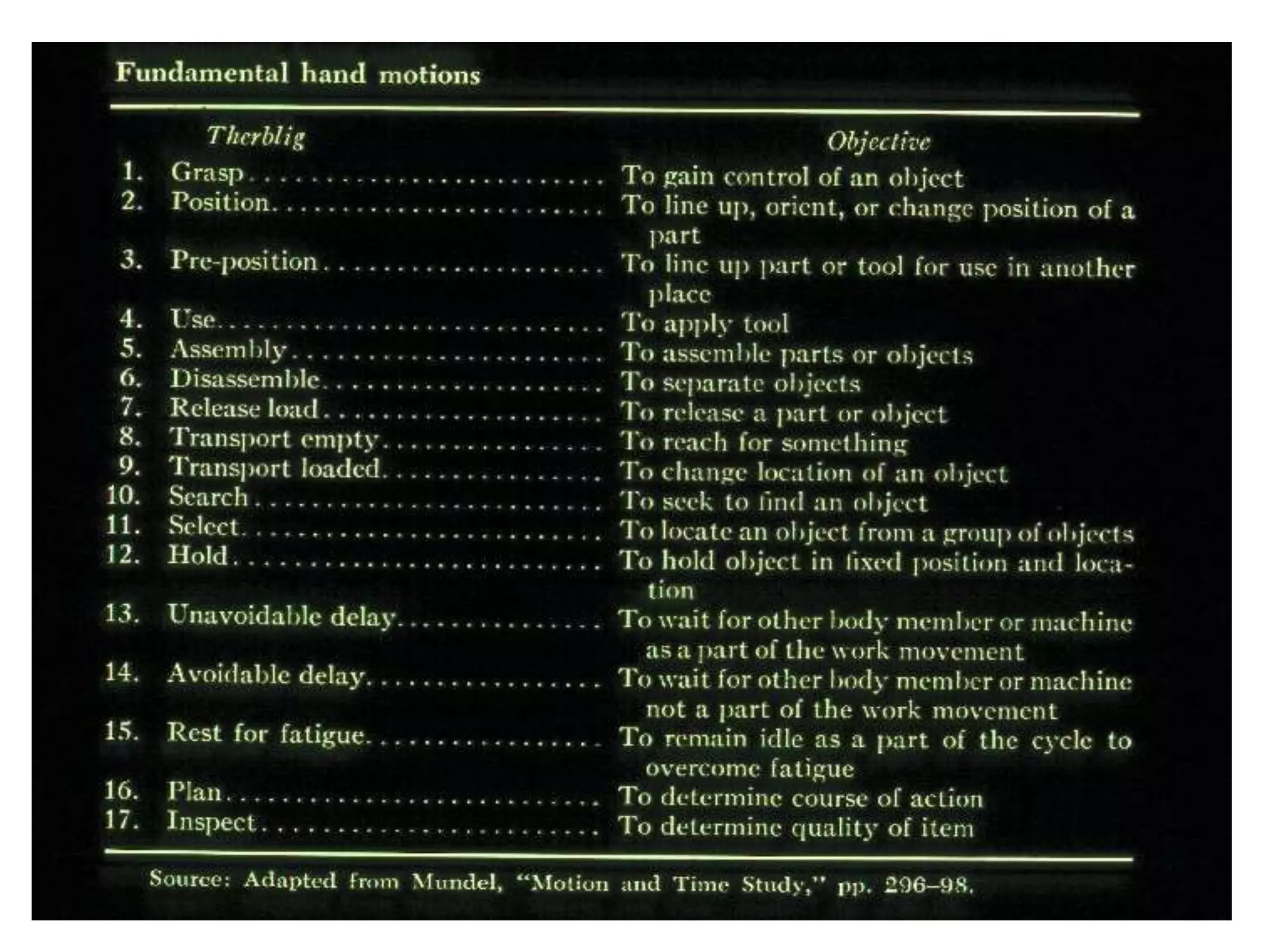
 Gilbreths drew symbols on operator charts to
represent various elements of a task
 They called these graphical symbols
“therbligs”
 Through proper rest breaks, fatigue could be
reduced.
 Suggestions:
 Reduced working hours so that employees had
sufficient time to recover and be prepared for the next
working day.
 Longer lunch periods, coffee or tea breaks.
 To make rest breaks more attractive to employees,
the Gilbreths suggested that organizations could
provide proper reclining chairs, lunch rooms, rest
rooms, or other entertainment.
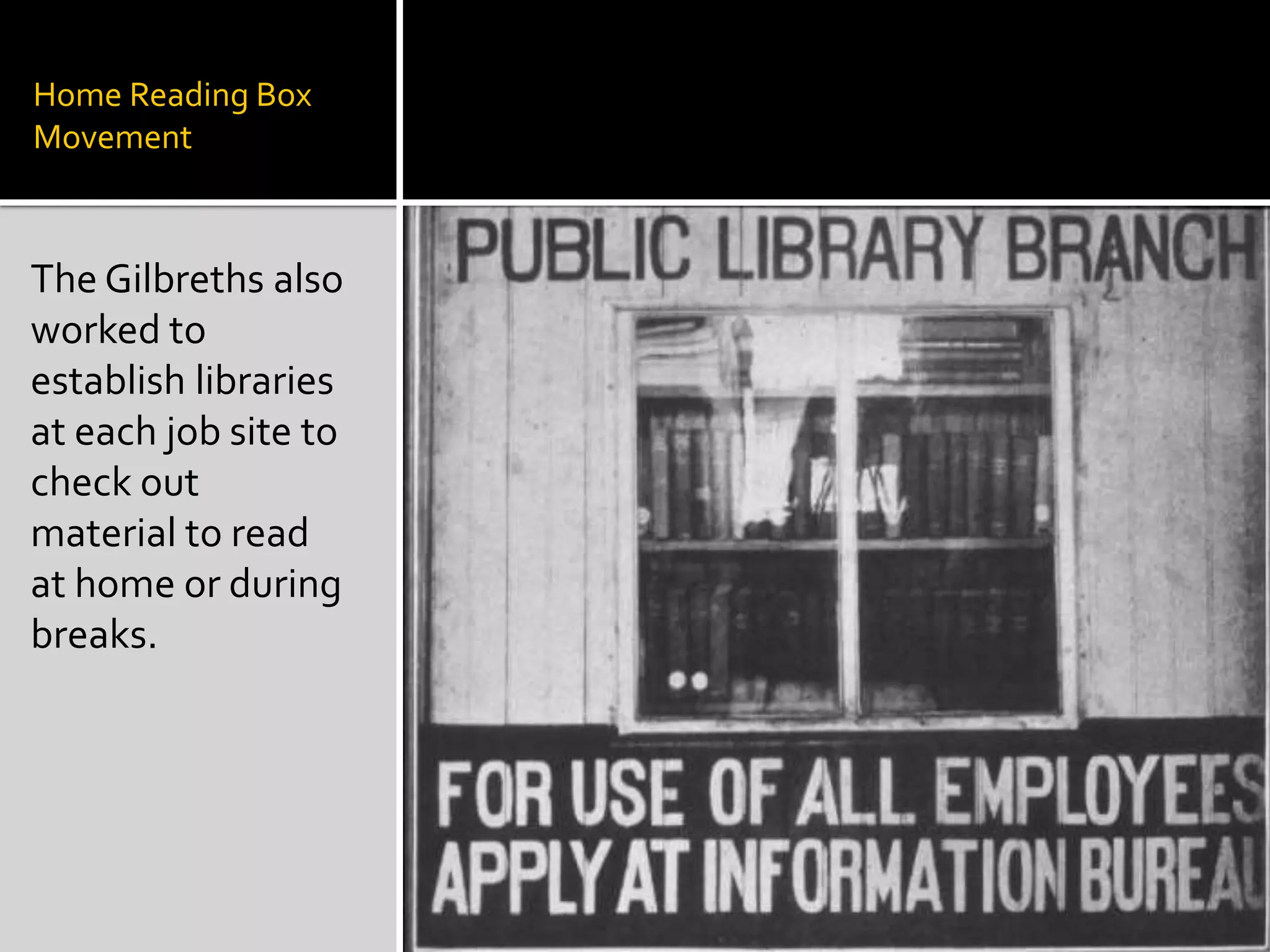
Home Reading Box
Movement
The Gilbreths also
worked to
establish libraries
at each job site to
check out
material to read
at home or during
breaks.
Ergonomics
-Frank Gilbreth is
often called the
“Father of
Ergonomics.”
-The Gilbreths
pioneered the use of
devices, such as
adjustable chairs and
improved
workstations, to ease
strain on the body
and reduce injuries.
Adjustable chair designed by F. and L. Gilbreth
 Mechanical engineer
 Joined Midvale Steel Company as an engineer
 Gantt’s early work paralleledTaylor’s in his
belief about worker selection, incentives to
reward performance, mutuality of interests,
etc.
 Taylor and Gantt admired each other’s work.
 Gantt was a prolific writer – over 150 titles.
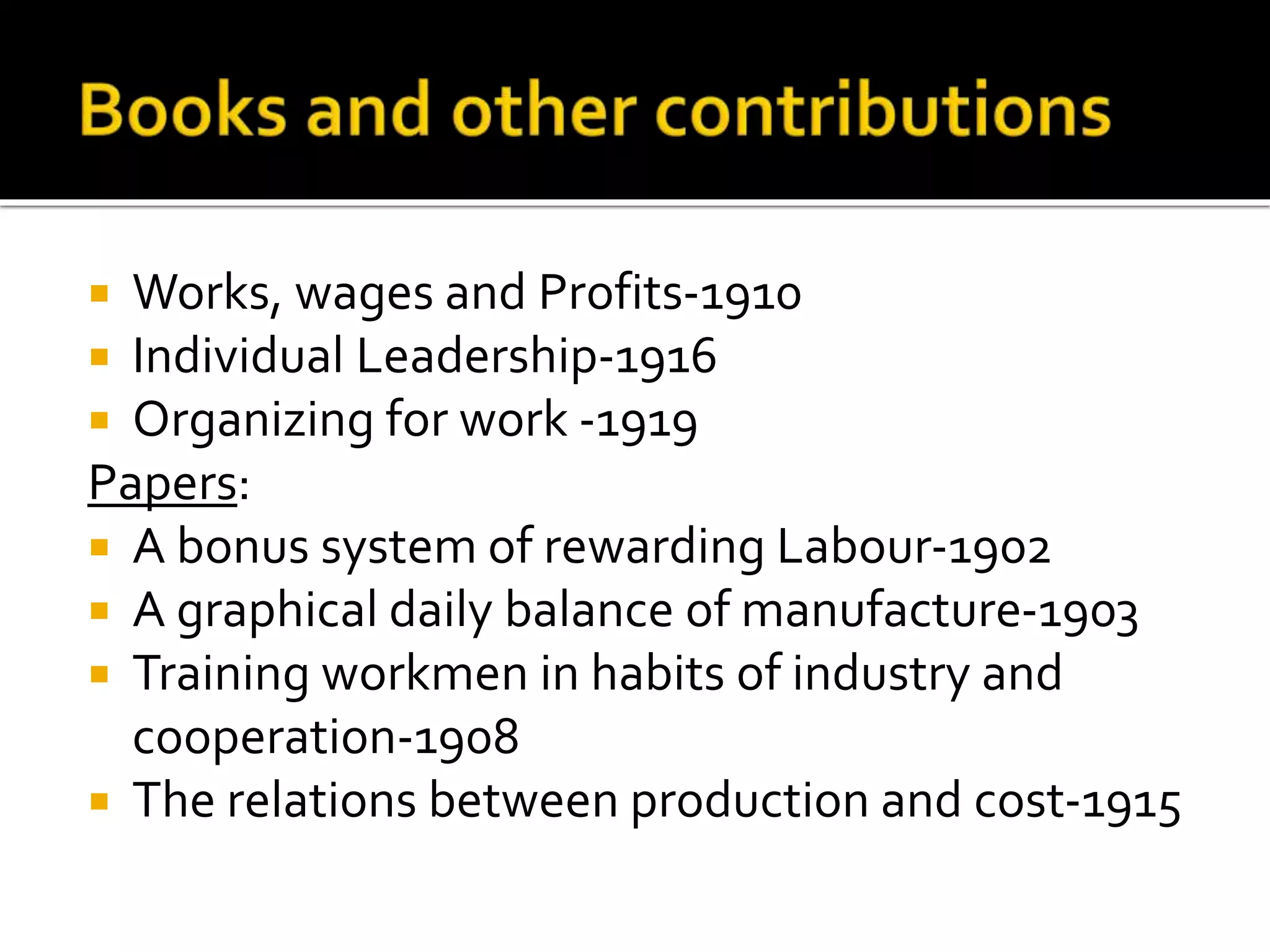
 Works, wages and Profits-1910
 Individual Leadership-1916
 Organizing for work -1919
Papers:
 A bonus system of rewarding Labour-1902
 A graphical daily balance of manufacture-1903
 Training workmen in habits of industry and
cooperation-1908
 The relations between production and cost-1915
 Implemented task work with a bonus to stimulate
performance.
 When he discovered that this provided little
incentive beyond meeting the standard, he
modified the payment plan. He influencedTaylor
becauseTaylor believed Gantt’s plan was better.
 Rewards to supervisors when their employees came
up to standard (rewarded development of
employees).
 Emphasized importance of morale, training, and
development of employees.

Scientific management theory

  • 1.
  • 2.
     Focuses onworker and machine relationships  Organizational productivity can be increased by increasing the efficiency of production processes
  • 3.
     Father ofScientific Management  Published Principles of Scientific Management  He believed that managers should: (1) develop a series of rules and routines to help workers in their daily work (2) replace the rule-of-thumb method by finding the most efficient way of accomplishing a task (3) Select scientifically, and the train, teach and develop the worker
  • 4.
    (4) provide wageincentives for workers for increased output
  • 5.
     Emphasized methodby focusing on identifying the elemental motions in work, the way these motions were combined to form methods of operation, and the basic time each motion took  Frank Gilbreth, known as the Father ofTime and Motion Studies and wrote Motion Study and in 1919 together with his wife Lillian, they wrote Applied Motion Study
  • 6.
     Dividing workinto the most fundamental elements possible, studying those elements separately and in relation to one another; and from these studied elements, when timed, building methods or least waste
  • 7.
     Searching scientificanalysis of methods and equipment used or planned in doing a piece of work, development in practical detail of the best way of doing it, and determination of the time required
  • 8.
     Gilbreths drewsymbols on operator charts to represent various elements of a task  They called these graphical symbols “therbligs”
  • 10.
     Through properrest breaks, fatigue could be reduced.  Suggestions:  Reduced working hours so that employees had sufficient time to recover and be prepared for the next working day.  Longer lunch periods, coffee or tea breaks.  To make rest breaks more attractive to employees, the Gilbreths suggested that organizations could provide proper reclining chairs, lunch rooms, rest rooms, or other entertainment.
  • 11.
    Home Reading Box Movement TheGilbreths also worked to establish libraries at each job site to check out material to read at home or during breaks.
  • 12.
    Ergonomics -Frank Gilbreth is oftencalled the “Father of Ergonomics.” -The Gilbreths pioneered the use of devices, such as adjustable chairs and improved workstations, to ease strain on the body and reduce injuries. Adjustable chair designed by F. and L. Gilbreth
  • 13.
     Mechanical engineer Joined Midvale Steel Company as an engineer  Gantt’s early work paralleledTaylor’s in his belief about worker selection, incentives to reward performance, mutuality of interests, etc.  Taylor and Gantt admired each other’s work.  Gantt was a prolific writer – over 150 titles.
  • 14.
     Works, wagesand Profits-1910  Individual Leadership-1916  Organizing for work -1919 Papers:  A bonus system of rewarding Labour-1902  A graphical daily balance of manufacture-1903  Training workmen in habits of industry and cooperation-1908  The relations between production and cost-1915
  • 15.
     Implemented taskwork with a bonus to stimulate performance.  When he discovered that this provided little incentive beyond meeting the standard, he modified the payment plan. He influencedTaylor becauseTaylor believed Gantt’s plan was better.  Rewards to supervisors when their employees came up to standard (rewarded development of employees).  Emphasized importance of morale, training, and development of employees.