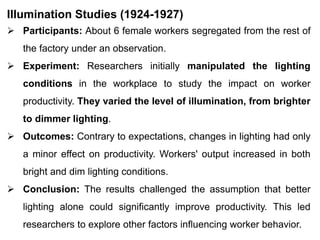
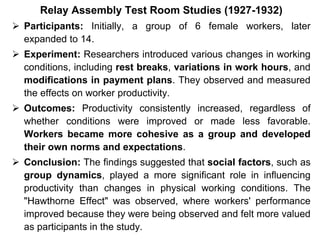
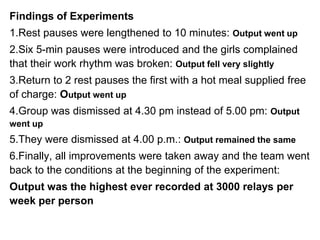
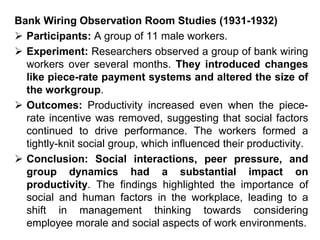
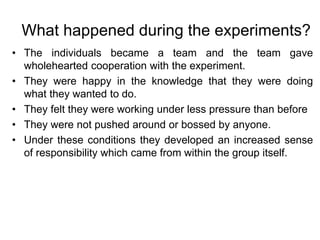
The Hawthorne Studies conducted in the 1920s and 1930s explored the impact of various working conditions on productivity. The illumination studies found that changes in lighting had little effect, while the relay assembly studies discovered that productivity consistently increased regardless of whether conditions improved or worsened. This highlighted the importance of social and human factors in influencing worker behavior and performance. The Hawthorne Effect was observed, where participants performed better simply from being observed. The studies challenged assumptions of scientific management and were influential in establishing the human relations school of management.