Chapter    9
          Top Performance through
          Empowerment, Teamwork, and
          Communication
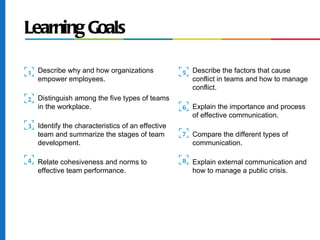
Learning Goals

1   Describe why and how organizations             5   Describe the factors that cause
    empower employees.                                 conflict in teams and how to manage
                                                       conflict.
2   Distinguish among the five types of teams
    in the workplace.                              6   Explain the importance and process
                                                       of effective communication.
3   Identify the characteristics of an effective
    team and summarize the stages of team          7   Compare the different types of
    development.                                       communication.

4   Relate cohesiveness and norms to               8   Explain external communication and
    effective team performance.                        how to manage a public crisis.
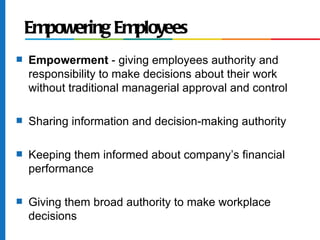
Empowering Employees
s   Empowerment - giving employees authority and
    responsibility to make decisions about their work
    without traditional managerial approval and control

s   Sharing information and decision-making authority

s   Keeping them informed about company’s financial
    performance

s   Giving them broad authority to make workplace
    decisions
Linking Rewards to Company
    Performance
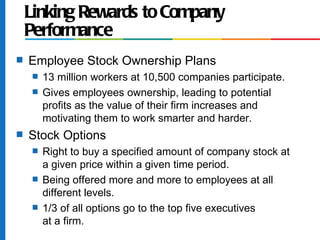
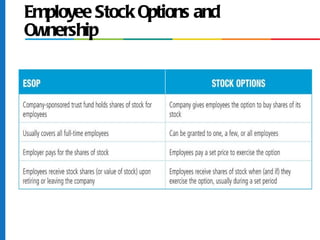
s   Employee Stock Ownership Plans
     s   13 million workers at 10,500 companies participate.
     s   Gives employees ownership, leading to potential
         profits as the value of their firm increases and
         motivating them to work smarter and harder.
s   Stock Options
     s   Right to buy a specified amount of company stock at
         a given price within a given time period.
     s   Being offered more and more to employees at all
         different levels.
     s   1/3 of all options go to the top five executives
         at a firm.
Employee Stock Options and
Ownership
Teams
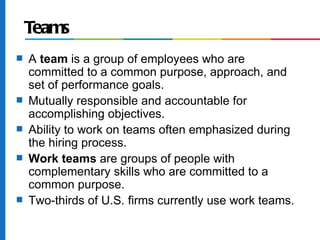
s   A team is a group of employees who are
    committed to a common purpose, approach, and
    set of performance goals.
s   Mutually responsible and accountable for
    accomplishing objectives.
s   Ability to work on teams often emphasized during
    the hiring process.
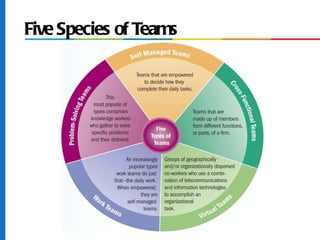
s   Work teams are groups of people with
    complementary skills who are committed to a
    common purpose.
s   Two-thirds of U.S. firms currently use work teams.
Five Species of Teams
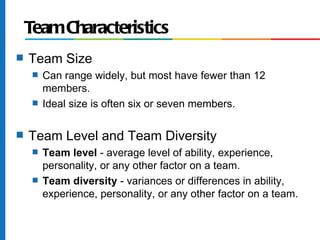
Team Characteristics
s   Team Size
     s   Can range widely, but most have fewer than 12
         members.
     s   Ideal size is often six or seven members.

s   Team Level and Team Diversity
     s   Team level - average level of ability, experience,
         personality, or any other factor on a team.
     s   Team diversity - variances or differences in ability,
         experience, personality, or any other factor on a team.
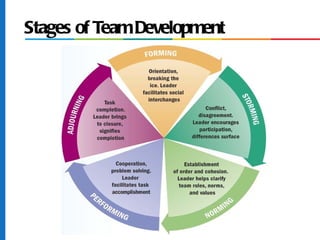
Stages of Team Development
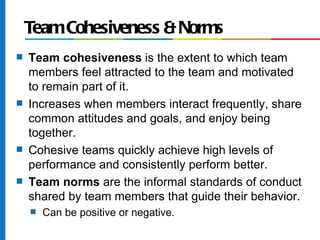
Team Cohesiveness & Norms
s   Team cohesiveness is the extent to which team
    members feel attracted to the team and motivated
    to remain part of it.
s   Increases when members interact frequently, share
    common attitudes and goals, and enjoy being
    together.
s   Cohesive teams quickly achieve high levels of
    performance and consistently perform better.
s   Team norms are the informal standards of conduct
    shared by team members that guide their behavior.
    s   Can be positive or negative.
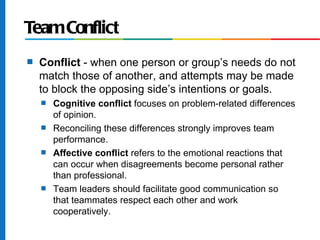
Team Conflict
s   Conflict - when one person or group’s needs do not
    match those of another, and attempts may be made
    to block the opposing side’s intentions or goals.
    s   Cognitive conflict focuses on problem-related differences
        of opinion.
    s   Reconciling these differences strongly improves team
        performance.
    s   Affective conflict refers to the emotional reactions that
        can occur when disagreements become personal rather
        than professional.
    s   Team leaders should facilitate good communication so
        that teammates respect each other and work
        cooperatively.
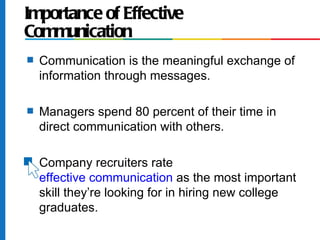
Importance of Effective
Communication
s   Communication is the meaningful exchange of
    information through messages.

s   Managers spend 80 percent of their time in
    direct communication with others.

s   Company recruiters rate
    effective communication as the most important
    skill they’re looking for in hiring new college
    graduates.
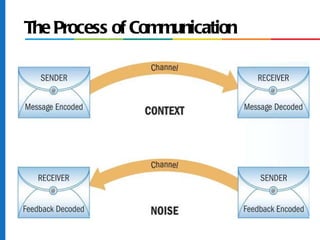
The Process of Communication
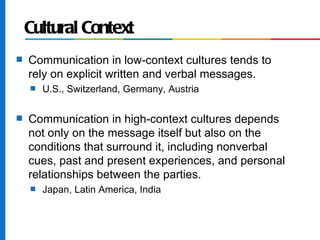
Cultural Context
s   Communication in low-context cultures tends to
    rely on explicit written and verbal messages.
    s   U.S., Switzerland, Germany, Austria

s   Communication in high-context cultures depends
    not only on the message itself but also on the
    conditions that surround it, including nonverbal
    cues, past and present experiences, and personal
    relationships between the parties.
    s   Japan, Latin America, India
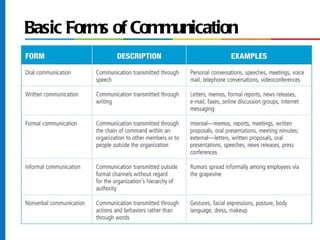
Basic Forms of Communication
Listening
s   Cynical listening: Receiver of a message feels
    that the sender is trying to gain some advantage
    from the communication.
s   Offensive listening: Receiver tries to catch the
    speaker in a mistake or contradiction.
s   Polite listening: Receiver listens mechanically to
    be polite rather than to communicate.
s   Active listening: Requires involvement with the
    information and empathy with the speaker’s
    situation; the basis for effective communication.
Formal Communication
s   Flows within the chain of command

s   Downward communication

s   Upward communication

s   Open and honest communication is key
Open Communication
s   With open communication, employees feel
    free to express opinions, offer suggestions,
    and even voice complaints.
s   7 Characteristics of Open Communication:
    s   Employees are valued
    s   High level of trust exists
    s   Conflict is invited and resolved positively
    s   Creative dissent is welcomed
    s   Employee input is solicited
    s   Employees are well-informed
    s   Feedback is ongoing
Informal Communication
s   Informal communication is to carry
    messages outside formally authorized
    channels.

s   The grapevine is an internal channel
    that passes information from unofficial
    sources.
Nonverbal Communication
s   Nonverbal communication transmits
    messages through actions and behaviors.
s   Gestures, posture, eye contact, tone and
    volume of voice, and even clothing choices are
    all nonverbal actions that become
    communication cues.
s   Have a far greater impact on communications
    than many people realize.
External Communication
s   External communication is a meaningful exchange
    of information to major audiences: customers,
    suppliers, firms, general public, government officials
s   Every communication with customers should
    create goodwill.
s   Communication during crisis:
     s   Respond to crisis quickly.
     s   Put top company management in front of the press.
     s   Stick to the facts.
     s   When you don’t know, offer to find out.
     s   Never say “no comment.”
     s   Speak to your audience.

Chapter 9: Teamwork

  • 1.
    Chapter 9 Top Performance through Empowerment, Teamwork, and Communication
  • 2.
    Learning Goals 1 Describe why and how organizations 5 Describe the factors that cause empower employees. conflict in teams and how to manage conflict. 2 Distinguish among the five types of teams in the workplace. 6 Explain the importance and process of effective communication. 3 Identify the characteristics of an effective team and summarize the stages of team 7 Compare the different types of development. communication. 4 Relate cohesiveness and norms to 8 Explain external communication and effective team performance. how to manage a public crisis.
  • 3.
    Empowering Employees s Empowerment - giving employees authority and responsibility to make decisions about their work without traditional managerial approval and control s Sharing information and decision-making authority s Keeping them informed about company’s financial performance s Giving them broad authority to make workplace decisions
  • 4.
    Linking Rewards toCompany Performance s Employee Stock Ownership Plans s 13 million workers at 10,500 companies participate. s Gives employees ownership, leading to potential profits as the value of their firm increases and motivating them to work smarter and harder. s Stock Options s Right to buy a specified amount of company stock at a given price within a given time period. s Being offered more and more to employees at all different levels. s 1/3 of all options go to the top five executives at a firm.
  • 5.
  • 6.
    Teams s A team is a group of employees who are committed to a common purpose, approach, and set of performance goals. s Mutually responsible and accountable for accomplishing objectives. s Ability to work on teams often emphasized during the hiring process. s Work teams are groups of people with complementary skills who are committed to a common purpose. s Two-thirds of U.S. firms currently use work teams.
  • 7.
  • 8.
    Team Characteristics s Team Size s Can range widely, but most have fewer than 12 members. s Ideal size is often six or seven members. s Team Level and Team Diversity s Team level - average level of ability, experience, personality, or any other factor on a team. s Team diversity - variances or differences in ability, experience, personality, or any other factor on a team.
  • 9.
    Stages of TeamDevelopment
  • 10.
    Team Cohesiveness &Norms s Team cohesiveness is the extent to which team members feel attracted to the team and motivated to remain part of it. s Increases when members interact frequently, share common attitudes and goals, and enjoy being together. s Cohesive teams quickly achieve high levels of performance and consistently perform better. s Team norms are the informal standards of conduct shared by team members that guide their behavior. s Can be positive or negative.
  • 11.
    Team Conflict s Conflict - when one person or group’s needs do not match those of another, and attempts may be made to block the opposing side’s intentions or goals. s Cognitive conflict focuses on problem-related differences of opinion. s Reconciling these differences strongly improves team performance. s Affective conflict refers to the emotional reactions that can occur when disagreements become personal rather than professional. s Team leaders should facilitate good communication so that teammates respect each other and work cooperatively.
  • 12.
    Importance of Effective Communication s Communication is the meaningful exchange of information through messages. s Managers spend 80 percent of their time in direct communication with others. s Company recruiters rate effective communication as the most important skill they’re looking for in hiring new college graduates.
  • 13.
    The Process ofCommunication
  • 14.
    Cultural Context s Communication in low-context cultures tends to rely on explicit written and verbal messages. s U.S., Switzerland, Germany, Austria s Communication in high-context cultures depends not only on the message itself but also on the conditions that surround it, including nonverbal cues, past and present experiences, and personal relationships between the parties. s Japan, Latin America, India
  • 15.
    Basic Forms ofCommunication
  • 16.
    Listening s Cynical listening: Receiver of a message feels that the sender is trying to gain some advantage from the communication. s Offensive listening: Receiver tries to catch the speaker in a mistake or contradiction. s Polite listening: Receiver listens mechanically to be polite rather than to communicate. s Active listening: Requires involvement with the information and empathy with the speaker’s situation; the basis for effective communication.
  • 17.
    Formal Communication s Flows within the chain of command s Downward communication s Upward communication s Open and honest communication is key
  • 18.
    Open Communication s With open communication, employees feel free to express opinions, offer suggestions, and even voice complaints. s 7 Characteristics of Open Communication: s Employees are valued s High level of trust exists s Conflict is invited and resolved positively s Creative dissent is welcomed s Employee input is solicited s Employees are well-informed s Feedback is ongoing
  • 19.
    Informal Communication s Informal communication is to carry messages outside formally authorized channels. s The grapevine is an internal channel that passes information from unofficial sources.
  • 20.
    Nonverbal Communication s Nonverbal communication transmits messages through actions and behaviors. s Gestures, posture, eye contact, tone and volume of voice, and even clothing choices are all nonverbal actions that become communication cues. s Have a far greater impact on communications than many people realize.
  • 21.
    External Communication s External communication is a meaningful exchange of information to major audiences: customers, suppliers, firms, general public, government officials s Every communication with customers should create goodwill. s Communication during crisis: s Respond to crisis quickly. s Put top company management in front of the press. s Stick to the facts. s When you don’t know, offer to find out. s Never say “no comment.” s Speak to your audience.