ORGANIZATION THEORY
Prabesh Ghimire
Organization of Health Service
Public Health Administration and Management
Classical Organization Theory
Developed during industrial revolution
Developed from efforts to find the “best way” to perform
and manage tasks.
Three main theories
• Scientific management theory
• Administrative management theory
• Behavioural theory
Prabesh Ghimire 2
Scientific Management Theory
Aroused because of the need to increase productivity and
efficiency
• How to increase the output of the average worker
• How to improve the efficiency of management
 Major contributors: Frederick Taylor, Henry Gantt, and
Frank and Lillian Gilbreth
Prabesh Ghimire 3
Principles of Scientific Management
Theory
Work, equipment and processes should be standardized
Time and task study should be used to determine the
standards for workers
Selection, training and developing workers instead of
allowing them to choose their own tasks and train
themselves.
Cooperate fully with the workers to ensure they use the
proper method
Divide work and responsibility so management is
responsible for planning work methods using scientific
principles and workers are responsible for executing the
work accordingly.
Prabesh Ghimire 4
Administrative Management Theory
Focused on total organization
Emphasis was on the development of managerial
principles rather than work methods
Major Contributors: Henry Fayol, Max Weber, Mary
Parker Follet…
Prabesh Ghimire 5
Weber’s theory
 Disliked organizations managed on personal family like
basis
• Employees loyal to individual supervisors rather than organization
According to Weber
• management should be managed impersonally
• Formal organization structure, where specific rules are followed is
important
• Authority should be something that was part of a person’s job and
passed from individual to individual as one person left and another
took over
Non-personal objective organization- bureaucracy
Prabesh Ghimire 6
Weber’s theory of bureaucracy
A well-defined hierarchy
• Positions in bureaucracy should be structured in a way the permits
higher positions to supervise and control the lower positions
• Facilitates control and order in organization
Division of labor and job specialization
• Responsibilities should be specialized so that each employee has
the necessary expertise to do a particular task
• Fosters ability and merit as the primary characteristics of a
bureaucratic organization.
Former rules and regulations
• Standard operating procedures should govern all organization
activities to provider certainty and facilitate coordination
Prabesh Ghimire 7
Weber’s theory of bureaucracy
Impersonality
• Managers should maintain impersonal relationship with employees
so that favoritism and personal prejudice do not influence decisions
Competence
• Staffs are selected and appointed based on technical qualifications
and ability, rather than personal loyalty and relationships
Records
• Bureaucracy needs to maintain complete files regarding all its
activities
Prabesh Ghimire 8
Fayol’s Principles of Management
1. Division of work
2. Authority and
responsibility
3. Discipline
4. Unity of command
5. Unity of direction
6. Remuneration
7. Subordination of personal
interest to general interest
8. Centralization
9. Scalar chain
10. Order
11. Equity
12. Stability of tenure
13. Esprit de corps
14. Initiative
Prabesh Ghimire 9
Behavioural theories of Management
Successful organization depends largely on a manager’s
ability to understand and work with people.
Addresses human dimensions of work: motivation,
leadership, trust, teamwork and conflict management.
Major contributors: Mayo and Roethlsberger, Maslow, Mc
Gregor
Major contributions
• Hawthrone Experiement
• Maslow’s Need Hierarchy Theory
• Mc Gregor Theory of X & Y
• Herzberg’s Motivation Hygiene Theory
Prabesh Ghimire 10
Hawthrone Experiment
Organization is a social system not just techno-economic
system.
Employers can be motivate by psychological and social
wants because their behaviour is also influenced by
feelings, emotions and attitudes
Economic incentives are not the only method to motivate
people
Management must learn to develop co-operative attitudes
and not rely merely on command.
Prabesh Ghimire 11
Hawthrone Experiment
Productivity is linked with employee satisfaction.
Management must take greater interest in employee
satisfaction
Group psychology plays important role in organization.
We must therefore rely more on informal group effort
Key to higher productivity lies in employee morale. High
morale results in higher output
Prabesh Ghimire 12
Maslow’s need hierarchy theory
Theory of motivation
Considerations on five groups of human needs
Assumptions
Human needs are never completely satisfied
Human behaviour is purposeful and is motivated by the
need for satisfaction
Needs can be classified according to a hierarchical
structure of importance, from the lowest to highest
Prabesh Ghimire 13
Mc Gregor’s theory X and Y
Dichotomy about the assumptions managers make about
the workers and how these assumptions affect behaviour
Two basic kinds of manager exists
• Theory X manager
• Theory Y manager
Hard guy, soft guy approach of managing people in the
organization.
Prabesh Ghimire 14
Mc Gregor’s theory X and Y
Theory X
Negative assumptions about employee
Assumes that average person has an inherent dislike for
work and will avoid if they can
Employees are lazy, untrustworthy and incapable for
assuming responsibilities
They must be coerced, controlled, directed and
threatened with punishment to get them put forth
adequate efforts towards achievement of organization
objectives
Average employee prefer to be directed. They wish to
avoid responsibility and have little ambition. They are
interested only in security
Prabesh Ghimire 15
Mc Gregor’s theory X and Y
Theory Y
Work is as natural as play or rest if the conditions are
favorable
Employees are not only trustworthy and capable of
assuming responsibility, but also have high levels of
motivation.
People will exercise self-direction and self-control to
achieve organizational objectives to which they are
committed
Prabesh Ghimire 16
Applications of Classical Theory in
Health Care Organizations
Prabesh Ghimire 17
Scientific Management Theory
Hospitals using scientific management can design the
management structure, staffing and number of beds allocated
to particular units to care for a specific number of patients per
year.
Scientific management driven health care organizations can
evaluate health workers’ performance based on performance
indicators including productivity, number of patients seen
Process standardization are widely practiced to ensure health
care quality and efficiency: e.g. standards for Reproductive
Health services, standards for administration of vaccines
Work standardization are important in health organizations:
duty shifts, code of conduct, health ethics
Prabesh Ghimire 18
Applications of Bureaucratic Theory
 Job specialization should be very explicit in health care
organizations
• General practitioners, Specialist, Nursing, Radiology
Use of standard operating procedures are critical
components of health care procedures
• E.g. core competency steps to be followed for assisting birth
• SOPs for effective vaccine management
• SOPs for storage
Recently, Information management systems have been
an essential part of health care organizations
• HMIS, LMIS, FMIS, TIMS, IMIS
Impersonality and competence is must in health care-
specialized field (life vs death)
Prabesh Ghimire 19
Modern Organization Theory
Prabesh Ghimire 20
Modern Organization Theory
Considers an organization as an adaptive system which
has to adjust to changes in its environment.
Organization is viewed as a structured process in which
individuals interact for attaining objectives
Major theories
• Systems theory
• Contingency theory
Prabesh Ghimire 21
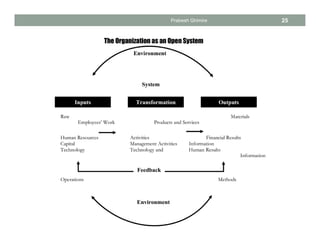
Systems management theory
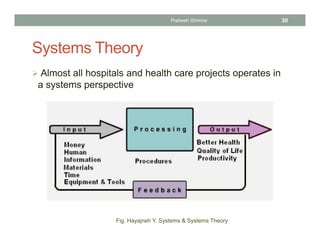
System: Interconnected and interrelated set of elements
functioning as a whole
Every system is goal-oriented and it must have a purpose
or objective to be attained
In designing the system we must establish the necessary
arrangement of the components
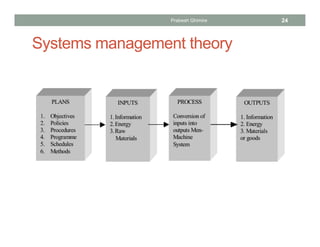
Inputs of information, material and energy allocated for
processing as per plan so that outputs can achieve the
objective of the system
Prabesh Ghimire 22
Systems management theory
Organization as a system is composed of five
elements
• Inputs- human, finance, material, equipment,
information
• Transformational processes- technological and
managerial
• Outputs- products or services
• Feedback- reaction from the environment
• Environment
Prabesh Ghimire 23
Prabesh Ghimire 24
Systems management theory
Prabesh Ghimire 25
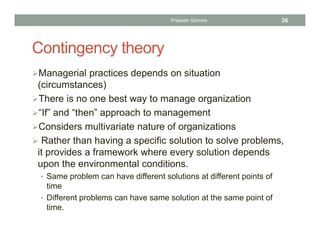
Contingency theory
Managerial practices depends on situation
(circumstances)
There is no one best way to manage organization
“If” and “then” approach to management
Considers multivariate nature of organizations
 Rather than having a specific solution to solve problems,
it provides a framework where every solution depends
upon the environmental conditions.
• Same problem can have different solutions at different points of
time
• Different problems can have same solution at the same point of
time.
Prabesh Ghimire 26
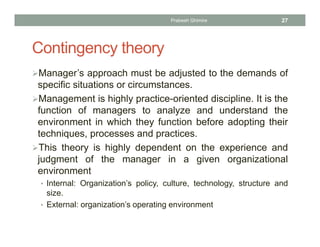
Contingency theory
Manager’s approach must be adjusted to the demands of
specific situations or circumstances.
Management is highly practice-oriented discipline. It is the
function of managers to analyze and understand the
environment in which they function before adopting their
techniques, processes and practices.
This theory is highly dependent on the experience and
judgment of the manager in a given organizational
environment
• Internal: Organization’s policy, culture, technology, structure and
size.
• External: organization’s operating environment
Prabesh Ghimire 27
Applications of Modern Theory in
Health Care Organizations
Prabesh Ghimire 28
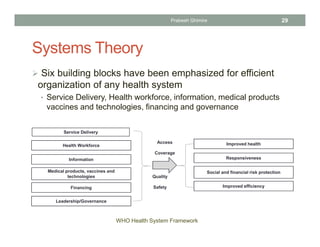
Systems Theory
 Six building blocks have been emphasized for efficient
organization of any health system
• Service Delivery, Health workforce, information, medical products
vaccines and technologies, financing and governance
Prabesh Ghimire 29
Service Delivery
Health Workforce
Information
Medical products, vaccines and
technologies
Financing
Leadership/Governance
Improved health
Responsiveness
Social and financial risk protection
Improved efficiency
Access
Coverage
Quality
Safety
WHO Health System Framework
Systems Theory
 Almost all hospitals and health care projects operates in
a systems perspective
Prabesh Ghimire 30
Fig. Hayajneh Y. Systems & Systems Theory
Contingency theory
Health care organization operates in highly unpredictable
situation (outbreaks, PH emergencies, disaster)
Health managers during emergency must build an
organizational culture and structure that improvises and
acknowledges that each disaster is unique.
More dynamic organizational structure could be
structured based on the nature of the problem (hazard)
and who needs to be involved and the actions taken.
Prabesh Ghimire 31
32
Queries & Discussion………
Prabesh Ghimire

Organization Theory

  • 1.
    ORGANIZATION THEORY Prabesh Ghimire Organizationof Health Service Public Health Administration and Management
  • 2.
    Classical Organization Theory Developedduring industrial revolution Developed from efforts to find the “best way” to perform and manage tasks. Three main theories • Scientific management theory • Administrative management theory • Behavioural theory Prabesh Ghimire 2
  • 3.
    Scientific Management Theory Arousedbecause of the need to increase productivity and efficiency • How to increase the output of the average worker • How to improve the efficiency of management  Major contributors: Frederick Taylor, Henry Gantt, and Frank and Lillian Gilbreth Prabesh Ghimire 3
  • 4.
    Principles of ScientificManagement Theory Work, equipment and processes should be standardized Time and task study should be used to determine the standards for workers Selection, training and developing workers instead of allowing them to choose their own tasks and train themselves. Cooperate fully with the workers to ensure they use the proper method Divide work and responsibility so management is responsible for planning work methods using scientific principles and workers are responsible for executing the work accordingly. Prabesh Ghimire 4
  • 5.
    Administrative Management Theory Focusedon total organization Emphasis was on the development of managerial principles rather than work methods Major Contributors: Henry Fayol, Max Weber, Mary Parker Follet… Prabesh Ghimire 5
  • 6.
    Weber’s theory  Dislikedorganizations managed on personal family like basis • Employees loyal to individual supervisors rather than organization According to Weber • management should be managed impersonally • Formal organization structure, where specific rules are followed is important • Authority should be something that was part of a person’s job and passed from individual to individual as one person left and another took over Non-personal objective organization- bureaucracy Prabesh Ghimire 6
  • 7.
    Weber’s theory ofbureaucracy A well-defined hierarchy • Positions in bureaucracy should be structured in a way the permits higher positions to supervise and control the lower positions • Facilitates control and order in organization Division of labor and job specialization • Responsibilities should be specialized so that each employee has the necessary expertise to do a particular task • Fosters ability and merit as the primary characteristics of a bureaucratic organization. Former rules and regulations • Standard operating procedures should govern all organization activities to provider certainty and facilitate coordination Prabesh Ghimire 7
  • 8.
    Weber’s theory ofbureaucracy Impersonality • Managers should maintain impersonal relationship with employees so that favoritism and personal prejudice do not influence decisions Competence • Staffs are selected and appointed based on technical qualifications and ability, rather than personal loyalty and relationships Records • Bureaucracy needs to maintain complete files regarding all its activities Prabesh Ghimire 8
  • 9.
    Fayol’s Principles ofManagement 1. Division of work 2. Authority and responsibility 3. Discipline 4. Unity of command 5. Unity of direction 6. Remuneration 7. Subordination of personal interest to general interest 8. Centralization 9. Scalar chain 10. Order 11. Equity 12. Stability of tenure 13. Esprit de corps 14. Initiative Prabesh Ghimire 9
  • 10.
    Behavioural theories ofManagement Successful organization depends largely on a manager’s ability to understand and work with people. Addresses human dimensions of work: motivation, leadership, trust, teamwork and conflict management. Major contributors: Mayo and Roethlsberger, Maslow, Mc Gregor Major contributions • Hawthrone Experiement • Maslow’s Need Hierarchy Theory • Mc Gregor Theory of X & Y • Herzberg’s Motivation Hygiene Theory Prabesh Ghimire 10
  • 11.
    Hawthrone Experiment Organization isa social system not just techno-economic system. Employers can be motivate by psychological and social wants because their behaviour is also influenced by feelings, emotions and attitudes Economic incentives are not the only method to motivate people Management must learn to develop co-operative attitudes and not rely merely on command. Prabesh Ghimire 11
  • 12.
    Hawthrone Experiment Productivity islinked with employee satisfaction. Management must take greater interest in employee satisfaction Group psychology plays important role in organization. We must therefore rely more on informal group effort Key to higher productivity lies in employee morale. High morale results in higher output Prabesh Ghimire 12
  • 13.
    Maslow’s need hierarchytheory Theory of motivation Considerations on five groups of human needs Assumptions Human needs are never completely satisfied Human behaviour is purposeful and is motivated by the need for satisfaction Needs can be classified according to a hierarchical structure of importance, from the lowest to highest Prabesh Ghimire 13
  • 14.
    Mc Gregor’s theoryX and Y Dichotomy about the assumptions managers make about the workers and how these assumptions affect behaviour Two basic kinds of manager exists • Theory X manager • Theory Y manager Hard guy, soft guy approach of managing people in the organization. Prabesh Ghimire 14
  • 15.
    Mc Gregor’s theoryX and Y Theory X Negative assumptions about employee Assumes that average person has an inherent dislike for work and will avoid if they can Employees are lazy, untrustworthy and incapable for assuming responsibilities They must be coerced, controlled, directed and threatened with punishment to get them put forth adequate efforts towards achievement of organization objectives Average employee prefer to be directed. They wish to avoid responsibility and have little ambition. They are interested only in security Prabesh Ghimire 15
  • 16.
    Mc Gregor’s theoryX and Y Theory Y Work is as natural as play or rest if the conditions are favorable Employees are not only trustworthy and capable of assuming responsibility, but also have high levels of motivation. People will exercise self-direction and self-control to achieve organizational objectives to which they are committed Prabesh Ghimire 16
  • 17.
    Applications of ClassicalTheory in Health Care Organizations Prabesh Ghimire 17
  • 18.
    Scientific Management Theory Hospitalsusing scientific management can design the management structure, staffing and number of beds allocated to particular units to care for a specific number of patients per year. Scientific management driven health care organizations can evaluate health workers’ performance based on performance indicators including productivity, number of patients seen Process standardization are widely practiced to ensure health care quality and efficiency: e.g. standards for Reproductive Health services, standards for administration of vaccines Work standardization are important in health organizations: duty shifts, code of conduct, health ethics Prabesh Ghimire 18
  • 19.
    Applications of BureaucraticTheory  Job specialization should be very explicit in health care organizations • General practitioners, Specialist, Nursing, Radiology Use of standard operating procedures are critical components of health care procedures • E.g. core competency steps to be followed for assisting birth • SOPs for effective vaccine management • SOPs for storage Recently, Information management systems have been an essential part of health care organizations • HMIS, LMIS, FMIS, TIMS, IMIS Impersonality and competence is must in health care- specialized field (life vs death) Prabesh Ghimire 19
  • 20.
  • 21.
    Modern Organization Theory Considersan organization as an adaptive system which has to adjust to changes in its environment. Organization is viewed as a structured process in which individuals interact for attaining objectives Major theories • Systems theory • Contingency theory Prabesh Ghimire 21
  • 22.
    Systems management theory System:Interconnected and interrelated set of elements functioning as a whole Every system is goal-oriented and it must have a purpose or objective to be attained In designing the system we must establish the necessary arrangement of the components Inputs of information, material and energy allocated for processing as per plan so that outputs can achieve the objective of the system Prabesh Ghimire 22
  • 23.
    Systems management theory Organizationas a system is composed of five elements • Inputs- human, finance, material, equipment, information • Transformational processes- technological and managerial • Outputs- products or services • Feedback- reaction from the environment • Environment Prabesh Ghimire 23
  • 24.
    Prabesh Ghimire 24 Systemsmanagement theory
  • 25.
  • 26.
    Contingency theory Managerial practicesdepends on situation (circumstances) There is no one best way to manage organization “If” and “then” approach to management Considers multivariate nature of organizations  Rather than having a specific solution to solve problems, it provides a framework where every solution depends upon the environmental conditions. • Same problem can have different solutions at different points of time • Different problems can have same solution at the same point of time. Prabesh Ghimire 26
  • 27.
    Contingency theory Manager’s approachmust be adjusted to the demands of specific situations or circumstances. Management is highly practice-oriented discipline. It is the function of managers to analyze and understand the environment in which they function before adopting their techniques, processes and practices. This theory is highly dependent on the experience and judgment of the manager in a given organizational environment • Internal: Organization’s policy, culture, technology, structure and size. • External: organization’s operating environment Prabesh Ghimire 27
  • 28.
    Applications of ModernTheory in Health Care Organizations Prabesh Ghimire 28
  • 29.
    Systems Theory  Sixbuilding blocks have been emphasized for efficient organization of any health system • Service Delivery, Health workforce, information, medical products vaccines and technologies, financing and governance Prabesh Ghimire 29 Service Delivery Health Workforce Information Medical products, vaccines and technologies Financing Leadership/Governance Improved health Responsiveness Social and financial risk protection Improved efficiency Access Coverage Quality Safety WHO Health System Framework
  • 30.
    Systems Theory  Almostall hospitals and health care projects operates in a systems perspective Prabesh Ghimire 30 Fig. Hayajneh Y. Systems & Systems Theory
  • 31.
    Contingency theory Health careorganization operates in highly unpredictable situation (outbreaks, PH emergencies, disaster) Health managers during emergency must build an organizational culture and structure that improvises and acknowledges that each disaster is unique. More dynamic organizational structure could be structured based on the nature of the problem (hazard) and who needs to be involved and the actions taken. Prabesh Ghimire 31
  • 32.