The Changing Face
of Business
Chapter 1
Define what is business.
Identify and describe the factors of
production.
Describe the private enterprise system.
Identify the six eras in the history of
business.
1
Learning Objectives
Explain how today’s business
workforce and the nature of work
itself is changing.
Identify the skills and attributes
needed for the 21st
century manager.
Outline the characteristics that make
a company admired .
2
3
4
5
6
7
Profit-seeking activities and enterprises provide
goods and services necessary to an economic
system.
Profit-seeking is the reward for business people
who take the risk involved to offer goods and
services to customers.
See Fortune 500 for a list of major U.S.
companies.
What is Business?
– Not-for-profit organizations are business-like
establishments that have primary objectives
other than profits.
Although they place public service over profit
making, they still need money to achieve their
goals
These organizations are a major part of the U.S.
economy
Not-For-Profit Organizations
Factors of Production
Natural Resources
Capital
Human Resources
Entrepreneurship
Occupational Outlook Handbook
Capitalism
Adam Smith is the father of capitalism.
“Invisible Hand”
Economic system determines business
ownership, profits, and resources
Rewards firms for their ability to serve the needs
of consumers
Minimized government intervention
Competition is the battle among businesses for
consumer acceptance.
The Private Enterprise System
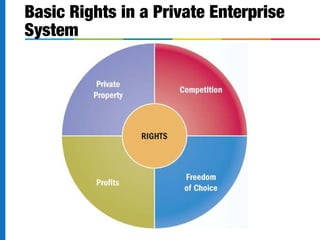
Basic Rights in a Private Enterprise
System
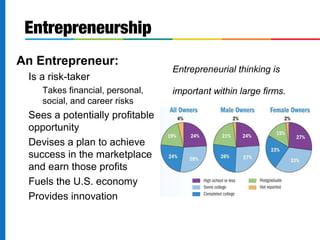
An Entrepreneur:
Is a risk-taker
Takes financial, personal,
social, and career risks
Sees a potentially profitable
opportunity
Devises a plan to achieve
success in the marketplace
and earn those profits
Fuels the U.S. economy
Provides innovation
Entrepreneurship
Entrepreneurial thinking is
important within large firms.
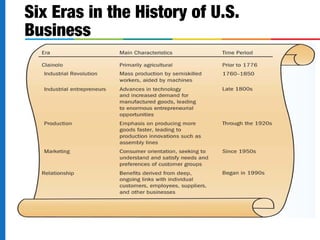
Six Eras in the History of U.S.
Business
Relationship Management
Activities to build and maintain mutually
beneficial ties with customers and other parties
Relationship management depends
on technology.
Managing Relationships through
Connections
A partnership is an affiliation of two or
more companies that help each other
achieve common goals.
A strategic alliance is a partnership
formed to create a competitive advantage
for both parties (see Amazon).
Strategic Alliances and
Partnerships
Dedicated workers who can foster strong
ties with customers
Capable of high-quality production
Able to compete in global markets
Technically savvy
Today’s Business Workforce
By 2030, the number of U.S. workers 65 or
older will reach 72 million.
Many baby boomers are hitting the peak of
their careers, while Generations X and Y are
launching their careers.
Technology has intensified the hiring
challenge by requiring workers to have ever
more advanced skills.
U.S. Census Bureau
Changes in the Workforce:
Aging Population
Economists predict the U.S. labor pool could
soon fall short by as many as 10 million
people.
The two fastest-growing ethnic populations in
the United States are Hispanics and people of
Asian origin.
Employee teams with individuals of different
genders, ethnic backgrounds, cultures,
religions, ages, and physical and mental
abilities are more effective.
Changes in the Workforce:
Shrinking Labor Pool/Diversity
Outsourcing is using outside vendors to
produce goods or fulfill services and functions
that were previously handled in-house or in-
country.
Offshoring is the relocation of business
processes to lower-cost locations overseas.
Changes in the Workforce:
Outsourcing
Younger workers are looking to something
other than work-comes-first
Telecommuting and job-sharing
Part-time and temporary workers are growing
Collaboration is replacing working alone
Value risk-taking and innovation
Changes in the Workforce:
Flexibility and
Innovation through Collaboration
Critical-thinking
Creativity
Ability to lead change
Vision
The 21st
-Century Manager
Critical thinking is the ability to analyze and
assess information to pinpoint problems or
opportunities.
Creativity is the capacity to develop novel
solutions to perceived organizational
problems.
Critical Thinking and Creativity
Guide employees and organizations through
changes
Managers must be comfortable with tough
decisions.
Factors that require organizational change
can come from external and internal sources.
Ability to Lead Change
Solid profits
Stable growth
Safe and challenging work environment
High-quality goods and services
Business ethics and social responsibility
Fortune’s list of Most Admired Companies
What Makes a Company Admired?
New Technologies
Population Shifts
Emerging nations
Shrinking Global Barriers
Trade, communication, transportation
The Future of Business

Boone 15e student_ppt_ch01

  • 1.
    The Changing Face ofBusiness Chapter 1
  • 2.
    Define what isbusiness. Identify and describe the factors of production. Describe the private enterprise system. Identify the six eras in the history of business. 1 Learning Objectives Explain how today’s business workforce and the nature of work itself is changing. Identify the skills and attributes needed for the 21st century manager. Outline the characteristics that make a company admired . 2 3 4 5 6 7
  • 3.
    Profit-seeking activities andenterprises provide goods and services necessary to an economic system. Profit-seeking is the reward for business people who take the risk involved to offer goods and services to customers. See Fortune 500 for a list of major U.S. companies. What is Business?
  • 4.
    – Not-for-profit organizationsare business-like establishments that have primary objectives other than profits. Although they place public service over profit making, they still need money to achieve their goals These organizations are a major part of the U.S. economy Not-For-Profit Organizations
  • 5.
    Factors of Production NaturalResources Capital Human Resources Entrepreneurship Occupational Outlook Handbook
  • 6.
    Capitalism Adam Smith isthe father of capitalism. “Invisible Hand” Economic system determines business ownership, profits, and resources Rewards firms for their ability to serve the needs of consumers Minimized government intervention Competition is the battle among businesses for consumer acceptance. The Private Enterprise System
  • 7.
    Basic Rights ina Private Enterprise System
  • 8.
    An Entrepreneur: Is arisk-taker Takes financial, personal, social, and career risks Sees a potentially profitable opportunity Devises a plan to achieve success in the marketplace and earn those profits Fuels the U.S. economy Provides innovation Entrepreneurship Entrepreneurial thinking is important within large firms.
  • 9.
    Six Eras inthe History of U.S. Business
  • 10.
    Relationship Management Activities tobuild and maintain mutually beneficial ties with customers and other parties Relationship management depends on technology. Managing Relationships through Connections
  • 11.
    A partnership isan affiliation of two or more companies that help each other achieve common goals. A strategic alliance is a partnership formed to create a competitive advantage for both parties (see Amazon). Strategic Alliances and Partnerships
  • 12.
    Dedicated workers whocan foster strong ties with customers Capable of high-quality production Able to compete in global markets Technically savvy Today’s Business Workforce
  • 13.
    By 2030, thenumber of U.S. workers 65 or older will reach 72 million. Many baby boomers are hitting the peak of their careers, while Generations X and Y are launching their careers. Technology has intensified the hiring challenge by requiring workers to have ever more advanced skills. U.S. Census Bureau Changes in the Workforce: Aging Population
  • 14.
    Economists predict theU.S. labor pool could soon fall short by as many as 10 million people. The two fastest-growing ethnic populations in the United States are Hispanics and people of Asian origin. Employee teams with individuals of different genders, ethnic backgrounds, cultures, religions, ages, and physical and mental abilities are more effective. Changes in the Workforce: Shrinking Labor Pool/Diversity
  • 15.
    Outsourcing is usingoutside vendors to produce goods or fulfill services and functions that were previously handled in-house or in- country. Offshoring is the relocation of business processes to lower-cost locations overseas. Changes in the Workforce: Outsourcing
  • 16.
    Younger workers arelooking to something other than work-comes-first Telecommuting and job-sharing Part-time and temporary workers are growing Collaboration is replacing working alone Value risk-taking and innovation Changes in the Workforce: Flexibility and Innovation through Collaboration
  • 17.
    Critical-thinking Creativity Ability to leadchange Vision The 21st -Century Manager
  • 18.
    Critical thinking isthe ability to analyze and assess information to pinpoint problems or opportunities. Creativity is the capacity to develop novel solutions to perceived organizational problems. Critical Thinking and Creativity
  • 19.
    Guide employees andorganizations through changes Managers must be comfortable with tough decisions. Factors that require organizational change can come from external and internal sources. Ability to Lead Change
  • 20.
    Solid profits Stable growth Safeand challenging work environment High-quality goods and services Business ethics and social responsibility Fortune’s list of Most Admired Companies What Makes a Company Admired?
  • 21.
    New Technologies Population Shifts Emergingnations Shrinking Global Barriers Trade, communication, transportation The Future of Business