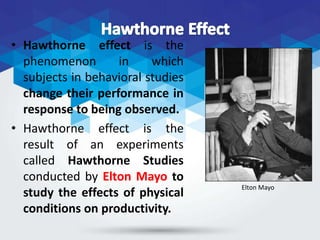
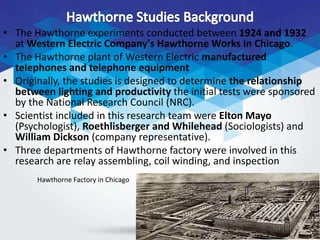
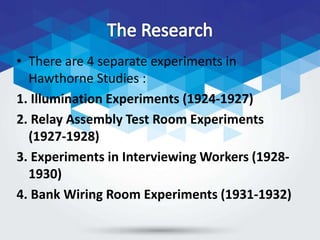
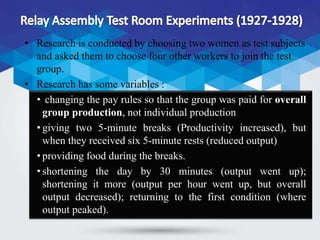
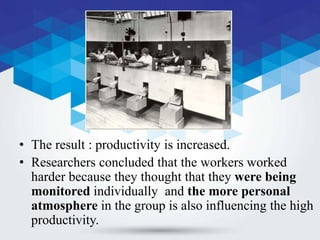
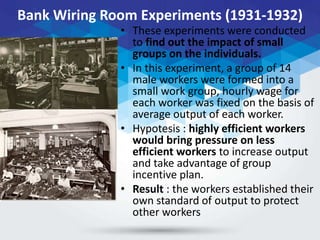
The Hawthorne Studies conducted in the 1920s and 1930s at the Hawthorne Works of Western Electric found that increased productivity resulted from workers being observed, not from changes in physical working conditions. Multiple experiments tested factors like lighting, breaks, and payment incentives, but productivity rose regardless, suggesting the influence of the social environment. The studies demonstrated that human relations and morale in the workplace are important for motivation and output.







![[EN].CleverGroup Vietnam Profile 20251202](https://cdn.slidesharecdn.com/ss_thumbnails/en-260120091417-fe6f88ec-thumbnail.jpg?width=640&height=640&fit=bounds)


