Chapter   11

          Customer-Driven Marketing
Learning Objectives

1   Summarize the ways in which marketing     5   Describe the marketing research
    creates utility.                              function.

2   Discuss the marketing concept.            6   Identify and explain the methods
                                                  available for segmenting consumer
3   Describe not-for-profit marketing, and        and business markets.
    identify the five major categories of
    nontraditional marketing.                 7   Outline the determinants
                                                  of consumer behavior.
4   Outline the basic steps in developing a
    marketing strategy.                       8   Discuss the benefits and
                                                  tools for relationship
                                                  marketing.
W Is Marketing?
     hat
s   Marketing- set of processes for creating,
    communicating, and delivering value to customers and
    for managing customer relationships in ways that benefit
    the organization and its stakeholders.
    s   Marketing begins with discovering unmet customer needs and
        continues with researching the potential market; producing a good
        or service capable of satisfying the targeted customers; and
        promoting, pricing, and distributing that good or service.
    s   Throughout the entire marketing process, a successful organization
        focuses on building customer relationships.
    s   The best marketers not only give consumers what they want but
        even anticipate consumers’ needs before those needs surface.
s   Exchange process- activity in which two or more parties
    give something of value to each other to satisfy
    perceived needs.
How Marketing Creates Utility
s   Utility: power of a good or service to satisfy a
    want or need

s   Create time utility by making a good or service
    available when customers want to purchase it.
s   Create place utility by making a product
    available in a location convenient for customers.
s   Create ownership utility through an orderly
    transfer of goods and services from the seller to
    the buyer.
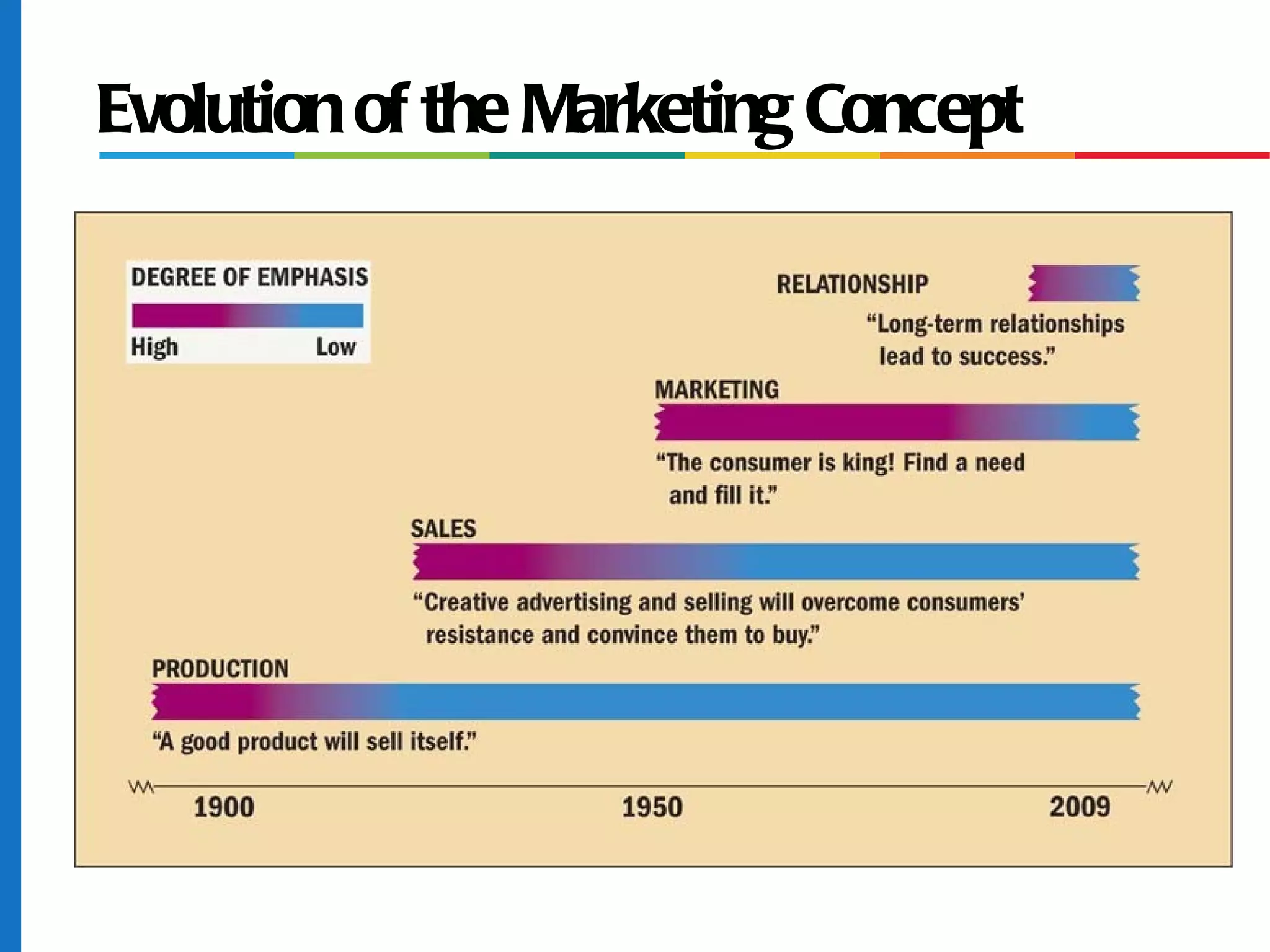
Evolution of the Marketing Concept
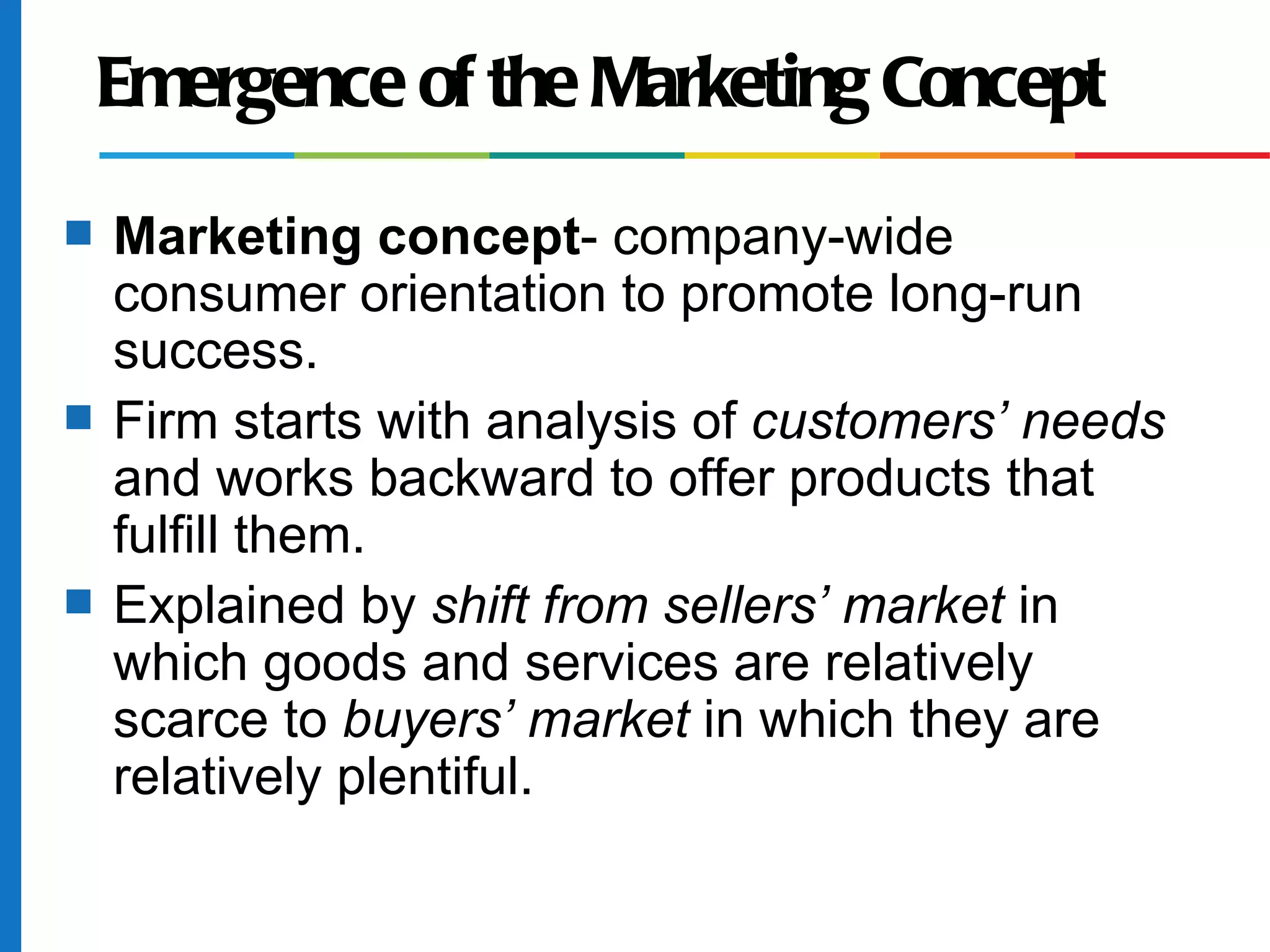
Emergence of the Marketing Concept
s   Marketing concept- company-wide
    consumer orientation to promote long-run
    success.
s   Firm starts with analysis of customers’ needs
    and works backward to offer products that
    fulfill them.
s   Explained by shift from sellers’ market in
    which goods and services are relatively
    scarce to buyers’ market in which they are
    relatively plentiful.
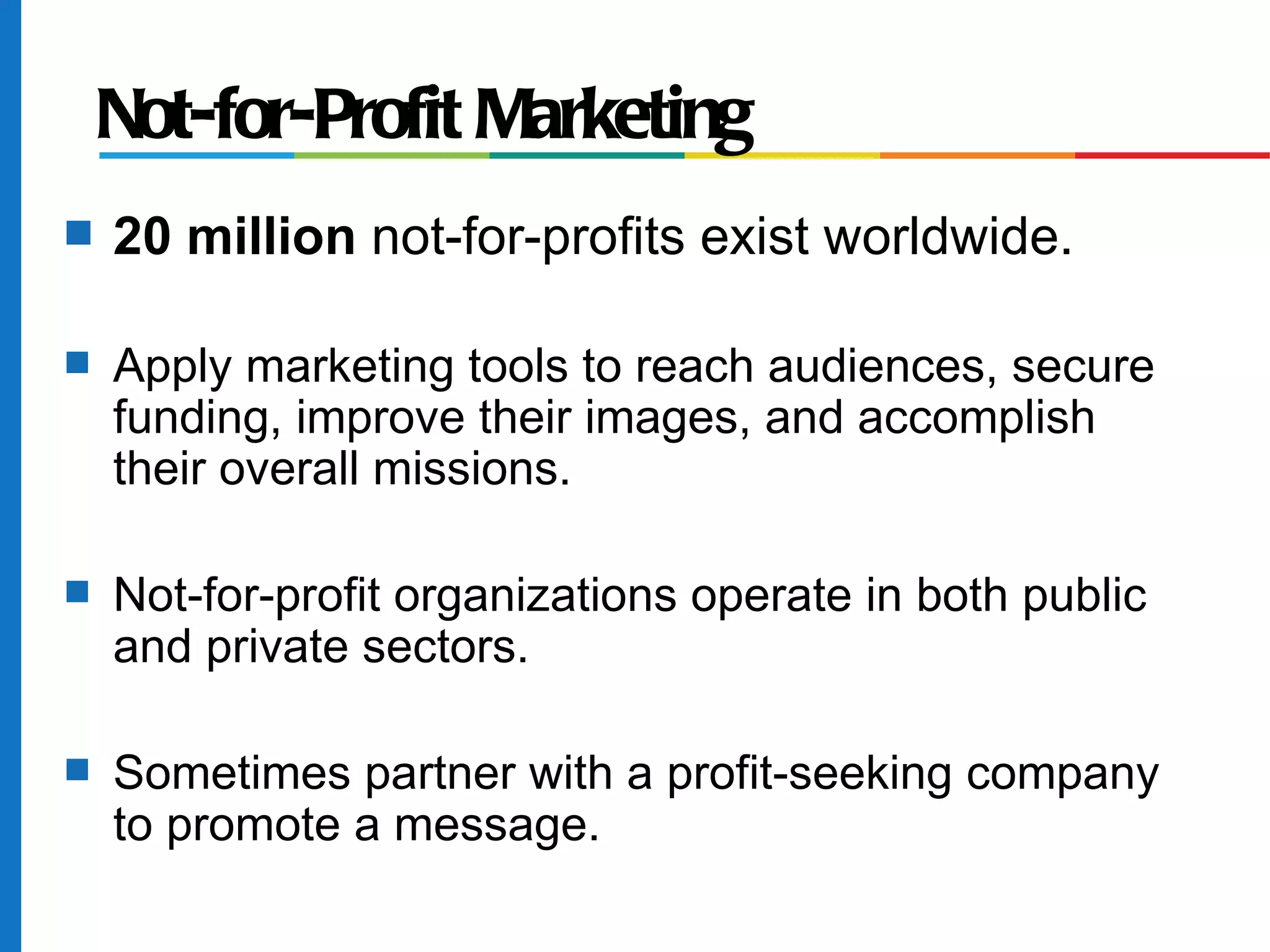
Not-for-Profit Marketing
s   20 million not-for-profits exist worldwide.

s   Apply marketing tools to reach audiences, secure
    funding, improve their images, and accomplish
    their overall missions.

s   Not-for-profit organizations operate in both public
    and private sectors.

s   Sometimes partner with a profit-seeking company
    to promote a message.
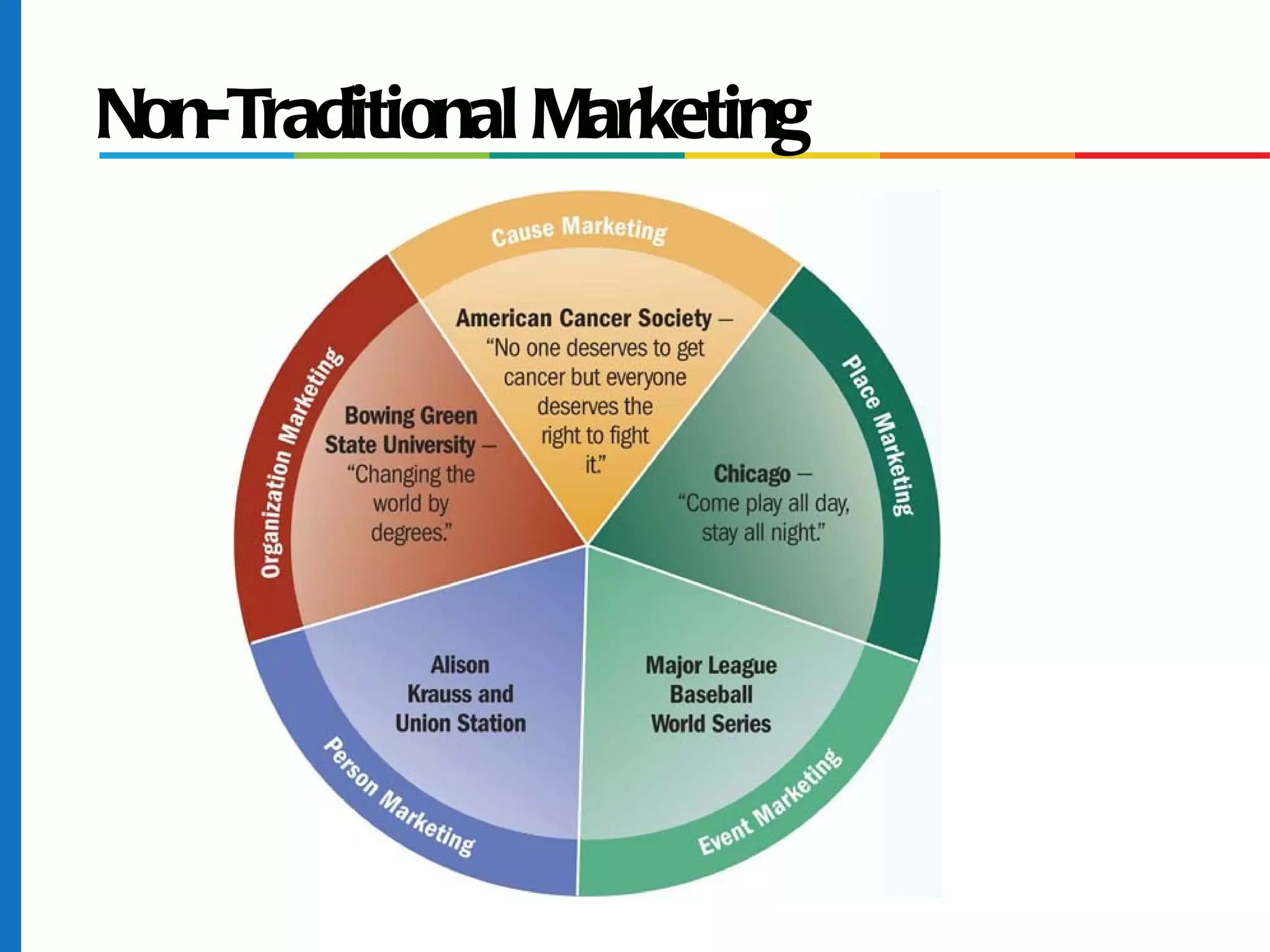
Non-Traditional Marketing
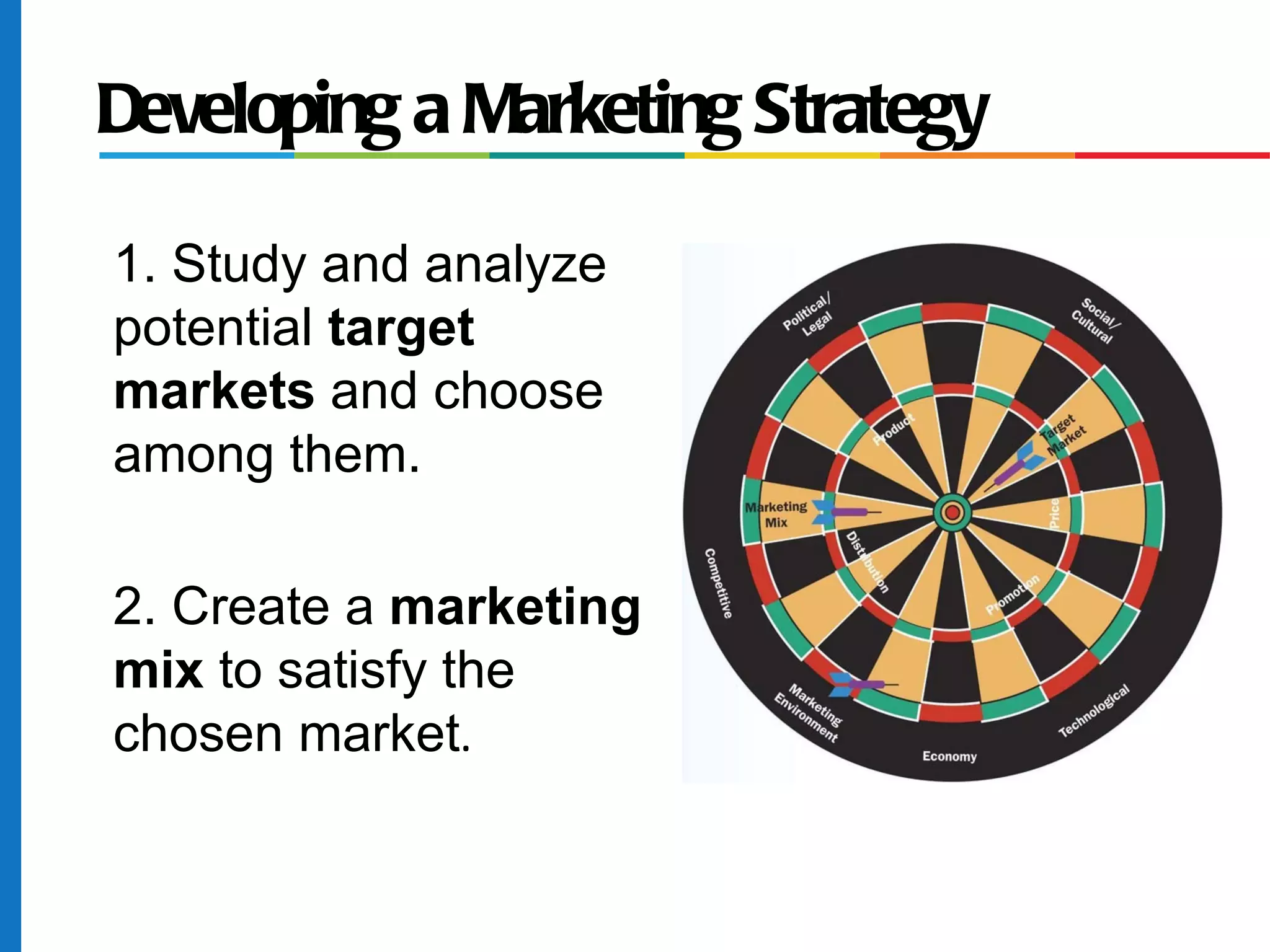
Developing a Marketing Strategy

1. Study and analyze
potential target
markets and choose
among them.

2. Create a marketing
mix to satisfy the
chosen market.
Selecting a Target Market
s   Target market- group of people toward whom an
    organization markets its goods, services, or ideas
    with a strategy designed to satisfy their specific
    needs and preferences.

s   Types of Markets
    s   consumer (B2C) product: good or service that is
        purchased by end users
    s   business (B2B) product: good or service purchased to be
        used, either directly or indirectly, in the production of
        other goods for resale
Marketing Mix
s   Marketing Mix blends the four strategies to fit the
    needs and preferences of a specific target market.
    → Product strategy involves the nature of the product and its
      package design, brand names, trademarks, and product
      image.
    → Distribution strategy ensures that customers receive their
      purchases in the proper quantities at the right times and
      locations.
    → Promotional strategy blends advertising, personal selling,
      sales promotion, and public relations to achieve its goals of
      informing, persuading, and influencing purchase decisions.
    → Pricing strategy is setting profitable and justifiable prices for
      the firm’s product offerings, sometimes subject to
      government scrutiny.
Marketing Mix for International
Markets
s   Standardization- offering the same marketing
    mix in every market.
s   Adaptation- developing a unique marketing
    mix to fit each market’s local competitive
    conditions, consumer preferences, and
    government regulations.
s   Mass customization- allows a firm to mass
    produce goods and services while adding
    unique features to individual or small groups of
    orders.
Marketing Research
s   Marketing research– the process of collecting and
    evaluating information to support marketing decision
    making. AC Nielson– Consumer Research
s   Secondary data– Previously published data from trade
    associations, advertising agencies, marketing research
    firms, and other sources.
s   Primary data– Data collected through observation,
    surveys, and other forms of observational study.
s   Data mining– computer searches of customer data to
    detect patterns and relationships.
s   Business intelligence– activities and technologies for
    gathering, storing, and analyzing data to make better
    competitive decisions
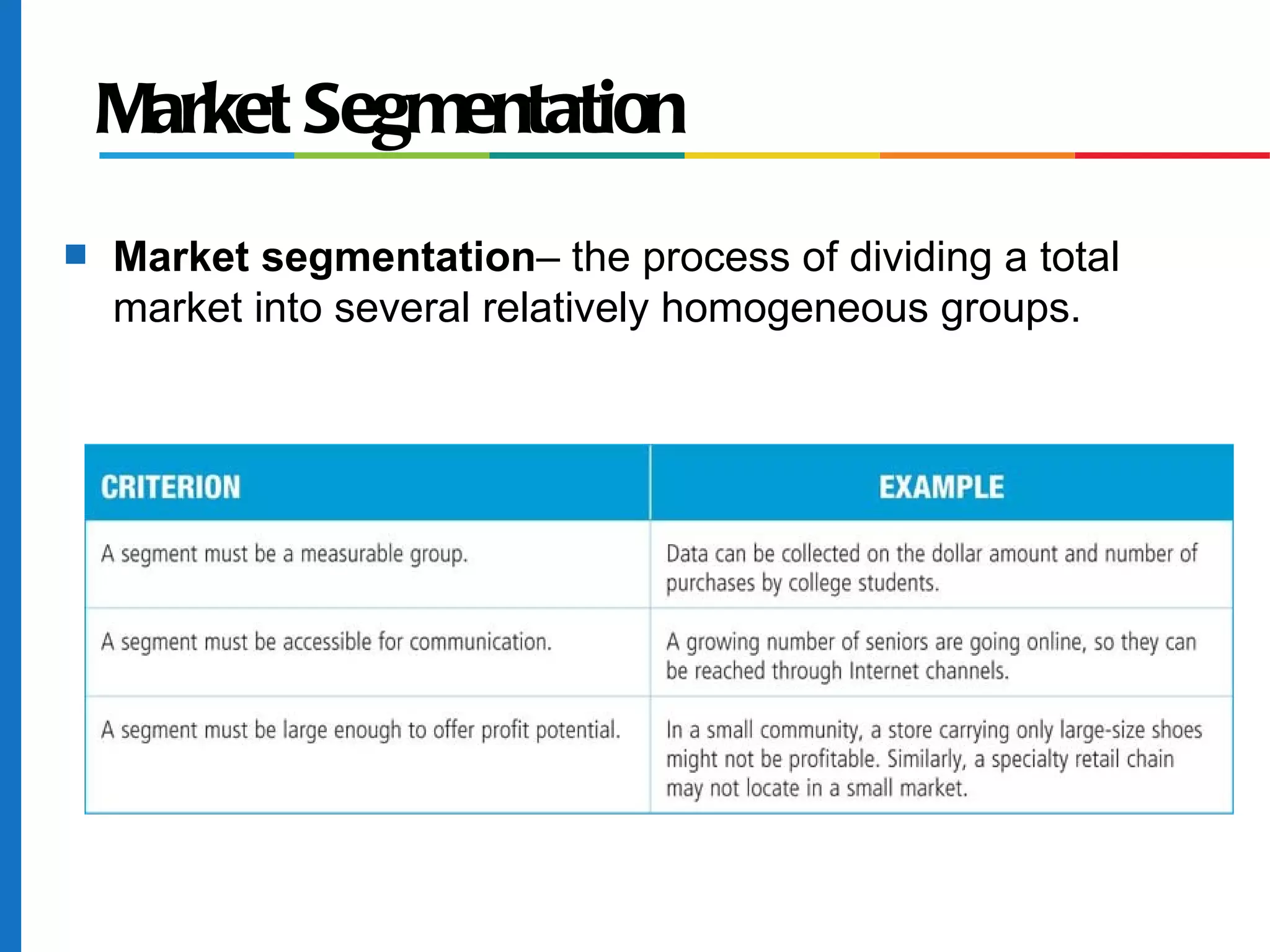
Market Segmentation
s   Market segmentation– the process of dividing a total
    market into several relatively homogeneous groups.
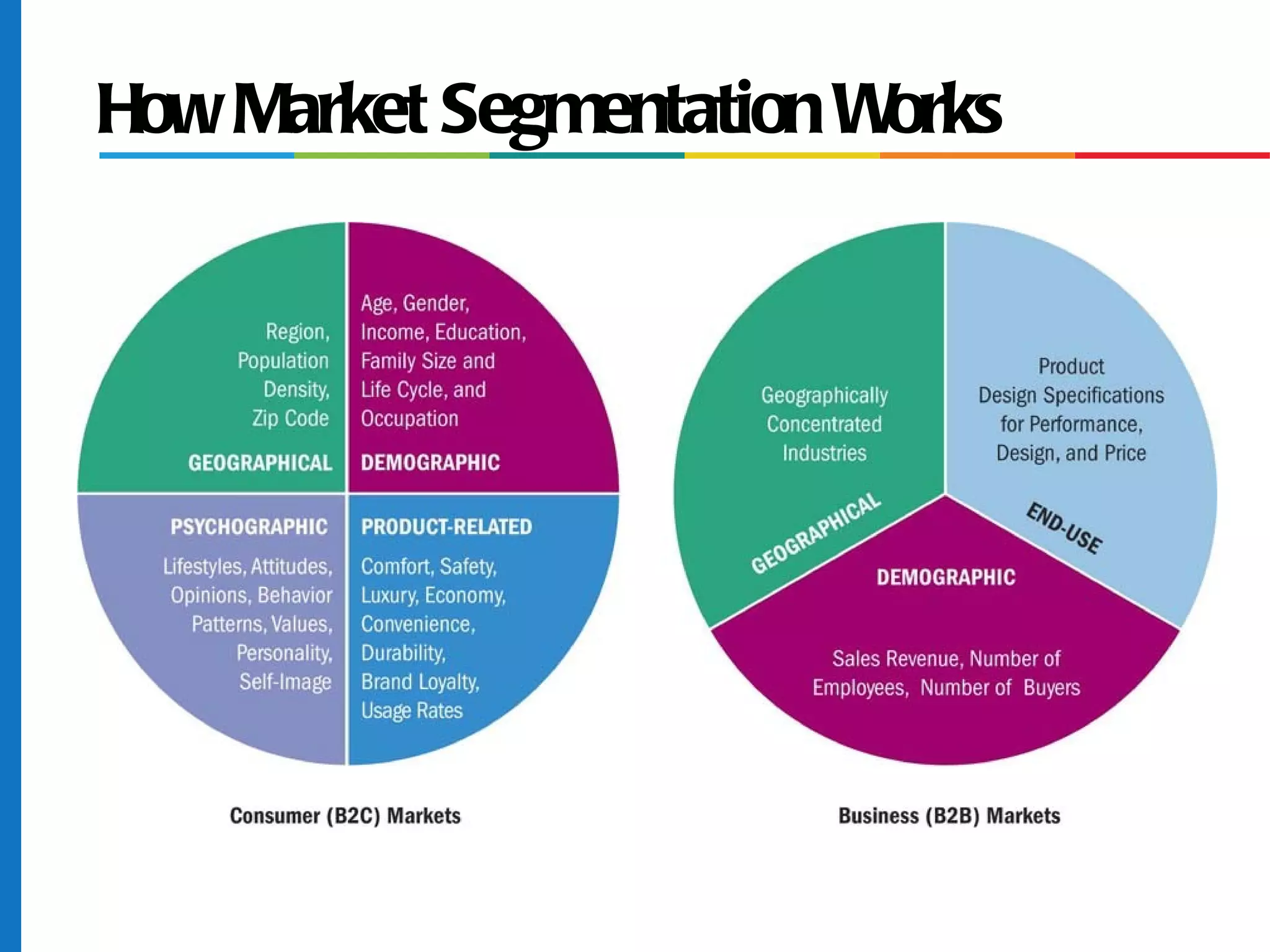
How Market Segmentation Works
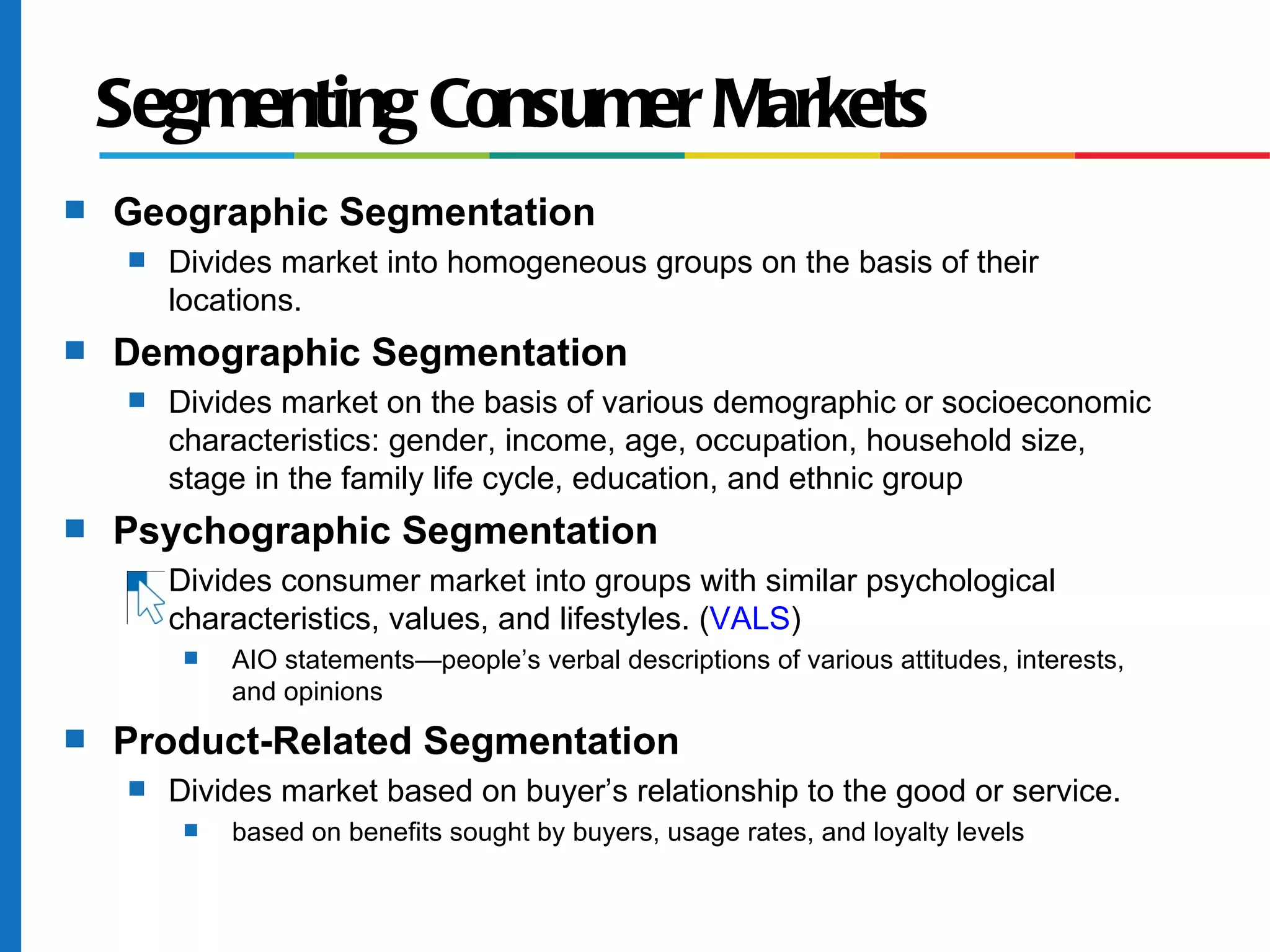
Segmenting Consumer Markets
s   Geographic Segmentation
     s   Divides market into homogeneous groups on the basis of their
         locations.
s   Demographic Segmentation
     s   Divides market on the basis of various demographic or socioeconomic
         characteristics: gender, income, age, occupation, household size,
         stage in the family life cycle, education, and ethnic group
s   Psychographic Segmentation
     s   Divides consumer market into groups with similar psychological
         characteristics, values, and lifestyles. (VALS)
          s   AIO statements—people’s verbal descriptions of various attitudes, interests,
              and opinions
s   Product-Related Segmentation
     s   Divides market based on buyer’s relationship to the good or service.
          s   based on benefits sought by buyers, usage rates, and loyalty levels
Segmenting Business Markets
s   Geographic segmentation– targets
    geographically concentrated industries.
s   Demographic, or customer-based,
    segmentation– a good or service
    intended for a specific organizational
    market (i.e. healthcare).
s   End-use segmentation– focuses on
    the precise way a B2B purchaser will
    use a product.
Determining W Customers W
                 hat         ant
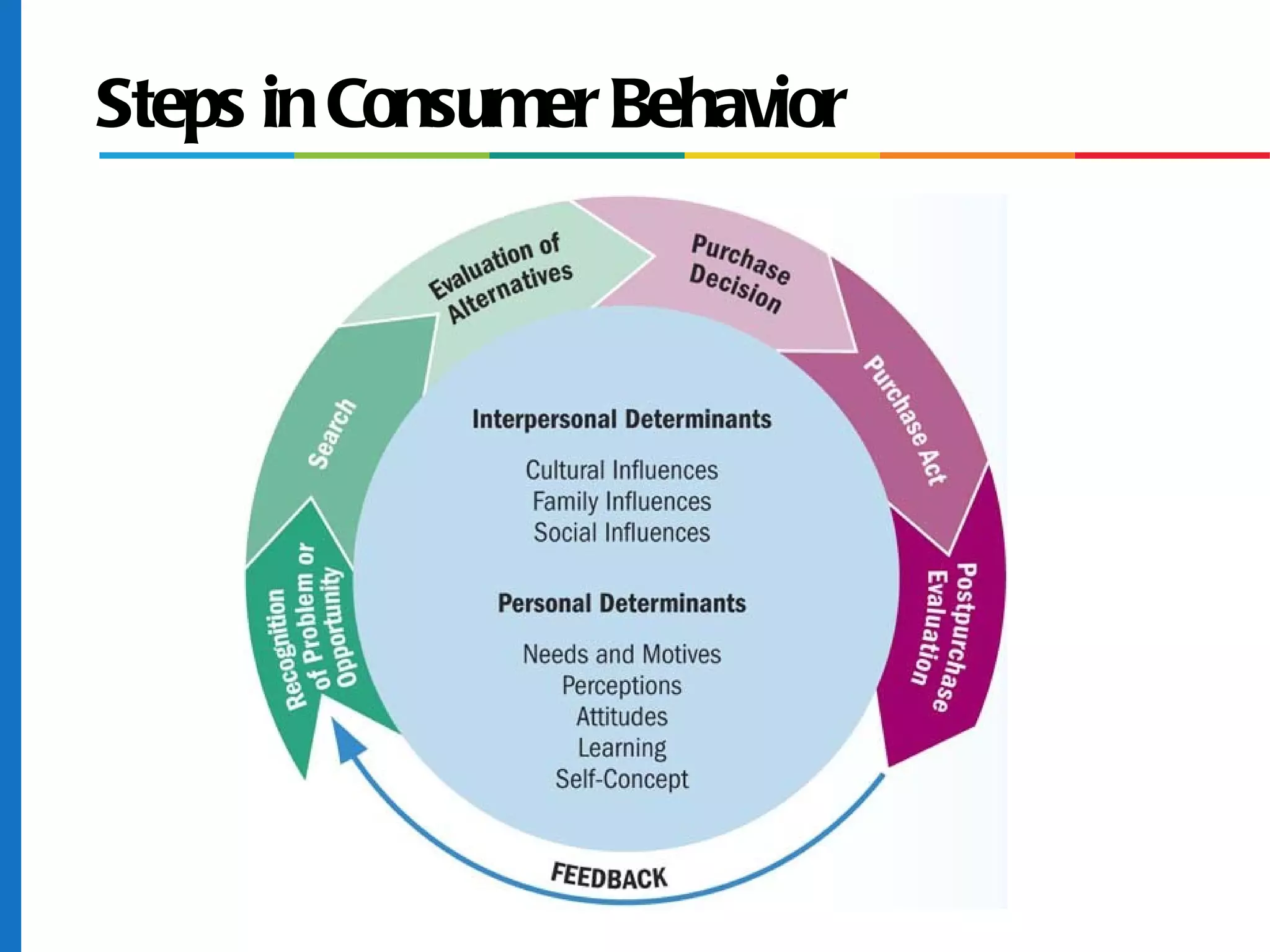
s   Consumer behavior- actions of ultimate
    consumers directly involved in obtaining,
    consuming, and disposing of products and the
    decision processes that precede and follow these
    actions.
    s   Personal factors: needs and motives, perceptions,
        attitudes, self-concept
    s   Interpersonal factors: cultural, social, and family
        influences
    s   External factors: economic events
s   Business buying behavior- often includes a
    variety of influences from multiple decision makers.
Steps in Consumer Behavior
Relationship Marketing
s   Relationship marketing- developing and
    maintaining long-term, cost-effective exchange
    relationships with partners.

s   Consumers enter into relationships only if
    there is some benefit to them.

s   Relationship marketing seeks to achieve
    customer satisfaction.
Benefits of Relationship Marketing
s   Lower costs and higher profits for the business.
s   Efficient targeting of best customers increases the
    lifetime value of a customer.
    s   revenues and intangible benefits (referrals and
        customer feedback) from a customer over the life of
        the relationship, minus the amount the company must
        spend to acquire and serve that customer.
s   Stronger relationships with business partners and
    opportunities to combine capabilities and
    resources to better accomplish goals.
Tools for Nurturing Customer
    Relationships
s   80/20 principle: frequent customers have a
    higher lifetime value, so businesses allocate
    resources accordingly
s   Frequency marketing: reward purchasers with
    cash, rebates, and other premiums (
    TGI Fridays reward program)
s   Affinity programs: solicit involvement based on
    common interest
s   Comarketing: businesses jointly market each
    others’ products
s   Cobranding: firms link their names in a single
    product
One-to-One Marketing

s   Customizing products and marketing and
    rapidly delivering goods.

s   Customer relationship management
    software helps companies gather, sort, and
    interpret data about specific customers.
Chapter 11: Marketing

Chapter 11: Marketing

  • 1.
    Chapter 11 Customer-Driven Marketing
  • 2.
    Learning Objectives 1 Summarize the ways in which marketing 5 Describe the marketing research creates utility. function. 2 Discuss the marketing concept. 6 Identify and explain the methods available for segmenting consumer 3 Describe not-for-profit marketing, and and business markets. identify the five major categories of nontraditional marketing. 7 Outline the determinants of consumer behavior. 4 Outline the basic steps in developing a marketing strategy. 8 Discuss the benefits and tools for relationship marketing.
  • 3.
    W Is Marketing? hat s Marketing- set of processes for creating, communicating, and delivering value to customers and for managing customer relationships in ways that benefit the organization and its stakeholders. s Marketing begins with discovering unmet customer needs and continues with researching the potential market; producing a good or service capable of satisfying the targeted customers; and promoting, pricing, and distributing that good or service. s Throughout the entire marketing process, a successful organization focuses on building customer relationships. s The best marketers not only give consumers what they want but even anticipate consumers’ needs before those needs surface. s Exchange process- activity in which two or more parties give something of value to each other to satisfy perceived needs.
  • 4.
    How Marketing CreatesUtility s Utility: power of a good or service to satisfy a want or need s Create time utility by making a good or service available when customers want to purchase it. s Create place utility by making a product available in a location convenient for customers. s Create ownership utility through an orderly transfer of goods and services from the seller to the buyer.
  • 5.
    Evolution of theMarketing Concept
  • 6.
    Emergence of theMarketing Concept s Marketing concept- company-wide consumer orientation to promote long-run success. s Firm starts with analysis of customers’ needs and works backward to offer products that fulfill them. s Explained by shift from sellers’ market in which goods and services are relatively scarce to buyers’ market in which they are relatively plentiful.
  • 7.
    Not-for-Profit Marketing s 20 million not-for-profits exist worldwide. s Apply marketing tools to reach audiences, secure funding, improve their images, and accomplish their overall missions. s Not-for-profit organizations operate in both public and private sectors. s Sometimes partner with a profit-seeking company to promote a message.
  • 8.
  • 9.
    Developing a MarketingStrategy 1. Study and analyze potential target markets and choose among them. 2. Create a marketing mix to satisfy the chosen market.
  • 10.
    Selecting a TargetMarket s Target market- group of people toward whom an organization markets its goods, services, or ideas with a strategy designed to satisfy their specific needs and preferences. s Types of Markets s consumer (B2C) product: good or service that is purchased by end users s business (B2B) product: good or service purchased to be used, either directly or indirectly, in the production of other goods for resale
  • 11.
    Marketing Mix s Marketing Mix blends the four strategies to fit the needs and preferences of a specific target market. → Product strategy involves the nature of the product and its package design, brand names, trademarks, and product image. → Distribution strategy ensures that customers receive their purchases in the proper quantities at the right times and locations. → Promotional strategy blends advertising, personal selling, sales promotion, and public relations to achieve its goals of informing, persuading, and influencing purchase decisions. → Pricing strategy is setting profitable and justifiable prices for the firm’s product offerings, sometimes subject to government scrutiny.
  • 12.
    Marketing Mix forInternational Markets s Standardization- offering the same marketing mix in every market. s Adaptation- developing a unique marketing mix to fit each market’s local competitive conditions, consumer preferences, and government regulations. s Mass customization- allows a firm to mass produce goods and services while adding unique features to individual or small groups of orders.
  • 13.
    Marketing Research s Marketing research– the process of collecting and evaluating information to support marketing decision making. AC Nielson– Consumer Research s Secondary data– Previously published data from trade associations, advertising agencies, marketing research firms, and other sources. s Primary data– Data collected through observation, surveys, and other forms of observational study. s Data mining– computer searches of customer data to detect patterns and relationships. s Business intelligence– activities and technologies for gathering, storing, and analyzing data to make better competitive decisions
  • 14.
    Market Segmentation s Market segmentation– the process of dividing a total market into several relatively homogeneous groups.
  • 15.
  • 16.
    Segmenting Consumer Markets s Geographic Segmentation s Divides market into homogeneous groups on the basis of their locations. s Demographic Segmentation s Divides market on the basis of various demographic or socioeconomic characteristics: gender, income, age, occupation, household size, stage in the family life cycle, education, and ethnic group s Psychographic Segmentation s Divides consumer market into groups with similar psychological characteristics, values, and lifestyles. (VALS) s AIO statements—people’s verbal descriptions of various attitudes, interests, and opinions s Product-Related Segmentation s Divides market based on buyer’s relationship to the good or service. s based on benefits sought by buyers, usage rates, and loyalty levels
  • 17.
    Segmenting Business Markets s Geographic segmentation– targets geographically concentrated industries. s Demographic, or customer-based, segmentation– a good or service intended for a specific organizational market (i.e. healthcare). s End-use segmentation– focuses on the precise way a B2B purchaser will use a product.
  • 18.
    Determining W CustomersW hat ant s Consumer behavior- actions of ultimate consumers directly involved in obtaining, consuming, and disposing of products and the decision processes that precede and follow these actions. s Personal factors: needs and motives, perceptions, attitudes, self-concept s Interpersonal factors: cultural, social, and family influences s External factors: economic events s Business buying behavior- often includes a variety of influences from multiple decision makers.
  • 19.
  • 20.
    Relationship Marketing s Relationship marketing- developing and maintaining long-term, cost-effective exchange relationships with partners. s Consumers enter into relationships only if there is some benefit to them. s Relationship marketing seeks to achieve customer satisfaction.
  • 21.
    Benefits of RelationshipMarketing s Lower costs and higher profits for the business. s Efficient targeting of best customers increases the lifetime value of a customer. s revenues and intangible benefits (referrals and customer feedback) from a customer over the life of the relationship, minus the amount the company must spend to acquire and serve that customer. s Stronger relationships with business partners and opportunities to combine capabilities and resources to better accomplish goals.
  • 22.
    Tools for NurturingCustomer Relationships s 80/20 principle: frequent customers have a higher lifetime value, so businesses allocate resources accordingly s Frequency marketing: reward purchasers with cash, rebates, and other premiums ( TGI Fridays reward program) s Affinity programs: solicit involvement based on common interest s Comarketing: businesses jointly market each others’ products s Cobranding: firms link their names in a single product
  • 23.
    One-to-One Marketing s Customizing products and marketing and rapidly delivering goods. s Customer relationship management software helps companies gather, sort, and interpret data about specific customers.

Editor's Notes

  • #11 Selecting the target market is very important as then an organization can concentrate its financial and time resources in going after this market. Markets can be classified by type of product– consumer and business.