TOPIC- PEARSON’S HSAB CONCEPT
S U B M I T T E D B Y – L A R A S A H U
R O L L N O . – 1 9
B S C B E D 6 T H S E M E S T E R
R I E B H O P A L
CHEMISTRY ASSIGNMENT
Pearson’s HSAB concept.
 In 1963 R. G. Pearson extended and generalized the
qualitative correlation between Lewis acids and
Lewis bases by classifying them into two categories
Hard and Soft.
 This qualitative concept explains the stability of
metal complexes and the mechanisms of their
reactions
 This concept is also known as Hard and Soft Acids
and Bases (HSAB) Theory.
 Lewis acids and bases can be classified by
designating them as hard or soft. Acids and bases are
not strictly hard or soft, since many ions and
compounds are classified as intermediate. The
categorizations are based on three factors:
(1) charge density, or charge-to-size ratio
(2) polarizability
(3) covalent vs. ionic nature of interactions.
Hard Acids/Bases:
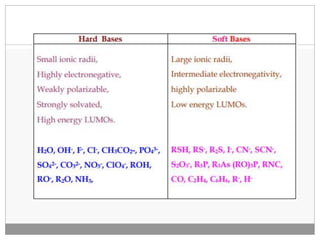
 In general, "Hard" acids and bases have a high charge density,
are not very polarizable, and form bonding interactions that
are more ionic in nature. These atoms and ions tend to have
high charge and/or small radius.
 Typical Hard Acids: metal ions with high positive charges
and smaller ionic sizes tend to be hard acids. Early transition
metal ions in the 3d series tend to be hard Lewis acids.
 Typical Hard Bases: Small anions and neutral molecules;
heteroatoms of the second row of the periodic table are
typically hard (N,O,F). Some examples of hard acids and bases
include: H+, O2-, OH-, F-, Fe3+, and Al3+. Oxygen atoms are
always hard, and N atoms are usually hard.
Soft Acids/Bases:
 In general, "Soft" acids or bases have a low charge density, are more
polarizable, and form bonds that are more covalent in nature. These
atoms/ions tend to have low charge and/or large radius.
 Typical Soft Acids: Transition metals with (+1) charge (such as
Cu+) or that are in the late 4d and 5d series (like Cd2+ and Hg2+), are
classified as soft. Soft acids often include transition metals in the
second and third row of the periodic table that have a +1 or +2
charge, as well as late transition metals (especially those in the 4d
and 5d series) with filled or almost completely filled d orbitals.
 Typical Soft Bases: Larger anions and neutral molecules. For
example, I- and S2- are soft bases.
Intermediate Acids/Bases:
 These are acids and bases with intermediate
character, between hard and soft. For example,
trimethylborane, Fe2+, and Pb2+ cations are
intermediate acids, and pyridine and aniline are
examples of intermediate bases.
HSAB Principle
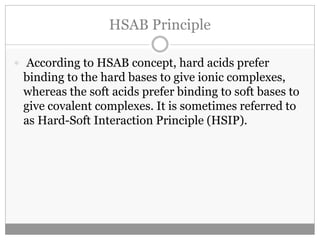
 According to HSAB concept, hard acids prefer
binding to the hard bases to give ionic complexes,
whereas the soft acids prefer binding to soft bases to
give covalent complexes. It is sometimes referred to
as Hard-Soft Interaction Principle (HSIP).
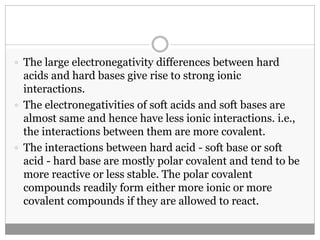
 The large electronegativity differences between hard
acids and hard bases give rise to strong ionic
interactions.
 The electronegativities of soft acids and soft bases are
almost same and hence have less ionic interactions. i.e.,
the interactions between them are more covalent.
 The interactions between hard acid - soft base or soft
acid - hard base are mostly polar covalent and tend to be
more reactive or less stable. The polar covalent
compounds readily form either more ionic or more
covalent compounds if they are allowed to react.
APPLICATIONS OF HSAB PRINCIPLE
There are numerous applications of the HSAB
principle. It helps in understanding organic reaction
mechanisms, metal-ligand interactions in metal
complexes, ore processing in metallurgy,
precipitations in qualitative analysis etc.
 In hydrogen bonding:
The strong hydrogen bond is possible in cases
of H2O, NH3, and HF, since the donor atoms (F, O &
N) are hard Lewis bases and their interactions with
partially positively charged H, which is a hard acid,
are stronger.
 Linkage of ambidentate ligands to metal atoms:
It is one of the important applications of the HSAB principle.
The SCN- ligand is an ambidentate ligand and can be S-bound
to metal (M-SCN) and referred to as thiocyanate or can be N-
bound to metal (M-NCS) and is referred to as isothiocyanate.
The choice among S-bound or N-bound is decided by soft or
hard acid-base behavior. S is a comparatively soft base than N
atom. Hence soft metal ions are S-bound while hard metal
ions are N-bound.
1) SCN- bonds through sulfur atom (soft base) when bonded to
Pt2+, a soft acid.
2) It bonds through nitrogen atom (a hard base) when linked
to Cr3+, a hard acid.
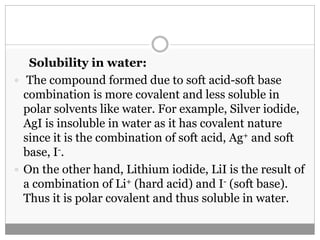
Solubility in water:
 The compound formed due to soft acid-soft base
combination is more covalent and less soluble in
polar solvents like water. For example, Silver iodide,
AgI is insoluble in water as it has covalent nature
since it is the combination of soft acid, Ag+ and soft
base, I-.
 On the other hand, Lithium iodide, LiI is the result of
a combination of Li+ (hard acid) and I- (soft base).
Thus it is polar covalent and thus soluble in water.
 Site preference:
 1) RCOX is a hard acid and reacts with the nitrogen
end of SCN- ion to form an acyl isothiocyanate.
 2) Whereas the softer methyl group bonds to the
Sulfur atom and forms methyl thiocyanate.
LIMITATIONS OF PEARSON'S HSAB
MODEL
 Pearson's HSAB theory is in direct contradiction with
Fajan's rules. For example, the later predict the nature of
Beryllium salts to be more covalent. But according to the
HSAB principle, the Be2+ ion is hard acid and is expected
to show charge controlled bonding that results in more
ionic nature for beryllium compounds. But this is not
true.
 Since hydrogen ion, H+ is a hard acid and hydride ion, H-
is a soft base, according to HSAB principle the
interactions between them must be polar covalent and
H2 must be unstable. Indeed H2 is a stable molecule with
pure covalent nature.
Thank You.

Pearson's HSAB Theory

  • 1.
    TOPIC- PEARSON’S HSABCONCEPT S U B M I T T E D B Y – L A R A S A H U R O L L N O . – 1 9 B S C B E D 6 T H S E M E S T E R R I E B H O P A L CHEMISTRY ASSIGNMENT
  • 2.
    Pearson’s HSAB concept. In 1963 R. G. Pearson extended and generalized the qualitative correlation between Lewis acids and Lewis bases by classifying them into two categories Hard and Soft.  This qualitative concept explains the stability of metal complexes and the mechanisms of their reactions  This concept is also known as Hard and Soft Acids and Bases (HSAB) Theory.
  • 3.
     Lewis acidsand bases can be classified by designating them as hard or soft. Acids and bases are not strictly hard or soft, since many ions and compounds are classified as intermediate. The categorizations are based on three factors: (1) charge density, or charge-to-size ratio (2) polarizability (3) covalent vs. ionic nature of interactions.
  • 4.
    Hard Acids/Bases:  Ingeneral, "Hard" acids and bases have a high charge density, are not very polarizable, and form bonding interactions that are more ionic in nature. These atoms and ions tend to have high charge and/or small radius.  Typical Hard Acids: metal ions with high positive charges and smaller ionic sizes tend to be hard acids. Early transition metal ions in the 3d series tend to be hard Lewis acids.  Typical Hard Bases: Small anions and neutral molecules; heteroatoms of the second row of the periodic table are typically hard (N,O,F). Some examples of hard acids and bases include: H+, O2-, OH-, F-, Fe3+, and Al3+. Oxygen atoms are always hard, and N atoms are usually hard.
  • 5.
    Soft Acids/Bases:  Ingeneral, "Soft" acids or bases have a low charge density, are more polarizable, and form bonds that are more covalent in nature. These atoms/ions tend to have low charge and/or large radius.  Typical Soft Acids: Transition metals with (+1) charge (such as Cu+) or that are in the late 4d and 5d series (like Cd2+ and Hg2+), are classified as soft. Soft acids often include transition metals in the second and third row of the periodic table that have a +1 or +2 charge, as well as late transition metals (especially those in the 4d and 5d series) with filled or almost completely filled d orbitals.  Typical Soft Bases: Larger anions and neutral molecules. For example, I- and S2- are soft bases.
  • 6.
    Intermediate Acids/Bases:  Theseare acids and bases with intermediate character, between hard and soft. For example, trimethylborane, Fe2+, and Pb2+ cations are intermediate acids, and pyridine and aniline are examples of intermediate bases.
  • 10.
    HSAB Principle  Accordingto HSAB concept, hard acids prefer binding to the hard bases to give ionic complexes, whereas the soft acids prefer binding to soft bases to give covalent complexes. It is sometimes referred to as Hard-Soft Interaction Principle (HSIP).
  • 11.
     The largeelectronegativity differences between hard acids and hard bases give rise to strong ionic interactions.  The electronegativities of soft acids and soft bases are almost same and hence have less ionic interactions. i.e., the interactions between them are more covalent.  The interactions between hard acid - soft base or soft acid - hard base are mostly polar covalent and tend to be more reactive or less stable. The polar covalent compounds readily form either more ionic or more covalent compounds if they are allowed to react.
  • 12.
    APPLICATIONS OF HSABPRINCIPLE There are numerous applications of the HSAB principle. It helps in understanding organic reaction mechanisms, metal-ligand interactions in metal complexes, ore processing in metallurgy, precipitations in qualitative analysis etc.  In hydrogen bonding: The strong hydrogen bond is possible in cases of H2O, NH3, and HF, since the donor atoms (F, O & N) are hard Lewis bases and their interactions with partially positively charged H, which is a hard acid, are stronger.
  • 13.
     Linkage ofambidentate ligands to metal atoms: It is one of the important applications of the HSAB principle. The SCN- ligand is an ambidentate ligand and can be S-bound to metal (M-SCN) and referred to as thiocyanate or can be N- bound to metal (M-NCS) and is referred to as isothiocyanate. The choice among S-bound or N-bound is decided by soft or hard acid-base behavior. S is a comparatively soft base than N atom. Hence soft metal ions are S-bound while hard metal ions are N-bound. 1) SCN- bonds through sulfur atom (soft base) when bonded to Pt2+, a soft acid. 2) It bonds through nitrogen atom (a hard base) when linked to Cr3+, a hard acid.
  • 14.
    Solubility in water: The compound formed due to soft acid-soft base combination is more covalent and less soluble in polar solvents like water. For example, Silver iodide, AgI is insoluble in water as it has covalent nature since it is the combination of soft acid, Ag+ and soft base, I-.  On the other hand, Lithium iodide, LiI is the result of a combination of Li+ (hard acid) and I- (soft base). Thus it is polar covalent and thus soluble in water.
  • 15.
     Site preference: 1) RCOX is a hard acid and reacts with the nitrogen end of SCN- ion to form an acyl isothiocyanate.  2) Whereas the softer methyl group bonds to the Sulfur atom and forms methyl thiocyanate.
  • 16.
    LIMITATIONS OF PEARSON'SHSAB MODEL  Pearson's HSAB theory is in direct contradiction with Fajan's rules. For example, the later predict the nature of Beryllium salts to be more covalent. But according to the HSAB principle, the Be2+ ion is hard acid and is expected to show charge controlled bonding that results in more ionic nature for beryllium compounds. But this is not true.  Since hydrogen ion, H+ is a hard acid and hydride ion, H- is a soft base, according to HSAB principle the interactions between them must be polar covalent and H2 must be unstable. Indeed H2 is a stable molecule with pure covalent nature.
  • 17.