K Mohamed Rafi
The interstitium of the lung is not normally visible radiographic-
ally; it becomes visible only when disease (e.g., edema, fibrosis,
tumor) increases its volume and attenuation.
The interstitial space is defined as continuum of loose
connective tissue throughout the lung composed of three
subdivisions:
(i) the bronchovascular (axial), surrounding the bronchi,
arteries, and veins from the lung root to the level of the
respiratory bronchiole
(ii) the parenchymal (acinar), situated between the alveolar and
capillary basement membranes
(iii) the subpleural, situated beneath the pleura, as well as in the
interlobular septae.
The Lung Interstitium
Secondary lobule
 For the purposes of the interpretation of HRCT, the
secondary lobule is most appropriately conceptualized
as having three principal parts or components:
 Interlobular septa and contiguous subpleural
interstitium
 Centrilobular structures
 Lobular parenchyma and acini
Lobular Anatomy and the Concept of Cortical &
Medullary Lung
Patterns of Interstitial Lung Disease
 Generally, HRCT findings of lung disease can be
classified into four large categories based on their
appearances. These are
 (i) linear and reticular opacities,
 (ii) nodules and nodular opacities,
 (iii) increased lung opacity, and
 (iv) abnormalities associated with decreased lung
opacity, including cystic lesions, emphysema, and
airway abnormalities.
Linear and reticular opacities,
Thickening of the interstitial fiber
network of the lung by fluid or fibrous
tissue, or because of interstitial
infiltration by cells or other material,
primarily results in an increase in linear
or reticular lung opacities as seen on
HRCT
Linear and reticular opacities,
Linear or reticular opacities may be manifested by the
 interface sign,
 peribronchovascular interstitial thickening,
 interlobular septal thickening,
 parenchymal bands,
 subpleural interstitial thickening,
 intralobular interstitial thickening,
 honeycombing,
 irregular linear opacities, &
 subpleural lines
Interface sign
 The presence of irregular interfaces between the
aerated lung parenchyma and bronchi, vessels, or
visceral pleural surfaces has been termed the interface
sign. The interface sign is nonspecific, and is
commonly seen in patients with an interstitial
abnormality, regardless of its cause. In the original
description of the interface sign, this finding was
visible in 89% of patients with interstitial lung disease
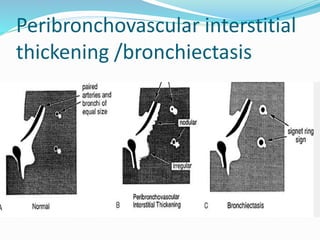
Peribronchovascular Interstitial
Thickening
 Central bronchi and pulmonary arteries are
surrounded and enveloped by a strong connective
tissue sheath, termed the peribronchovascular
interstitium, extending from the level of the
pulmonary hila into the peripheral lung. In the lung
periphery, the peribronchovascular interstitium
surrounds centrilobular arteries and bronchioles, and,
more distally, supports the alveolar ducts and alveoli
 The peribronchovascular interstitium is also termed
the axial interstitium by Weibel.
• Lymphangitic carcinomatosis,
lymphoma, leukemia
• Lymphoproliferative disease (e.g.,
lymphocytic interstitial pneumonia)
• sarcoid
nodular
• Pulmonary edema
• Lymphangitic
carcinomatosis
smooth
• Sarcoidosis
• Silicosis/coal worker’s
pneumoconiosis, talcosis
conglomerate
masses
SMOOTH
NODULAR
Peribronchovascular interstitial
thickening /bronchiectasis
Peribronchovascular interstitial
thickening /bronchiectasis
Interlobular Septal Thickening
 Thickened septa 1 to 2 cm in length may outline part
of or an entire lobule and are usually seen extending to
the pleural surface, being roughly perpendicular to the
pleura
 Lobules at the pleural surface may have a variety of
appearances, but they are often longer than they are
wide, resembling a cone or truncated cone.
 Within the central lung, thickened septa outline
lobules that are 1 to 2.5 cm in diameter and appear
polygonal, or sometimes hexagonal, in shape
Smooth
• Pulmonary edema
• Lymphangitic carcinomatosis, lymphoma, leukemia
irregular
• Silicosis/coal worker’s pneumoconiosis; talcosis
• Asbestos
• Hypersensitivity pneumonitis
Nodular
“beaded
• Sarcoidosis
SMOOTH
Nodular
Irregular
Differential diagnosis of intralobular
interstitial thickening
Crazy pavement appearance
Subpleural Interstitial
Thickening
 Thickening of the interlobular septa within the
peripheral lung is associated with thickening of the
subpleural interstitium
 differential diagnosis of subpleural interstitial
thickening is the same as that of interlobular septal
thickening, although subpleural interstitial thickening
is more common than septal thickening in patients
with IPF or UIP of any cause
Parenchymal Bands
 The term parenchymal band has been used to describe
a nontapering, reticular opacity, usually several
millimeters in thickness and from 2 to 5 cm in length,
seen in patients with atelectasis, pulmonary fibrosis,
or other causes of interstitial thickening
Honeycombing
 Honeycombing is defined by the presence of small air-
containing cystic spaces, generally lined by
bronchiolar epithelium and having thickened walls
composed of dense fibrous tissue. Honeycombing
indicates the presence of end-stage lung and can be
seen in many diseases leading to end-stage pulmonary
fibrosis
Honeycombing
This 50-year-old man presented with end-stage lung fibrosis
PA chest radiograph shows medium to coarse reticular
B: CT scan shows multiple small cysts (honeycombing) involving
predominantly the subpleural peripheral regions of lung. Traction
bronchiectasis, another sign of end-stage lung fibrosis.
Subpleural Lines
 curvilinear opacity a few millimeters or less in
thickness, less than 1 cm from the pleural surface and
paralleling the pleura, is termed a subpleural line .
 It is a nonspecific indicator of atelectasis, fibrosis, or
inflammation. It was first described in patients with
asbestosis , it was termed a subpleural curvilinear
shadow.
Nodular pattern
 The term nodule is defined as a rounded opacity, at
least moderately well-defined, and no more than 3 cm
in diameter
 The term small nodule is used to define a rounded
opacity smaller than 1 cm in diameter,
 whereas large nodule is used to refer to nodules 1 cm or
larger in diameter.
 Some authors have used micronodule to describe
nodules smaller than 7 mm in diameter.
1.Perilymphatic Distribution
For small nodules
3.Random Distribution
 Small nodules that appear randomly distributed in
relation to structures of the secondary lobule and lung
are often seen in patients with miliary tuberculosis
miliary fungal infections, and hematogenous
metastases
Random
2.Centrilobular Distribution
 Centrilobular nodules can reflect the presence of
either interstitial or airspace abnormalities, and the
histologic correlations reported to occur in association
with centrilobular nodules vary with the disease entity
 Centrilobular nodules may be dense and of
homogeneous opacity, or of ground-glass opacity and
may range from a few millimeters to a centimeter in
size.
Tree in bud appearance
3.Random Distribution
Hematogenous metastases and nodular ILD. This 45-year-old
woman presented with metastatic gastric carcinoma. The PA
chest radiograph shows a diffuse pattern of nodules, 6 to 10
mm in diameter.
Differential diagnosis of a nodular pattern of
interstitial lung disease
SHRIMP
Sarcoidosis
Histiocytosis (Langerhan cell
histiocytosis)
Hypersensitivity pneumonitis
Rheumatoid nodules
Infection (mycobacterial, fungal, viral)
Metastases
Microlithiasis, alveolar
Pneumoconioses (silicosis, coal
worker's, berylliosis)
Reticulonodular pattern
A reticulonodular pattern results from a combination
of reticular and nodular opacities.
This pattern is often difficult to distinguish from a
purely reticular or nodular pattern, and in such a case a
differential diagnosis should be developed based on
the predominant pattern.
If there is no predominant pattern, causes of both
nodular and reticular patterns should be considered.
most commonly in silicosis,sarcoidosis.
Increased lung opacity
Decreased Lung Opacity
A variety of abnormalities result in decreased lung
attenuation or air-filled cystic lesions on HRCT. These
include
 honeycombing,
 lung cysts,
 emphysema, bullae,
 pneumatoceles,
 cavitary nodules,
 bronchiectasis,
 mosaic perfusion,
 air-trapping due to airways disease
Honeycombing/cyst
 Honeycombing is defined by the presence of small air-
containing cystic spaces, generally lined by
bronchiolar epithelium and having thickened walls
composed of dense fibrous tissue. Honeycombing
indicates the presence of end-stage lung and can be
seen in many diseases leading to end-stage pulmonary
fibrosis
UIP
UIP
UIP
Cyst
Bullae
 Emphysematous bullae are well seen using HRCT. A
bulla has been defined as a
 sharply demarcated area of emphysema measuring 1
cm or more in diameter and possessing a thin
epithelialized wall that is usually no thicker than 1 mm
Blebs
 The term bleb is used pathologically to refer to a gas-
containing space within the visceral pleura
 Radiographically, this term is sometimes used to
describe a focal thin-walled lucency contiguous with
the pleura, usually at the lung apex.
 However, the distinction between bleb and bulla is of
little practical significance and is seldom justified. The
term bulla is preferred
How To Approach
a Practical
Diagnosis?
An acute appearance suggests pulmonary edema or
pneumonia
Rule no. 1
Pulmonary edema
sparing of the apices and extreme lung bases
characteristic ‘butterfly’ or ‘bat's wing’ distribution
Pulmonary edema
There is diffuse ground-glass opacification,
smooth thickening of multiple interlobular
septa and peribronchovascular cuffing.
Bilateral pleural effusions are also seen.
Reticulonodular lower lung predominant
distribution with decreased lung volumes
suggests: (APC)
1. Asbestosis
2. Aspiration (chronic)
3. Pulmonary fibrosis (idiopathic)
4.Collagen vascular disease
Rule no. 2
Asbestos-related
pleural disease and
asbestosis
Pulmonary fibrosis and rheumatoid arthritis.
Systemic sclerosis.
A: PA chest radiograph shows a bibasilar and subpleural distribution of fine
reticular ILD. The presence of a dilated esophagus (arrows) provides a clue to
the correct diagnosis.
B: CT scan shows peripheral ILD and a dilated esophagus (arrow).
A middle or upper lung predominant distribution
suggests: (Mycobacterium Settle Superiorly in
Lung)
1. Mycobacterial or fungal disease
2. Silicosis
3. Sarcoidosis
4. Langerhans Cell Histiocytosis
Rule no. 3
Complicated silicosis. PA chest radiograph shows multiple nodules
involving the upper and middle lungs, with coalescence of nodules
in the left upper lobe resulting in early progressive massive fibrosis
Sarcoidosis. CT scan shows nodular thickening of the bronchovascular bundles
(solid arrow) and subpleural nodules (dashed arrow), illustrating the typical
perilymphatic distribution of sarcoidosis.
Langerhan cell histiocytosis.
This 50-year-old man had a
30 pack-year history of
cigarette smoking.
A: PA chest radiograph shows
hyperinflation of the lungs
and fine bilateral reticular
ILD.
B: CT scan shows multiple
cysts (solid arrow) and
nodules (dashed arrow).
Associated lymphadenopathy suggests :
1.Sarcoidosis
2.neoplasm (lymphangitic carcinomatosis,
lymphoma, metastases)
3. infection (viral, mycobacterial, or fungal)
4. silicosis
Rule no. 4
Simple silicosis.
A: CT scan with lung windowing shows numerous circumscribed
pulmonary nodules, 2 to 3 mm in diameter (arrows).
B: CT scan with mediastinal windowing shows densely calcified
hilar (solid arrows) and subcarinal (dashed arrow) nodes.
Associated pleural thickening and/or
calcification suggest asbestosis.
Rule no. 5
Associated pleural effusion suggests :
1.pulmonary edema
2.lymphangitic carcinomatosis
3.lymphoma
4.collagen vascular disease
Rule no. 6
Cardiogenic pulmonary edema.
PA chest radiograph shows enlargement of the cardiac
silhouette, bilateral ILD, enlargement of the azygos vein (solid
arrow), and peribronchial cuffing (dashed arrow).
Lymphangitic carcinomatosis. This 53-year-old man presented
with chronic obstructive pulmonary disease and large-cell
bronchogenic carcinoma of the right lung.
CT scan shows unilateral nodular thickening (arrows) and a
malignant right pleural effusion.
Associated pneumothorax suggests
lymphangioleiomyomatosis or LCH.
Rule no. 7
Lymphangioleiomyomatosis
(LAM).
A: PA chest radiograph shows a
right basilar pneumothorax and
two right pleural drainage
catheters. The lung volumes are
increased, which is characteristic
of LAM, and there is diffuse
reticular ILD.
B: CT scan shows bilateral thin-
walled cysts and a loculated right
pneumothorax (P).
Associated with increased lung volume
* cystic fibrosis (CF)
* eosinophilic granuloma (EG)
* lymphangioleiomyomatosis (LAM)
Rule no. 8
Tell me the rules
again?
1. Acute
•P.Edema
•Pneumonia
2. Pleural effusion
•1.pulmonary edema
•2.lymphangitic carcinomatosis
•3.lymphoma
•4.collagen vascular disease
3.Pneumothorax
•lymphangioleiomyom
atosis
•LCH
4.Predominantly Below with
reduced volume
1.Asbestosis
2. Aspiration (chronic)
3. Pulmonary fibrosis (idiopathic)
4.Collagen vascular disease
5. A middle or upper lung predominant
1. Mycobacterial or fungal disease
2. Silicosis
3. Sarcoidosis
4. Langerhans Cell Histiocytosis
6. Associated lymphadenopathy
1.Sarcoidosis
2.neoplasm (lymphangitic
carcinomatosis, lymphoma,
metastases)
3. infection (viral, mycobacterial, or
fungal)
4. silicosis
7. Pleural Thickening
and or Calcification
•Asbestosis
Associated with increased lung
volume
* cystic fibrosis (CF)
* eosinophilic granuloma (EG)
* lymphangioleiomyomatosis
(LAM)
Summary
Thank You
for this
opportunity
REF- HRCT-WEB

Interstitial lung-diseases

  • 1.
  • 3.
    The interstitium ofthe lung is not normally visible radiographic- ally; it becomes visible only when disease (e.g., edema, fibrosis, tumor) increases its volume and attenuation. The interstitial space is defined as continuum of loose connective tissue throughout the lung composed of three subdivisions: (i) the bronchovascular (axial), surrounding the bronchi, arteries, and veins from the lung root to the level of the respiratory bronchiole (ii) the parenchymal (acinar), situated between the alveolar and capillary basement membranes (iii) the subpleural, situated beneath the pleura, as well as in the interlobular septae. The Lung Interstitium
  • 5.
    Secondary lobule  Forthe purposes of the interpretation of HRCT, the secondary lobule is most appropriately conceptualized as having three principal parts or components:  Interlobular septa and contiguous subpleural interstitium  Centrilobular structures  Lobular parenchyma and acini
  • 12.
    Lobular Anatomy andthe Concept of Cortical & Medullary Lung
  • 14.
    Patterns of InterstitialLung Disease  Generally, HRCT findings of lung disease can be classified into four large categories based on their appearances. These are  (i) linear and reticular opacities,  (ii) nodules and nodular opacities,  (iii) increased lung opacity, and  (iv) abnormalities associated with decreased lung opacity, including cystic lesions, emphysema, and airway abnormalities.
  • 15.
    Linear and reticularopacities, Thickening of the interstitial fiber network of the lung by fluid or fibrous tissue, or because of interstitial infiltration by cells or other material, primarily results in an increase in linear or reticular lung opacities as seen on HRCT
  • 16.
    Linear and reticularopacities, Linear or reticular opacities may be manifested by the  interface sign,  peribronchovascular interstitial thickening,  interlobular septal thickening,  parenchymal bands,  subpleural interstitial thickening,  intralobular interstitial thickening,  honeycombing,  irregular linear opacities, &  subpleural lines
  • 18.
    Interface sign  Thepresence of irregular interfaces between the aerated lung parenchyma and bronchi, vessels, or visceral pleural surfaces has been termed the interface sign. The interface sign is nonspecific, and is commonly seen in patients with an interstitial abnormality, regardless of its cause. In the original description of the interface sign, this finding was visible in 89% of patients with interstitial lung disease
  • 20.
    Peribronchovascular Interstitial Thickening  Centralbronchi and pulmonary arteries are surrounded and enveloped by a strong connective tissue sheath, termed the peribronchovascular interstitium, extending from the level of the pulmonary hila into the peripheral lung. In the lung periphery, the peribronchovascular interstitium surrounds centrilobular arteries and bronchioles, and, more distally, supports the alveolar ducts and alveoli  The peribronchovascular interstitium is also termed the axial interstitium by Weibel.
  • 21.
    • Lymphangitic carcinomatosis, lymphoma,leukemia • Lymphoproliferative disease (e.g., lymphocytic interstitial pneumonia) • sarcoid nodular • Pulmonary edema • Lymphangitic carcinomatosis smooth • Sarcoidosis • Silicosis/coal worker’s pneumoconiosis, talcosis conglomerate masses
  • 23.
  • 24.
  • 25.
  • 26.
  • 27.
    Interlobular Septal Thickening Thickened septa 1 to 2 cm in length may outline part of or an entire lobule and are usually seen extending to the pleural surface, being roughly perpendicular to the pleura  Lobules at the pleural surface may have a variety of appearances, but they are often longer than they are wide, resembling a cone or truncated cone.  Within the central lung, thickened septa outline lobules that are 1 to 2.5 cm in diameter and appear polygonal, or sometimes hexagonal, in shape
  • 29.
    Smooth • Pulmonary edema •Lymphangitic carcinomatosis, lymphoma, leukemia irregular • Silicosis/coal worker’s pneumoconiosis; talcosis • Asbestos • Hypersensitivity pneumonitis Nodular “beaded • Sarcoidosis
  • 30.
  • 31.
  • 32.
  • 34.
    Differential diagnosis ofintralobular interstitial thickening
  • 35.
  • 38.
    Subpleural Interstitial Thickening  Thickeningof the interlobular septa within the peripheral lung is associated with thickening of the subpleural interstitium  differential diagnosis of subpleural interstitial thickening is the same as that of interlobular septal thickening, although subpleural interstitial thickening is more common than septal thickening in patients with IPF or UIP of any cause
  • 39.
    Parenchymal Bands  Theterm parenchymal band has been used to describe a nontapering, reticular opacity, usually several millimeters in thickness and from 2 to 5 cm in length, seen in patients with atelectasis, pulmonary fibrosis, or other causes of interstitial thickening
  • 42.
    Honeycombing  Honeycombing isdefined by the presence of small air- containing cystic spaces, generally lined by bronchiolar epithelium and having thickened walls composed of dense fibrous tissue. Honeycombing indicates the presence of end-stage lung and can be seen in many diseases leading to end-stage pulmonary fibrosis
  • 43.
  • 45.
    This 50-year-old manpresented with end-stage lung fibrosis PA chest radiograph shows medium to coarse reticular B: CT scan shows multiple small cysts (honeycombing) involving predominantly the subpleural peripheral regions of lung. Traction bronchiectasis, another sign of end-stage lung fibrosis.
  • 46.
    Subpleural Lines  curvilinearopacity a few millimeters or less in thickness, less than 1 cm from the pleural surface and paralleling the pleura, is termed a subpleural line .  It is a nonspecific indicator of atelectasis, fibrosis, or inflammation. It was first described in patients with asbestosis , it was termed a subpleural curvilinear shadow.
  • 48.
    Nodular pattern  Theterm nodule is defined as a rounded opacity, at least moderately well-defined, and no more than 3 cm in diameter  The term small nodule is used to define a rounded opacity smaller than 1 cm in diameter,  whereas large nodule is used to refer to nodules 1 cm or larger in diameter.  Some authors have used micronodule to describe nodules smaller than 7 mm in diameter.
  • 49.
  • 51.
    3.Random Distribution  Smallnodules that appear randomly distributed in relation to structures of the secondary lobule and lung are often seen in patients with miliary tuberculosis miliary fungal infections, and hematogenous metastases
  • 52.
  • 53.
    2.Centrilobular Distribution  Centrilobularnodules can reflect the presence of either interstitial or airspace abnormalities, and the histologic correlations reported to occur in association with centrilobular nodules vary with the disease entity  Centrilobular nodules may be dense and of homogeneous opacity, or of ground-glass opacity and may range from a few millimeters to a centimeter in size.
  • 59.
    Tree in budappearance
  • 66.
  • 67.
    Hematogenous metastases andnodular ILD. This 45-year-old woman presented with metastatic gastric carcinoma. The PA chest radiograph shows a diffuse pattern of nodules, 6 to 10 mm in diameter.
  • 68.
    Differential diagnosis ofa nodular pattern of interstitial lung disease SHRIMP Sarcoidosis Histiocytosis (Langerhan cell histiocytosis) Hypersensitivity pneumonitis Rheumatoid nodules Infection (mycobacterial, fungal, viral) Metastases Microlithiasis, alveolar Pneumoconioses (silicosis, coal worker's, berylliosis)
  • 69.
    Reticulonodular pattern A reticulonodularpattern results from a combination of reticular and nodular opacities. This pattern is often difficult to distinguish from a purely reticular or nodular pattern, and in such a case a differential diagnosis should be developed based on the predominant pattern. If there is no predominant pattern, causes of both nodular and reticular patterns should be considered. most commonly in silicosis,sarcoidosis.
  • 70.
  • 72.
    Decreased Lung Opacity Avariety of abnormalities result in decreased lung attenuation or air-filled cystic lesions on HRCT. These include  honeycombing,  lung cysts,  emphysema, bullae,  pneumatoceles,  cavitary nodules,  bronchiectasis,  mosaic perfusion,  air-trapping due to airways disease
  • 74.
    Honeycombing/cyst  Honeycombing isdefined by the presence of small air- containing cystic spaces, generally lined by bronchiolar epithelium and having thickened walls composed of dense fibrous tissue. Honeycombing indicates the presence of end-stage lung and can be seen in many diseases leading to end-stage pulmonary fibrosis
  • 75.
  • 76.
  • 77.
  • 78.
  • 79.
    Bullae  Emphysematous bullaeare well seen using HRCT. A bulla has been defined as a  sharply demarcated area of emphysema measuring 1 cm or more in diameter and possessing a thin epithelialized wall that is usually no thicker than 1 mm
  • 80.
    Blebs  The termbleb is used pathologically to refer to a gas- containing space within the visceral pleura  Radiographically, this term is sometimes used to describe a focal thin-walled lucency contiguous with the pleura, usually at the lung apex.  However, the distinction between bleb and bulla is of little practical significance and is seldom justified. The term bulla is preferred
  • 87.
    How To Approach aPractical Diagnosis?
  • 88.
    An acute appearancesuggests pulmonary edema or pneumonia Rule no. 1
  • 89.
    Pulmonary edema sparing ofthe apices and extreme lung bases characteristic ‘butterfly’ or ‘bat's wing’ distribution
  • 90.
    Pulmonary edema There isdiffuse ground-glass opacification, smooth thickening of multiple interlobular septa and peribronchovascular cuffing. Bilateral pleural effusions are also seen.
  • 91.
    Reticulonodular lower lungpredominant distribution with decreased lung volumes suggests: (APC) 1. Asbestosis 2. Aspiration (chronic) 3. Pulmonary fibrosis (idiopathic) 4.Collagen vascular disease Rule no. 2
  • 92.
  • 93.
    Pulmonary fibrosis andrheumatoid arthritis.
  • 94.
    Systemic sclerosis. A: PAchest radiograph shows a bibasilar and subpleural distribution of fine reticular ILD. The presence of a dilated esophagus (arrows) provides a clue to the correct diagnosis. B: CT scan shows peripheral ILD and a dilated esophagus (arrow).
  • 95.
    A middle orupper lung predominant distribution suggests: (Mycobacterium Settle Superiorly in Lung) 1. Mycobacterial or fungal disease 2. Silicosis 3. Sarcoidosis 4. Langerhans Cell Histiocytosis Rule no. 3
  • 96.
    Complicated silicosis. PAchest radiograph shows multiple nodules involving the upper and middle lungs, with coalescence of nodules in the left upper lobe resulting in early progressive massive fibrosis
  • 97.
    Sarcoidosis. CT scanshows nodular thickening of the bronchovascular bundles (solid arrow) and subpleural nodules (dashed arrow), illustrating the typical perilymphatic distribution of sarcoidosis.
  • 98.
    Langerhan cell histiocytosis. This50-year-old man had a 30 pack-year history of cigarette smoking. A: PA chest radiograph shows hyperinflation of the lungs and fine bilateral reticular ILD. B: CT scan shows multiple cysts (solid arrow) and nodules (dashed arrow).
  • 99.
    Associated lymphadenopathy suggests: 1.Sarcoidosis 2.neoplasm (lymphangitic carcinomatosis, lymphoma, metastases) 3. infection (viral, mycobacterial, or fungal) 4. silicosis Rule no. 4
  • 100.
    Simple silicosis. A: CTscan with lung windowing shows numerous circumscribed pulmonary nodules, 2 to 3 mm in diameter (arrows). B: CT scan with mediastinal windowing shows densely calcified hilar (solid arrows) and subcarinal (dashed arrow) nodes.
  • 101.
    Associated pleural thickeningand/or calcification suggest asbestosis. Rule no. 5
  • 102.
    Associated pleural effusionsuggests : 1.pulmonary edema 2.lymphangitic carcinomatosis 3.lymphoma 4.collagen vascular disease Rule no. 6
  • 103.
    Cardiogenic pulmonary edema. PAchest radiograph shows enlargement of the cardiac silhouette, bilateral ILD, enlargement of the azygos vein (solid arrow), and peribronchial cuffing (dashed arrow).
  • 104.
    Lymphangitic carcinomatosis. This53-year-old man presented with chronic obstructive pulmonary disease and large-cell bronchogenic carcinoma of the right lung. CT scan shows unilateral nodular thickening (arrows) and a malignant right pleural effusion.
  • 105.
  • 106.
    Lymphangioleiomyomatosis (LAM). A: PA chestradiograph shows a right basilar pneumothorax and two right pleural drainage catheters. The lung volumes are increased, which is characteristic of LAM, and there is diffuse reticular ILD. B: CT scan shows bilateral thin- walled cysts and a loculated right pneumothorax (P).
  • 107.
    Associated with increasedlung volume * cystic fibrosis (CF) * eosinophilic granuloma (EG) * lymphangioleiomyomatosis (LAM) Rule no. 8
  • 108.
    Tell me therules again?
  • 109.
    1. Acute •P.Edema •Pneumonia 2. Pleuraleffusion •1.pulmonary edema •2.lymphangitic carcinomatosis •3.lymphoma •4.collagen vascular disease 3.Pneumothorax •lymphangioleiomyom atosis •LCH 4.Predominantly Below with reduced volume 1.Asbestosis 2. Aspiration (chronic) 3. Pulmonary fibrosis (idiopathic) 4.Collagen vascular disease
  • 110.
    5. A middleor upper lung predominant 1. Mycobacterial or fungal disease 2. Silicosis 3. Sarcoidosis 4. Langerhans Cell Histiocytosis 6. Associated lymphadenopathy 1.Sarcoidosis 2.neoplasm (lymphangitic carcinomatosis, lymphoma, metastases) 3. infection (viral, mycobacterial, or fungal) 4. silicosis 7. Pleural Thickening and or Calcification •Asbestosis Associated with increased lung volume * cystic fibrosis (CF) * eosinophilic granuloma (EG) * lymphangioleiomyomatosis (LAM)
  • 111.
  • 112.