HOW READ CHEST CT -3


     ANAS SAHLE ,MD
Basic elements

               Appearance
                 pattern

                                 Distribution
Patient data
                                   pattern


                      Ct
                interpretation
FIGURE 17.3. HRCT Findings in
    Interstitial Lung Disease
1- Interlobular (Septal) Lines
2-Intralobular Lines
3-Thickened Fissures
4-Thickened bronchovascular
structures              Dot lik
5-Centrilobular (Lobular tree-in-bud
Core) Abnormalities      lldefined
6- Subpleural lines
7-Parenchymal bands
8-Honeycombing
9-Thin-walled cysts
10-Irregularity of Lung Interfaces
11-Ground-Glass or Hazy
Increased Density
12-Architectural Distortion and
Traction Bronchiectasis
13-Conglomerate Masses
14-Consolidation
Appearance pattern


 Increased Decreased
                          Nodular      Linear
    lung        lung
                          opacities   opacities
attenuation attenuation
Increased lung attenuation


         Ground-glass opacity


             Consolidation
Nodular pattern


           Size

       Appearance

       Attenuation

       Distribution
WHAT IS DOMINANT PATTERN ?
B-Nodules
B-Nodules
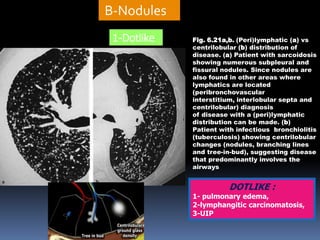
 1-Dotlike   Fig. 6.21a,b. (Peri)lymphatic (a) vs
             centrilobular (b) distribution of
             disease. (a) Patient with sarcoidosis
             showing numerous subpleural and
             fissural nodules. Since nodules are
             also found in other areas where
             lymphatics are located
             (peribronchovascular
             interstitium, interlobular septa and
             centrilobular) diagnosis
             of disease with a (peri)lymphatic
             distribution can be made. (b)
             Patient with infectious bronchiolitis
             (tuberculosis) showing centrilobular
             changes (nodules, branching lines
             and tree-in-bud), suggesting disease
             that predominantly involves the
             airways


                       DOTLIKE :
             1- pulmonary edema,
             2-lymphangitic carcinomatosis,
             3-UIP
B-Nodules
2- Ill-defined (Ground-Glass) centri-lobular nodules
                       FIGURE 17.7.
                       Centri-lobular Ground-Glass Nodules in
                       Sub-acute Hypersensitivity Pneumonitis.
                       HRCT shows the typical poorly defined
                       centri-lobular nodules (arrows) of subacute
                       hypersensitivity pneumonitis (bird-fancier's
                       lung).
                      Caption: Picture 5. High-resolution chest CT
                      scan of a patient with hypersensitivity
                      pneumonitis demonstrates centrilobular
                      nodules. These nodules are unlike those of
                      sarcoidosis, in which the nodules are
                      subpleural and along peribronchovascular
                      interstitium

                     Ill-defined (Ground-Glass) centri-lobular
                     nodules represent disease of the bronchiole
                     and adjacent parenchyma :
                     1- subacute hypersensitivity pneumonitis
                     2-cryptogenic organizing pneumonia (COP),
B-Nodules
3-tree-in-bud appearance


             Figure 2. Postprimary active tuberculosis in a
             66-year-old woman with a chronic cough.
             High-resolution CT scans of the right lung
             show peripheral, poorly defined, small (2–4-
             mm-diameter) centrilobular nodules and
             branching linear opacities of similar caliber
             originating from a single stalk (the tree-in-bud
             pattern) in the lower lobe (arrow)
B-Nodules
      Centri-lobular (Lobular Core) Abnormalities

                   Tree-in-bud almost always indicates the presence of:
1. Endobronchial spread of infection (TB, MAC, any bacterial bronchopneumonia).
2. Airway disease associated with infection (cystic fibrosis, bronchiectasis).
3. less often, an airway disease associated primarily with mucus retention (allergic
   bronchopulmonary aspergillosis, asthma).


                                                         (Mycobacterium Avium
                                                         Complex Disease)


 Typical Tree-in-bud appearance in a patient
 with active TB.
Nodules
Dot-like                         tree-in-bud                          Ill-defined
• pulmonary edema.               appearance                           centrilobular
• lymphangitic carcinomatosis.   • Tree-in-bud almost always          nodules
• UIP                              indicates the presence of:
                                                                      represent disease of the
                                 • Endobronchial spread of            bronchiole and adjacent
                                   infection (TB, MAC, any            parenchyma:
                                   bacterial bronchopneumonia)
                                                                      • in subacute hypersensitivity
                                 • Airway disease associated
                                                                        pneumonitis
                                   with infection (cystic fibrosis,
                                   bronchiectasis)                    • cryptogenic organizing
                                                                        pneumonia (COP).
                                 • less often, an airway disease
                                   associated primarily with
                                   mucus retention (allergic
                                   bronchopulmonary
                                   aspergillosis, asthma).
B-Nodules
Nodular distribution
B-Nodules
B-Nodules
Algorithm for nodular pattern
B-Nodules
                            sarcoidosis


                                                       •Nodules predominating in the
                                                       peribronchovascular, interlobular, and
                                                       subpleural regions those portions of
                                                       the interstitium where the lymphatics
                                                       lie are said to have a perilymphatic
                                                       distribution


Sarcoidosis: typical presentation with nodules along
the bronchovascular bundle and fissures Notice the
partially calcified node in the left hilum.
sarcoidosis
1-WHAT IS DOMINANT PATTERN ?

 2- Where is it distribution within lung
LEFT: miliary TB

RIGHT: metastases
B-Nodules
                  4-Conglomerate
                  Masses
     FIGURE 17.10. Nodules and a Conglomerate
     Mass in Silicosis. A. Posteroanterior radiograph of
     a 79-year-old patient with silicosis shows diffuse
     nodules as well as a conglomerate mass in the
     right upper lobe (arrow). B. HRCT scan through
     the upper lobes shows peribronchovascular and
     subpleural micronodules (small arrows), larger
     nodules (curved arrow), and a conglomerate
     mass representing progressive massive fibrosis in
     the right upper lobe (large arrow). The pleural
     effusions are caused by concomitant congestive
     heart failure.
           Conglomerate Masses:
       1- Sarcoidosis
      2-Silicosis 3-CWP 4-Radiation fibrosis
   These conglomerate masses are most often seen in
   patients with end-stage sarcoidosis but can occur in
   complicated silicosis with progressive massive fibrosis
   (PMF) (Fig. 17.10) or radiation fibrosis
NODULAR PATTERN
              Sub-pleural nodules
                       Absent                                    Present

                                                       Random ,
      Centri-lobular distribution                       uniform
                                                      distribution
                                                                           ALSO
                                            Peri-bronchovascular
                                            Septal
                                   Tree in bud         Random
                                            Centri-lobular           Peri-lymphaatic
     Tree in bud absent
                                     present patchy distribution
                                            In        distribution    distribution


Peri-bronchiolar   peri-vascular   Peri-bronchiolar
    diseases         diseases           diseses
Regional distribution
                     (nodular pattern)

   Upper lung            Lower lung          Diffuse

• Histiocytosis       • Asbestosis     • Hypersensitivity
• Sarcoidosis         • Organising       pneumonitis
• Silicosis             pneumonia      • Diffuse
• Pneumocoinosis      • Hematogenous     pneumonia
• Tuberculosis          metastases     • Lymphangitic
                      • Alveolar         spread of tumor
• RB-ILD
                        hemorrhage     • Hematogenous
                                         metastases
                                       • Sarcoidosis
Regional distribution
                 (nodular pattern)
      Central lung              Peripheral lung

• Sarcoidosis              • Asbestosis
• Silicosis                • Organising pneumonia
• Pneumocoinosis           • Hematogenous
• Lymphangitic spread of     metastases
  tumor                    • Hypersensitivity
                             pneumonitis
                           • NSIP
                           • Septic emboli
                           • Small airway disease
Regional distribution
              (nodular pattern)
                             Uni-lateral
  Posterior lung
                              asymetric
• Sarcoidosis            • Pneumonia
• Silicosis              • Sarcoidosis
• Pneumocoinosis         • Lymphangitic
• Asbestosis               spread of tumor
• Hypersensitivity
  pneumonitis
How  read  chest ct  3

How read chest ct 3

  • 1.
    HOW READ CHESTCT -3 ANAS SAHLE ,MD
  • 2.
    Basic elements Appearance pattern Distribution Patient data pattern Ct interpretation
  • 3.
    FIGURE 17.3. HRCTFindings in Interstitial Lung Disease 1- Interlobular (Septal) Lines 2-Intralobular Lines 3-Thickened Fissures 4-Thickened bronchovascular structures Dot lik 5-Centrilobular (Lobular tree-in-bud Core) Abnormalities lldefined 6- Subpleural lines 7-Parenchymal bands 8-Honeycombing 9-Thin-walled cysts 10-Irregularity of Lung Interfaces 11-Ground-Glass or Hazy Increased Density 12-Architectural Distortion and Traction Bronchiectasis 13-Conglomerate Masses 14-Consolidation
  • 4.
    Appearance pattern IncreasedDecreased Nodular Linear lung lung opacities opacities attenuation attenuation
  • 5.
    Increased lung attenuation Ground-glass opacity Consolidation
  • 6.
    Nodular pattern Size Appearance Attenuation Distribution
  • 7.
  • 8.
  • 9.
    B-Nodules 1-Dotlike Fig. 6.21a,b. (Peri)lymphatic (a) vs centrilobular (b) distribution of disease. (a) Patient with sarcoidosis showing numerous subpleural and fissural nodules. Since nodules are also found in other areas where lymphatics are located (peribronchovascular interstitium, interlobular septa and centrilobular) diagnosis of disease with a (peri)lymphatic distribution can be made. (b) Patient with infectious bronchiolitis (tuberculosis) showing centrilobular changes (nodules, branching lines and tree-in-bud), suggesting disease that predominantly involves the airways DOTLIKE : 1- pulmonary edema, 2-lymphangitic carcinomatosis, 3-UIP
  • 10.
    B-Nodules 2- Ill-defined (Ground-Glass)centri-lobular nodules FIGURE 17.7. Centri-lobular Ground-Glass Nodules in Sub-acute Hypersensitivity Pneumonitis. HRCT shows the typical poorly defined centri-lobular nodules (arrows) of subacute hypersensitivity pneumonitis (bird-fancier's lung). Caption: Picture 5. High-resolution chest CT scan of a patient with hypersensitivity pneumonitis demonstrates centrilobular nodules. These nodules are unlike those of sarcoidosis, in which the nodules are subpleural and along peribronchovascular interstitium Ill-defined (Ground-Glass) centri-lobular nodules represent disease of the bronchiole and adjacent parenchyma : 1- subacute hypersensitivity pneumonitis 2-cryptogenic organizing pneumonia (COP),
  • 11.
    B-Nodules 3-tree-in-bud appearance Figure 2. Postprimary active tuberculosis in a 66-year-old woman with a chronic cough. High-resolution CT scans of the right lung show peripheral, poorly defined, small (2–4- mm-diameter) centrilobular nodules and branching linear opacities of similar caliber originating from a single stalk (the tree-in-bud pattern) in the lower lobe (arrow)
  • 12.
    B-Nodules Centri-lobular (Lobular Core) Abnormalities Tree-in-bud almost always indicates the presence of: 1. Endobronchial spread of infection (TB, MAC, any bacterial bronchopneumonia). 2. Airway disease associated with infection (cystic fibrosis, bronchiectasis). 3. less often, an airway disease associated primarily with mucus retention (allergic bronchopulmonary aspergillosis, asthma). (Mycobacterium Avium Complex Disease) Typical Tree-in-bud appearance in a patient with active TB.
  • 13.
    Nodules Dot-like tree-in-bud Ill-defined • pulmonary edema. appearance centrilobular • lymphangitic carcinomatosis. • Tree-in-bud almost always nodules • UIP indicates the presence of: represent disease of the • Endobronchial spread of bronchiole and adjacent infection (TB, MAC, any parenchyma: bacterial bronchopneumonia) • in subacute hypersensitivity • Airway disease associated pneumonitis with infection (cystic fibrosis, bronchiectasis) • cryptogenic organizing pneumonia (COP). • less often, an airway disease associated primarily with mucus retention (allergic bronchopulmonary aspergillosis, asthma).
  • 14.
  • 15.
  • 16.
  • 17.
    B-Nodules sarcoidosis •Nodules predominating in the peribronchovascular, interlobular, and subpleural regions those portions of the interstitium where the lymphatics lie are said to have a perilymphatic distribution Sarcoidosis: typical presentation with nodules along the bronchovascular bundle and fissures Notice the partially calcified node in the left hilum.
  • 18.
  • 19.
    1-WHAT IS DOMINANTPATTERN ? 2- Where is it distribution within lung
  • 20.
  • 21.
    B-Nodules 4-Conglomerate Masses FIGURE 17.10. Nodules and a Conglomerate Mass in Silicosis. A. Posteroanterior radiograph of a 79-year-old patient with silicosis shows diffuse nodules as well as a conglomerate mass in the right upper lobe (arrow). B. HRCT scan through the upper lobes shows peribronchovascular and subpleural micronodules (small arrows), larger nodules (curved arrow), and a conglomerate mass representing progressive massive fibrosis in the right upper lobe (large arrow). The pleural effusions are caused by concomitant congestive heart failure. Conglomerate Masses: 1- Sarcoidosis 2-Silicosis 3-CWP 4-Radiation fibrosis These conglomerate masses are most often seen in patients with end-stage sarcoidosis but can occur in complicated silicosis with progressive massive fibrosis (PMF) (Fig. 17.10) or radiation fibrosis
  • 22.
    NODULAR PATTERN Sub-pleural nodules Absent Present Random , Centri-lobular distribution uniform distribution ALSO Peri-bronchovascular Septal Tree in bud Random Centri-lobular Peri-lymphaatic Tree in bud absent present patchy distribution In distribution distribution Peri-bronchiolar peri-vascular Peri-bronchiolar diseases diseases diseses
  • 23.
    Regional distribution (nodular pattern) Upper lung Lower lung Diffuse • Histiocytosis • Asbestosis • Hypersensitivity • Sarcoidosis • Organising pneumonitis • Silicosis pneumonia • Diffuse • Pneumocoinosis • Hematogenous pneumonia • Tuberculosis metastases • Lymphangitic • Alveolar spread of tumor • RB-ILD hemorrhage • Hematogenous metastases • Sarcoidosis
  • 24.
    Regional distribution (nodular pattern) Central lung Peripheral lung • Sarcoidosis • Asbestosis • Silicosis • Organising pneumonia • Pneumocoinosis • Hematogenous • Lymphangitic spread of metastases tumor • Hypersensitivity pneumonitis • NSIP • Septic emboli • Small airway disease
  • 25.
    Regional distribution (nodular pattern) Uni-lateral Posterior lung asymetric • Sarcoidosis • Pneumonia • Silicosis • Sarcoidosis • Pneumocoinosis • Lymphangitic • Asbestosis spread of tumor • Hypersensitivity pneumonitis