comparators
Contents by: CB.EN.P2MFG15006
Ilyas Hussain
introduction
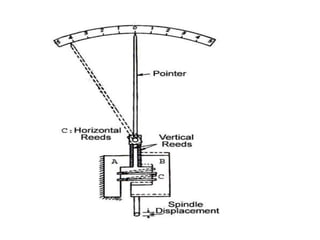
 The general principle of the comparator is to indicate
the differences in size between the standard and the
work being measured by the means of some pointer
on a scale with sufficient magnification.
 It thus does not measure the actual dimension but
indicates how much it differs from the basic
dimension.
Classification of comparators
 Mechanical comparators.
 Mechanical-optical comparators.
 Electrical and Electronic comparators.
 Pneumatic comparators.
 Fluid displacement comparators.
 Projection comparators.
 Multi-check comparators.
 Automatic gauging machines.
characteristics
 Instrument must be of robust design and
construction.
 Readings should be obtained in least possible time.
 Provision must be made for temperature effect.
 Scale must be linear and must have straight line
characteristics.
 Indicator should be constant in its return to zero.
 Instrument must withstand a reasonable ill usage
without permanent harm.
uses
 Where components are to be checked at a very fast
rate.
 Newly purchased gauges can be inspected.
 Attached with some machines, to maintain required
tolerance at all stages of manufacturing.
 Used in selective assembly.
Fluid displacement comparators
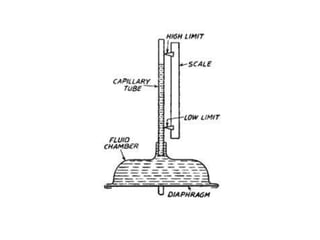
 In this comparator, a fine bore capillary tube is
arranged so that its lower end is placed in a chamber
of relatively large cross-sectional area and containing
a fluid of low viscosity.
 At the bottom of the chamber, a diaphragm is fitted,
which gets deflected by pressure transmitted to it by
the measuring plunger.
 Due to deflection of diaphragm, a small quantity of
liquid rises up in the capillary tube.
 A scale is arranged at the side of tube and limit
pointers are set relative to this to indicate the high
and low limits of the dimension being measured.
Advantages
Accurate dimensioning of simple parts.
Easy construction.
It is economic.
Do not require external supply of energy.
Portable and easily issued from store.
Disadvantages of the instrument
 It is too much dependent upon the temperature as the
fluid changes its volume with change in temperature.
 The deflection of the diaphragm per unit measuring force
is not constant.
 There is certain passivity in the instrument due to the
characteristics of diaphragm and the viscosity of the
fluid.
Projection comparator
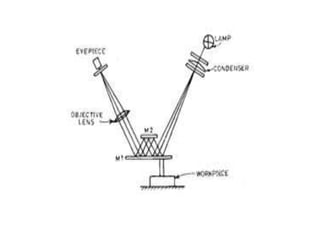
 Fundamentally projection comparator (projector) is a
measuring instrument which projects an enlarged
shadow of the part being measured on a screen,
where it is compared to a master drawing.
 In any projection system, there are four essential
elements, source of light, collimating or condensing
lens, projection lens and screen.
 The illumination required for any projector is a
parallel beam of light, which can be achieved if the
source of light is a point source and is placed at the
principal focus of the collimating lens.
 The purpose of collimating lens is to render the
beam of light from point source parallel.
 By this device, complicated shaped parts can be
easily checked.
advantages
 It has small number of moving parts and hence a
higher accuracy.
 In the optical comparators, the scale can be made to
move past a datum line and thus have high range
and no parallax errors.
 It has very high magnification.
 Optical lever is weightless.
disadvantages
 As the instrument has high magnification, heat from
the lamp, transformer etc. may cause the setting to
drift.
 An electrical supply is necessary.
 The apparatus is usually large and expensive.
 When the scale is projected on a screen, then it is
essential to use the instrument to a dark room in
order to take the readings easily.
 The instruments in which the scale is viewed through
the eyepiece of a microscope are not convenient for
continuous use.
Multi check comparators
 Now-a-days modern trend in comparison is towards
the inspection of all dimensions at the same time, as
it is economical procedure.
 It is particularly desired where various dimensions
have some relationship with each other, e.g.,
diameter and concentricity measurement.
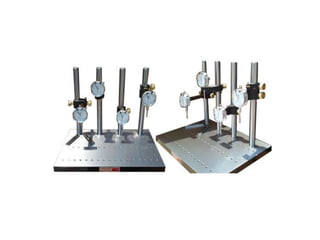
 This job is done by multi check comparators, which
are of the following types and incorporate the
following systems of amplification.
 (a) Electrical (b) Air (c) Combination ‘air-electric’.
A. Electric Multi checks:
 This is combination gauge incorporating about
twenty or more electrical-check heads to measure
simultaneously a number of dimensions of one
part.
 For each dimension, there is one measuring head
and signal lights for each dimension indicate
whether it is within tolerance, undersize or oversize.
 The instrument is used for high production checking
and chances of any error in any dimension are less.
 As it will not be desirable to see all the lights for
various dimensions, a master signal light is used to
integrate all the individual lights, and inspector has
to watch only one light.
 On seeing the master light warning individual signal
lights are examined.
 This instrument is well suited for all sizes of works.
B. Air Multi checks:
 In this instrument, group of air comparators are set
up to check a number of dimensions. In this type of
instrument, initially some difficulty is experienced in
setting the various comparators to check various
dimensions and to arrange them in compact form.
 In one setting all the dimensions can be checked
and the time of inspection is reduced considerably.
 Mass inspection becomes possible and high quality
can be ensured.
C. An air Electric Multi check:
 This makes use of both types of comparators.
It is very easy to use air comparator for
checking diameter and concentricity, so for
this purpose air comparator is used, while for
other measurements electric-checks are
used.
Automatic gauging machines
 Automatic inspection machines are very economical
for final inspection in high production manufacturing
facilities.
 Arrangements for automatic transport of parts from
one measuring station to other by electro-
mechanical, hydraulic, or pneumatic mechanisms are
provided.
 Part transportation system is designed for efficient
and safe movement through machine.
 Information received from the measuring station(s) is
processed by the gauging amplifier and compared to
a desired and predetermined standard.
 Good or bad components are identified
automatically and bad components are discharged in
a reject chute for collection of scrap parts.
 Automatic gauging machines are used because these
provide output information that can be easily
interfaced with statistical analyzers, computers, CRTs
and printers.
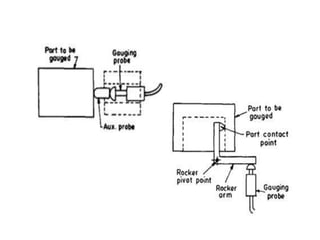
 The following points should be considered while
designing automatic gauging systems:
 Gauging probes should be designed to be actuated
by an auxiliary probe, rather than the gauging probe
connecting the part directly.
 This way the service life of gauging probe is
enhanced considerably because now only auxiliary
probe rams into slides against the parts.
 The probes should be made retractable type to
prevent possible wear or damage to the probes. The
probe heads are thus held back till the part is in
gauging position.
Thank you

Comparators ppt

  • 1.
  • 2.
    introduction  The generalprinciple of the comparator is to indicate the differences in size between the standard and the work being measured by the means of some pointer on a scale with sufficient magnification.  It thus does not measure the actual dimension but indicates how much it differs from the basic dimension.
  • 4.
    Classification of comparators Mechanical comparators.  Mechanical-optical comparators.  Electrical and Electronic comparators.  Pneumatic comparators.  Fluid displacement comparators.  Projection comparators.  Multi-check comparators.  Automatic gauging machines.
  • 5.
    characteristics  Instrument mustbe of robust design and construction.  Readings should be obtained in least possible time.  Provision must be made for temperature effect.  Scale must be linear and must have straight line characteristics.  Indicator should be constant in its return to zero.  Instrument must withstand a reasonable ill usage without permanent harm.
  • 6.
    uses  Where componentsare to be checked at a very fast rate.  Newly purchased gauges can be inspected.  Attached with some machines, to maintain required tolerance at all stages of manufacturing.  Used in selective assembly.
  • 7.
    Fluid displacement comparators In this comparator, a fine bore capillary tube is arranged so that its lower end is placed in a chamber of relatively large cross-sectional area and containing a fluid of low viscosity.  At the bottom of the chamber, a diaphragm is fitted, which gets deflected by pressure transmitted to it by the measuring plunger.  Due to deflection of diaphragm, a small quantity of liquid rises up in the capillary tube.  A scale is arranged at the side of tube and limit pointers are set relative to this to indicate the high and low limits of the dimension being measured.
  • 9.
    Advantages Accurate dimensioning ofsimple parts. Easy construction. It is economic. Do not require external supply of energy. Portable and easily issued from store.
  • 10.
    Disadvantages of theinstrument  It is too much dependent upon the temperature as the fluid changes its volume with change in temperature.  The deflection of the diaphragm per unit measuring force is not constant.  There is certain passivity in the instrument due to the characteristics of diaphragm and the viscosity of the fluid.
  • 11.
    Projection comparator  Fundamentallyprojection comparator (projector) is a measuring instrument which projects an enlarged shadow of the part being measured on a screen, where it is compared to a master drawing.  In any projection system, there are four essential elements, source of light, collimating or condensing lens, projection lens and screen.
  • 12.
     The illuminationrequired for any projector is a parallel beam of light, which can be achieved if the source of light is a point source and is placed at the principal focus of the collimating lens.  The purpose of collimating lens is to render the beam of light from point source parallel.  By this device, complicated shaped parts can be easily checked.
  • 14.
    advantages  It hassmall number of moving parts and hence a higher accuracy.  In the optical comparators, the scale can be made to move past a datum line and thus have high range and no parallax errors.  It has very high magnification.  Optical lever is weightless.
  • 15.
    disadvantages  As theinstrument has high magnification, heat from the lamp, transformer etc. may cause the setting to drift.  An electrical supply is necessary.  The apparatus is usually large and expensive.  When the scale is projected on a screen, then it is essential to use the instrument to a dark room in order to take the readings easily.  The instruments in which the scale is viewed through the eyepiece of a microscope are not convenient for continuous use.
  • 16.
    Multi check comparators Now-a-days modern trend in comparison is towards the inspection of all dimensions at the same time, as it is economical procedure.  It is particularly desired where various dimensions have some relationship with each other, e.g., diameter and concentricity measurement.  This job is done by multi check comparators, which are of the following types and incorporate the following systems of amplification.  (a) Electrical (b) Air (c) Combination ‘air-electric’.
  • 17.
    A. Electric Multichecks:  This is combination gauge incorporating about twenty or more electrical-check heads to measure simultaneously a number of dimensions of one part.  For each dimension, there is one measuring head and signal lights for each dimension indicate whether it is within tolerance, undersize or oversize.  The instrument is used for high production checking and chances of any error in any dimension are less.
  • 18.
     As itwill not be desirable to see all the lights for various dimensions, a master signal light is used to integrate all the individual lights, and inspector has to watch only one light.  On seeing the master light warning individual signal lights are examined.  This instrument is well suited for all sizes of works.
  • 19.
    B. Air Multichecks:  In this instrument, group of air comparators are set up to check a number of dimensions. In this type of instrument, initially some difficulty is experienced in setting the various comparators to check various dimensions and to arrange them in compact form.  In one setting all the dimensions can be checked and the time of inspection is reduced considerably.  Mass inspection becomes possible and high quality can be ensured.
  • 20.
    C. An airElectric Multi check:  This makes use of both types of comparators. It is very easy to use air comparator for checking diameter and concentricity, so for this purpose air comparator is used, while for other measurements electric-checks are used.
  • 22.
    Automatic gauging machines Automatic inspection machines are very economical for final inspection in high production manufacturing facilities.  Arrangements for automatic transport of parts from one measuring station to other by electro- mechanical, hydraulic, or pneumatic mechanisms are provided.  Part transportation system is designed for efficient and safe movement through machine.
  • 23.
     Information receivedfrom the measuring station(s) is processed by the gauging amplifier and compared to a desired and predetermined standard.  Good or bad components are identified automatically and bad components are discharged in a reject chute for collection of scrap parts.  Automatic gauging machines are used because these provide output information that can be easily interfaced with statistical analyzers, computers, CRTs and printers.
  • 24.
     The followingpoints should be considered while designing automatic gauging systems:  Gauging probes should be designed to be actuated by an auxiliary probe, rather than the gauging probe connecting the part directly.  This way the service life of gauging probe is enhanced considerably because now only auxiliary probe rams into slides against the parts.  The probes should be made retractable type to prevent possible wear or damage to the probes. The probe heads are thus held back till the part is in gauging position.
  • 26.