



LEADERSHIP
CREATIVITY
Don’t let the future
just happen: it is
always better for us
if we create it.
Current Business Challenges
 Every facet of
business is changing
at an accelerating
rate.
Current Business Challenges
Competition
is increasing
Current Business Challenges
 Business is
becoming
increasingly global
in scope
Current Business Challenges
 New technologies
are being
introduced at a
breathtaking rate
Current Business Challenges
 The composition of
the work force is
changing, as are its
members’ values and
expectations
Current Business Challenges
 There are increasing
shortages of resources
ranging from water to
skilled employee.
Current Business Challenges
 The World economy is
being transformed from an
industrial economy to one
based on knowledge and
information
Current Business Challenges
 Market and economic
conditions throughout
the world are
extremely unstable
Current Business Challenges
 Constituents, such as
shareholders and
environmentalists, are
making greater demands
on the organization.
Current Business Challenges
 Not only is the
business environment
changing rapidly but
is becoming much
more complex.
Definition
Innovation is how a
firm or an individual
makes money from
creativity.
Origination: Definition
The process of
generating
something.
origination
 Organizations, seek to create original
ideas and concepts that will end up
as innovations, e.g
 new or enhanced products
 services,
 processes that Increase efficiency,
 highly competitive marketing
campaigns, or superior management
origination
Original ideas
just aren’t
enough…
Innovation
 The process of creating
something new that has
significant value to an
individual, a group , an
organization, an industry or a
society.
Innovation
An innovation is a
creation that has
significant value.
Distinction between
Innovation & Origination
 First,
You need to learn how to tell
whether the ideas you
generate are creative or
merely original.
Distinction between
Innovation & Origination
Second,
to be innovative you need to go
beyond merely being creative.
 You need to know whether the ideas
you generate have potential for
significant value, that is, the potential
to become innovations
Distinction between
Innovation & Origination
Finally,
Firms as well as
individuals must learn to
turn creations into
innovations.
Importance of
Innovation & Creativity
 Solving problems and pursuing
opportunities require solutions, many
of which may be unique to the
specific situation. Therefore,
creativity and the resultant
innovation are fundamental to the
survival and prosperity of the firm
Creativity, the Springboard to Innovation
Before we can have
innovation, we must
have creativity…
Creativity, the Springboard to Innovation
Creativity is
thinking forward
Creativity, the Springboard to Innovation
 Expanding on our earlier
definition, creativity, then, is
the skill to originate the new
and to make the new
valuable.
Creativity, the Springboard to Innovation
The new key word is skill;
 creativity is a skill, it is not
something mystical, available only
to a few.
 It can be learned by anyone.
 Everyone possesses an innate
capacity for creativity…
Creativity, the Springboard to Innovation
 But the development of the capacity
into a skill has been thwarted, for the
most part by parents and bosses who
provide and enforce rules about what
is acceptable behavior and because
only a few behaviors are allowed,
certainly is stifled…
Creativity, the Springboard to Innovation
Therefore, you must
act to develop this
skill, to unleash your
untapped potential.
Creativity, the Springboard to Innovation
 Creativity can be incremental,
occurring in a society of small
progressive steps, such as the
lengthy painstaking research that
led to the
development of polio vaccine.
Creativity, the Springboard to Innovation
 Conversely;
Creativity can involve giant leaps of
progress in which many links in the
evolutionary chain of concepts are
hurdled by a single effort. e.g The
main workings of Apple Computer’s
Machintosh PC
Creativity, the Springboard to Innovation
 For an organization, one of the
critical steps in achieving
innovation is developing the
creative problem-solving skills of
its human resources-its
managers, professionals, and
other employees.
Creativity, the Springboard to Innovation
 The product of the creative effort
need not be a tangible physical
object. It may be an idea, an
association of facts, an insight or a
more effective or efficient process, as
well as a new product or service.
 Each of these, when fully expressed
and functioning has value.
Product Innovation
… results in new
products or services,
or enhancements to
old products or
services
Process Innovation
… results in improved
processes within the
organization-for example, in
operations, human resources
management, or finance.
It focuses on improving
effectiveness and efficiency.
Marketing Innovation
innovation is related to the
marketing functions of promotion,
pricing an distribution, as well as
to product functions other than
product development ( e.g,
packing or advertising).
Management Innovation
Management
innovation improves
the way the
organization is
managed.
The Possibilities
 For innovation to occur, the possibilities
for creativity and innovation must exist.
 Regardless of your creative talents,
however great your knowledge or skill, you
will not be able to create many innovations
if you are not functioning in a favorable
situation. If the organization’s culture
does not support creativity
The Process
 Numerous techniques can be used to
increase the creativity of problem solving
within an organization. Learning these
takes time and effort but you can master
them. These processes are directed at
increasing creativity in all stages of the
problem-solving process. E.g Brain
Storming
Successful Organization
 design more new products and
concepts,
 utilize their resources more effectively
and efficiently,
 market their product more creatively,
and
 manage more effectively
successful organization
 It is creativity in managing all of the
economic functions marketing,
operations, finance, human
resources, research and development
and information management that
separate the truly successful
companies from the less successful
ones
successful organization
If you think the way you’ve
always thought, and do
what you’ve always done,
you’ll get the results
you’ve always got.
Attributes of Creativity
 Curiosity
 Adventure
 Innocence
 Experimentation
 Difference
Reactive Association
Crisis
Disaster
Barrier
Bottleneck
Trouble
Problem
Proactive Association
Challenge
Wish
Opportunity
Desire
Problem
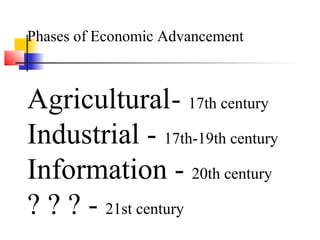
Phases of Economic Advancement
Agricultural- 17th century
Industrial - 17th-19th century
Information - 20th century
? ? ? - 21st century
Phases of Economic Advancement
Creativity - 21st century?
Contemporary Business Games
Restructuring Through:
Acquisitions
Mergers
MBO
Cost Focus
improved profitability
better-looking balance sheet
lean and mean until all fats are
removed leaving just the muscles
outsourcing
monetising benefits
Contemporary Business Games
Quality
TQM
Customer Service
customer satisfaction is out
customer delight is in
Contemporary Business Games
NEW HOPE Creativity
Sources
day-dreaming - word some
reflections on experience long past
music - used by some
intuition - needed by all
will or compelling vision - needed by all
inner strength - to endeavour, to overcome fear of risk
needed by all
You can not become
what you need to be by
remaining what you are.
ALWAYS THINK ANEW
Continual challenging of your
mindsets will make you a more
effective manager.
MINDSET
Taking a different route
away from old tested
perception to attain a new
result = Creativity
Lateral Thinking
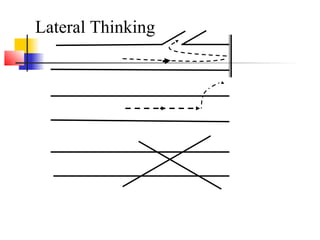
Lateral Thinking
Continual challenging of
your mindsets will make
you a more effective
manager.
MINDSET
Purpose concept
(what are we trying to do)
Mechanism concept
(how does/will it work)
Value concept
(why is it useful)
CREATIVE STEPS
Defined Creative Areas
Problem
Improvement tasks
Project design or invention
Opportunity
CREATIVE STEPS
•Define the task/focus
•Apply systematic creative
tools
•Evaluate and implement
output
CREATIVE STEPS
The Creative Challenge
 Why like this?
 Why has it to be like this
 Aren’t there alternatives?
The goal is to debunk a “uniqueness”
The Creative Challenge
 Acknowledge the existing
 Seek possible alternatives
 Compare existing with
alternatives
The current is just one of many
possibilities.
The Creative Challenge
Attack:
Neglect
Lock-in
Complacency
Time sequence
The Creative Challenge
Why risk giving the
‘wrong’ answer in class
when only the ‘correct’
answer is rewarded?
The Creative Challenge
Concept (what’s being done)
Idea (how things can be done)
Shaping factors (assumptions)
Polarization (either/or)
Creativity relates to
Creation relates to
Beginning relates to Renewal
Curiosity,adventure
experimentation, challenge.
New, different, helpful.
Identifying Creativity
Process of seeing the
exceptions
Identifying Creativity
Process of producing
order out of chaos
Identifying Creativity
Bringing into being
something of value that
was not there before
Identifying Creativity
Analysis - what is
Design- what could be –
CREATIVITY
Identifying Creativity
Establish a programme of
suggestions - to cover both putting
wrong things right as well as better
ways of achieving what currently
looks perfect.
What To Do
Uses of Creativity
 Improvement - the biggest potential
 better way
 lower cost
 less time
 fewer errors
 less energy
 less irritation
 less wastage
 simpler method
Uses of Creativity
 Problem Solving
 alternative problem definitions
 overcoming a difficulty (overlap with
“improvement”)
 task setting (or problem finding)
 problem avoidance
Uses of Creativity
 Value and Opportunity
 add value
 reposition (generate options)
 design opportunities (entrepreneurial
spirit)
Uses of Creativity
 Futuristic
 contingency design (fall-
back position)
Uses of Creativity
 Motivation
 generates interest and
excitement (best to reward
creative efforts not just
results)
Like just about everything in business,
innovation happens when the people at the
top make it a priority and put pressure on
people to deliver it.
Just like sales, production or financial goals,
businesses that stay ahead always have
innovation goals too.
Uses of Creativity.
Creativity is an art. Art is having the vision
to see the world differently and the skill to
portray that vision.
Having skill without seeing the world
differently is the basis of craftman-ship.
Uses of Creativity.
Steps to Regular Creativity
 Devote some time to creative thinking
 Make creative efforts
 Stop persistent negativism
 Look at benefits of new ideas
 Express intuition and gut feelings as
they occur to you
RUNNING FOR SURVIVAL
Tools for Creativity
faith in own ability
absence of negativism or negative
judgment
precise observation - observance
penetrating questioning.
Business Applications
Zenith and cash evacuation
WH.O. Salt-Sugar Solution
Creativity Training
Engages people’s minds
Stimulates people’s imagination
Organizes thinking processes
Discovers and utilize talents
Running for Survival
Every morning in Africa,
an antelope wakes up. It
knows it must run faster
than the lion or it will be
killed.
Running for Survival
Every morning a lion
wakes up. It knows it
must outrun the antelope
or it will starve to death.
Running for Survival
It doesn’t matter if
you’re a lion or antelope.
When the sun comes up
you’d better be running.
THANK YOU

Leadership creativity modified onakoya.ppt