How does light travel
and interact with
matter?
Chapter 12: Lesson 3:
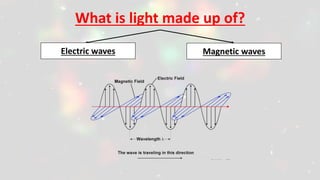
What is light made up of?
Electric waves Magnetic waves
What is light made up of?
Electric waves Magnetic waves
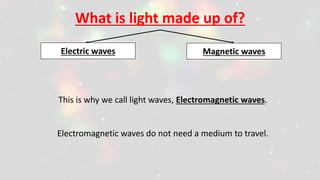
This is why we call light waves, Electromagnetic waves.
Electromagnetic waves do not need a medium to travel.
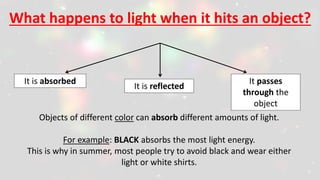
What happens to light when it hits an object?
It is absorbed
It is reflected
It passes
through the
object
Objects of different color can absorb different amounts of light.
For example: BLACK absorbs the most light energy.
This is why in summer, most people try to avoid black and wear either
light or white shirts.
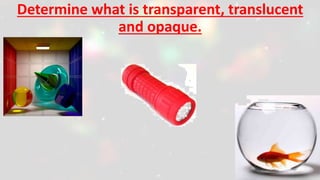
Determine what is transparent, translucent
and opaque.
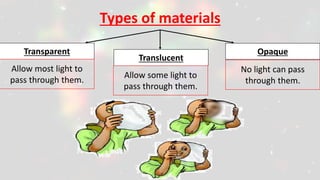
Types of materials
Transparent
Translucent
Opaque
Allow most light to
pass through them.
Allow some light to
pass through them.
No light can pass
through them.
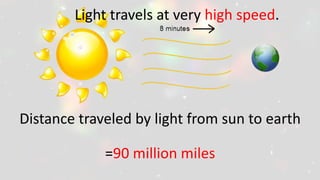
Distance traveled by light from sun to earth
=90 million miles
Light travels at very high speed.
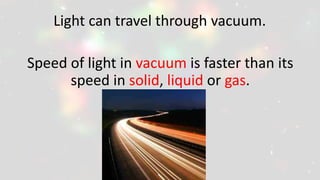
Light can travel through vacuum.
Speed of light in vacuum is faster than its
speed in solid, liquid or gas.
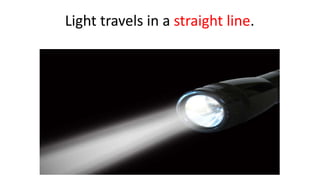
Light travels in a straight line.
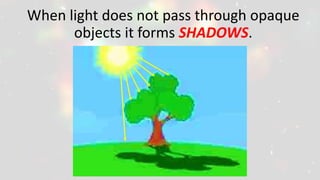
When light does not pass through opaque
objects it forms SHADOWS.
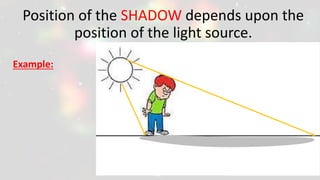
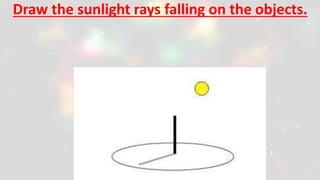
Position of the SHADOW depends upon the
position of the light source.
Example:
Draw the sunlight rays falling on the objects.
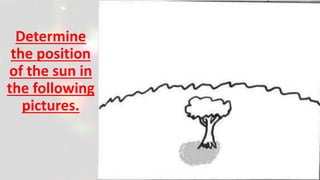
Determine
the position
of the sun in
the following
pictures.

How does light travel and interact

  • 1.
    How does lighttravel and interact with matter? Chapter 12: Lesson 3:
  • 2.
    What is lightmade up of? Electric waves Magnetic waves
  • 3.
    What is lightmade up of? Electric waves Magnetic waves This is why we call light waves, Electromagnetic waves. Electromagnetic waves do not need a medium to travel.
  • 4.
    What happens tolight when it hits an object? It is absorbed It is reflected It passes through the object Objects of different color can absorb different amounts of light. For example: BLACK absorbs the most light energy. This is why in summer, most people try to avoid black and wear either light or white shirts.
  • 5.
    Determine what istransparent, translucent and opaque.
  • 6.
    Types of materials Transparent Translucent Opaque Allowmost light to pass through them. Allow some light to pass through them. No light can pass through them.
  • 7.
    Distance traveled bylight from sun to earth =90 million miles Light travels at very high speed.
  • 8.
    Light can travelthrough vacuum. Speed of light in vacuum is faster than its speed in solid, liquid or gas.
  • 9.
    Light travels ina straight line.
  • 10.
    When light doesnot pass through opaque objects it forms SHADOWS.
  • 11.
    Position of theSHADOW depends upon the position of the light source. Example:
  • 12.
    Draw the sunlightrays falling on the objects.
  • 13.
    Determine the position of thesun in the following pictures.