
How communities learnLee Rainie, Director, Pew Internet Project6.9.11Black Hills Knowledge NetworkEmail: Lrainie@pewinternet.orgTwitter: @Lrainie
New learning environmentSpeed, availability, searchability of informationNew kinds of participatory knowledge creation – rearrangement of expertiseReallocation of attentionImportance of social networksElevation of new literacies
4New kind of learnersMore self directed and better prepared to capture new information inputsMore reliant on feedback and responseMore attuned to group-based knowledgeMore open to cross discipline insights, creating their own “tagged” taxonomiesMore oriented towards people being their own individual nodes of production
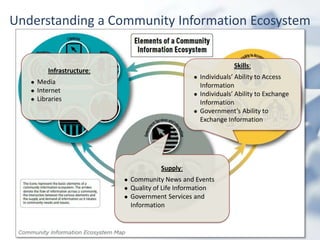
New media ecology-- Knight Commission on Information Needs of CommunitiesQuality journalism through local newspapers, local television and radio stations, and online sourcesA local government with a committed policy on transparencyCitizens with effective opportunities to have their voices heard and to affect public policyReady access to information that enhances quality of life, including information provided by trusted intermediary organizations in the community on a variety of subjects
High speed internet available to all citizensLocal schools with computer and high-speed internet access, as well as curricula that support digital and media literacy A vibrant public library, or other public center for information that provides digital resources and professional assistanceA majority of government information and services online, accessible through a central and easy to use portalNew media ecology-- Knight Commission on Information Needs of Communities
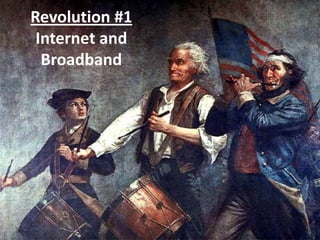
Revolution #1 Internet and Broadband7
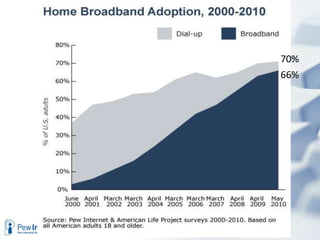
70% 66%
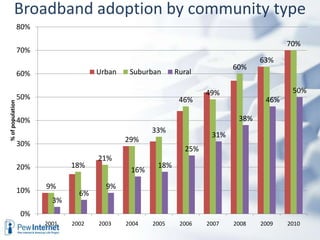
Broadband adoption by community type
Home b-band South Dakota = 60%
Consequences for info ecosystemExplosion of creators and niches
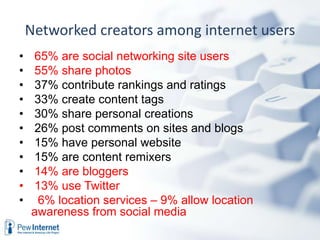
Networked creators among internet users65% are social networking site users
55% share photos
 37% contribute rankings and ratings
 33% create content tags
 30% share personal creations
 26% post comments on sites and blogs
 15% have personal website
 15% are content remixers
14% are bloggers
 13% use Twitter
6% location services – 9% allow location awareness from social media Revolution #2 Wireless Connectivity14
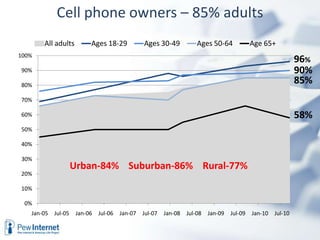
Cell phone owners – 85% adults96% 90% 85% 58% Urban-84%    Suburban-86%    Rural-77%
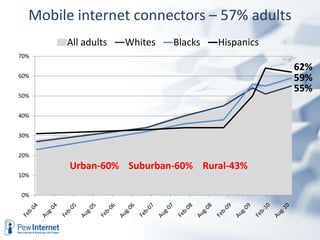
Mobile internet connectors – 57% adults62% 59% 55% Urban-60%    Suburban-60%    Rural-43%
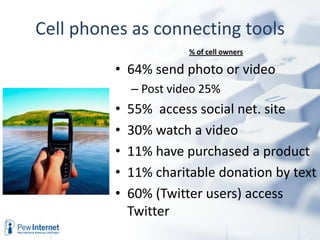
Cell phones as connecting tools% of cell owners64% send photo or videoPost video 25% 55%  access social net. site30% watch a video  11% have purchased a product11% charitable donation by text 60% (Twitter users) access Twitter2/22/201117
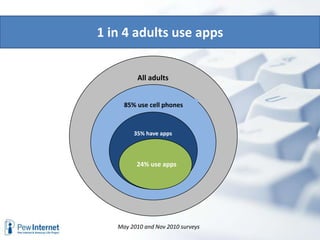
1 in 4 adults use appsAll adults85% use cell phones35% have apps24% use appsMay 2010 and Nov 2010 surveys
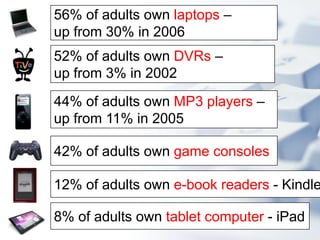
56% of adults own laptops – up from 30% in 200652% of adults own DVRs – up from 3% in 200244% of adults own MP3 players – up from 11% in 200542% of adults own game consoles12% of adults own e-book readers - Kindle8% of adults own tablet computer - iPad
Revolution #3Social Networking 20
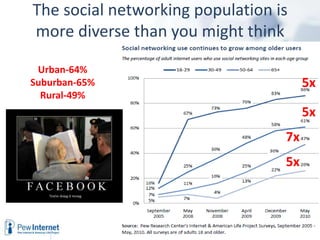
The social networking population is more diverse than you might thinkUrban-64%    Suburban-65%    Rural-49%5x5x7x5x2/22/201121
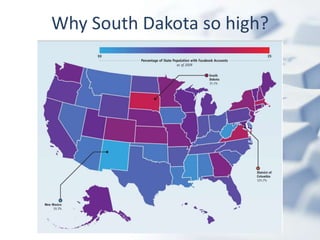
Why South Dakota so high?

How Communities Learn

  • 1.
    How communities learnLeeRainie, Director, Pew Internet Project6.9.11Black Hills Knowledge NetworkEmail: Lrainie@pewinternet.orgTwitter: @Lrainie
  • 3.
    New learning environmentSpeed,availability, searchability of informationNew kinds of participatory knowledge creation – rearrangement of expertiseReallocation of attentionImportance of social networksElevation of new literacies
  • 4.
    4New kind oflearnersMore self directed and better prepared to capture new information inputsMore reliant on feedback and responseMore attuned to group-based knowledgeMore open to cross discipline insights, creating their own “tagged” taxonomiesMore oriented towards people being their own individual nodes of production
  • 5.
    New media ecology--Knight Commission on Information Needs of CommunitiesQuality journalism through local newspapers, local television and radio stations, and online sourcesA local government with a committed policy on transparencyCitizens with effective opportunities to have their voices heard and to affect public policyReady access to information that enhances quality of life, including information provided by trusted intermediary organizations in the community on a variety of subjects
  • 6.
    High speed internetavailable to all citizensLocal schools with computer and high-speed internet access, as well as curricula that support digital and media literacy A vibrant public library, or other public center for information that provides digital resources and professional assistanceA majority of government information and services online, accessible through a central and easy to use portalNew media ecology-- Knight Commission on Information Needs of Communities
  • 7.
  • 9.
  • 10.
    Broadband adoption bycommunity type
  • 11.
    Home b-band SouthDakota = 60%
  • 12.
    Consequences for infoecosystemExplosion of creators and niches
  • 13.
    Networked creators amonginternet users65% are social networking site users
  • 14.
  • 15.
    37% contributerankings and ratings
  • 16.
    33% createcontent tags
  • 17.
    30% sharepersonal creations
  • 18.
    26% postcomments on sites and blogs
  • 19.
    15% havepersonal website
  • 20.
    15% arecontent remixers
  • 21.
  • 22.
    13% useTwitter
  • 23.
    6% location services– 9% allow location awareness from social media Revolution #2 Wireless Connectivity14
  • 24.
    Cell phone owners– 85% adults96% 90% 85% 58% Urban-84% Suburban-86% Rural-77%
  • 25.
    Mobile internet connectors– 57% adults62% 59% 55% Urban-60% Suburban-60% Rural-43%
  • 26.
    Cell phones asconnecting tools% of cell owners64% send photo or videoPost video 25% 55% access social net. site30% watch a video 11% have purchased a product11% charitable donation by text 60% (Twitter users) access Twitter2/22/201117
  • 27.
    1 in 4adults use appsAll adults85% use cell phones35% have apps24% use appsMay 2010 and Nov 2010 surveys
  • 28.
    56% of adultsown laptops – up from 30% in 200652% of adults own DVRs – up from 3% in 200244% of adults own MP3 players – up from 11% in 200542% of adults own game consoles12% of adults own e-book readers - Kindle8% of adults own tablet computer - iPad
  • 29.
  • 30.
    The social networkingpopulation is more diverse than you might thinkUrban-64% Suburban-65% Rural-49%5x5x7x5x2/22/201121
  • 31.

Editor's Notes

  • #2 Title: How Communities LearnSubject: Lee Rainie, Director of the Pew Research Center’s Internet & American Life Project, will discuss the latest trends in Americans use of the internet and smart phones and how people use technology to learn and share information about their communities. He will explore the role of social networks – the technological kind as well as the real-world kind – in shaping the way people gather information and make sense of it.
  • #6 http://www.knightcomm.org/read-the-report-and-comment/
  • #7 http://www.knightcomm.org/read-the-report-and-comment/
  • #10 Rise of broadband at home was transformative – internet becomes a central info and communications hub in the home after the switch from dial-up. People do more stuff online; privilege the internet over other info sources in many cases; report better outcomes from internet use, and, most importantly become content creators. Two thirds of adults and 80% of teens are content creators. This is the big change the internet has introduced to media landscape. Probably take a minute to say this.
  • #12 http://www.ntia.doc.gov/reports/2010/ESA_NTIA_US_Broadband_Adoption_Report_11082010.pdf
  • #13 Perhaps biggest change in info ecology is the democratization of media – and proliferation of niches. The Long Tail becomes reality for media and brands.
  • #14 This is the way Pew Internet measures content creation….
  • #19 9% of cell phone users have software applications or “apps” on their phones that help them track or manage their health. Some 15% of those ages 18-29 have such apps.
  • #23 http://mashable.com/2010/04/05/facebook-us-infographic/http://www.socialbakers.com/united-states-facebook-statistics/
  • #28 http://www.knightcomm.org/read-the-report-and-comment/