Do you
Speak
Social?
WOMMA Webinar
15 July 2009


Presented by:
Antony Mayfield
Head of Social Media, iCrossing


                                  1
I don’t want to read
 about what people
  had for breakfast
                       2
Is that a rational
response to Twitter?


                       3
Remember the blog
  and Facebook
   equivalents?

                    4
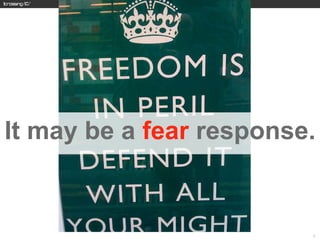
It may be a fear response.


                         5
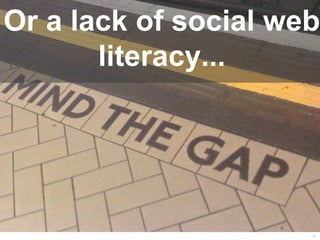
Or a lack of social web
       literacy...


                      6
(please don’t say
  “Twitteracy”)

                    7
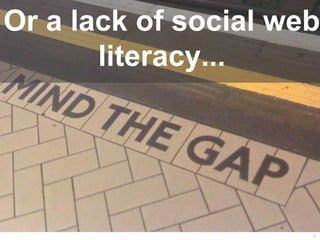
Or a lack of social web
       literacy...


                      8
One problem is when
we think we’ve seen
    it all before

                      9
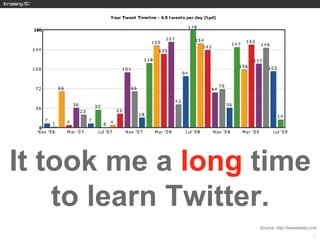
It took me a long time
    to learn Twitter.
                  Source: http://tweetstats.com
                                            10
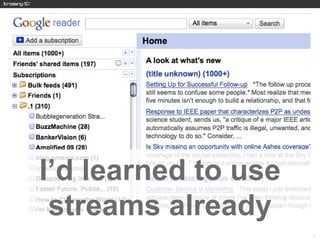
I’d learned to use
 streams already
                     11
When Google Wave
arrives we’ll be learning
      all over again
                            12
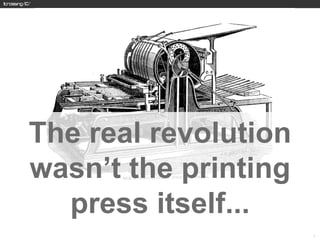
The real revolution
wasn’t the printing
  press itself...
                      13
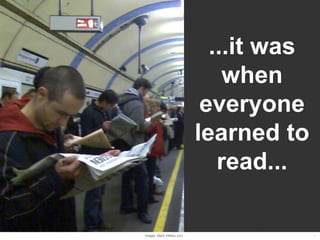
...it was
                               when
                            everyone
                           learned to
                              read...


Image: Mark Hillary (cc)                 14
...and
write.


         15
Now we are learning
 reading/writing on
   the social web.

                      16
Network literacy
       What you know or don't know
       about how networks work can
       influence how much freedom,
       wealth and participation you
       and your children will have in
       the rest of this century.

       http://twitter.com/hrheingold


                                        17
Social web literacy
      An understanding of and
   competence in using social web
   platforms, tools and behaviors.


                                     18
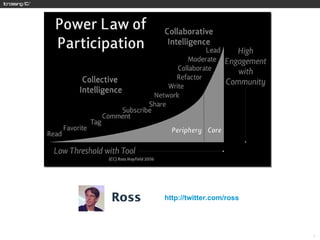
http://twitter.com/ross


                          19
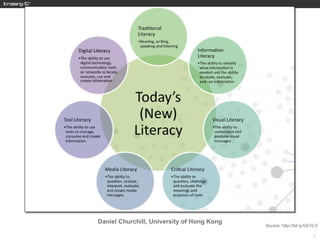
Daniel Churchill, University of Hong Kong   Source: http://bit.ly/GkYLO

                                                                    20
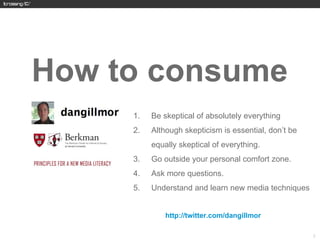
How to consume
     1.   Be skeptical of absolutely everything
     2.   Although skepticism is essential, don’t be
          equally skeptical of everything.
     3.   Go outside your personal comfort zone.
     4.   Ask more questions.
     5.   Understand and learn new media techniques


          http://twitter.com/dangillmor


                                                       21
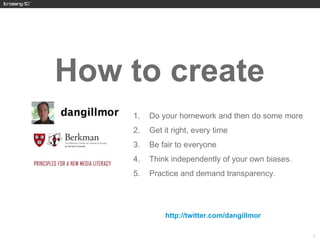
How to create
     1.   Do your homework and then do some more
     2.   Get it right, every time
     3.   Be fair to everyone
     4.   Think independently of your own biases.
     5.   Practice and demand transparency.


          http://twitter.com/dangillmor


                                                    22
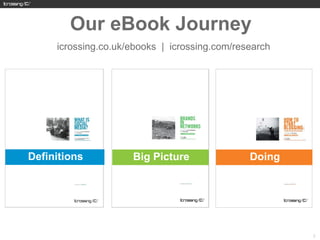
Our eBook Journey
     icrossing.co.uk/ebooks | icrossing.com/research


Definitions          Big Picture               Doing


                                                       23
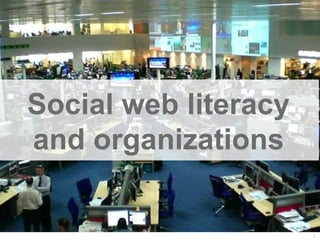
Social web literacy
and organizations


                      24
There are many
“breakfast”-like
 statements...

                   25
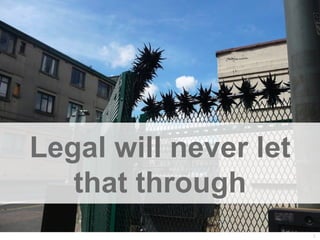
Legal will never let
   that through
                       26
IT has us locked down
                        27
Can’t see the ROI


                    28
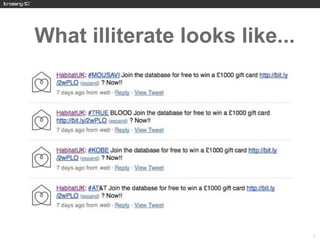
And many examples
    of illiteracy


                    29
What illiterate looks like...


                                30
But nothing that can’t - and
 hasn’t - been overcome


                           31
Scribes / Tribes


                   32
Resist the temptation to
 become scribes for a
         brand

                           33
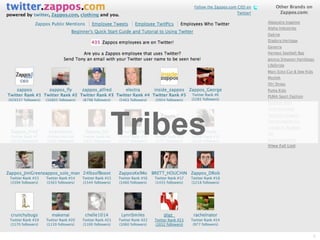
Tribes


         34
How to spread social
   web literacy


                       35
Personal
    Learning by doing
Build it into your workflow
   Share compulsively

                              36
Organizations
    Establish principles
      Think networks
         Open up IT
        Grassroots
        Frameworks
       Measurement
  Learning as deliverables

                             37
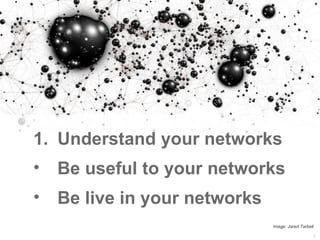
1. Understand your networks
2. Be useful to your networks
3. Be live in your networks   Image: Jared Tarbell

                                                 38
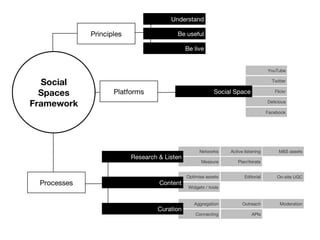
Understand

             Principles                  Be useful

                                              Be live


                                                                                     YouTube

  Social                                                                              Twitter

  Spaces            Platforms                              Social Space                Flickr


Framework                                                                           Delicious

                                                                                    Facebook


                                                    Networks     Active listening               Assets
                          Research & Listen
                                                     Measure        Plan/iterate


                                              Optimise assets           Editorial       On-site UGC
 Processes                         Content
                                               Widgets / tools


                                                 Aggregation           Outreach           Moderation
                                  Curation
                                                  Connecting                APIs
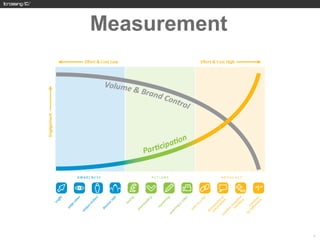
Measurement


              40
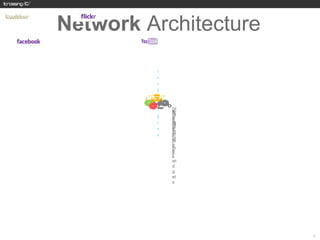
Network Architecture


       social         Media platforms
       space

                RSS   Forums


                      Applications / widgets


                      Streams / feeds


                                               41
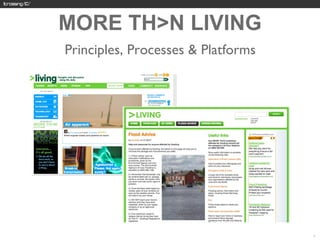
MORE TH>N LIVING
Principles, Processes & Platforms


                                    42
Blogs are cheap and
very, very good…


                      43
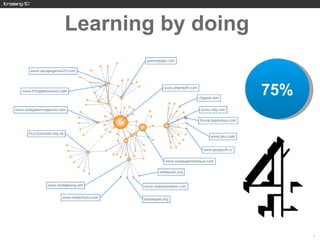
Learning by doing


                    44
Learning by doing

                    75%


                          44
Free(dom) vs. fantasy IP


                           45
In summary
     Opportunity and responsibility
               Commitment
            Tribes not scribes
Commit to developing your personal literacy
        Spread social web literacy


                                              46
Thank you
Tel:       +44 1273 827 721 | 866.516.2566
Email:     antony.mayfield@icrossing.co.uk
Sites:     www.icrossing.co.uk | www.icrossing.com
Blogs:     connect.icrossing.co.uk | greatfinds.icrossing.com
           www.antonymayfield.com
Twitter:   @icrossing_uk | @icrossing | @amayfield


                                                                47
48
Useful links

   http://icrossing.co.uk/ebooks
   http://icrossing.com/research
   http://www.commoncraft.com/
http://delicious.com/amayfield/literacy


                                          49

WOMMA: Do You Speak Social?

Editor's Notes

  • #2 Today I’d like to share an emeging idea and a key insight that’s informing how we think about social media and brands at iCrossing. Let’s be clear up front: this isn’t a guide to how to use social media jargon, or how social media works - there are plenty of resources for that online and I’m assuming a certain level of familairity with social media among people who would sign up for a WOMMA webinar. What we will be discussing is the idea of social web literacy - or web literacy more broadly - and its importance for, well, everyone, but us as individuals and for the brands and organisations we work with. I’m trying to stretch my own social web literacy today by keeping an eye on the WOMMA tag on my Tweetdeck while presenting.
  • #3 If you have ever tried explaining Twitter in a meeting you may have heard something along these lines. It usually comes with a sneer. It sometimes feels like a gauntlet being thrown down. Sometimes it is your job to pick it up - sometimes it is your duty as a citizen of the web.
  • #4 I mean, I don’t like
  • #5 Over the past our years I have had the same conversations over dinner, the same marketing meetings about Facebook and blogs...
  • #6 I like to win arguments - I always have. But over the years I have learned to realise that not every conversation is conducted on rational grounds. Often people are saying something other than they mean. Sometimes they aren’t saying anything at all - their words form and emotional response. “Yuk!” or “Eek!” So we comfort them, or try to convince them of the virtues of the technology or the platform...
  • #9 It is because people think they are literate - because they read and write.
  • #10 We think they are web listerate - because they can use email, a browser, a social network, without too much trouble... They look at Twitter, they dive in, with a great deal of good faith and expectations that all will be revealed to them. ...and someone is talking about what they had for breakfast.
  • #11 Truth is my network got it before me by a long stretch. But I stuck around because they did. And because they kept finding new ways to make it useful to them. So it started becoming more useful to me. I’d been here before with blogs. I knew the best thing to do was to hang around and if something made sense to people who I liked and respected it was worth trying to learn. Plus... I had some literacy, some skills I could bring with me from Facebook and blogs and my broader web literacy.
  • #13 I love the premise of Google Wave - that email is based on an analogy that is pre-web. And deep down I loathe email. It’s grinding up of my time, its needy completism, its easy transfer of responsibility to “someone” in the To line... But first glance at Google Wave means I know I will need to learn this one. I know I will start off illiterate. Maybe that’s a key spect of social web liteeracy - being comfortable with having to learn stuff every other week.
  • #14 Literacy. It’s all about not conflating the technology, the marvel of the platform with with the uses that it is put to. This is the device.
  • #16 But it was mass literacy that was the behaviour. The behaviour which turned religion, politics, commerce, art, society spinning about.
  • #18 Howard Rheingold got me thinking about literacy. He calls it network literacy. I like that. Maybe I should stick with that. But as my more marketing literate colleagues are always telling me - you talk about networks and they think you mean TV, or telecoms. Me - I think we’ll get there. But meantime...
  • #19 ...social web literacy is what I will bang on about. It’s all about personally and around our wider organsiations, developing and spreading social web literacy... That’s quite a challenge - so I want to talk about some models for thinking about it...
  • #20 Ross Mayfield - no relation - is someone who has consistently cut through to the quick about how social media works - or rather how we work with it. I’m still antranced by his partcipatioin curve. As m’learned colleague Jim Byford pointed out, it describes the learning journey of someone using social media, the ladder of participation as Forrester call it.